Last updated 5 months ago
EIP-712 Typed structured data signing for Cardano
Problem
The current message signing standard on Cardano (CIP-8) only supports signing raw text. It lacks structure, and type definitions—meaning users have no way to understand what they’re signing or why.
Solution
Implement structured, typed message signing for Cardano, inspired by EIP-712, to improve security, usability, and support for dApps, L2s, and governance protocols.
Total to date
This is the total amount allocated to EIP-712 Typed structured data signing for Cardano.
1/4
Formal Specification Draft of Cardano EIP-712
Cost: $ADA 28,500
Delivery: Month 1 - Dec 2025
2/4
Final Specification & CIP Acceptance
Cost: $ADA 25,000
Delivery: Month 3 - Feb 2026
3/4
SDK for the stuctured message signing standard
Cost: $ADA 27,250
Delivery: Month 5 - Apr 2026
4/4
Close-out Report
Cost: $ADA 14,250
Delivery: Month 6 - May 2026
About this idea
NB: Monthly reporting was deprecated from January 2024 and replaced fully by the Milestones Program framework. Learn more here
[Proposal setup] Proposal title
Please provide your proposal title
EIP-712 Typed structured data signing for Cardano
[Proposal Summary] Budget Information
Enter the amount of funding you are requesting in ADA
95000
[Proposal Summary] Time
Please specify how many months you expect your project to last
6
[Proposal Summary] Translation Information
Please indicate if your proposal has been auto-translated
No
Original Language
en
[Proposal Summary] Problem Statement
What is the problem you want to solve?
The current message signing standard on Cardano (CIP-8) only supports signing raw text. It lacks structure, and type definitions—meaning users have no way to understand what they’re signing or why.
[Proposal Summary] Supporting Documentation
Supporting links
[Proposal Summary] Project Dependencies
Does your project have any dependencies on other organizations, technical or otherwise?
No
Describe any dependencies or write 'No dependencies'
No dependencies
[Proposal Summary] Project Open Source
Will your project's outputs be fully open source?
Yes
License and Additional Information
MIT
[Theme Selection] Theme
Please choose the most relevant theme and tag related to the outcomes of your proposal
Infrastructure
[Campaign Category] Category Questions
Mention your open source license and describe your open source license rationale.
MIT License because it is widely adopted and permissive. This aligns with our goal of enabling dApp developers, wallet teams, and researchers to freely adopt and extend the EIP-712 implementation across the Cardano ecosystem.
How do you make sure your source code is accessible to the public from project start, and people are informed?
The source code will be published in a public GitHub repository from day one under the MIT license. Progress will be tracked in real time through commits, issues, and milestones. Key releases will be announced via Twitter and Discord to reach dApp developers, auditors, and the Cardano community. Documentation will be maintained alongside the codebase to ensure clarity and adoption by other teams. Furthermore a CIP associated with the work will be published and the CIP thread updated with progress.
How will you provide high quality documentation?
The CIP will serve as the canonical technical specification for the standard. We will also provide developer-friendly documentation, code examples, and integration guides in the GitHub repo. Technical documentation will be written alongside implementation and updated throughout the project. Our team includes experienced contributors familiar with writing Cardano documentation and CIPs.
[Your Project and Solution] Solution
Please describe your proposed solution and how it addresses the problem
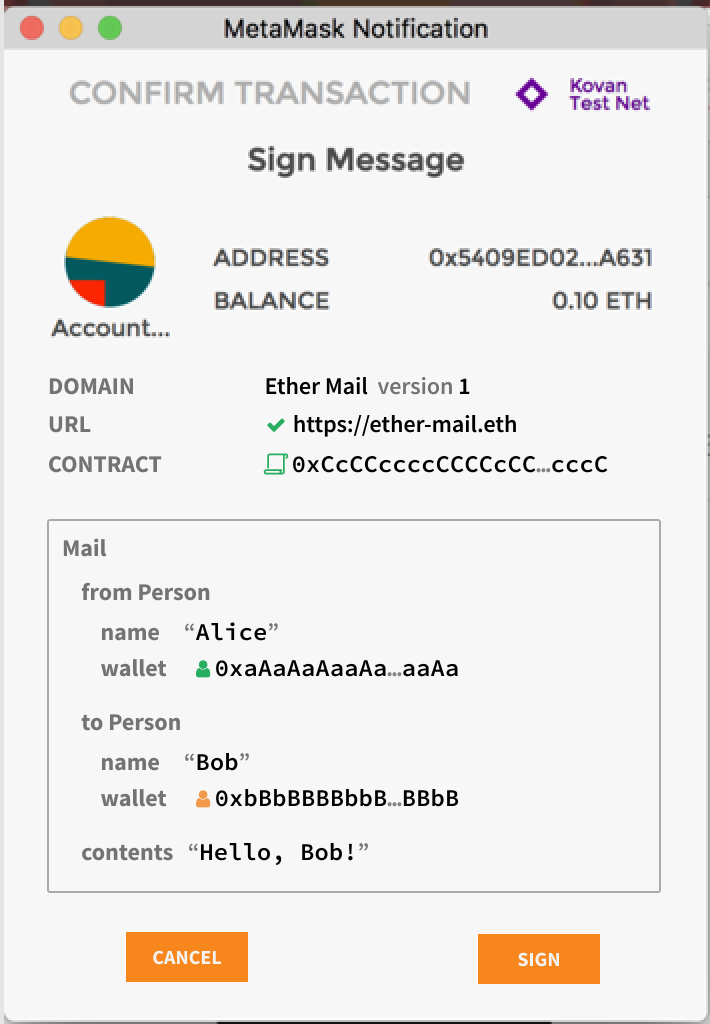
We propose to implement a structured message signing standard for Cardano based on EIP-712. This standard enables users to sign typed, human-readable data with clear intent and domain separation. Our solution addresses the current weaknesses of CIP-8, which only supports raw or hashed string payloads—making signatures hard to understand, verify, or safely reuse across dApps and chains.
We will define a schema system for typed messages using CBOR and CDDL to maintain compatibility with Cardano’s native encoding and smart contract infrastructure. A domain separator format will be established to prevent replay attacks across different applications, networks, and contexts. Signable data will follow a defined structure (e.g. JSON-like tuples or maps).
This work includes:
A formal CIP specifying the structure, encoding, and verification rules
A JavaScript SDK that implements the standard for dApp and wallet integration
This solution will empower dApps, L2s, and DAO tooling to request secure and meaningful signatures from users while allowing wallets to render clear, readable signing prompts. This raises the bar for safety, usability, and composability in Cardano’s signing ecosystem.
It will allow us to support signed messages akin to the following:
 age
age
[Your Project and Solution] Impact
Please define the positive impact your project will have on the wider Cardano community
This project will deliver a foundational security and UX upgrade for the Cardano ecosystem by enabling structured, typed message signing. It will reduce phishing risks, eliminate blind-signing practices, and make signatures safer, more interpretable, and reusable across dApps, wallets, and Layer 2 protocols.
By introducing a Cardano-native equivalent of EIP-712, we empower developers to build secure off-chain protocols such as DAO voting, token approvals, order books, and identity attestations—without relying on opaque or misused signature formats. Wallets will be able to render signing prompts that clearly show users what they are authorizing and for whom, improving trust and transparency.
This standard will directly benefit developers building dApps, bridges, and L2s, as well as users who interact with them. It also increases interoperability with Ethereum-like ecosystems and sets the stage for safer multi-chain coordination. All code and documentation will be open source and maintained for the community to adopt, extend, and audit.
By solving a critical gap in Cardano’s developer experience, this work strengthens the foundation for safe, scalable user interactions and accelerates adoption of secure signature-based tooling across the ecosystem.
[Your Project and Solution] Capabilities & Feasibility
What is your capability to deliver your project with high levels of trust and accountability? How do you intend to validate if your approach is feasible?
Philip DiSarro is a accomplished developer in the Cardano ecosystem, with deep expertise in smart contract architecture, and dApp protocol design. He is the author of multiple open-source Cardano tools and has contributed to protocol standards and advanced smart contract frameworks. Philip also leads Midgard, a pioneering Layer 2 project in the ecosystem.
This proposal will be delivered by Anastasia Labs, a team with a strong track record of completing complex blockchain infrastructure work. Anastasia Labs has successfully shipped protocol integrations, L2 designs, on-chain governance tooling, and custom wallet SDKs. The team has both the technical depth and execution discipline needed to deliver a specification-level standard, Plutus smart contracts, off-chain libraries, and wallet integrations.
We will validate feasibility early through prototype libraries, schema tests, and testnet signature verification demos. Structured feedback from dApp developers and wallet teams will guide refinement before finalizing the standard. All work will be versioned, audited openly, and delivered iteratively with public visibility.
[Milestones] Project Milestones
Milestone Title
Formal Specification Draft of Cardano EIP-712
Milestone Outputs
A complete draft of the Cardano adaptation of EIP-712, authored in CIP format.
Clear definition of domain separation logic tailored to Cardano’s address format, network ID, and UTxO model.
A formal description of supported types, encoding rules, and security considerations (e.g., replay protection, type safety).
Public GitHub repository initialized with versioned CIP draft and structured discussion threads.
Acceptance Criteria
CIP draft published to the CIP GitHub repository under a unique pull request.
Demonstrable engagement from at least 3 domain experts in the Cardano technical community (e.g., comments, approvals) in the CIP process.
Evidence of Completion
GitHub link to the CIP PR and the link to the discussion / engagement from at-least three domain experts.
Delivery Month
2
Cost
20000
Progress
30 %
Milestone Title
Final Specification & CIP Acceptance
Milestone Outputs
A complete and finalized technical specification for the protocol will be produced iteratively based on the feedback provided by editors and community developers from the draft. The draft proposal will undergo the full CIP editorial process, including revisions and community feedback, and ultimately be accepted and merged into the official CIP repository. Supporting documentation, examples, and rationale will be included to ensure clarity and broad developer adoption.
Acceptance Criteria
The CIP is reviewed and formally accepted by the CIP editors.
The specification is merged into the official Cardano Foundation CIP GitHub repository.
No outstanding change requests or revisions from CIP editors remain.
Evidence of Completion
Link to the merged PR in the official CIP GitHub repository.
Confirmation of acceptance from a CIP editor (comment or label in the GitHub thread).
Snapshot of the final CIP rendered on the Cardano Foundation site or GitHub.
Delivery Month
2
Cost
20000
Progress
60 %
Milestone Title
SDK for the stuctured message signing standard
Milestone Outputs
A fully documented, open-source SDK that enables signing of EIP-712-like structured messages on Cardano.
Type-safe interface for domain separator and message struct generation.
End-to-end support for preparing messages for signing, reconstructing the signable hash, and verifying signatures.
Developer guide and README with usage examples.
Acceptance Criteria
SDK is released
Developers can generate domain separator and message hash from typed inputs.
Signatures produced by the SDK verify correctly on-chain.
Unit and integration tests achieve ≥95% coverage.
Documentation and examples are available in the repository.
Evidence of Completion
Public GitHub repository with source code, tests, and documentation. This will also include a link to a specific release branch.
Delivery Month
6
Cost
50000
Progress
90 %
Milestone Title
Close-out Report
Milestone Outputs
A comprehensive close-out report summarizing the project’s objectives, deliverables, challenges, and achievements. The report will detail the development process of the EIP-712 implementation on Cardano, integration results, and developer resources created. It will include written documentation and a recorded video demonstration of the final working implementation across supported environments.
Acceptance Criteria
A clearly written report covering each deliverable and how it was achieved
Inclusion of insights or lessons learned during implementation
A working demo or walkthrough video showing the signature flow using EIP-712 format on Cardano
Documentation of APIs or SDKs created, with example usage
Evidence of Completion
Link to the public close-out report (e.g., on GitHub or project site)
A downloadable or hosted video demonstrating the working implementation and tooling
Screenshots or links showing functioning components (e.g., dApp signature flows, SDK usage)
References to the repositories or packages produced during the project
Delivery Month
7
Cost
5000
Progress
100 %
[Final Pitch] Budget & Costs
Please provide a cost breakdown of the proposed work and resources
The proposed budget covers the full scope of research, development, and integration work required to standardize and implement a secure, EIP-712-style structured message signing protocol on Cardano.
This includes:
Protocol design, formal specification, and submission as a Cardano Improvement Proposal (CIP)
Development of a reference implementation and test suite
Creation of a production-ready JavaScript SDK for frontend and wallet use
Backend integration utilities and message verification tools
Cross-team collaboration to ensure compatibility with existing wallet UX and infrastructure (e.g., Lace)
Security review of hashing schemes, signature domains, and message serialization
Documentation and developer onboarding materials
Final demonstration video and close-out reporting deliverables
The funding also accounts for coordination, testing infrastructure, and project management. The requested amount reflects the cost of delivering high-quality tooling and specifications that are production-grade, audit-aware, and integration-ready.
No portion of the budget is allocated to marketing or general overhead. All resources are focused on direct development and delivery of the core protocol and tools.
[Final Pitch] Value for Money
How does the cost of the project represent value for the Cardano ecosystem?
This proposal delivers exceptional value to the Cardano ecosystem by addressing a key UX and security limitation in current wallet implementations—structured message signing. The requested 95,000 ADA supports >630 engineering hours, distributed across protocol design, smart contract development, wallet integration collaboration, testing, and documentation.
The resulting standards and reference implementation will reduce phishing risk, improve interoperability, and create a safer developer and user experience across wallets and dApps. The work directly contributes to Cardano's technical maturity and ecosystem tooling, creating long-term value that will be leveraged by any project requiring secure off-chain signing.
Given the scope of innovation and direct alignment with Cardano's infrastructure goals, this proposal offers strong value for the requested cost.
[Required Acknowledgements] Consent & Confirmation
Terms and Conditions:
Yes
Team
Philip DiSarro — Lead Architect (Anastasia Labs)
Founder of Anastasia Labs and author of numerous CIPs. Philip leads system design, specification, and implementation efforts across Cardano native and smart contract integrations.
Angel Castillo — Wallet Integration Lead
Core contributor to the Lace wallet team. Angel will support integration work and ensure alignment between the proposed protocol and Lace's wallet UX and technical requirements.
Additionally the project team will include:
1x - Cryptographer
1x - Backend Enginer