Last updated a year ago
GameChanger: On-Chain File Storage on Cardano (GCFS)
Problem
Current Cardano governance and dApps rely on centralized and external infrastructure for off-chain file, data and code storage, introducing single points of failure and limiting decentralization
Solution
Rewrite and open-source GCFS as a TypeScript library for reading and searching files stored on-chain, and a web server that can even serve HTML for frontends, supporting fully on-chain resilient DApps
Total to date
This is the total amount allocated to GameChanger: On-Chain File Storage on Cardano (GCFS).
About this idea
[Proposal setup] Proposal title
Please provide your proposal title
GameChanger: On-Chain File Storage on Cardano (GCFS)
[Proposal Summary] Budget Information
Enter the amount of funding you are requesting in ADA
100000
[Proposal Summary] Time
Please specify how many months you expect your project to last
7
[Proposal Summary] Translation Information
Please indicate if your proposal has been auto-translated
No
Original Language
en
[Proposal Summary] Problem Statement
What is the problem you want to solve?
Current Cardano governance and dApps rely on centralized and external infrastructure for off-chain file, data and code storage, introducing single points of failure and limiting decentralization
[Proposal Summary] Supporting Documentation
Supporting links
- https://youtu.be/042b4gQ3SZ0?si=RSkCw-hwAs-cvYQj ,
- https://x.com/GameChangerOk/status/1834062592060322161 ,
- https://preprod-gcfs.onrender.com/gcfs/1170d12887c70593e40938a5ff1832f9eb2b8e4a328a982621b36a57/test/latest/www/KeepCalmMinterDapp.html ,
- https://preprod-gcfs.onrender.com/gcfs/1170d12887c70593e40938a5ff1832f9eb2b8e4a328a982621b36a57/test/latest/
[Proposal Summary] Project Dependencies
Does your project have any dependencies on other organizations, technical or otherwise?
Yes
Describe any dependencies or write 'No dependencies'
Dandelion-Lite: 1 or 2 official and community Cardano APIs to query the on-chain data GameChanger Wallet: source of the code, for testing and as the current reference implementation. Because Catalyst process takes time to launch it may depend on commercial decisions from the owner.
[Proposal Summary] Project Open Source
Will your project's outputs be fully open source?
Yes
License and Additional Information
Former source code is private, closed sourced, owned by Adriano Fiorenza (GameChanger Wallet). All of the outputs of this project will be released as open source under the MIT license for the community
[Theme Selection] Theme
Please choose the most relevant theme and tag related to the outcomes of your proposal
Infrastructure
[Campaign Category] Category Questions
Mention your open source license and describe your open source license rationale.
As everything we usually release to the community, we will release under MIT license as is permisive and gives more freedom to builders to reuse. Collaboration will not be enforced by license but will be highly apreciated so we can all grow together.
How do you make sure your source code is accessible to the public from project start, and people are informed?
This is the 3rd and last time we try to release this working product to an ecosystem we know is needing it. We have done our best to share word about it on social media, and even advertize it through online and in-person workshops,all without funding. Peoples from governance and the main entities behind Cardano are aware of it already.
Most of our infrastructure projects find home first at Dandelion Lite, this open community and these node operators are always aware of these projects.
Project will be published on Github under MIT license on every milestone output reached upon start.
How will you provide high quality documentation?
We have experience in documenting source code libraries and projects and we benefit on doing so to maximize open source collaboration oportunities. You can take as an example this released project: https://github.com/GameChangerFinance/unimatrix .
[Your Project and Solution] Solution
Please describe your proposed solution and how it addresses the problem
The problem:
Are Cardano DApps Truly Decentralized?
Cardano takes a unique approach to DApps by offloading certain parts of their execution and storage off-chain. This strategy enhances performance and reliability compared to solutions like EVM chains. However, this design introduces a critical flaw—one that has become more pronounced with the adoption of the CIP-30 standard.
The off-chain components of Cardano DApps currently rely on centralized cloud infrastructures. Their source code and application data are not stored in a decentralized, long-term, fail-proof, and censorship-resistant solution.
While great projects like Iagon aim to address some of these challenges and more, they still fall short of offering mission-critical solutions for Cardano. Like IPFS and other decentralized storage solutions, they store data outside the Cardano network itself, which can create single points of failure and data loss due to potential global outages, team challenges, or platform security breaches.
For mission-critical Cardano applications—and even minimal, essential versions of any Cardano app—the only reliable solution is to rely on Cardano itself. This is the only path to a truly decentralized, fault-tolerant, and censorship-resistant infrastructure.
Currently, terabytes of on-chain transaction metadata are being generated by apps and users. Yet, there’s no coherent strategy for indexing and searching this data. A system that can organize this "chaos" and treat it like searchable files would be invaluable for developers and users alike. Such a solution could also optimize the use of precious on-chain storage, reducing redundancy and potentially introducing compression features.
Since April 1st, 2023, Cardano has had GCFS—a fully on-chain file storage solution that has proven itself capable of hosting not only DApp off-chain code but also on-chain source code. It can even support minimal, cost-effective frontends, helping create a censorship-resistant, fault-tolerant Cardano ecosystem. This would position Cardano to remain competitive against other chains, like EVM, that have already embraced fully self-contained DApps with long-term viability, even in worst-case scenarios.
The CIP-30 wallet standard, inspired by MetaMask’s design, encourages the offloading of even more DApp code outside of decentralized storage and execution. This approach does little to foster open-source collaboration or DApp/protocol interoperability, limiting Cardano's potential.
Just two weeks after Nami Wallet introduced the CIP-30 standard, GameChanger Wallet proposed an alternative approach. This Universal DApp Connector specification is designed specifically for UTXO-based blockchains like Cardano and moves away from the "MetaMask model" that works better for Ethereum. This alternative allows critical parts of DApp execution to happen on the client side, running directly on user devices. This increases decentralization by putting control into users’ hands, ensuring transparency, and creating an environment ripe for open-source collaboration.
The key to this system is GCScript, a simple language built on universal building blocks like JSON, common across platforms and languages. GCScript is to Cardano somewhat Solidity is to Ethereum, but it preserves underlying Cardano’s deterministic nature.
GCScript integrates seamlessly with GCFS, empowering developers to store reusable source code on-chain. This not only ensures that DApps are auditable, decentralized, fault-tolerant, and censorship-resistant but also encourages developers to collaborate, fostering an unprecedented explosion of open-source, decentralized DApps on Cardano.
GCFS development began in 2022 out of proposer’s funds and development efforts and remains unfunded and unsupported by Cardano, this is our 3rd and last attempt to release it to the community .
GCFS is currently implemented on GameChanger Wallet and some tooling demos:
- on GCScript language, 4 functions available for developers to build dapps with it
- through the GCFS File Uploader UI at Playground IDE
- on a GCFS web server demo for Catalyst
The Solution:
We will rewrite, improve and open source GCFS as a typescript library for allowing applications to read and search for files stored on-chain, and we will include a GCFS web server rewritten from grown up as a proper implementation example to serve files including HTML for fully on-chain hosted frontends as you can try out through our MVP demo GCFS web server published here:
Announcement of the Demo: https://x.com/GameChangerOk/status/1834062592060322161
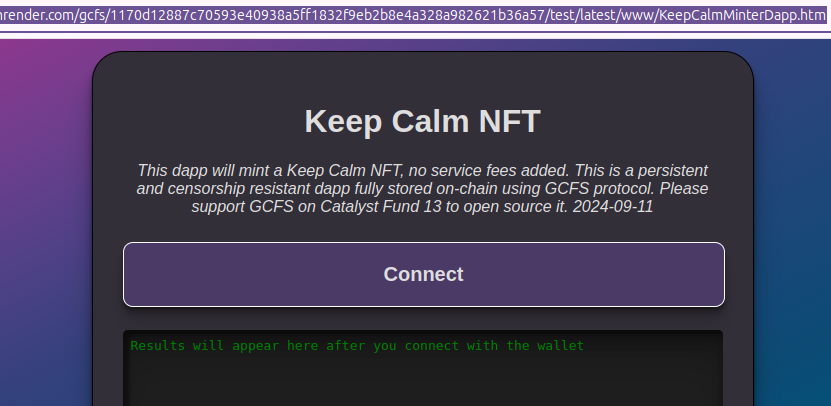
Image: A dapp 100% stored on-chain, yes, even the html file
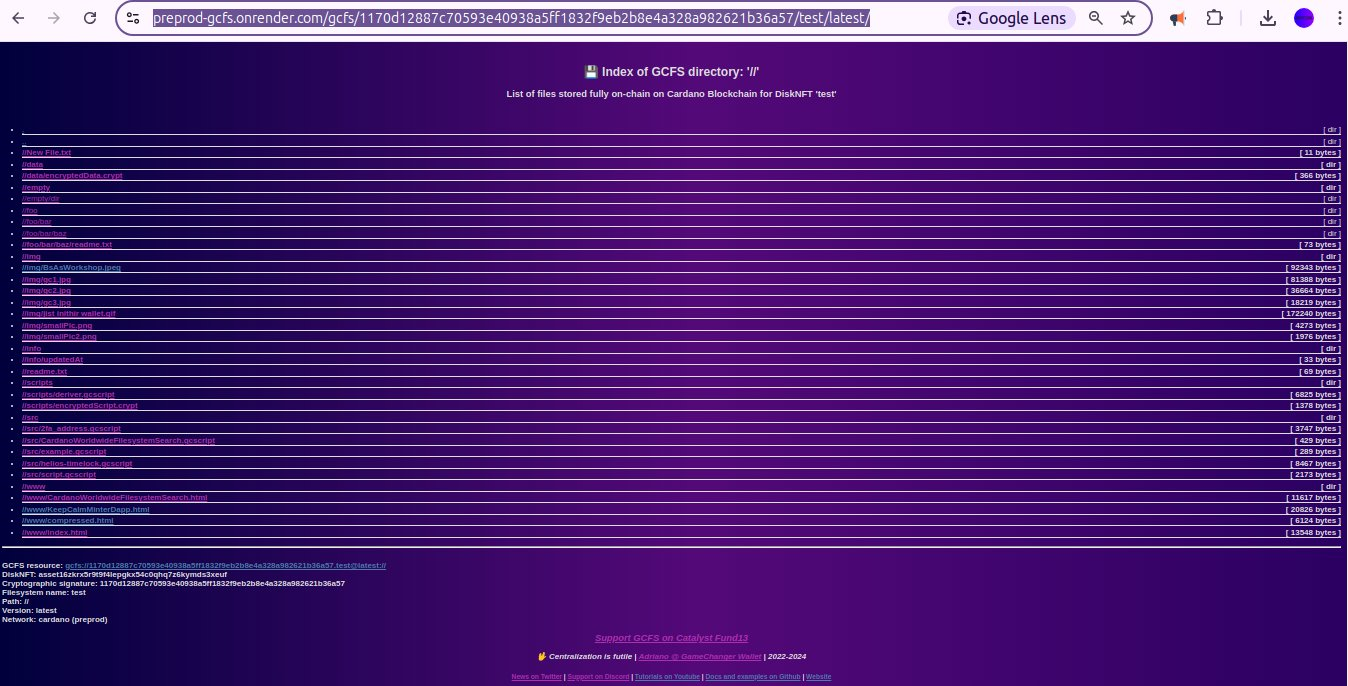
Image: Directory index of a user's on-chain file system
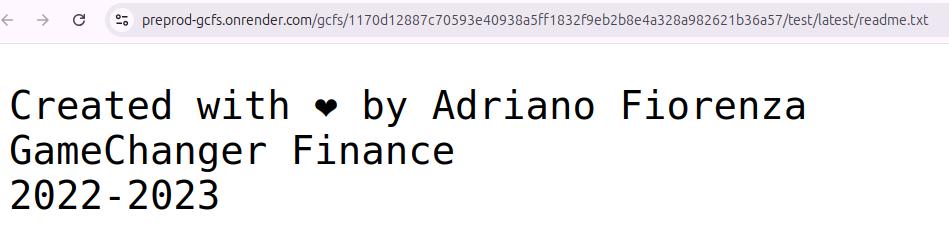
Image: One of the first files ever written on chain.
GCFS allows for running filtered searches across all file systems stored on-chain allowing developers not only to store files but also to use them as a global database for dapps, fostering a grand variety of applications, from voting to social media, to oracles and fully on-chain open and universal protocols. As you can try yourself on the demo, the web server will allow to run queries to build this kind of applications.
A directory index rendered on backend-side will help users, and developers, to understand the structure of on-chain file systems and to seamlessly explore them as if one were navigating the web.
Please check our other Fund14 proposals here
[Your Project and Solution] Impact
Please define the positive impact your project will have on the wider Cardano community
A Cardano ecosystem that embraces GCFS would mean:
- no more broken links, perma-pin your files forever on Cardano: #governance #nfts #dapps
- dapps will be able to live as long as the chain itself, even if their creators leave the space
- dapps will be fault tolerant, anyone would be able to launch a mirror of your favorite dapp to keep it alive and to colaborate with decentralization
- source code will be cryptographically signed by creators and maintainers
- source code will be inmutable, yet updatable, as every modification will generate a new version of it
- dapps will be censorship resistant, moderate content through selective mirroring
- dapps will be even more transparent and auditable than open source ones, as here the concept of open deployment is introduced.
- developers also embracing GCScript will be able to collaborate with each other for the first time without programming language barriers. A typescript developer will be able to reuse the same code a low level C developer for IOT will be using. Create an on-chain version of your dapp code and let others to use it and build on top of it.
- users will have fault tolerant governance actions, NFTs and other kind of data and files stored on-chain forever
- user data, dapps, voting, oracles, social networks, source code maintainance, nfts, smart contracts, everything we do can benefit from this protocol
[Your Project and Solution] Capabilities & Feasibility
What is your capability to deliver your project with high levels of trust and accountability? How do you intend to validate if your approach is feasible?
We have a good track record on Catalyst with 10+ finished projects and on the Cardano community, delivering innovative solutions and tooling since 2021.
As far as possible we will always deliver first and then look for funding for open sourcing, maintaining and growing our libraries, products and solutions.
GCFS is a working protocol since Q1 2023, implemented on GameChanger Wallet UI (File Uploader, DiskNFT Viewer and Workspace Loader), GCScript DSL functions and on a demo web server for developers.
[Milestones] Project Milestones
Milestone Title
Base + API Provider
Milestone Outputs
On a branch or tag referencing current milestone:
- MIT license
- Base of the typescript library repository
- Create a first API provider, potencially using a GraphQL API or PostgreSQL
- Types and helper functions
- Testing
- Project documentation
Acceptance Criteria
- open public access to the repository and to the milestone's branch or tag
- MIT license
- First types and helper functions, an early API provider and the library repository structure are present
- Tests are passing
- initial documentation is present
Evidence of Completion
- Source code and MIT license on github repository , on milestone branch or tag.
- Tests are passing
- initial documentation is present
Delivery Month
2
Cost
20000
Progress
20 %
Milestone Title
GCFS Headers and Data Streams
Milestone Outputs
On a branch or tag referencing current milestone:
- Adapt and use API provider for fetching a GCFS header
- Adapt and use API provider for fetching a GCFS data stream
- Types and/or helper functions
- TSDoc documentation
- Testing
Acceptance Criteria
- open public access to the repository and to the milestone's branch or tag
- New types and helper functions, GCFS header and data streams fetching functions, and unit tests are present
- Tests are passing
Evidence of Completion
- Source code and MIT license on github repository , on milestone branch or tag.
- Tests are passing.
Delivery Month
3
Cost
20000
Progress
40 %
Milestone Title
GCFS Record
Milestone Outputs
On a branch or tag referencing current milestone:
- Consume and process GCFS header and data stream to produce a GCFS file system record or instance
- Types and/or helper functions
- TSDoc documentation
- Testing
- Updated project documentation if required
Acceptance Criteria
- Open public access to the repository and to the milestone's branch or tag.
- New types and helper functions, GCFS record or instance helper functions, and unit tests are presents
- Tests are passing
- Documentation is updated if required
Evidence of Completion
- Source code and MIT license on github repository , on milestone branch or tag.
- Tests are passing.
- New documentation is present if required
Delivery Month
4
Cost
25000
Progress
70 %
Milestone Title
GCFS Server
Milestone Outputs
On a branch or tag referencing current milestone:
- Create an example implementation of a NodeJs Express web server with a search API to search files using basic filters
- Update GCFS library if needed
- TSDoc documentation
- Project documentation
Acceptance Criteria
- Open public access to the repository and to the milestone's branch or tag.
- The example server implementation with documented code is present
- You can run some queries over testnet filesystems
- Updates to the library are present if needed
Evidence of Completion
- Example server source code and MIT license and documentation on github repository , on milestone branch or tag.
Delivery Month
6
Cost
20000
Progress
80 %
Milestone Title
Final Milestone
Milestone Outputs
- Milestone 5 branch or tag containing this milestone's outputs plus all the previous outputs from other milestones
- Added missing documentation if any
- Closeout documentation and video demonstrating the project outcome
Acceptance Criteria
- Closeout report and video are published/submitted on App and links may be offered on repository if required.
- Added documentation if was necesary to be included
- All other previous outputs from previous milestones in their own accepted criteria state
Evidence of Completion
- The existance and public access of the repository with the branch or tag referencing final milestone
- The existance of more documentation if necesary
- The existances and public access to the final report and video
Delivery Month
7
Cost
15000
Progress
100 %
[Final Pitch] Budget & Costs
Please provide a cost breakdown of the proposed work and resources
- Milestone 1: 20000 ADA
- Milestone 2: 20000 ADA
- Milestone 3: 25000 ADA
- Milestone 4: 20000 ADA
- Milestone 5: 15000 ADA
Total: ~960hs x USD 85/hr = USD 81.600,00 ~ 120000,00 ADA at an average rate taken from 2025 price volatility ~ 100000 ADA
[Final Pitch] Value for Money
How does the cost of the project represent value for the Cardano ecosystem?
GCFS has been delivered already without funding at our own risk. It took around 6 months from design, testing, full implementation on wallet side and dapp connector side for being used with dapps. It has been improved and maintained all this time since 2023 from it's builder's time and effort. A demo web server has been provided for early testing ground and for gathering real use case feedback prior to do a proper final implementation from ground up for this proposal. Taking into account that we are not charging for those research plus full working hours and that at the end even a web server for ready-to-use and easy integration will be provided we think It makes a good investment on community funds to allocate them on infrastructure everybody will be able to use from now on.
Please also consider that there is no token launch involved here, that we will be open sourcing and redesigning code to let everyone be able to use and deploy on their own.
As this is the third attempt at Catalyst, most likely this will be the last attempt to open source it, we can't afford spending more time advertising this any longer.
[Required Acknowledgements] Consent & Confirmation
Terms and Conditions:
Yes
Team
Project Architect, Lead Developer:
Adriano Fiorenza is an Entrepreneur & Senior Full Stack Developer with 15+ years of experience software and IOT development. Founder and Developer of GameChanger Wallet, Unimatrix Sync, GCFS protocol, Universal Dapp Connector specification, GCScript DSL, delivered 10+ funded Catalyst projects, participated in 1st gen Plutus Pioneer Program.
His Linkedin profile can be found at https://ar.linkedin.com/in/adriano-fiorenza