Last updated 11 months ago
Midnight privacy Voting SDK
Problem
- No modular SDK for commit–reveal voting on Midnight
- Unclear interfaces between voting logic and dApp
- Low code reuse from existing prototypes
- No common technical guidelines for new teams
Solution
Building a standardized, modular SDK for commit–reveal voting on Midnight, complete with CLI tools, tests, and docs—ensuring scalability, future-proof updates, and seamless onboarding.
Total to date
This is the total amount allocated to Midnight privacy Voting SDK.
About this idea
[Proposal setup] Proposal title
Please provide your proposal title
Midnight privacy Voting SDK
[Proposal Summary] Budget Information
Enter the amount of funding you are requesting in ADA
92738
[Proposal Summary] Time
Please specify how many months you expect your project to last
6
[Proposal Summary] Translation Information
Please indicate if your proposal has been auto-translated
No
Original Language
en
[Proposal Summary] Problem Statement
What is the problem you want to solve?
- No modular SDK for commit–reveal voting on Midnight
- Unclear interfaces between voting logic and dApp
- Low code reuse from existing prototypes
- No common technical guidelines for new teams
[Proposal Summary] Supporting Documentation
Supporting links
- https://vcc.gitbook.io/m9dao-project/proposal/2nd-stage-sdk-dev ,
- https://anonymous-voting-sdk-kbow6kb.gamma.site/
[Proposal Summary] Project Dependencies
Does your project have any dependencies on other organizations, technical or otherwise?
No
Describe any dependencies or write 'No dependencies'
No dependencies
[Proposal Summary] Project Open Source
Will your project's outputs be fully open source?
Yes
License and Additional Information
Apache 2.0
[Theme Selection] Theme
Please choose the most relevant theme and tag related to the outcomes of your proposal
Developer Tools
[Campaign Category] Category Questions
Mention your open source license and describe your open source license rationale.
Apache 2.0 promotes open use, modification, and redistribution, fostering transparency and collaboration — core values of Project Catalyst. Its patent grants protect contributors and users, reducing legal risks in blockchain projects and supporting ecosystem stability. Allowing integration into both proprietary and open-source projects, Apache 2.0 enables sustainable SDK and app development within Cardano’s developer community. Widely adopted by major blockchain projects, it builds trust, facilitates partnerships, and attracts diverse contributors to Catalyst-funded initiatives
How do you make sure your source code is accessible to the public from project start, and people are informed?
We release our source code publicly from the start under the Apache 2.0 license, promoting transparency and collaboration. It’s hosted on public repos with clear docs and updates to keep the community informed, aligning with Project Catalyst values.
How will you provide high quality documentation?
We create clear, detailed technical documentation covering architecture, logic flow, and data structures. The docs are regularly updated alongside code changes and include examples to help developers understand and use the system effectively. This ensures accessibility and supports community adoption and contribution.
[Your Project and Solution] Solution
Please describe your proposed solution and how it addresses the problem
Problem
Lack of a standardized SDK for implementing commit–reveal voting on Midnight
Building DAO applications with strong privacy is a core goal of the Midnight ecosystem.
One of the most critical components of these DAO systems is the anonymous voting mechanism, often implemented using the commit–reveal voting model.
Although our team has developed a feasible prototype simulating voting logic and testing scenarios with Midnight’s testnet, a significant gap remains:
- There is no standardized SDK library for reuse across projects.
- No clear module standards or API interfaces, making integration into dApps complex and inconsistent.
- No official test harness to verify correctness and compatibility with changes in the Midnight stack (e.g., epoch model changes, ZK mechanisms).
This forces each development team to "start from scratch," rewriting voting logic and environment simulations, facing high risks when the Midnight testnet changes. This issue not only slows product development but also hinders the widespread adoption of private voting mechanisms within the Cardano & Midnight ecosystem.
📌 Summary of key issues:
- No standardized modular SDK for commit–reveal voting on Midnight.
- Lack of clear abstraction layers and interfaces between voting logic and dApp environment.
- Difficulty reusing code from existing prototypes or dApps.
- No common technical guidelines or standards for new teams joining the ecosystem.
Solution:
For more details: Please read here https://vcc.gitbook.io/m9dao-project/proposal/2nd-stage-sdk-dev/technical-details
Building a Standardized Modular SDK for Commit–Reveal Voting on Midnight
This proposal focuses on productizing the research outcomes from our 1st stage by delivering a developer-ready SDK for private voting on Midnight.
While 1st stage (Research & Prototype) validated the technical feasibility of commit–reveal voting through a working prototype and internal simulation, it was never intended to be reused directly in production environments. The prototype was purpose-built for testing hypotheses, not for integration into other projects.
The 2nd stage bridges this gap by transforming the prototype logic into a standardized, reusable SDK that other development teams can plug into their DAO/dApp projects without rewriting core voting logic from scratch.
Core Objectives
- Standardize the technical interface for commit–reveal voting logic on Midnight.
Modularize components (logic, CLI tools, testing environment, documentation) to maximize maintainability and scalability.
- Provide an official test harness to validate correctness and compatibility against Midnight updates (e.g., epoch model changes, ZK feature updates).
- Deliver a developer onboarding experience with clear documentation, examples, and integration guidelines.
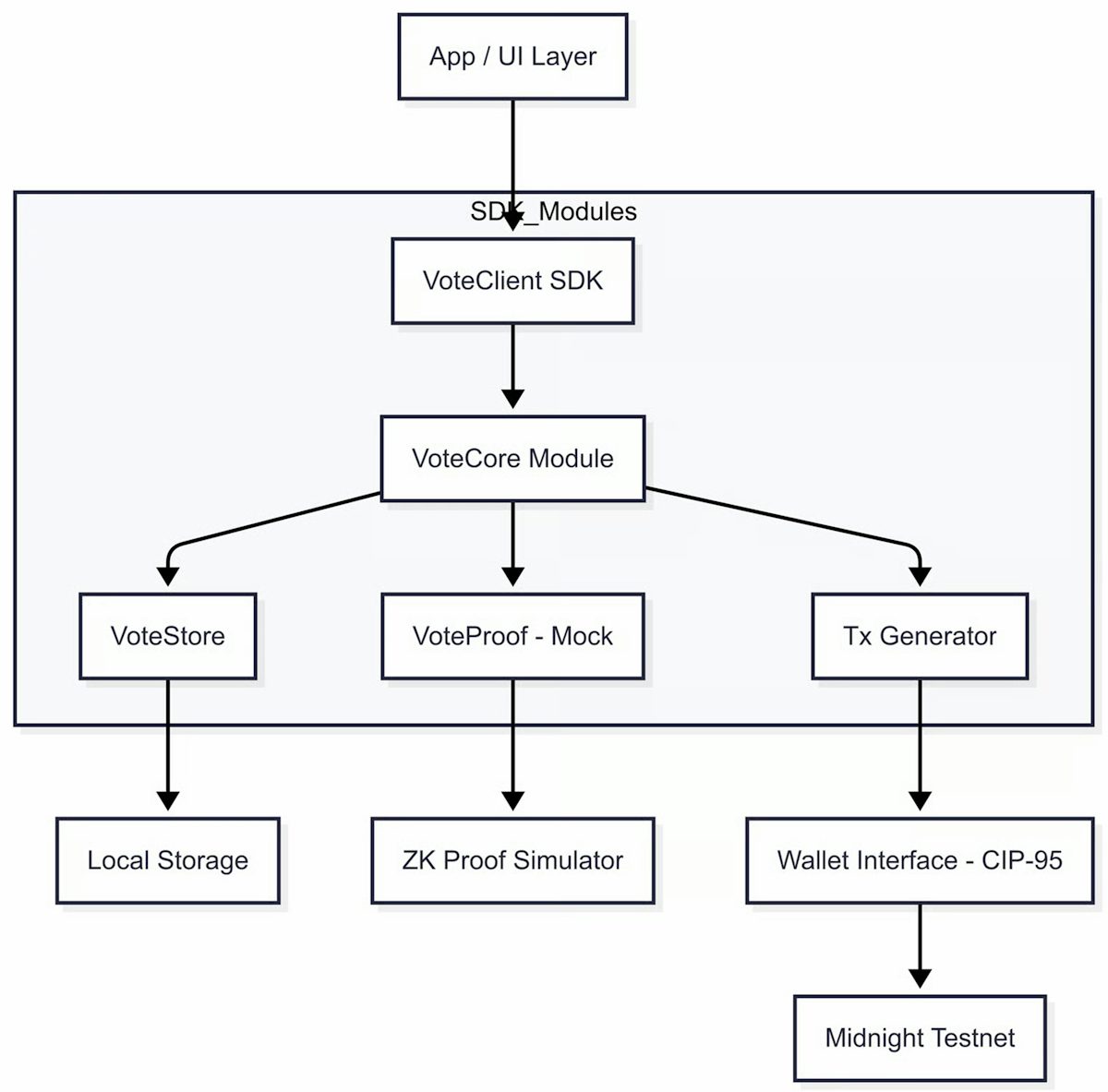
SDK Main Components
vote-core (Voting Logic)
- Core functions for commit, reveal, and verification.
- Neutral API design with no hard dependency on specific wallets or storage layers.
- Configurable timing parameters (voting window, commit/reveal phases).
vote-cli (Command-line & Automation)
- CLI for running, reproducing, and automating voting scenarios.
- Easy configuration via YAML/JSON (voter lists, seed, ZK parameters).
vote-test-env (Simulation & Testing)
- Simulates epochs, block times, and failure/recovery cases.
- Supports stress testing with large-scale parallel scenarios.
vote-docs (Technical Documentation)
- Covers system architecture, module integration, and API usage.
- Includes risk analysis and fallback strategies for unstable testnet or missing ZK features.
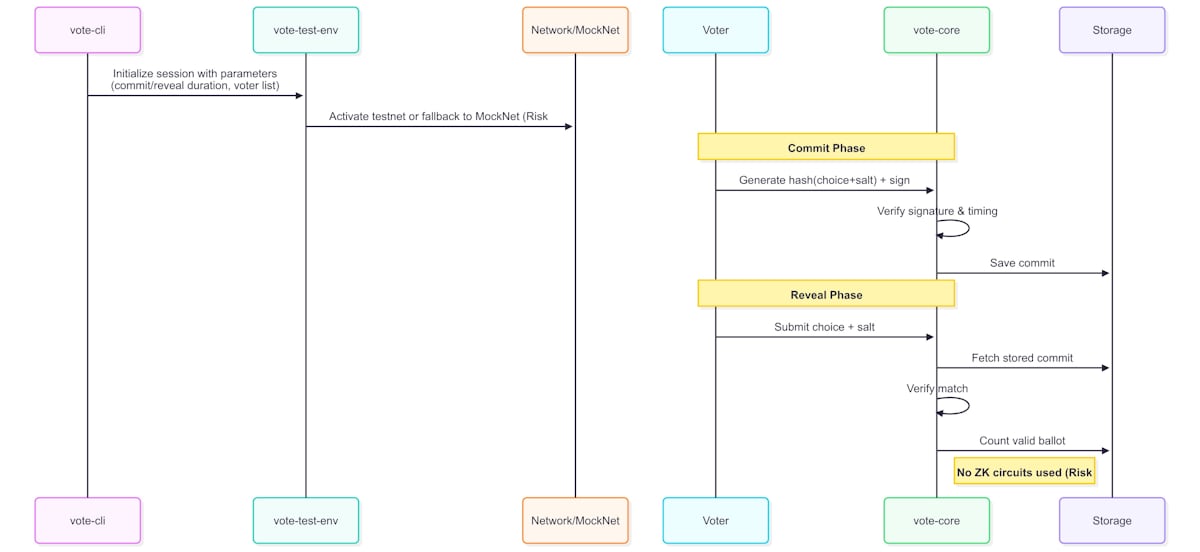
Key Difference from Research phase:
Research phase: Experimental prototype to test feasibility → internal use, not modular, no standard API, no reusable test harness.
SDK dev phase: Developer-facing SDK with stable API, reusable modules, formal test harness, and integration documentation for ecosystem adoption.
Technical Approach & Design
- Maximum Modularization
- The SDK components are packaged independently, allowing them to be replaced or extended as needed. For example, the commit/reveal logic can be upgraded to integrate Plonk or Noir once the Midnight stack becomes stable.
- Separation of the Abstraction Layer
- The SDK provides an abstraction interface that does not directly depend on Midnight’s official SDK. This approach enables:
- Easy mocking and testing without requiring a live network.
- Faster adaptation to protocol changes in Midnight.
- Decoupling core voting logic from low-level blockchain dependencies.
[Your Project and Solution] Impact
Please define the positive impact your project will have on the wider Cardano community
Impact & Benefits for Cardano Ecosystem
1. Accelerates DAO Development on Midnight & Cardano
- By providing a ready-to-use SDK, developers can integrate commit–reveal voting into their dApps without reinventing the wheel.
- Reduces development time and complexity, enabling faster DAO product launches in the ecosystem.
2. Establishes a Technical Standard for Private Voting
- Creates a consistent API and module structure for commit–reveal voting, improving interoperability between projects.
- Sets a precedent for future privacy-preserving DAO tools in the Cardano ecosystem.
3. Boosts Ecosystem Security & Reliability
- The SDK’s built-in test harness ensures that voting logic is validated against protocol changes, minimizing the risk of critical errors.
- Encourages best practices in zero-knowledge proof integration and secure vote handling.
4. Enhances Developer Experience & Onboarding
- Clear documentation, examples, and integration guides lower the entry barrier for new developers.
- Reduces fragmentation by guiding teams toward reusable, standardized solutions.
5. Future-Proof & Adaptable to Protocol Changes
- Modular architecture allows easy upgrades (e.g., integrating new ZK schemes, adapting to epoch model updates).
- Decoupled abstraction layer ensures compatibility even as Midnight evolves.
- Strengthens Cardano’s Position in Privacy-first Governance
- Encourages adoption of privacy-preserving governance models beyond Cardano-native DAOs, including cross-chain and enterprise use cases.
- Demonstrates Cardano’s leadership in building robust, open-source governance frameworks.
[Your Project and Solution] Capabilities & Feasibility
What is your capability to deliver your project with high levels of trust and accountability? How do you intend to validate if your approach is feasible?
Team Capability
Our team consists of experienced blockchain developers, solution architects, and DAO specialists who have previously built a working commit–reveal prototype on Midnight’s testnet. With expertise in Rust, zero-knowledge proofs, and DAO governance, we have the technical capacity to deliver a production-ready SDK.
Preparation Work
Prior to this proposal, we conducted preliminary research on solution design, reviewed relevant ZK frameworks, and validated the commit–reveal logic through internal simulations. We have also drafted the implementation roadmap and identified key milestones to ensure smooth execution.
Check our preparation: https://vcc.gitbook.io/m9dao-project/proposal/2nd-stage-sdk-dev/technical-details
Transparency & Open Source
The entire SDK, documentation, and integration samples will be released under an open-source license on GitHub, ensuring transparency, community contribution, and long-term ecosystem adoption.
[Milestones] Project Milestones
Milestone Title
SDK Architecture Standardization
Milestone Outputs
- Core commit–reveal voting logic extracted from prototype into reusable vote-core library.
- Well-defined traits/interfaces for core operations (commit, reveal, tally).
- Initial API draft following Rust conventions and error handling.
- Base SDK folder structure and architecture documentation.
Acceptance Criteria
- vote-core is a standalone Rust library with modularized components.
- All public functions and traits are documented using Rustdoc.
- Error handling implemented using Result and custom error enums.
- Architecture documentation describes module interactions and data flow.
Evidence of Completion
- GitHub repository containing the vote-core library with compiled documentation.
- API draft accessible via generated Rustdoc pages.
- Architecture diagram and technical documentation committed to /docs folder.
Delivery Month
1
Cost
18229
Progress
20 %
Milestone Title
SDK Feature Development
Milestone Outputs
- Core submodules implemented: VoteSession, CommitProof, TallyEngine.
- Epoch/slot/lock-time simulation module for offline testing.
- Unit tests covering commit, reveal, tally, and epoch simulation logic.
Acceptance Criteria
- src/lib.rs contains fully implemented commit–reveal–tally workflow.
- Epoch simulation can mimic block/slot progression and phase timing.
- Unit tests achieve at least 90% coverage for all core modules.
- All functions produce structured logs for debugging and analysis.
Evidence of Completion
- GitHub repository containing completed src/lib.rs and submodules.
- Test coverage report showing ≥90% coverage.
- Logs demonstrating execution of each core function committed to /tests/logs folder.
Delivery Month
3
Cost
31068
Progress
50 %
Milestone Title
Documentation & Sample Integration Kit
Milestone Outputs
- Complete API documentation with JSON schemas for all input/output structures.
- Demo sample app showcasing SDK usage via CLI and/or web mock.
- Integration guide for developers, including setup, usage, and troubleshooting steps.
- One case study demonstrating real-world application of the SDK.
Acceptance Criteria
- API documentation generated in HTML format using Rustdoc or equivalent.
- JSON schema definitions fully match implemented SDK data structures.
- Sample app compiles and runs successfully, performing commit–reveal voting flow.
- Integration guide enables new developers to set up and run the SDK within 30 minutes.
- Case study clearly explains SDK application in a practical voting scenario.
Evidence of Completion
- API documentation available in /docs/api directory.
- JSON schema files stored in /docs/schema.
- GitHub repo containing sample-app folder with working CLI/Web demo.
- Published integration guide in /docs/integration_guide.md.
- Case study file in /docs/case_study.md.
Delivery Month
5
Cost
23095
Progress
80 %
Milestone Title
Public Release & Packaging
Milestone Outputs
- Fully tested and optimized SDK packaged for public use.
- Source code cleaned, documented, and compliant with open-source licensing requirements.
- SDK released as version v1.0.0 on GitHub under approved open-source license.
- Changelog and release notes summarizing changes and features.
- Final project report submitted to Catalyst.
Acceptance Criteria
- All tests pass with minimum 90% coverage.
- Codebase complies with selected open-source license (e.g., Apache 2.0, MIT).
- Performance benchmarks documented, meeting targeted efficiency goals.
- GitHub release tagged v1.0.0 with downloadable package and source code.
- Changelog includes all key updates since initial development.
- Final report accepted by Catalyst review process.
Evidence of Completion
- GitHub repository with v1.0.0 tag and release assets.
- /LICENSE file and license compliance checklist.
- Benchmark results documented in /docs/benchmarks.md.
- Changelog (CHANGELOG.md) and release notes published.
- Final report available in /docs/final_report.pdf
Delivery Month
6
Cost
20346
Progress
100 %
[Final Pitch] Budget & Costs
Please provide a cost breakdown of the proposed work and resources
Total: 92,738 ADA
ADA rate ~ 0.8$
Milestone 1 – SDK Architecture Standardization
Description: Refactor prototype SDK module, define trait/interface, Architecture Standardization.
Roles n' Hours:
- Solution Architect: 70h × 100 = 7,000 ADA
- Core Developer: 60h × 90 = 5,400 ADA
- Documentation Specialist: 30h × 85 = 2,550 ADA
- DevOps & Tooling Engineer: 25h × 65 = 1,625 ADA
- Project Management: 40h × 80 = 3,200 ADA
Cost: 18,229 ADA
Milestone 2 – Core SDK Feature Development
Description: buillding commit/reveal modules, epoch simulation, unit tests.
Roles n' Hours:
- Solution Architect: 60h × 100 = 6,000 ADA
- Core Developer: 150h × 90 = 13,500 ADA
- Documentation Specialist: 80h × 85 = 6,800 ADA
- DevOps & Tooling Engineer: 30h × 65 = 1,950 ADA
- Project Management: 55h × 80 = 4,400 ADA
Cost: 31,068 ADA
Milestone 3 – Documentation and Sample Integration
Description: Creating API doc, demo app, integration guide.
Roles n' Hours:
- Solution Architect: 35h × 100 = 3,500 ADA
- Core Developer: 80h × 90 = 7,200 ADA
- Documentation Specialist: 60h × 85 = 5,100 ADA
- DevOps & Tooling Engineer: 80h × 65 = 5,200 ADA
- Project Manager: 40h × 80 = 3,200 ADA
Cost: 23,095 ADA
Milestone 4 – Public Release and Packaging
Description: QA, benchmark, open-source release.
Roles n' Hours:
- Solution Architect: 30h × 100 = 3,000 ADA
- Core Developer: 60h × 90 = 5,400 ADA
- Documentation Specialist: 50h × 85 = 4,250 ADA
- DevOps & Tooling Engineer: 90h × 65 = 5,850 ADA
- Project Management: 50h × 80 = 4,000 ADA
Cost: 20,346 ADA
[Final Pitch] Value for Money
How does the cost of the project represent value for the Cardano ecosystem?
This SDK delivers a cost-effective, production-grade foundation for integrating anonymous voting into DAO infrastructures on Cardano, powered by the Midnight privacy stack.
By modularizing complex components such as commit–reveal voting, time-locked sessions, and zero-knowledge proof handling, the SDK drastically reduces technical overhead for ecosystem builders.
The project is fully open-source and designed for reusability, ensuring that other teams can build upon it without reinventing the wheel. Based on typical market development rates, it is estimated to save 30–50% of development cost and time for future DAO-related applications.
The team behind the SDK consists of experienced Rust developers and privacy researchers with a proven track record in blockchain R&D.
The deliverables follow best practices in software engineering: clean code, robust test coverage, formal documentation, and production-ready packaging. This ensures long-term maintainability and real-world applicability across multiple use cases within the Cardano ecosystem.
[Required Acknowledgements] Consent & Confirmation
Terms and Conditions:
Yes
Team
Do Trung Nhan
Role: Project lead
Experience: IT engineer with 10+ years of experience in complex software projects with high user traffic. 2 years of hands-on experience in Cardano smart contract development using Plutus, Aiken, and Haskell. Skilled in smart contract development, testing, and blockchain transaction integration.
Pham Cong Hai
Role: Tech lead
Experience: 3+ years of experience in Vue.js, Nuxt 3, Rutst, TypeScript, and JavaScript. Skilled in backend frameworks like NestJS and ExpressJS, with experience in UI development using Tailwind CSS. Currently a Frontend Web Developer at tabtab.me – a real estate platform powered by AI. Graduated from Hanoi University of Science and Technology.
VCC team
Role: Project co-manager
An experienced Catalyst-funded team from Vietnam with a proven track record of delivering high-quality projects for the Cardano ecosystem. Our members bring expertise in blockchain development, DAO governance, community building, content creation, and technical documentation.
Have successfully completed multiple Catalyst proposals, reaching tens of thousands of community members through educational content, multilingual resources, and practical blockchain tools. Our mission is to connect, educate, and empower the Vietnamese and global Cardano community.