Last updated 9 months ago
Scaffold Cardano: Aiken Development Toolkit
Problem
Presently, Cardano developers face a fragmented toolset and setting up a full Haskell-based Plutus development environment is notoriously complex
Solution
Scaffold Cardano is a full-stack development framework designed to simplify building DApps on Cardano. Leveraging from Ethereum’s Scaffold-ETH.
Total to date
This is the total amount allocated to Scaffold Cardano: Aiken Development Toolkit.
About this idea
[Proposal setup] Proposal title
Please provide your proposal title
Scaffold Cardano: Aiken Development Toolkit
[Proposal Summary] Budget Information
Enter the amount of funding you are requesting in ADA
65000
[Proposal Summary] Time
Please specify how many months you expect your project to last
6
[Proposal Summary] Translation Information
Please indicate if your proposal has been auto-translated
No
Original Language
en
[Proposal Summary] Problem Statement
What is the problem you want to solve?
Presently, Cardano developers face a fragmented toolset and setting up a full Haskell-based Plutus development environment is notoriously complex
[Proposal Summary] Project Dependencies
Does your project have any dependencies on other organizations, technical or otherwise?
No
Describe any dependencies or write 'No dependencies'
No dependencies
[Proposal Summary] Project Open Source
Will your project's outputs be fully open source?
Yes
License and Additional Information
Yes, all outputs will be fully open source. We plan to license the code under the MIT license, as this permissive license maximizes reuse and community collaboration. The codebase will be hosted on GitHub from day one, with clear contribution guidelines to encourage ecosystem involvement. Adopting MIT mirrors best practices in open-source tooling and ensures any developer can freely use, modify, and extend our framework
[Theme Selection] Theme
Please choose the most relevant theme and tag related to the outcomes of your proposal
Developer Tools
[Campaign Category] Category Questions
Mention your open source license and describe your open source license rationale.
We will release Scaffold Cardano under the MIT License. This permissive license allows any developer or organization to freely use, modify, and redistribute our framework while maintaining attribution. Our rationale is to maximize adoption and community contribution, ensuring that developers in the Cardano ecosystem can integrate Scaffold Cardano into their projects without legal friction. By adopting MIT, we promote open collaboration and innovation, which aligns with Catalyst’s goal of supporting reusable, long-term public infrastructure.
How do you make sure your source code is accessible to the public from project start, and people are informed?
From day one, the entire codebase will be hosted publicly on GitHub, including all development branches, sample projects, and CI/CD pipelines. Each milestone will have dedicated release tags, and progress will be shared through GitHub issues, PRs, and project boards. We will also communicate updates via social channels (Twitter/X, Discord, and relevant Cardano forums) to ensure the community is aware of new features, beta releases, and tutorials. This approach ensures full transparency, early access to the code, and continuous community engagement.
How will you provide high quality documentation?
We will provide comprehensive, multi-layered documentation including:
•	Step-by-step guides and tutorials for new developers, covering Plutus and Aiken integration, contract deployment, and frontend binding usage.

•	Interactive live code examples using embedded sandboxes, allowing developers to experiment without local setup.

•	API references and auto-generated type documentation for all bindings between smart contracts and front-end frameworks.

•	Video walkthroughs and demo applications to illustrate best practices and practical workflows.
[Your Project and Solution] Solution
Please describe your proposed solution and how it addresses the problem
Cardano’s existing smart contract tools are powerful but disjoint. Plutus is a safe full-stack environment based on Haskell, and Aiken is a modern Rust-inspired language designed for improved developer experience . However, in practice developers must piece together separate tools: coding on-chain contracts, compiling via cardano-cli, running local nodes, writing off-chain JS code manually, and deploying with long CLI commands.
As one Cardano developer noted, “Cardano has no comparable IDE. The closest thing is Plutus Playground, which is just a toy… there is no workflow from [the Playground] to deploying and interacting with the smart contract in the real blockchain”. This fragmentation leads to a steep learning curve, high development costs, and wasted time
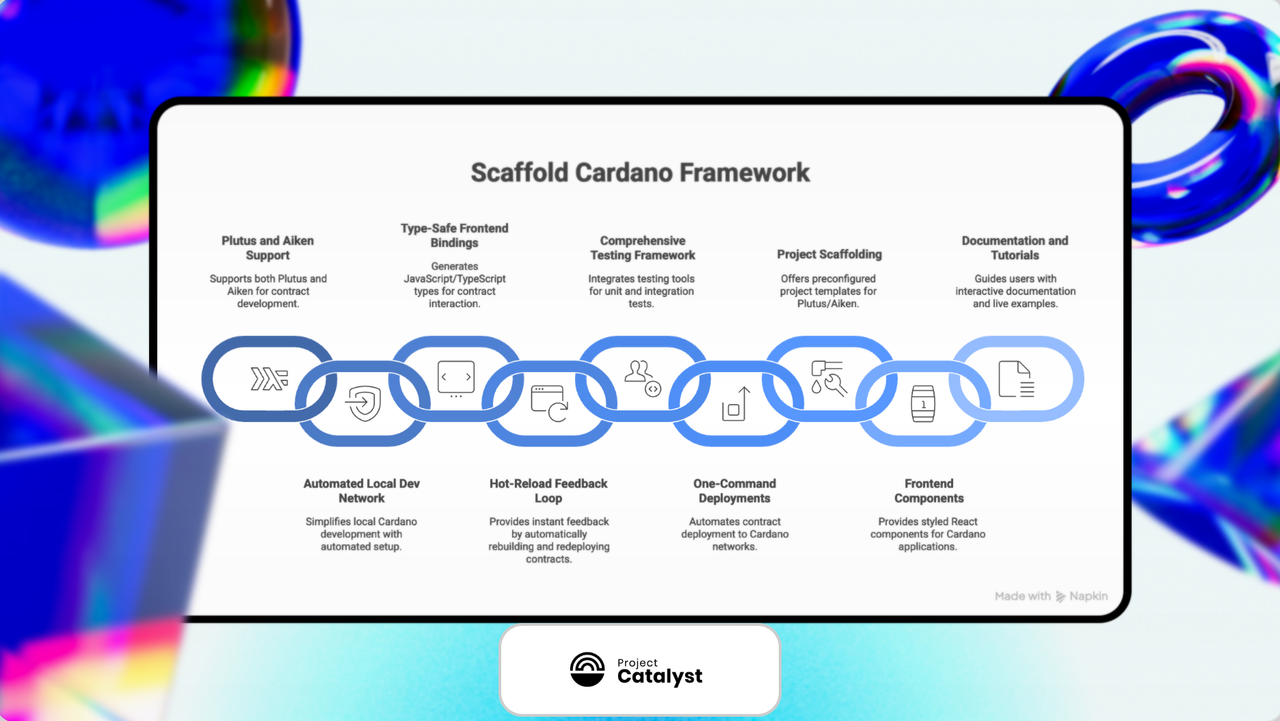
Our solution: Scaffold Cardano provides the first unified developer environment tailored to Cardano. It tightly integrates Plutus and Aiken contract development with frontend tooling:
- We support both Plutus and Aiken out of the box. Developers can write Plutus contracts in Haskell or write in Aiken’s C-like syntax, which compiles directly to Plutus Core. In either case, our framework manages compilation and interfaces
- A local Cardano dev network is automated. With one command, a developer can spin up a sandbox test node (e.g. via Cardano Testnet or the new IOG development node) for immediate experimentation. Deploying and testing on-chain logic locally becomes as easy as npm run dev.
- We generate type-safe frontend bindings. For each contract, a build step generates JavaScript/TypeScript types and helper functions (e.g. using Lucid), providing strong typing and convenience for interacting with on-chain code. This solves the “missing tooling” problem where Rust/Haskell contracts had no smooth bridge to web interfaces.
- Project scaffolding: Using npx create-cardano, developers can bootstrap a new project preconfigured for Plutus/Aiken. The base template includes basic contract and front-end wiring. Two example extensions will cover common patterns (for example, an ERC-20–style fungible token and an NFT marketplace). This directly addresses the “ready-to-use templates” idea, dramatically reducing setup time.
- Frontend components: We supply a library of styled React components tailored for Cardano. These include wallet connection dialogs, token balances, and transaction forms. This means front-end devs don’t have to reinvent UI for every Cardano app; they can drag-and-drop proven components.
- • Documentation and tutorials: Interactive docs with live code examples will guide users step-by-step, ensuring newcomers can get a working DApp running in minutes.
In essence, Scaffold Cardano abstracts all the repetitive boilerplate of Cardano DApp development. By providing a cohesive, production-ready framework, we transform a fragmented stack into a streamlined developer experience. This is genuine innovation for Cardano: there is currently no single toolset that combines contract hot-reload, full-stack scaffolding, and cross-network deployment.
Our approach is complementary to learning tools like Plutus or Marlowe Playground – those are great for prototypes, but Scaffold Cardano targets production-grade app development
[Your Project and Solution] Impact
Please define the positive impact your project will have on the wider Cardano community
Scaffold Cardano will generate significant positive impact across the Cardano ecosystem:
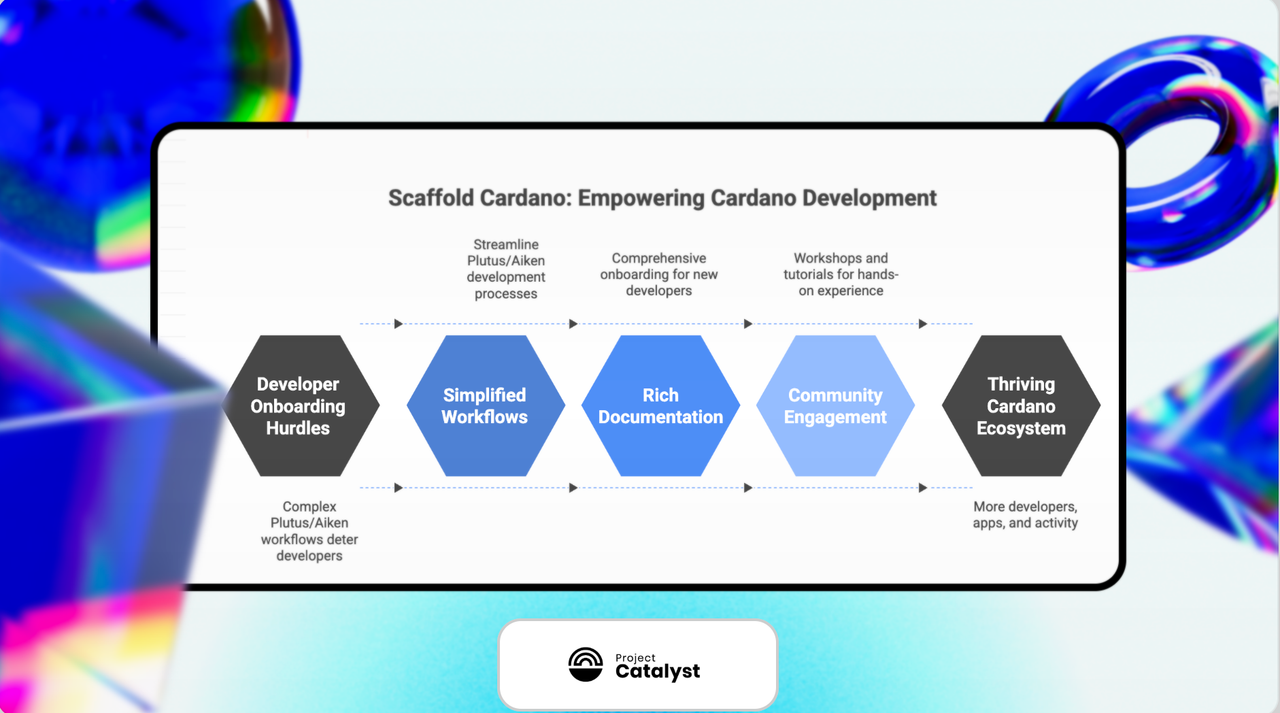
- Lowering Barriers & Expanding the Developer Base: By simplifying Plutus/Aiken workflows and providing rich documentation, we make Cardano accessible to Rust and Haskell developers who were previously deterred by the complexity. This broadens the talent pool. For example, Aiken itself was created because Plutus “becomes difficult or even frustrating to use” with Haskell tooling; our framework builds on that effort. Comprehensive onboarding means more developers will “choose Cardano” for smart contracts.
- Accelerating Innovation: With less development overhead, teams can launch DApps much faster. As pointed out in similar proposals, a streamlined framework “reduces development time and costs” and “encourages the creation of diverse and innovative dApps”. Faster time-to-market will lead to more Cardano applications (DeFi, NFTs, gaming, etc.) being built and deployed.
- Strengthening the Ecosystem: An open-source, production-ready toolkit under MIT license encourages community contributions and forked innovations . The cumulative effect is a healthier ecosystem: more active projects, more collaboration, and a virtuous cycle of growth.
- Measurable Benefits: We will track metrics to demonstrate impact. These include downloads/NPM installs, GitHub stars and forks, number of projects scaffolded, and developer survey feedback. As one proposal notes, monitoring “user adoption rates, the number of dApps developed, and developer satisfaction” provides transparency on ecosystem benefit . We will publish these metrics in post-launch reports.
- Community Education and Engagement: We will conduct workshops and tutorials (online and at hackathons) using Scaffold Cardano. By doing so, new developers gain hands-on experience building Cardano DApps. This aligns with Catalyst’s goals of developer outreach.
- Economic Growth: Ultimately, by empowering more developers to build on Cardano, Scaffold Cardano contributes to network usage and ADA utility. Increased transaction activity and application diversity (all documented via our metrics) will positively affect Cardano’s economic network value .
[Your Project and Solution] Capabilities & Feasibility
What is your capability to deliver your project with high levels of trust and accountability? How do you intend to validate if your approach is feasible?
Our team has a proven track record in building blockchain developer frameworks. Collectively, we have deep knowledge of both on-chain (smart contract) and off-chain (DApp) stacks.
We will follow an agile development process with open community engagement. All code and milestones will be tracked publicly on GitHub. Progress reports and interim deliverables will be shared regularly, ensuring transparency and allowing early feedback (as recommended in Catalyst guidelines). We also note that major Cardano stakeholders recognize this need:the Cardano team is already working on a browser-based IDE for Plutus and Marlowe. Scaffold Cardano is timely and complementary.
We are prepared to meet all requirements. We acknowledge that KYC will be completed upon award, and we commit to deliver a full report at project completion and a follow-up survey after three months. With our combined skill set and the clarity of our plan, we are confident in delivering the toolkit on schedule and budget.
[Milestones] Project Milestones
Milestone Title
Core Architecture & Setup
Milestone Outputs
Public GitHub monorepo with initial project structure (supporting Plutus, Aiken, and front-end code); an automated script to launch a local Cardano test node; prototype of the type-safe binding generator (e.g. generating TypeScript stubs from a Plutus contract); UX wireframes and initial design for the Scaffold Cardano portal/landing page.
Acceptance Criteria
Repository initializes successfully and builds sample contracts; local dev node launches within ~2 minutes of command; binding generator produces working TS definitions for a sample contract; design mockups reviewed and 80% approved by team.
Evidence of Completion
GitHub repository link with initial commit and folder structure; video or logs showing local node startup; example generated code snippets; attached wireframe images.
Delivery Month
2
Cost
20000
Progress
20 %
Milestone Title
Development Experience Enhancements
Milestone Outputs
Implementation of real-time hot-reload for contracts (on-code-change); a React/TypeScript UI component library for common Cardano interactions (wallet connection, token display, transaction forms); an integrated testing framework (e.g. scripts to run Plutus emulator tests); deployment pipeline scripts for Cardano testnet and mainnet (using cardano-cli or Lucid); beta release of Scaffold Cardano toolkit on GitHub; initial live landing page.
Acceptance Criteria
Hot-reload updates UI within 3 seconds of contract change; test suite achieves ≥80% coverage on core modules; deployment scripts successfully push an example contract to testnet and mainnet in under 2 minutes; at least 10 external developers have tested the beta toolkit; landing page is live with feature list.
Evidence of Completion
Demo video of hot-reload in action; test coverage report screenshots; GitHub release tag for beta version; feedback survey or issue comments from 10+ beta testers; live URL for landing page.
Delivery Month
2
Cost
15000
Progress
20 %
Milestone Title
Templates and Documentation
Milestone Outputs
npx create-cardano CLI tool and base project template published to npm; two application template extensions (e.g. a fungible token DApp and an NFT marketplace) demonstrating common use-cases with working smart contracts and UIs; complete developer documentation (website/blog format) with interactive code examples covering all features; integration of one-click frontend deployment (e.g. Vercel); full public alpha release of Scaffold Cardano (website with download links and docs); two developer workshops or webinars introducing the framework.
Acceptance Criteria
CLI scaffolding command generates a new project in <30 seconds; the two example templates are fully functional and documented; documentation covers 100% of framework features; ≥50 developers onboarded through workshops or online; framework successfully deploys DApps on Cardano mainnet (and optionally Hydra) networks.
Evidence of Completion
GitHub/npm package for create-cardano; demo apps for token/NFT with source repos; online docs URL; workshop attendance list (and recorded sessions); deployed demo apps URLs.
Delivery Month
1
Cost
15000
Progress
30 %
Milestone Title
Finalization & Adoption
Milestone Outputs
Finalize all remaining features and UI improvements based on beta feedback; published case studies or “examples in the wild” of DApps built with Scaffold Cardano; community feedback report (including survey results from at least 5 developer teams); usage metrics report (downloads, stars, etc.); final project report summarizing achievements and next steps; marketing efforts (social media, forum posts, hackathon demos) to encourage adoption.
Acceptance Criteria
During the eighth month, the focus will be on completing all remaining features and UI enhancements, fully incorporating feedback from beta testers. This includes finalizing core modules, refining user flows for both Plutus and Aiken integrations, and ensuring that the framework is robust, stable, and developer-friendly.
Additionally, the milestone emphasizes real-world adoption and visibility. We will publish detailed case studies or “examples in the wild” highlighting DApps that have successfully integrated Scaffold Cardano, demonstrating the framework’s practical utility and versatility.
Community engagement and feedback collection remain central. A structured feedback report will be prepared, incorporating results from surveys of at least five developer teams who have actively used the framework. This report will evaluate usability, documentation clarity, onboarding experience, and overall satisfaction, providing actionable insights for future development.
To track adoption and community traction, we will compile usage metrics, including GitHub downloads, stars, forks, contributions, and other relevant analytics. These metrics will serve as quantitative indicators of the framework’s reach and impact.
Finally, the milestone will produce a comprehensive final project report summarizing the achievements of all previous milestones, lessons learned, adoption outcomes, and recommended next steps for future improvements. Marketing and outreach efforts will also be implemented to encourage broader adoption, including social media campaigns, forum posts in Cardano developer communities, hackathon demos, and live walkthroughs or tutorial sessions.
Evidence of Completion
• Official release of Scaffold Cardano version 1.0 on GitHub, including complete documentation, examples, and onboarding guides.
•	Verified adoption by at least five projects or developer teams, with evidence of usage in production or active experimentation.

•	Developer satisfaction of 80% or higher, based on survey responses evaluating usability, integration experience, and documentation.

•	Delivery of the final project report, summarizing case studies, adoption metrics, community feedback, and roadmap for future iterations.

•	Completion of marketing and outreach activities aimed at promoting the framework and engaging the developer community.
Delivery Month
1
Cost
15000
Progress
30 %
[Final Pitch] Budget & Costs
Please provide a cost breakdown of the proposed work and resources
Development Personnel: ~50,000 ADA. Covers the equivalent of two full-time developers (Plutus/Aiken and front-end expertise) and one part-time UI/UX engineer.
Infrastructure & Tools: ~5,000 ADA. Includes cloud hosting for CI/CD and test nodes, domain hosting for scaffoldcardano.com, and essential paid tools (e.g. analytics, communication).
Workshops & Events: ~5,000 ADA. For organizing developer workshops, hackathon support, and community meetups (venue, prizes, etc.).
Contingency & Miscellaneous: ~5,000 ADA. Reserve for unforeseen expenses (e.g. additional cloud usage, expert consultation, translation/localization).
These allocations ensure we can cover salaries, infrastructure, and community outreach to maximize the project’s success. All costs will be justified with receipts and included in the final report.
[Final Pitch] Value for Money
How does the cost of the project represent value for the Cardano ecosystem?
This project provides excellent value to Cardano for several reasons:
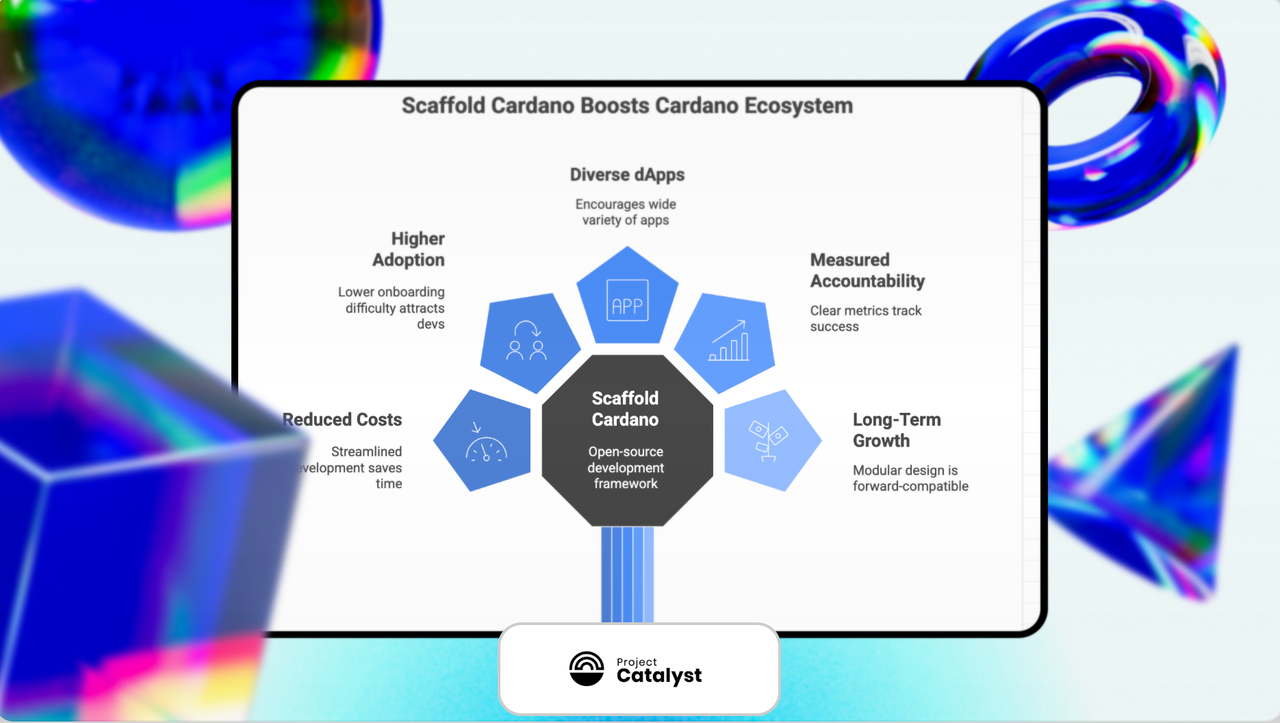
- Open-Source Multiplier: By releasing under MIT, every ADA spent yields a reusable public good. Other projects can build on our framework (or parts of it) without restriction, amplifying the impact of the initial investment. This fosters a culture of collaboration and innovation in the Cardano community.
- Reduced Development Costs: A streamlined framework saves developers significant time. As noted by similar initiatives, improving developer experience “reduces the time and resources developers need to build on the platform,” which accelerates DApp deployment and adoption. In practice, if Scaffold Cardano cuts days or weeks off each new project, the total savings across the ecosystem will dwarf our grant cost.
- Lower Barriers, Higher Adoption: By dramatically lowering onboarding difficulty, we attract new developers (especially Rust/Haskell devs) who would otherwise not attempt Cardano development. This broadens the ecosystem with minimal direct cost. Well-written documentation and tutorials (as we will provide) are proven to bring in more users. More developers and projects means more ADA transactions and usage in the long run.
- Measured Accountability: We will implement clear metrics to track success (usage stats, number of dApps built, community feedback). This transparency assures that funds are effective for example, we can report how many developers completed a “hello world” tutorial and went on to build real apps. Regular progress reports and community updates (outlined in our milestones) ensure ongoing accountability.
- Long-Term Growth: The framework’s modular design is forward-compatible with Cardano’s evolution (e.g. upcoming Hydra L2). This means the initial investment yields a sustainable platform that can be updated rather than rebuilt. The knowledge and community we cultivate around Scaffold Cardano will continue to pay dividends long after the grant.
[Required Acknowledgements] Consent & Confirmation
Terms and Conditions:
Yes
Team
Harry Phan (Project Lead & Web3 Educator): Harry will oversee the entire project, coordinating milestones, managing timelines, and ensuring quality across all deliverables. He also serves as the main point of contact for community engagement, documentation, and developer onboarding. With extensive experience in Web3 education and blockchain development, Harry ensures that both Plutus and Aiken workflows are well integrated and accessible to developers.Qui Vo (Backend Developer): Qui is responsible for developing and maintaining the core backend infrastructure of Scaffold Cardano. This includes smart contract integration, API development, and data handling workflows. He will also support beta testing and implement feature updates based on community feedback.Hai Tran (Frontend Developer): Hai will lead the frontend implementation, creating an intuitive, user-friendly interface for the framework. Responsibilities include UI/UX refinement, dashboard development, and ensuring seamless interaction between the frontend and backend modules. Hai will also work closely with the designer to implement consistent visual language and usability best practices.Long Nguyen (Designer & UX Specialist): Long is responsible for the overall visual design, user experience, and onboarding flows. He will create design systems, wireframes, and UI assets that align with developer needs, ensuring Scaffold Cardano is both functional and visually appealing. Long will also collaborate with Hai to translate design concepts into interactive features.