Last updated 9 months ago
[Aladin] Ensuring Fair Justice for On-Chain Disputes
Problem
When a dispute arises, freelancers often face biased, opaque decisions from centralized platforms. They feel unheard and powerless, with no fair recourse. This injustice is a huge barrier to trust.
Solution
This system creates a 'jury of peers' from the community to resolve disputes. It empowers users to have their case heard fairly and transparently, ensuring justice is accessible and affordable for all
Total to date
This is the total amount allocated to [Aladin] Ensuring Fair Justice for On-Chain Disputes.
About this idea
[Proposal setup] Proposal title
Please provide your proposal title
[Aladin] Ensuring Fair Justice for On-Chain Disputes
[Proposal Summary] Budget Information
Enter the amount of funding you are requesting in ADA
80230
[Proposal Summary] Time
Please specify how many months you expect your project to last
6
[Proposal Summary] Translation Information
Please indicate if your proposal has been auto-translated
No
Original Language
en
[Proposal Summary] Problem Statement
What is the problem you want to solve?
When a dispute arises, freelancers often face biased, opaque decisions from centralized platforms. They feel unheard and powerless, with no fair recourse. This injustice is a huge barrier to trust.
[Proposal Summary] Supporting Documentation
Supporting links
- https://docs.aladin.work/en/whitepaper ,
- https://docs.aladin.work/en/how-it-works/petition ,
- https://docs.aladin.work/en/smartcontract
[Proposal Summary] Project Dependencies
Does your project have any dependencies on other organizations, technical or otherwise?
No
Describe any dependencies or write 'No dependencies'
No dependencies
[Proposal Summary] Project Open Source
Will your project's outputs be fully open source?
Yes
License and Additional Information
The core arbitration smart contract and the accompanying Software Development Kit (SDK) will be released under the Apache 2.0 open-source license. This ensures our "Sultanate" protocol can become a foundational, public good—a decentralized justice layer that any project on Cardano can integrate to resolve disputes fairly and transparently.
[Theme Selection] Theme
Please choose the most relevant theme and tag related to the outcomes of your proposal.
Business Services
[Campaign Category] Category Questions
Describe what makes your idea innovative compared to what has been previously funded (whether by you or others).
While other projects focus on specific applications, this proposal builds a foundational justice layer for the entire community. The innovation is decentralizing power itself. By creating a community-run arbitration system, corporate judges are replaced with a jury of peers. This is a radical step towards a self-governing ecosystem where fairness is not dictated from the top down, but built from the ground up. This unlocks the potential for truly fair and transparent digital societies on Cardano.
Describe what your prototype or MVP will demonstrate, and where it can be accessed.
The MVP will be an interactive prototype where users can experience being a juror. They'll log in, review a sample dispute case, and cast their vote. They'll see in real-time how the system rewards honest participation and builds consensus. This will be accessible on Testnet with a full video walkthrough. The goal is for users to feel the power and responsibility of community-driven justice, demonstrating that a fair, decentralized court is not just a theory, but a tangible reality.
Describe realistic measures of success, ideally with on-chain metrics.
Success is measured by the community's trust in the system. The key community metric is the number of active participants in our simulated juror program. The initial goal is to engage 100+ community members as test jurors within three months. The quality of experience will be measured through surveys, aiming for a >80% confidence rating from participants that the process is fair and unbiased. Their belief in the system is our most important metric.
[Your Project and Solution] Solution
Please describe your proposed solution and how it addresses the problem
For every dollar lost to a payment dispute, businesses incur an additional $3.75 to $4.61 in total costs, contributing to billions in economic friction. But the true cost is human: the frustration and powerlessness a user feels when facing an opaque, biased decision from a centralized platform. For Cardano to host the high-value agreements of the real world, it cannot just offer efficiency; it must offer justice. The lack of a fair, affordable, and on-chain recourse for disputes is a critical barrier to mainstream adoption, and the time to solve it is now.
See more the research: https://docs.aladin.work/en/market-insight/global-gig-economy-market-opportunity-analysis))
This proposal will equip the Cardano ecosystem with a decentralized justice layer, the "Sultanate." Think of it as a 'jury of peers' for the digital age. When a dispute arises, the case is not sent to a corporate support desk, but to a council of experienced community members who stake their own funds to participate as jurors. This is made possible through a smart contract built with Aiken for maximum security. It uses game theory—a concept that uses incentives to guide behavior—to ensure fairness. Honest jurors who vote with the consensus are rewarded; those who vote randomly or maliciously lose their stake. This elegant economic model replaces the need for a central authority with a system where the community itself is incentivized to uphold justice.
Crucially, this is not a theoretical experiment. This justice layer is the next logical evolution of the Aladin ecosystem, built upon the foundation of our existing Aladin Work application, which is already live on the Apple App Store and Google Play. The community is not funding a project from scratch but is empowering the next, critical phase of a live, ongoing initiative. The platform for these disputes to arise already exists; now is the time to build the court.
We acknowledge that this MVP focuses on creating the core juror experience—staking, voting, and seeing the incentive model in action. It is a strategic decision to perfect the human and economic elements first. This ensures the system is fair and trusted before it is integrated to adjudicate real, high-value contracts. This proposal is a single, calculated step in a much larger journey to make Cardano the most just and trusted platform for global commerce.
Introduction a bout the Aladin platform
Redefining the Gig Economy
Aladin is a decentralized protocol and application built on Cardano, with a mission to provide a fair, transparent, and efficient infrastructure for the global job economy.
Our philosophy is encapsulated in the name Aladin, inspired by the timeless story of empowerment. In our ecosystem, every user is an 'Aladin' - empowered as the protagonist of their own journey, holding complete control. The $LAMP token is not merely an asset; it is their 'Magic Lamp' - the key to unlocking the full power of the protocol.
By holding $LAMP and making a request - whether it's seeking talented personnel for a complex project or finding help to fix a gas stove at home - an Aladin summons their 'Genie', ready to turn their wishes into tangible outcomes, safely and transparently.
Our platform operates on three core utilities:
Simplified Hiring: Aladin helps employers easily find suitable candidates based on their on-chain reputation (represented by their CVC score), minimizing time spent on interviews and manual verification.
High-Commitment Contracts: Smart contracts automatically lock the committed assets ($LAMP) of both parties, creating a serious work environment and ensuring both sides fulfill their responsibilities.
Verifiable Proof of Experience: Aladin encodes the experience accumulated through each successfully completed contract into a CVC score. This reputation is immutable, owned by the user, and can be leveraged across the entire Web3 ecosystem, not just on the Aladin app.
The Problem: Hurdles of the Modern Gig Economy
Lack of Trust and Commitment: Parties are often hesitant to engage due to the absence of mechanisms that guarantee contract enforcement and fair payment.
Difficult to Verify Experience: Resumes and recommendation letters are easily forged and do not reflect true capabilities, leading to risks for employers.
Walled Gardens (Data Silos): A worker's valuable experience on one platform (e.g., Upwork) cannot be transferred to another, forcing them to build their reputation from scratch repeatedly.
High Fees and Opaque Processes: Incumbent platforms charge high service fees, and their dispute resolution processes are often centralized, non-transparent, and potentially biased.
Aladin's Solution: A Global Trust and Reputation Layer
Aladin is more than just an application; it is a foundational protocol that solves the above issues by:
Establishing Trust through asset-backed escrow smart contracts.
Building Immutable Reputation via the on-chain CVC score, which reflects both experience and commitment.
Ensuring Justice with a decentralized arbitration system where the community, acting as Sultans, resolves disputes.
Promoting Open Interoperability through the Job-SCaaS model, allowing any other application to leverage Aladin's infrastructure.
What is CVC?
CVC (Committed Value in the Contract) is Aladin's core reputation score.
Calculation: The CVC value of a contract is based on the value of the staked $LAMP, pegged to a reliable stablecoin to insulate the reputation score from token price volatility.
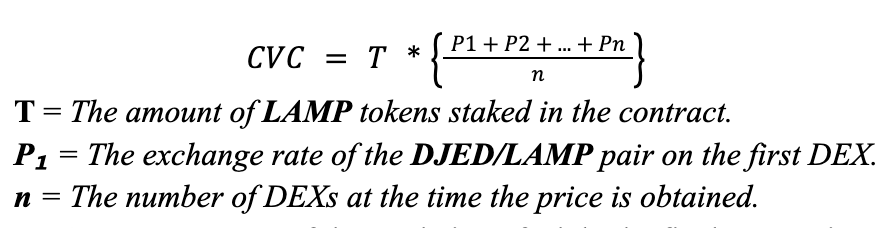
Accumulation: Upon successful completion of a job, the final transaction consumes the old reputation UTXO and creates a new one with an updated CVC score for both the Aladin and the Genie, permanently recording the experience on-chain.
Aladin Ecosystem
The Aladin ecosystem consists of two key components working in symbiosis:
The Aladin Protocol: The decentralized infrastructure layer, comprising smart contracts, Aladin Nodes, and governance rules.
The Aladin App: The user-facing application (web/mobile) that allows end-users to easily interact with the Aladin Protocol.
Key Roles in the Aladin App
Aladin: An individual or organization with a need, who posts a job or project.
Genie: A skilled individual who performs the requested job.
Sultan: The "arbiters," who are high-reputation Aladins or Genies (with high CVC scores). They can be nominated to the Petition Resolution Council to adjudicate disputes in specific job contracts.
How Aladin Works: The Lifecycle of a Job Smart Contract
The workflow of a contract on Aladin is designed to cover real-world scenarios, from initiation to either successful completion or failure.

Start: An Aladin posts a job request and criteria. The protocol suggests suitable Genies.
Contract Setup: The Aladin and Genie agree on terms and sign the smart contract.
Escrow: Both parties escrow $LAMP tokens. A Hydra Head can be opened for complex tasks.
Execution: The Genie performs the tasks.
Resolution: If it is Completed, both parties agree, the contract succeeds, funds are distributed, and the Treasury is updated. If it is Petition: In case of a dispute, the arbitration process with a Sultan is initiated (see Section 9). If the Deadline Risk: The Aladin may choose to outsource through a trusted Aladin Service Provider.
Reputation Update: Regardless of the outcome, the CVC scores of both parties are adjusted accordingly.
End: The smart contract is closed, the Hydra is closed also (if yes)
The Petition Process: Dispute Resolution by the Sultanate
This is the core mechanism for ensuring fairness.
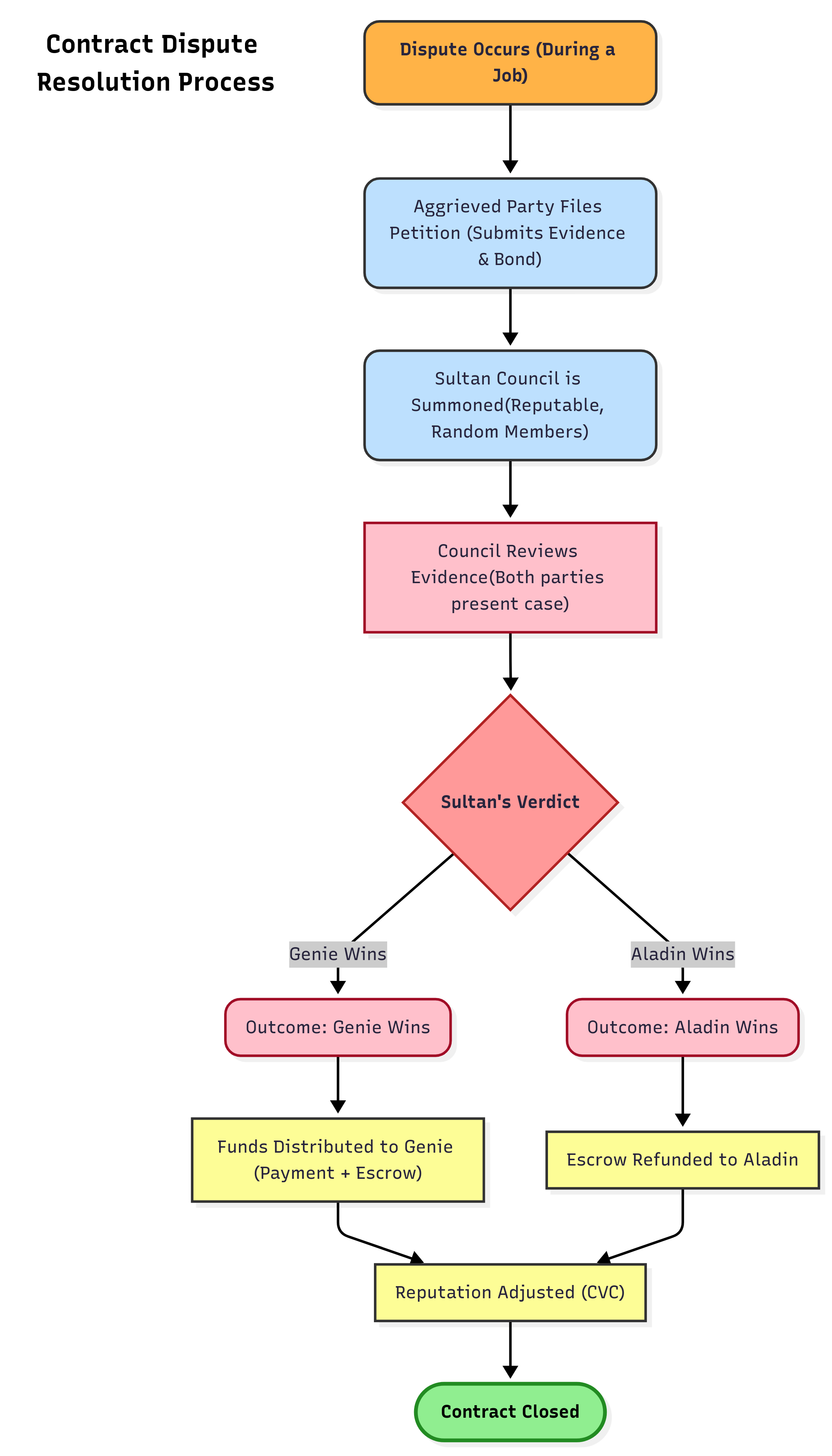
Initiation: An Aladin or Genie initiates the "Dispute" path.
Participation: A Sultan Council is randomly convened from high-reputation (high CVC) Genies and Aladins with relevant experience. They are tasked with arbitrating the dispute and casting votes to reach a final verdict.
Outcome:
- Genie Wins: The Genie receives the payment and the full escrowed amount from both parties.
- Aladin Wins: The Aladin receives a full refund of the escrowed amount from both parties.
Consequence: The losing party's CVC score is negatively impacted. Transaction fees from the fund distribution are sent to the Treasury.
[Your Project and Solution] Impact
Please define the positive impact your project will have on the wider Cardano community
This proposal's impact begins by establishing a new standard for fairness on Cardano, creating a trusted environment where complex, high-value agreements can finally thrive. The immediate goal is to engage over 100 community members in our simulated juror program and achieve a >80% confidence rating in the system's fairness. This isn't just about testing code; it's about building social consensus. These 100+ participants and their feedback will become an undeniable testament to the viability of decentralized justice, de-risking the concept for the entire ecosystem.
From this proven foundation, the impact expands exponentially as the open-source "Sultanate" protocol becomes a public good—a plug-and-play 'justice layer' for other Cardano projects:
- Decentralized Marketplaces: A project creating a decentralized version of eBay could integrate our SDK. Before, they would have to build a costly, complex, and potentially biased internal mediation system. After, they can simply plug into our protocol, offering their users access to an instant, fair, and community-driven court, dramatically increasing the trustworthiness of their platform.
- DAO Governance: A DAO could use our protocol to resolve contentious grant funding disputes or violations of community guidelines. Instead of relying on a small group of core members, they can offer a path to impartial arbitration, strengthening community trust and governance.
Ultimately, this project transforms Cardano from a platform of immutable transactions into a platform of enforceable agreements. It creates the missing piece needed for real-world adoption. By building this foundational justice layer, this project doesn't just deliver a dApp; it solidifies Cardano's reputation as the most secure, fair, and sophisticated platform for the future of the global economy.
[Your Project and Solution] Capabilities & Feasibility
What is your capability to deliver your project with high levels of trust and accountability? How do you intend to validate if your approach is feasible?
This proposal doesn't ask the community to fund a project from an idea on a napkin; it asks the community to fund the acceleration of a moving train. The Aladin Work application is already live on the iOS and Android stores, a tangible and public demonstration of the team's ability to deliver polished, user-facing products. This existing momentum dramatically de-risks the community's investment.
You can download to check and use the app by search on the app stores or by get the URLs: https://docs.aladin.work/en/app
To bring this powerful tool to life, a team with specific, battle-tested experience is required. This project is feasible because it is helmed by the right experts for each critical challenge:
- The challenge of designing a fair and robust economic system is paramount. That's why this project is led by Duc Le (CEO), who has already scaled a retail network to over 1,000 medicin shops in 3 years, mastering the creation of complex, incentive-aligned systems.
- The challenge of building a smart contract that securely manages staked funds and complex logic is non-negotiable. That's why the technical strategy is led by Nguyen Mau Luu (CTO), the former chief architect of the Optimal9 Core Banking System, a mission-critical platform demanding the highest levels of security.
- The challenge of creating an interface for justice that feels intuitive and fair is critical for user trust. That's why the user experience is guided by An Nguyen (Off-chain Lead), who previously led an app to over 500,000 downloads.
- The challenge of delivering on promises to the Catalyst community requires experience. That's why the on-chain development is led by Nguyen Vu Hoang (On-chain Lead), a Catalyst veteran with a proven track record of successfully delivering on previous Catalyst-funded projects (ProSkill).
This team's commitment to transparency is a covenant with the community. The detailed, verifiable milestones and commitment to regular updates ensure every voter has a clear, real-time view of how their delegated funds are empowering the ecosystem, every step of the way. This rigorous process is our promise of accountability.
[Milestones] Project Milestones
Milestone Title
Core Arbitration Logic & CLI
Milestone Outputs
- A technical specification and game theory document outlining the state machine, datum structures, juror incentives, and attack vector analysis.
- The complete Aiken source code for the Plutus V3 smart contract, covering the full lifecycle of a juror's interaction with a case.
- A full test suite that simulates juror staking, voting (both coherent and incoherent), and verifies the reward/penalty logic.
- An open-source CLI tool that allows developers to stake as a juror, create a sample dispute, cast a vote, and trigger the final adjudication.
Acceptance Criteria
- The specification is approved by the lead developer and clearly defines the economic incentives to ensure fair and coherent voting.
- The Aiken code compiles successfully. A wallet can stake tokens to become a juror, and the contract logic for voting is implemented as specified.
- The test suite achieves >95% code coverage and proves the game-theoretic incentives function correctly under various scenarios.
- The CLI can successfully execute the entire arbitration flow on the Preview Testnet, from juror registration to final reward distribution.
Evidence of Completion
- Link to the technical/game theory document in the public GitHub repository.
- Link to the /contracts directory in the public GitHub repository.
- Link to the test execution report and the /tests directory in the public GitHub repository.
- Link to a video recording demonstrating the CLI in action and a link to the CLI source code in the GitHub repository.
Delivery Month
2
Cost
17150
Progress
20 %
Milestone Title
Juror Portal UI & Case Viewer
Milestone Outputs
- A complete set of Figma mockups and a clickable prototype for the juror dashboard, case details page, and voting interface.
- A GitHub repository for the frontend application with the juror dashboard and case viewer UI implemented. Deployed to a public staging URL.
- A functional "Connect Wallet" feature. An integrated dashboard component that queries the blockchain to show the user's current juror stake and status.
Acceptance Criteria
- The Figma prototype is approved and provides a clear, unbiased, and intuitive user journey for a juror.
- The web application's UI is pixel-perfect according to the Figma designs and is fully responsive.
- A user can connect their wallet and the dashboard correctly reflects their on-chain juror status (or lack thereof).
Evidence of Completion
- Link to the public Figma prototype.
- Link to the frontend GitHub repository and the live staging URL.
- The juror status feature is functional on the live staging URL. A video demo shows a staked vs. unstaked user.
Delivery Month
1
Cost
11790
Progress
20 %
Milestone Title
End-to-End Testnet Voting
Milestone Outputs
- A transaction-building service that constructs the voting transaction, requires a signature from the juror's wallet, and submits it to the arbitration contract.
- A fully functional interactive prototype on Testnet where users can connect, view a sample case, cast a vote, and sign the transaction.
Acceptance Criteria
- The service can successfully build and submit a valid voting transaction to the Preview Testnet for a simulated case.
- The end-to-end voting flow is testable on the staging URL. The user's vote is successfully recorded on-chain in the contract's datum for the specific case.
Evidence of Completion
- Link to the transaction-building service module in the frontend GitHub repository.
- Link to a comprehensive video demonstration of a user participating as a juror in a test case on the live staging URL.
Delivery Month
1
Cost
12860
Progress
20 %
Milestone Title
Adjudication & Security Audit
Milestone Outputs
- The Aiken smart contract is updated with the final adjudication logic. The test suite is expanded to cover the automated reward distribution.
- A comprehensive security audit report focusing on the game-theoretic incentives, economic model, and potential exploits.
Acceptance Criteria
- The adjudication logic is functional and passes all tests. Rewards are correctly distributed to coherent jurors and penalties are applied to incoherent ones.
- The audit is completed, and the final report identifies zero critical or high-severity vulnerabilities.
Evidence of Completion
- The updated contract code is pushed to GitHub. A video demonstrates the automated adjudication process.
- The final, signed PDF of the security audit report is published in the public GitHub repository.
Delivery Month
1
Cost
20000
Progress
20 %
Milestone Title
Public Launch & Composability SDK
Milestone Outputs
- The final, audited smart contract is deployed on Cardano Mainnet. The juror portal is publicly accessible and functional on mainnet.
- A 3-5 minute animated explainer video. A publicly accessible GitBook explaining the rules, risks, and rewards of being a juror.
- A public npm package or GitHub repository with a clear API for initiating a dispute, monitoring its status, and retrieving the final verdict from our smart contract.
- A final, comprehensive Project Completion Report, including details of all milestone deliveries, results from the community testing program, and budget expenditure.
Acceptance Criteria
- The mainnet dApp is live, and users can successfully stake to become jurors. The deployed contract address is made public.
- The video is engaging and clearly explains the concept to a non-technical audience. The documentation is comprehensive.
- The SDK is well-documented and allows another developer to programmatically use our arbitration contract as the "justice layer" for their own dApp.
- The final report is submitted and meets all Catalyst requirements, detailing outcomes, budget expenditure, and results from the community testing program.
Evidence of Completion
- Link to the live mainnet juror portal. Link to the contract address on a Cardano explorer.
- Link to the video on YouTube or Vimeo and the public GitBook documentation site.
- Link to the SDK on GitHub/npm and its accompanying technical documentation.
- Link to the published Project Completion Report, including data and feedback from the simulated juror program.
Delivery Month
1
Cost
18430
Progress
20 %
[Final Pitch] Budget & Costs
Please provide a cost breakdown of the proposed work and resources
The total budget of ₳80,230 is strategically allocated across five key milestones to ensure maximum efficiency and accountability. The breakdown is as follows:
Milestone #1: Core Arbitration Logic & CLI
Cost: ₳17,150 - Progress: 20%
- ₳4,290 – Research & design the game-theoretic model and on-chain logic.
- ₳6,860 – Develop the core smart contract in Aiken.
- ₳3,430 – Create a property-based test suite for the economic model.
- ₳2,570 – Develop a Command-Line Interface (CLI) tool for simulation.
Milestone #2: Juror Portal UI & Case Viewer
Cost: ₳11,790 - Progress: 10%
- 4,290 – Design the UI/UX for the juror web portal.
- 4,290 – Set up the frontend web application project and implement UI.
- 3,210 – Integrate CIP-30 wallet connectivity and juror status feature.
Milestone #3: End-to-End Testnet Voting
Cost: ₳12,860 - Progress: 20%
- ₳6,430 – Develop the off-chain code and transaction-building logic for voting.
- ₳6,430 – Integrate the voting logic with the UI for a complete interactive prototype.
Milestone #4: Adjudication & Security Audit
Cost: ₳20,000 - Progress: 20%
- ₳5,710 – Implement the on-chain adjudication and reward/penalty logic.
- ₳14,290 – Engage a reputable third-party security firm for a professional audit.
Milestone #5: Public Launch & Composability SDK
Cost: ₳18,430 - Progress: 20%
- ₳2,290 – Deploy the audited arbitration contract and launch the public juror portal.
- ₳3,000 – Create user-facing documentation and a video tutorial.
- ₳4,570 – Develop and publish a Software Development Kit (SDK) for developers.
- ₳8,570 – Project Management & Final Reporting.
[Final Pitch] Value for Money
How does the cost of the project represent value for the Cardano ecosystem?
- This proposal represents an asymmetric bet for the Cardano Treasury: a modest investment to build the foundational justice layer needed to secure a share of the $582 billion global gig economy. The requested budget is a fraction of what a single enterprise would spend to design, build, and audit a comparable arbitration system.
- Instead of every project facing this monumental task, the Cardano Treasury has the opportunity to fund this critical infrastructure once, making it available as a free, open-source public good. This "buy-once, benefit-all" principle will save future Cardano dApps years of R&D and hundreds of thousands of dollars, multiplying the value of this initial investment across the entire ecosystem.
- The on-chain flywheel effect will provide a tangible return. A trusted justice layer will unlock higher-value, more complex transactions on Cardano. This increased economic activity directly translates to more network fees, a higher TVL, and a powerful showcase of Cardano's unique governance capabilities, attracting a new wave of sophisticated users and enterprise clients.
- This is not a speculative gamble. It is a calculated, intelligent investment in a team with proven momentum and existing assets, targeting a vast, validated market. The decision to fund this proposal is a decision to acquire a high-value, strategic asset that will accelerate Cardano's mission for years to come.

As the table illustrates, the value generation for the Cardano network is designed to grow exponentially:
- It begins with the Foundation Phase, where achieving a modest 500 contracts per day will already generate over ₳36,500 in annual network fees—a solid return on the initial Catalyst investment.
- As the product-market fit is validated in the Optimize Phase, this activity is projected to increase significantly, generating over ₳219,000 in annual fees.
- This is where the flywheel truly ignites. During the Scale-Up Phase, as Aladin captures a larger market share, the platform is projected to handle 30,000 contracts daily, generating **over 2.1 million ADA in network **transaction fees every year.
- In its mature Governance Phase, the platform has the potential to generate over 7.3 million ADA in annual fees, turning real-world economic activity into a massive, sustainable source of value for the entire Cardano network.
This phased growth unequivocally demonstrates that the value returned to the Cardano Treasury is projected to be many multiples of the total funding required for Aladin's foundational proposals. But the impact transcends financials. This level of consistent, real-world economic activity serves as a powerful beacon, significantly enhancing social proof and trust in the Cardano ecosystem for the entire world to see. It is a direct and tangible contribution to transforming the Cardano's vision of "1 billion users" from an aspiration into an achievable reality.
[Required Acknowledgements] Consent & Confirmation
Terms and Conditions:
Yes
Team
Aladin's groundbreaking vision is brought to life by a team that embodies a strategic fusion of talent: large-scale operational experience, top-tier fintech and blockchain expertise, a deep understanding of the real-world labor market, and a user-centric product mindset. We are the synthesis of Web2's execution power and Web3's decentralized vision.
Duc Le - Project Manager
- Facebook: Lê Văn Đức (https://www.facebook.com/LeDucOpus)
- Key Experience: Co-founded and successfully scaled the Big Family Pharmacy franchise to over 1,000 stores nationwide in just 3 years. This achievement demonstrates an exceptional ability to build, operate, and expand complex, trust-based networks.
- Role at Aladin: Leads the entire project, shaping business development and market expansion strategies. He ensures Aladin is not just a technological product but a business solution that addresses the real needs of the global economy.
Nguyen Mau Luu - Technology Manager
- LinkedIn: Nguyen Mau Luu (https://www.linkedin.com/in/nguyen-mau-luu-0999a6238/)
- Key Experience: Chief architect, co-developer, and owner of the Optimal9 Core Banking System—a mission-critical platform for the banking industry demanding the highest standards of security, stability, and transaction throughput.
- Role at Aladin: Responsible for designing the entire technical architecture, from the off-chain infrastructure to the on-chain smart contracts. He ensures the Aladin platform is secure, efficient, and ready for global scale.
Thanh Nguyen - Product Manager
- LinkedIn: Thanh Nguyen (https://www.linkedin.com/in/thanh-nguyen-b001b5321)
- Key Experience: Led product development teams at leading B2B SaaS platforms, specializing in automating complex enterprise workflows. He possesses deep expertise in User Research and UX Design.
- Role at Aladin: As the "voice of the user"; he shapes the product roadmap and features. He ensures that every interaction on Aladin, no matter how technically complex, is intuitive, user-friendly, and solves real-world pain points.
Chung Nguyen - Marketing Manager
- Facebook: Chung Nguyen (https://www.facebook.com/chung.marketer)
- Key Experience: Over 12 years of marketing experience, including 5 years as the director of Hong Duc Service, a domestic worker placement agency. This hands-on experience provides a grassroots understanding of the needs and behaviors of both employers and freelance workers.
- Role at Aladin: Develops the go-to-market strategy, ensuring Aladin's message resonates with its target audience. He is key to building a loyal user community and driving real-world adoption.
An Nguyen - Off-chain Lead (Mobile App)
- Key Experience: Managed the development of multiple applications, notably the HomeCarePlus family care app (https://play.google.com/store/apps/details?id=com.homecare.hccompany) and the Know car rental app (https://play.google.com/store/apps/details?id=com.loctoc.knownuggets.service&pcampaignid=web_share,) which achieved over 500,000 downloads. He led the team that built the current Aladin Work application available on Google Play and the App Store.
- Role at Aladin: Responsible for the development and operation of all user-facing applications (mobile & web). He ensures the Aladin app is stable, smooth, and a reliable gateway for millions of users to interact with the underlying blockchain protocol.
Nguyen Vu Hoang - On-chain Lead (Smart Contracts)
- GitHub: Nguyen Vu Hoang (https://github.com/nguyenvuhoang)
- Key Experience: A deep expert in the Cardano ecosystem, proficient in Aiken and Plutus. He has gained invaluable experience leading the development of projects funded by Project Catalyst (ProSkill).
- Role at Aladin: The architect of Aladin's "heart." He is responsible for translating all business logic (escrow, CVC, dispute resolution) into secure, efficient, and immutable smart contract code on the Cardano blockchain.
Phuong Vo - UI/UX Designer
- Telegram: Phuong Vo (https://t.me/caseyvo)
- Key Experience: Experienced in designing interfaces for complex applications, balancing rich functionality with simplicity.
- Role at Aladin: Responsible for "humanizing" blockchain technology. She ensures that every user, regardless of their crypto knowledge, can use Aladin easily, smoothly, and with confidence from their very first interaction.
Duc Tiger - Community Supporter
- LinkedIn: Duc Tiger (https://www.linkedin.com/in/ductiger/)
- Key Experience: An active and reputable member of the Cardano community with experience in Project Catalyst funding rounds.
- Role at Aladin: Serves as the vital bridge between the project and the Cardano community. He ensures transparency, accountability, and builds trust with users and stakeholders. He also leads community support initiatives to foster a strong and healthy ecosystem.
Extended Human Resources
- vKnight - Technical Support Team. Backing Aladin's technological prowess is vKnight, a technical powerhouse of nearly 80 skilled engineers led directly by CTO Nguyen Mau Luu. With diverse expertise spanning Fullstack, Blockchain, Security, and DevOps, vKnight ensures Aladin has the resources to implement the most complex features and consistently meet its roadmap milestones.
- Aladin- Flexible Operations Team. In addition to the core team, Aladin has access to a multi-talented pool of personnel from the company's other projects. They serve as a strategic reserve, ready to be deployed to accelerate progress when needed, ensuring Aladin operates smoothly and develops without interruption.
To see more a about our team, please visit: https://docs.aladin.work/en/about/team