Last updated 9 months ago
ANGO: RWA NFTs to Revitalize Rural Japan
Problem
Rural Japan’s high-value assets—vacant homes, inns, farms, breweries—lack financing and market access. They sit idle, wasting resources and weakening local economies.
Solution
We will build a Cardano RWA marketplace to tokenize local assets, enable primary/secondary trading with ADA, starting with ANGO's vacation rentals—unlocking idle value and driving revitalization.
Total to date
This is the total amount allocated to ANGO: RWA NFTs to Revitalize Rural Japan.
About this idea
[Proposal setup] Proposal title
Please provide your proposal title
ANGO: RWA NFTs to Revitalize Rural Japan
[Proposal Summary] Budget Information
Enter the amount of funding you are requesting in ADA
99144
[Proposal Summary] Time
Please specify how many months you expect your project to last
10
[Proposal Summary] Translation Information
Please indicate if your proposal has been auto-translated
No
Original Language
en
[Proposal Summary] Problem Statement
What is the problem you want to solve?
Rural Japan’s high-value assets—vacant homes, inns, farms, breweries—lack financing and market access. They sit idle, wasting resources and weakening local economies.
[Proposal Summary] Supporting Documentation
Supporting links
[Proposal Summary] Project Dependencies
Does your project have any dependencies on other organizations, technical or otherwise?
No
Describe any dependencies or write 'No dependencies'
No dependencies
[Proposal Summary] Project Open Source
Will your project's outputs be fully open source?
No
License and Additional Information
[Theme Selection] Theme
Please choose the most relevant theme and tag related to the outcomes of your proposal.
RWA
[Campaign Category] Category Questions
Describe what makes your idea innovative compared to what has been previously funded (whether by you or others).
Innovative because:
- an end-to-end regional revitalization projects pipeline on Cardano for regional Japan, rather than a single-asset pilot and working with several local partners;
- marketplace that can onboard many small operators with low setup cost;
- compliance-aware RWA templates to make small operators easier to adopt.
Describe what your prototype or MVP will demonstrate, and where it can be accessed.
Our MVP will run on multiple blockchain and digital assets created and sold can bridge to Cardano chain. MVP can demonstrate the full user journey: connect wallet, mint an RWA NFT, list it, buy with ADA, and transfer ownership. The MVP will have core functionalities for users and minimal admin functionalities. Access: demo URL with reviewer credentials, tutorial videos.
Describe realistic measures of success, ideally with on-chain metrics.
The following KPIs are set as short-term targets to measure success.
- Mint 50+ RWA NFTs
- Achieve 200+ on-chain transactions
- Onboard at least 100 unique ADA-paying users
- Engage 3+ local governments or tourism organizations
- Launch 3 different RWA asset types
- Generate 300+ views on demo and educational videos
- Record 10+ real-world uses of RWA NFTs (e.g., stays, bookings, exchanges)
[Your Project and Solution] Solution
Please describe your proposed solution and how it addresses the problem
(https://drive.google.com/file/d/1mqqV6aEsgiZzZwJypj2NHR2f4mTAekpS/view?usp=sharing))
Problem
In rural areas of Japan, many valuable but underutilized local assets remain idle. This not only leads to massive resource waste but also contributes to stagnation in regional development and the decline of local economies. The Japanese government has recognized this issue and introduced a series of regional revitalization policies. However, due to various structural and economic reasons, the disparity between Tokyo and rural regions remains significant.
To accelerate progress toward regional revitalization, the Japanese government incorporated the potential use of emerging technologies in its 2025 Basic Concept for Regional Revitalization 2.0. Notably, the document explicitly mentions the use of NFTs as one of the possible tools for promoting local development. Below is an excerpt from the official statement.
“The advancement of digital technologies—including AI, robotics, drones, and NFTs—is not only dramatically improving the convenience of daily life, but also expanding the range of options available to address various societal challenges. These emerging technologies are expected to contribute to solving regional issues by promoting labor-saving solutions and the creation of added value across all sectors and industries, as well as by fostering environments where young people and women can thrive more easily.”
Source: https://www.cas.go.jp/jp/seisaku/atarashii_chihousousei/pdf/20250613_honbun.pdf (In japanese)
According to the same government document, the challenges of regional revitalization in Japan can be broadly categorized into the following three areas:
How to maintain essential public services such as healthcare, transportation, and education in depopulated and aging regions;
How to manage and sustain infrastructure, including roads, bridges, water and sewage systems, and public facilities with limited local resources;
How to preserve and grow regional industries and employment, ensuring economic viability and preventing further decline.
The issue we are addressing in this proposal is closely related to the third challenge—how to preserve and grow regional industries and employment. Based on our research, the types of real-world assets (RWAs) that are well-suited for tokenization include: real estate, local production facilities for specialty foods and alcoholic beverages, traditional inns (ryokan), and idle farmland, among others.
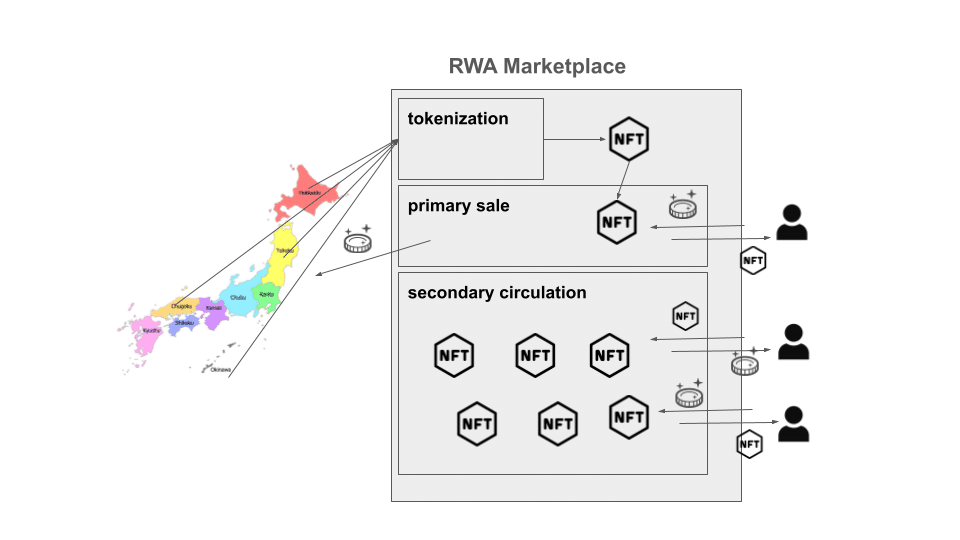
Our goal is to create a dedicated marketplace that enables the tokenization, primary sale, and secondary circulation of these RWAs.
Prototype
This project is an RWA (Real World Asset) marketplace focused on addressing the challenges of regional revitalization in Japan. Across Japan's rural areas, many high-quality resources remain underutilized. These include not only tourism and cultural assets, but also a significant amount of tangible real-world assets that have not been effectively leveraged.
ANGO is a company working to solve these challenges by transforming vacant rural homes into guesthouses and offering investment opportunities to the public through RWA NFTs (representing ownership interest), as well as accommodation NFTs (representing stay rights). This approach not only addresses the vacant house problem but also contributes to the revitalization of local economies. Today, ANGO operates guesthouses in several cities across Japan, converted from unused housing stock.
Click here to view details:
https://drive.google.com/file/d/1e1i477mMtW3YT04PCqKOSk12lNmw81LR/view?usp=sharing
However, ANGO has identified a major challenge: the liquidity of RWA NFTs remains limited. This lack of liquidity restricts broader user participation and hinders business expansion. To address this issue, we propose the creation of a dedicated RWA NFT marketplace focused on regional revitalization.
This marketplace will support the tokenization and sale of RWAs, offering both a secure and stable backend infrastructure and a user-friendly frontend interface. Through a structured process, real-world assets can be tokenized into NFTs on the (Cardano) blockchain. These NFTs will be tradable on-chain, promoting liquidity for RWA tokens, attracting a broader base of participants, and enabling the scaling of operations.
Value of prototypes
Rediscovery of the Value of Idle Assets
The most direct value of this project lies in unlocking the potential of underutilized assets. By tokenizing and circulating these assets, we significantly increase their utilization and liquidity, turning previously dormant resources into productive ones.
Creation of New Job Opportunities
As asset utilization increases, so will the demand for local jobs and services. For example, in the case of tokenized guesthouse RWAs, increased guest traffic will lead to new employment opportunities in maintenance, operations, cleaning, and customer service.
Establishment of a New Economic Paradigm
By combining blockchain technology, NFTs, and real-world assets in a decentralized framework, this project introduces an entirely new model for regional revitalization—a model that may serve as a blueprint for solving broader socioeconomic challenges across Japan.
Our approach
This project is to create a dedicated marketplace that enables the tokenization, primary sale, and secondary circulation of these RWAs.This project will help people rediscover the value of Japan’s underutilized regional assets, while providing more diverse and accessible investment opportunities. For local communities, it offers new resources to support regional revitalization.
By leveraging Cardano’s blockchain, we can facilitate the low-cost, secure, and fast transactions of RWA NFTs, significantly increasing market activity and attracting investment from around the world.
The project will begin with ANGO’s own vacation rental NFTs, and progressively expand to include a wider variety of RWAs, while encouraging more asset holders to participate in the marketplace.
Engagement
Our engagement strategy focuses on connecting three key stakeholder groups to drive adoption and impact:
Individual Investors and Web3 Users
We will engage retail investors by offering unique and tangible RWA investment opportunities—such as real estate, traditional inns, and regional food producers—through the ANGO RWA Marketplace. These assets will be purchasable using ADA, giving Cardano users new utility and value from their holdings.
Regional Asset Holders and Local Communities
Through our parent company RECIKA’s existing partnerships with local governments and tourism operators, and ANGO’s track record in converting vacant houses into guesthouses, we will onboard RWA holders who seek to tokenize and revitalize underutilized regional assets. We aim to build a feedback loop between communities and users via NFT-based DAO participation.
Cardano Community and Builders
We plan to work closely with the Cardano community by releasing updates, demo videos, and opening our MVP for testing. We will share our use case within DAO communities, NFT forums, and governance-focused groups—especially those interested in social impact and real-world adoption. We also hope to collaborate with other Catalyst-funded projects focused on infrastructure, payment integration, or RWA.
By starting with ANGO’s own vacation rental assets and gradually expanding the range of tokenized RWAs, we aim to foster a highly engaged, cross-sector community around Web3-driven regional revitalization.
Specificity
This project is the first attempt on Cardano to build a marketplace that enables the tokenization and circulation of real-world assets from regional Japan, with the goal of contributing to regional revitalization.
Importance to Cardano
If this project succeeds, Cardano will benefit in the following ways:
More investment opportunities will support payments using ADA, expanding its utility beyond traditional crypto use cases.
A wider variety of real-world services—such as accommodations, local products, and experiences—will become available for ADA payments.
The Cardano community will grow, as more individuals, investors, and regional stakeholders become involved through practical use cases.
Cardano’s reputation in Japan, especially among local governments and public institutions, will improve as it demonstrates real contributions to regional revitalization
[Your Project and Solution] Impact
Please define the positive impact your project will have on the wider Cardano community
(https://drive.google.com/file/d/1DWiequrJPxItjX37WVofGVyLJVCc6She/view?usp=sharing))
Setting KPIs (Key Performance Indicators)
To assess progress and achievements as an MVP, three KPIs are set as short-term targets.
- Mint 50+ RWA NFTs
- Achieve 200+ on-chain transactions
- Onboard at least 100 unique ADA-paying users
- Engage 3+ local governments or tourism organizations
- Launch 3 different RWA asset types
- Generate 300+ views on demo and educational videos
- Record 10+ real-world uses of RWA NFTs (e.g., stays, bookings, exchanges)
Expected Impacts
This project is expected to generate meaningful impact in both the Cardano ecosystem and the broader Japanese society:
- Increased real-world utility of ADA:By enabling the purchase and trading of real-world assets—such as renovated guesthouses, idle farmland, and regional food factories—using ADA, the project will expand Cardano’s role as a medium of exchange in tangible, real-life use cases.
- Boost in on-chain activity and adoption:The marketplace will drive NFT minting, ownership transfers, and on-chain transactions, contributing to measurable growth in Cardano’s transactional volume and wallet activity.
- Support for Japan’s regional revitalization:By unlocking the value of idle regional assets and improving their liquidity, the platform contributes directly to solving long-standing challenges around rural economic decline, depopulation, and asset underutilization.
- **New investment opportunities for the global community: **Individuals from around the world, including both existing and new Cardano users, will gain access to unique, culturally rich, and socially impactful investment options through RWA NFTs.
- **Greater public and institutional awareness of Cardano in Japan: **The project’s engagement with local governments and public stakeholders may open the door to Cardano being recognized as a trusted infrastructure for social and economic innovation.
- **A replicable model for global Web3 × RWA × local development: **If successful, this project could serve as a model for combining blockchain technology with regional development efforts in other countries facing similar issues.
Building a cooperation structure
The ANGO Marketplace is expected to generate direct impact on four key stakeholder groups:
- **Individual investors: **The potential buyers of RWA NFTs may come from all over the world. They may include both existing members of the Cardano community and new users who are drawn to Cardano through the practical utility and real-world impact of this project.
- **Travelers: **Service users play a vital role in this model. Their participation directly increases the utilization rate of idle resources and transforms those assets into tangible economic value.
- **Businesses: **As the initiator of this project, our company will also benefit from increased liquidity of our own RWA NFTs through the marketplace.
- **Local governments: **Local governments will directly benefit from the implementation of this project, as it contributes to regional revitalization. They are also considered potential external partners in the initiative.
For these four types of participants, we expect the ANGO Marketplace to bring positive contributions to the broader Cardano ecosystem in the following ways:
First, the project itself will scale rapidly, enabling the renovation of more vacant houses into guesthouses.
Since ADA payments have already been integrated into ANGO’s operations during Fund12, the expansion of the project will broaden the scope of ADA usability, allowing ADA to be used in more real-world settings.
This utility growth will help support the value of ADA by increasing real-world demand and transactional usage.
Second, ADA holders—particularly individual investors—will gain access to more diverse investment opportunities.
Investing in RWA NFTs representing real estate in Japan’s culturally and scenically rich regions is not only financially promising, but also highly appealing for its tangible connection to local experiences and tourism.
Third, through increased interaction with travelers and collaboration with local governments, Cardano’s visibility and influence will expand significantly within and beyond the blockchain community.
In particular, engagement with municipal governments may open pathways for official recognition of Cardano in Japan.
Currently, regional revitalization efforts in Japan are largely driven through traditional means.
Introducing a Web3 × Regional Revitalization model could serve as a major turning point and create widespread social and policy-level impact within the country.
[Your Project and Solution] Capabilities & Feasibility
What is your capability to deliver your project with high levels of trust and accountability? How do you intend to validate if your approach is feasible?
(https://drive.google.com/file/d/1T0ldQCAvufSamplaOIqBEQpECVGVJYB2/view?usp=sharing))
ANGO initially launched its RWA and accommodation NFT purchase services on Ethereum, and in Fund12, successfully implemented these services on the Cardano blockchain as well. Currently, ANGO’s native NFTs support both ETH and ADA payments.
Years of experience in Web3 development ensure a reliable foundation for this project. Therefore, we are confident in our ability to successfully build a secure, stable, and user-friendly RWA NFT Marketplace.
Furthermore, ANGO has been adopted as an official tool by the DAO Association of Japan, and is one of the very few DAO projects in Japan legally permitted to operate as a limited liability company (LLC). It has accumulated proven cases of projects that combine RWA utilization and DAO-based governance.
The ANGO technical team has extensive experience in the development and operation of Web3 projects.In addition to the solutions already implemented under ANGO, the team has also contributed to several related initiatives, including UNICASK (https://unicask.jp/en/)) and DigitalMe. Among them, UNICASK is Japan’s pioneering and most prominent whisky-cask investment NFT project, which has garnered significant public attention and media coverage.
Our extensive experience and track record demonstrate that this project is highly feasible, credible, and transparent.
As a result, the team is highly committed, and the project itself has already gained a high level of trust and recognition within the Web3 and broader public sectors.
[Milestones] Project Milestones
Milestone Title
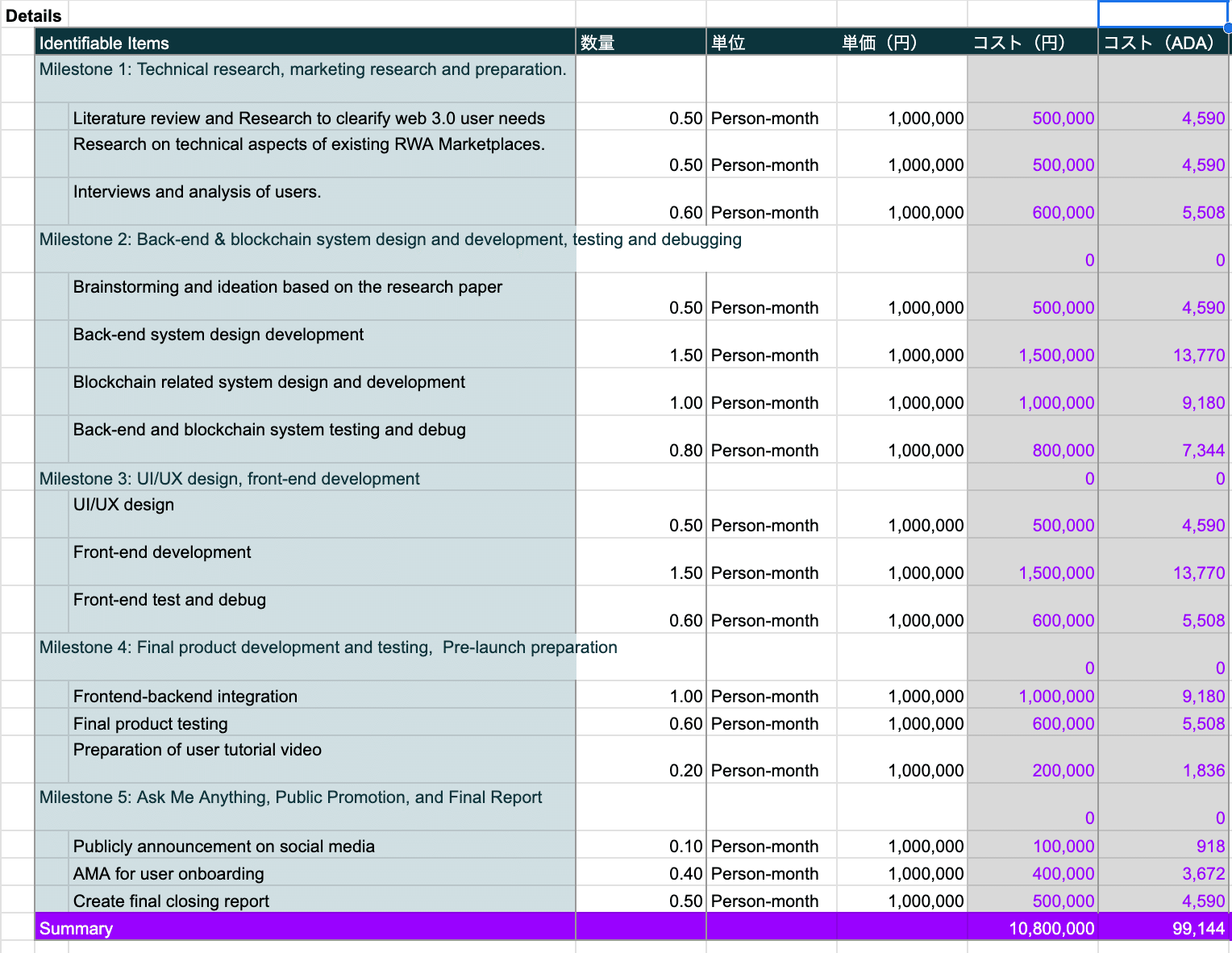
Technical research, marketing research and preparation.
Milestone Outputs
Milestone 1 includes the following key activities. Milestone 1 focuses on research on how to engage web3.0 international users
- Literature review on the issue and Research on international web 3.0 user needs.
- Research on technical aspects of existing RWA Marketplaces.
- Interviews and analysis of users.
Prepare a technical research paper and a marketing paper summarizing the results of the above research.
Acceptance Criteria
Finalize the market and technical research papers, publish them on Google Docs and share them with the Catalyst Challenge reviewers.
- research paper based on desktop research of user needs for web3 users
- technical research result report
- interview report of users and final user needs design
Evidence of Completion
Reviewers will have access to the market and technical research reports and will be able to
- link to research paper based on desktop research of user needs for web3 users
- link to technical research result report
- link to interview report of users and final user needs report
Delivery Month
1
Cost
14688
Progress
20 %
Milestone Title
Back-end & blockchain system design and development, testing and debugging
Milestone Outputs
Milestone 2 will include the following key activities
- Brainstorming and ideation based on the research paper
- Back-end system design development
- Blockchain related system design and development
- Back-end and blockchain system testing and debug
Acceptance Criteria
Provide Catalyst Challenge reviewers have access to the following documentation
- Back-end system design and development documentation
- Blockchain related system design and development documentation
- Back end and blockchain testing report
- Back end and blockchain bug fix report
Evidence of Completion
- Back-end system design and development documentation is completed and shared to reviewers
- Blockchain related system design and development documentation is completed and shared to reviewers
- Back end and blockchain scenario testing report and all tests passed. Reviewers can access the report.
- Back end and blockchain bug fix report and all reported bugs fixed. Reviewers can access the report.
Delivery Month
4
Cost
34884
Progress
50 %
Milestone Title
UI/UX design, front-end development
Milestone Outputs
[A: Milestone outputs]
The criteria are shown below. There are three main criteria, with front-end development being the main one.
- UI/UX design
- Front-end development
- Front-end test and debug
Acceptance Criteria
[B: Acceptance criteria]
- UI/UX design documentation is completed
- Verify proper display and responsiveness of frontend layout
- Front-end development code is shared to reviewer
- Demo video of the frontend interface
Evidence of Completion
[C: Evidence of milestone completion].
- Reviewers can access the development report
- Reviewers can access the testing and debug report
- Frontend demo video publicly accessible for reviewers verification (YouTube)
Delivery Month
7
Cost
23868
Progress
70 %
Milestone Title
Final product development and testing, Pre-launch preparation
Milestone Outputs
Complete final FE/BE integration and make the end-to-end flows for RWA tokenization (mint), primary listing, and secondary trading (buy/sell/transfer) run stably in a staging environment. Implement wallet connections (Lace/Nami), ADA payments, fee computation, rollback on failure, and reconciliation of inventory/executions. Provide an admin UI for asset registration, order management, and audit logs. Produce three user tutorial videos (wallet setup, buy, list; 3–5 min each) and prepare for publication.
Acceptance Criteria
(1) All 10 E2E scenarios (mint/list/buy/cancel/refund/transfer, etc.) pass; (2) 0 critical defects and ≤3 major open issues; (3) ≥30 verifiable testnet transactions on staging (10 mint, 10 list, 10 buy); (4) wallet connection success rate ≥98%; (5) three tutorial videos completed with scripts, captions, and thumbnails; (6) reviewers can access the specification, test report, and demo environment.
Evidence of Completion
Provide: staging URL and credentials; links to demo videos for key flows; a complete test-case matrix with results; list of closed issues; hash list of testnet mints/listings/purchases; sample audit logs exported from the admin UI; unlisted links to the three tutorial videos with scripts and subtitle files—so that third parties can independently verify completion.
Delivery Month
9
Cost
16524
Progress
90 %
Milestone Title
AMA (Ask Me Anything) and public promotion
Milestone Outputs
The final milestone includes the following key activities
- The launch of the final product will be publicly announced on social media platforms, including X (formerly Twitter).
- AMA for user onboarding
- Create final closing report
Acceptance Criteria
The following items are made available to the reviewer for review
- Reviewers will be able to access the Poster on X
- AMA(on X space) for user onboarding and recorded
- Final closing report publicly available
Evidence of Completion
Share a public, time-stamped recording link to the user-onboarding AMA hosted on X Spaces, including the event URL, date/time, speaker handles, attendee count, and a brief Q&A summary. Provide a link to the final closing report (PDF/Doc) detailing delivered features, verified on-chain transactions, users onboarded, SBTs issued, budget vs. actuals, known limitations, and next-step recommendations. Include links to the release tag and the demo environment used in the AMA.
Delivery Month
10
Cost
9180
Progress
100 %
[Final Pitch] Budget & Costs
Please provide a cost breakdown of the proposed work and resources
(https://drive.google.com/file/d/1ODa91s-71QIskIoMIyIpafG7Hd4wPZGn/view?usp=sharing))
Milestone 1
Estimated timeline for delivery: 1st month
Cost: 14,688 ADA ( $ 10,880 )
Completion rate: 14.81%
Milestone 2
Estimated delivery date: 4th month.
Cost: 34,884 ADA ( $ 25,840 )
Completion rate: 50%.
Milestone 3
Estimated delivery date: 7th month.
Cost: 23,868 ADA ( $ 17,680 )
Completion rate: 74.07%.
Milestone 4
Timeline for delivery: 9th month
Cost: 16,524 ADA ( $ 12,240 )
Completion rate: 90.74%
Milestone 5(final)
Estimated timeline for delivery: 10th month.
Cost: 9,180 ADA( $ 6,800 )
Completion rate: 100%
[Final Pitch] Value for Money
How does the cost of the project represent value for the Cardano ecosystem?
(https://drive.google.com/file/d/1FpZo8C2ub5dbI4JqVtZFmfP04SagqcMg/view?usp=sharing))
The proposed budget is both cost-effective and high-impact, offering strong value for the Cardano ecosystem across several dimensions:
High ROI in On-Chain Activity
This project will generate significant on-chain transactions, including NFT minting, asset transfers, and ADA-based payments. Even in the MVP stage, with only 10 tokenized properties, we expect to generate at least $1.3 million USD in total value locked (TVL). Long term, this number could exceed $55 million, representing more than 650× the requested funding.
Real-World Utility for ADA
By enabling ADA to be used for purchasing real-world assets such as guesthouses, farmland, or local specialty goods, we expand ADA’s role beyond DeFi and speculation into real economic use cases.
User and Community Growth
The platform will attract both new and existing users, including global investors and Japanese residents, by offering tangible investment opportunities. In the long term, we estimate up to 3 million users may interact with the platform, creating 6+ million on-chain transactions.
Low-Cost Development by a Proven Team
The ANGO technical team has already delivered Web3 projects (e.g., UNICASK, DigitalMe), and has successfully implemented both Ethereum and Cardano-based versions of RWA NFTs. This means we can deliver high-quality results with a very efficient use of funds.
Social and Institutional Impact
The project is aligned with Japan’s Regional Revitalization 2.0 policy, which explicitly references the use of NFTs. This gives Cardano the opportunity to be recognized not just as a crypto platform, but as a nationally relevant infrastructure. The project also has support from local governments and communities.
Scalability and Reusability
The marketplace we build for RWA tokenization can be reused by other asset holders and local initiatives, allowing future Catalyst proposals and developers to build on top of our work without repeating foundational costs.
In summary, the requested funding will not only deliver a working MVP but also lay the foundation for real-world adoption of Cardano in one of the most institutionally conservative yet economically significant markets: Japan. The return—measured in TVL, on-chain activity, ADA use, and social impact—far outweighs the initial investment.
[Required Acknowledgements] Consent & Confirmation
Terms and Conditions:
Yes
Team
Chris DAI
Blockchain evangelist and co-founder and CEO of Japanese blockchain companies. Pioneered redeemable physical asset NFTs and successfully completed several NFTs sales. Focuses on inventing decentralized businesses in the non-financial sector utilizing blockchain technology. Deeply attracted to the decentralized model and its business, social and philosophical aspects. Advisor to Japan Blockchain Association, Committee member of the Investigation of Blockchain Utilization of Authentication Information of Japanese Positioning Satellites, and Research Institute of Economy, Trade, and Industry Blockchain research team member.
Co-authored (2019) Next Blockchain: Ecosystem for Next Generation Industries. Nikkei Business Publications and (2020). Blockchain and Crypto Currency. Springer.
Yi Liu
CTO of Recika. Seasoned blockchain product manager. Lead system development for UniCask and ANGO.
Possesses over 10 years of experience in system development at a major securities company, with deep knowledge in software engineering and project management. Completed a Master's degree in Engineering at Nagoya University.
Kento Honda
Joined RECIKA at the end of 2021 and became Business manager of UniCask in 2022.
He was responsible for the planning, design, sales and marketing of the world's first small batch whisky cask NFT.
As a result, the $40 million barrel sold out in nine minutes. He then sold the NFT in collaboration with seven IPs, and was also in charge of planning, coordination with various parties and marketing here.
In addition, as a POC for Livesola (a service that visualizes fan behavior and contributions in the form of NFTs and tokens), we organized a three-hour live broadcast using a TV station's studio.
He has also participated in other consulting teams for major automotive companies, and has experience in coordinating projects mainly using NFTs with a wide variety of stakeholders.
He has also been involved in ANGO since 2023. Currently, he is working with engineers on the development required to raise funds using NFTs in a limited liability company type DAO from new property development.
KOKO
Master of Science in Science from Tokyo Institute of Technology. Currently enrolled in the doctoral program at Institute of Science Tokyo. Research topics include decision-making within DAOs, tokenomics, and cryptocurrencies. Joined Recika in 2022, primarily responsible for DAO model design, tokenomics design, and simulations. Has a deep understanding of the philosophy, technologies, and applications of Web3.