Last updated 10 months ago
[BLAB] AI-Powered Stake Pool Optimization Cardano Phase 1
Problem
Explorers show static data. SPOs lack fee/forecast tools; delegators overwhelmed by info → stake centralization risk.
Solution
CardanoStake adds AI-driven simulation, forecasting & pool recommendations, with open APIs and CIP-30 wallet actions.
Total to date
This is the total amount allocated to [BLAB] AI-Powered Stake Pool Optimization Cardano Phase 1.
About this idea
[Proposal setup] Proposal title
Please provide your proposal title
[BLAB] AI-Powered Stake Pool Optimization Cardano Phase 1
[Proposal Summary] Budget Information
Enter the amount of funding you are requesting in ADA
60895
[Proposal Summary] Time
Please specify how many months you expect your project to last
7
[Proposal Summary] Translation Information
Please indicate if your proposal has been auto-translated
No
Original Language
en
[Proposal Summary] Problem Statement
What is the problem you want to solve?
Explorers show static data. SPOs lack fee/forecast tools; delegators overwhelmed by info → stake centralization risk.
[Proposal Summary] Supporting Documentation
Supporting links
[Proposal Summary] Project Dependencies
Does your project have any dependencies on other organizations, technical or otherwise?
No
Describe any dependencies or write 'No dependencies'
No dependencies
[Proposal Summary] Project Open Source
Will your project's outputs be fully open source?
Yes
License and Additional Information
During Milestone 1, the repository will remain private to allow feature completion and security review. Access can be granted to Catalyst reviewers for audit. Starting from Milestone 2 (MVP release), selected modules (infra scripts, baseline models) will be made public for community review. By Milestone 4 (pilot completion), the entire codebase will be released on GitHub under Apache-2.0/MIT, with full documentation and deployment scripts.
[Theme Selection] Theme
Please choose the most relevant theme and tag related to the outcomes of your proposal.
AI
[Campaign Category] Category Questions
Describe what makes your idea innovative compared to what has been previously funded (whether by you or others).
AI-powered forecasting and simulation go beyond static explorers. Unlike past funded tools, CardanoStake combines:
- ML predictions of ROS & pool trends (not just past data).
- SPO fee/saturation simulators with competition impact.
- Delegator recommendations tailored to goals, not fixed ranks.
- UTXO-aware modeling for higher accuracy.
- Dual focus: serving SPOs & delegators, enhancing decentralization.
Describe what your prototype or MVP will demonstrate, and where it can be accessed.
The Phase 1 MVP will demonstrate:
- AI dashboard with performance forecasts, fee simulations, competitive analysis.
- Delegator guidance via predicted pool recommendations.
- SPO tools: fee calculator, ROS simulator, performance tracker.
- Wallet integration (CIP-30): in-platform delegation.
- Public APIs: third parties access prediction data.
- Testnet deployment with selected SPOs/delegators.
- Accessible at cardanostake.io (testnet) with open-source repo published progressively.
Describe realistic measures of success, ideally with on-chain metrics.
- Quantitative: ≥15 SPOs & ≥100 delegators; ROS t+1 forecast ≥10% lower RMSE/MAE vs baselines; uptime ≥99%, API p95<2s; cohort HHI/Gini ↓, no stake↑>1% to top-10 pools.
- Qualitative: ≥70% users report higher confidence; ≥2 public case studies.
- Why it matters: SPOs gain smarter fee tools, delegators get transparent choices, ecosystem moves toward stronger decentralization.
[Your Project and Solution] Solution
Please describe your proposed solution and how it addresses the problem
CardanoStake is an AI-powered platform helping SPOs optimize fee strategies and delegators make transparent, data-driven choices. Phase 1 delivers a testnet MVP with 15+ SPOs and 100+ delegators.
How we address the problem:
- For SPOs: AI-powered fee simulators, performance dashboards, competitor benchmarking.
- For Delegators: ML-driven pool recommendations based on predicted ROS, reliability, and saturation.
- Platform: Processes historical chain data (ROS, pledge, blocks, fees) to detect trends and forecast outcomes.
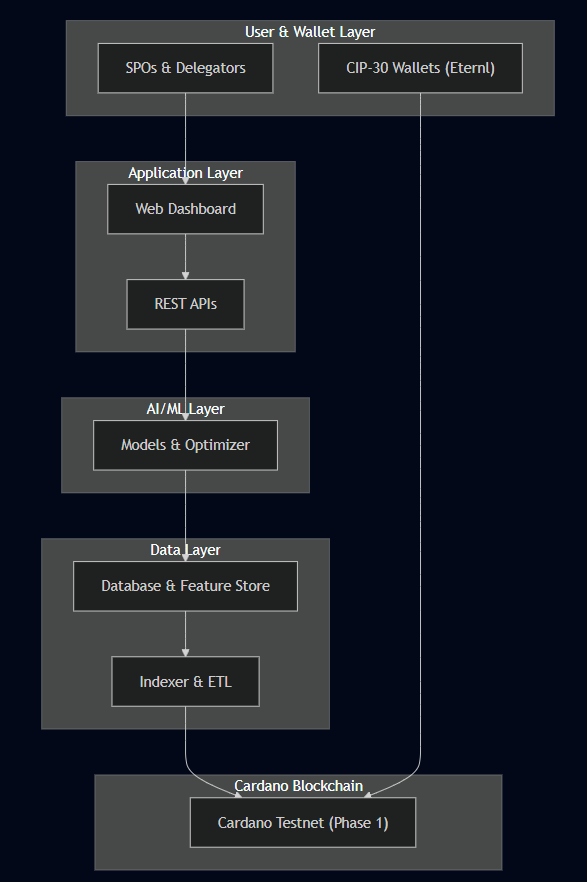
_ Image 1. Overview_
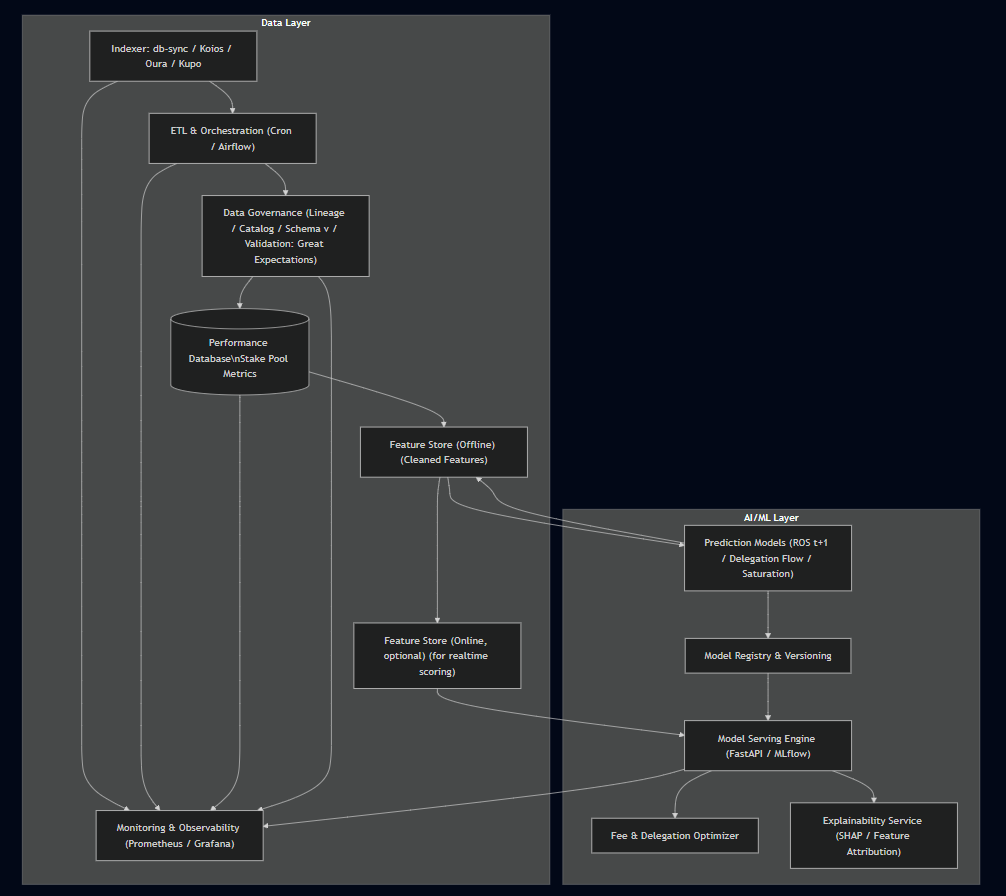
_ Image 2. Data & AI/ML Layer_
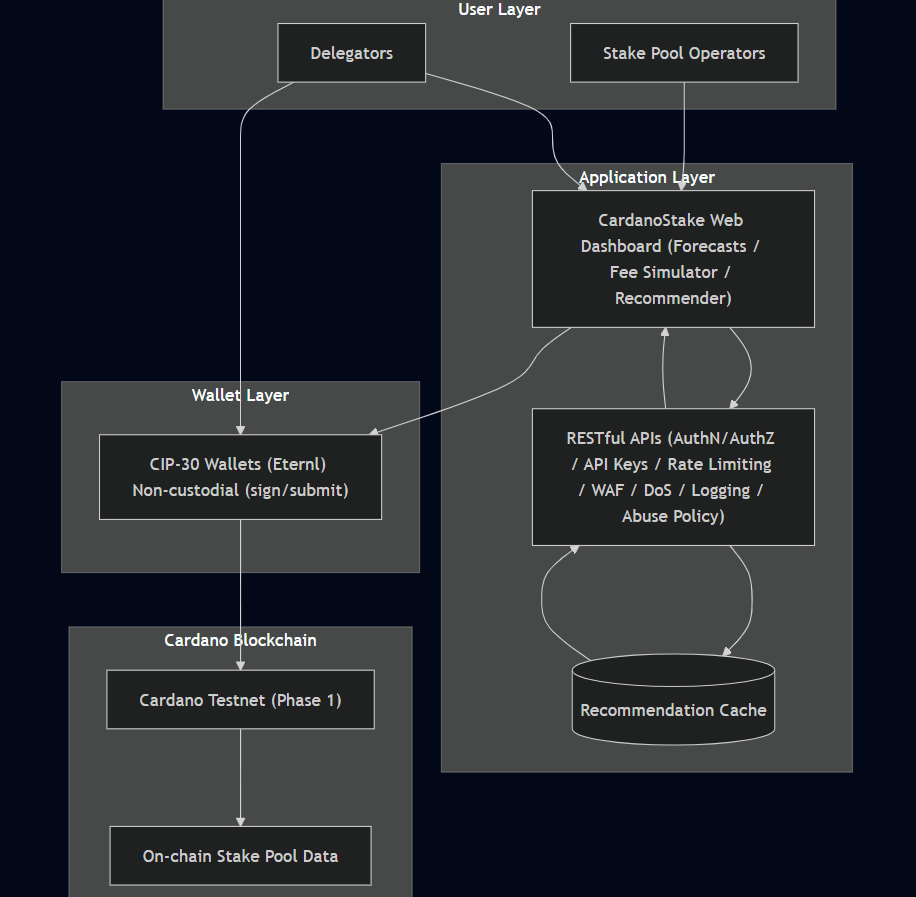
_ Image 3. User, Wallet & Application Layer_
Why this approach:
Current explorers (Adapools, PoolTool) provide static statistics but lack predictive insights. ML enables dynamic forecasting; UTXO-aware modeling allows more precise fee/pledge simulations. Phase 1 MVP + pilot validate measurable value before scaling.
Who we will engage:
- Primary Users: 15+ SPOs (from 3,000+ active), 100+ delegators (from 100k ADA holders).
- Secondary Stakeholders: Cardano Foundation (decentralization), researchers (open datasets), developers (APIs).
What is unique about your solution?
- AI-First Predictions: ROS forecasts beyond static dashboards.
- UTXO-Aware Optimization: Improves precision of fee and saturation simulations.
- Dual-Sided Platform: Serving both SPOs and delegators.
- Open Predictive Analytics: Forecast error metrics (RMSE, MAE, sMAPE) published publicly, showing ≥10% reduction vs baselines.
Why this is important to Cardano:
- For SPOs: Smarter fee structures, fairer competition.
- For Delegators: Clearer pool comparisons and data-driven delegation choices.
- For New SPOs: Lower entry barriers via guidance tools.
- Ecosystem Benefits: Potential to support decentralization, improve efficiency, and enhance engagement; demonstrating AI-driven differentiation from other L1s.
[Your Project and Solution] Impact
Please define the positive impact your project will have on the wider Cardano community
Validate that AI-powered optimization improves stake pool performance and delegation outcomes. Through an MVP + pilot (15 SPOs, 100 delegators), we will demonstrate measurable efficiency and UX gains, forming the basis for wider adoption.
How Success Brings Value to Cardano Community:
- Enhanced Cohort Efficiency: Pilot SPOs evaluated for reward variance reduction and ROS stability, rather than fixed % gains.
- Improved Decentralization (Phase 1 Proxy): AI-guided delegation measured at cohort-level HHI and Gini, with guardrails to prevent increased stake concentration in top pools.
- Enhanced User Experience: ≥70% of delegators report reduced “choice paralysis” and improved confidence.
- Ecosystem Growth (Future Potential): MVP adoption encourages broader SPO and delegator participation; APIs remain open for developers and researchers.
How We Measure This Impact:
- Adoption: ≥15 SPOs and ≥100 delegators actively participating in pilot.
- Forecasting Performance: ≥10% lower RMSE and MAE vs baselines (naïve, seasonal-naïve, EWMA) for ROS t+1 predictions, validated with walk-forward testing and reproducible code.
- System Reliability: ≥99% uptime; API latency p95 <2s across a 14-day observation window.
- Decentralization (Cohort-Level): HHI and Gini decrease within the pilot group; no stake increase >1% to top-10 pools.
- Usage: ≥200 optimization transactions and ≥1,000 pool queries executed during pilot.
- Satisfaction: Average survey score ≥4/5 from SPOs and delegators.
How We Share Outputs and Opportunities:
- Open Access: Free API + platform access for pilot.
- Transparency: Public repo (progressively opened), quarterly reports, blog updates.
- Community Engagement: Monthly calls + active Discord/Telegram feedback loop.
- Knowledge Sharing: Public docs, case studies, and outreach to explorers (Adapools, PoolTool) + academic researchers.
[Your Project and Solution] Capabilities & Feasibility
What is your capability to deliver your project with high levels of trust and accountability? How do you intend to validate if your approach is feasible?
Our team combines hands-on blockchain expertise, practical Cardano development experience, and recognized achievements within the ecosystem. Members participated in early Cardano training programs (Plutus Pioneer, CBCA, Emergo Academy) and have delivered award-winning blockchain prototypes. Our current project builds on this foundation via a multidisciplinary team covering blockchain architecture, backend engineering, full-stack development, and project management.
The LMS - CaUTC project won 2nd prize, student Track at the Cardano Blockchain Hackathon 2025.

Experienced & Diverse Team:
- Blockchain mentors: Stake pool operator, CBCA certified, Plutus Pioneer #4 graduate, with 3+ years node operation and mentoring experience. Currently supporting a pilot with SPOs and delegators on the Cardano testnet.
- **Cardano developers: **Skilled in Plutus and backend integration, with hands-on prototypes in DeFi and staking tools. Responsible for model-serving backend, APIs, and data integration.
- Full-stack developers: Experienced in React, Node.js, and PostgreSQL, delivering end-to-end solutions from data pipelines to web dashboards and wallet (CIP-30) integration.
- Project leadership: Track record in hackathon-winning teams, community building, and coordinating academic–industry blockchain collaborations.
- Academic–industry link: UTC members contribute both research depth and deployment capability, ensuring feasibility of real-world implementation.
Recognized Achievements
- Award-winning solution: LMS–CaUTC earned 2nd Prize, Student Track at the Cardano Blockchain Hackathon 2025.
- Research excellence:
- 1st Prize – Scientific Research Competition (Blockchain).
- 3rd Prize – Scientific Research Competition (Blockchain).
Feasibility & Execution Plan:
- Technical readiness: Team has prior experience operating db-sync/Koios pipelines, building ETL and model serving (MLflow/FastAPI), and integrating CIP-30 on Cardano testnet (no smart contracts in Phase 1).
- Workflow: Agile methodology with milestone-based delivery, GitHub repositories for version control, and transparent progress tracking.
- Pilot-first approach: MVP to be tested with SPOs and delegators on the Cardano testnet for adoption and feedback before scaling.
- Risk mitigation: Governance structure, community feedback loops, and phased validation reduce delivery risks.
Financial Accountability:
- Structured budgeting with clear allocations for development, infrastructure, and community engagement.
- Milestone-based disbursement aligned with Catalyst requirements.
- Open reporting with deliverables shared via GitHub, public dashboards, and quarterly updates.
Commitment to Open-Source & Community Growth:
- Source code, documentation, and deployment guides released publicly on GitHub under open license.
- Insights and results from the pilot shared through workshops, online webinars, and reports.
- Designed for replication in other universities and educational institutions, contributing to global Cardano adoption.
[Milestones] Project Milestones
Milestone Title
Infrastructure & Data Pipeline
Milestone Outputs
- Cardano indexer (db-sync/Koios/Oura) deployed and synced.
- ETL pipeline established (Cron/Airflow) from blockchain → performance database.
- Database schema designed and documented, ≥6 months of pool data loaded.
- Baseline prediction models (moving average, naive, EWMA) implemented in reproducible notebooks.
- OpenAPI 3.1 specification drafted with 5 endpoints.
Acceptance Criteria
- Indexer sync ≥99% of blocks for last 6 months.
- ETL pipeline latency ≤24h (target ≤6h).
- Data consistency Koios vs db-sync ≥95% across sampled metrics (ROS, blocks, fees) with documented sampling method.
- Baseline models reproducible with fixed seed, notebook runs end-to-end.
- OpenAPI 3.1 spec validated with ≥5 queries returning correct responses.
Evidence of Completion
- Private GitHub repo (audit access for Catalyst reviewers); will follow Open-Source Plan for later public release.
- Screenshots/logs of indexer sync and ETL job runs.
- Database schema diagram (ERD) and documentation.
- Test API endpoint with documented sample queries & responses.
- Short demo video showing baseline predictions running.
Delivery Month
2
Cost
13474
Progress
20 %
Milestone Title
AI/ML Development
Milestone Outputs
- ML models trained on historical stake-pool performance.
- Benchmark report comparing baselines (naive, seasonal-naive, EWMA) vs ML (RMSE/MAE, sMAPE).
- Model registry & versioning established (≥2 versions) via MLflow.
- Reproducible Jupyter notebooks (1-click run) for training & evaluation.
- Prototype model serving (FastAPI/MLflow) with early API on testnet + monitoring.
Acceptance Criteria
- We will establish clear baseline benchmarks (naive, seasonal-naive, EWMA) and publish RMSE/MAE results. Our objective is to explore whether ML models can deliver meaningful improvements (targeting around ~10% on average compared to the best baseline). Even if improvement varies across pools, the emphasis will be on transparency and reproducibility of results.
- Forecast horizon clearly defined (epoch+1).
- Benchmark results reproducible using notebooks (1-click run).
- Registry includes ≥2 model versions (seed, hash, metadata).
- API serves valid predictions for ≥100 pools on testnet with p95 latency <2s, p99 <3s, error-rate <1% under ≥10 req/s for ≥10 minutes.
Evidence of Completion
- GitHub repo with ML code, notebooks, and benchmark report (PDF).
- Screenshots/logs of model registry & versioned artifacts.
- Public testnet API endpoint with sample queries/responses.
- Short demo video running the prediction workflow end-to-end.
Delivery Month
2
Cost
16632
Progress
50 %
Milestone Title
Application Layer & Wallet Integration
Milestone Outputs
- Web dashboard (forecast viewer, fee simulator, recommender UI).
- REST API with AuthN/AuthZ, rate-limiting, and logging.
- Wallet integration (CIP-30) enabling delegation to pools on testnet (non-custodial: sign/submit only).
- Documentation & finalized OpenAPI specification.
Acceptance Criteria
- Web dashboard with three features (forecast, fee simulator, recommender).
- REST API meets p95 < 2s, p99 < 3s, error rate < 1% for ≥14 days.
- CIP-30 non-custodial delegation functional on testnet.
- The recommender will include decentralization safeguards:
- a diversification penalty when too much stake is allocated to a single pool,
- a soft-cap threshold per pool to reduce over-concentration, and
- weighted randomization to spread delegations more evenly.
Evidence of Completion
- Live testnet web app demo link.
- GitHub repo with frontend/backend code + API docs.
- Test reports/screenshots of delegation transactions.
- Screenshots/video of UI features (forecasts, recommendations, fee sim).
Delivery Month
2
Cost
17105
Progress
80 %
Milestone Title
Pilot & Evaluation
Milestone Outputs
- Pilot program with ≥15 SPOs and ≥100 delegators.
- User survey results (UX, usefulness, NPS/CSAT).
- Impact report (accuracy, adoption, decentralization effect).
- ≥2 case studies of SPO/delegators using recommendations.
- Full open-source release (models, backend, dashboard) on GitHub.
Acceptance Criteria
- We aim to engage around 15 SPOs and approximately 100 delegators during the pilot. We have already started conversations with community SPOs and will continue outreach through Telegram/Discord channels. In case participation falls short, we will complement pilot data with controlled simulations to ensure impact metrics remain measurable.
- Survey with ≥70% positive responses.
- Impact report with HHI/Gini and decentralization guardrails (top-10 increase ≤1pp, top-1 ≤0.5pp).
- Demonstrated application of recommendation policy (diversification penalty, soft-cap, randomization) with no violation of guardrails.
Evidence of Completion
- Survey results (raw + summary).
- Impact report PDF (published link).
- Case studies uploaded.
- Public GitHub repo with all code & documentation.
- Close-out demo video showing MVP running + pilot feedback.
Delivery Month
1
Cost
13684
Progress
100 %
[Final Pitch] Budget & Costs
Please provide a cost breakdown of the proposed work and resources
Milestone 1: Infrastructure & Data Pipeline
Estimated cost for this phase: 13474 ADA => 22.13%
Milestone 2: AI/ML Development
Estimated cost for this phase: 16632 ADA => 27.31%
Milestone 3: Application Layer & Wallet Integration
Estimated cost for this phase: 17105 ADA => 28.09%
Milestone 4: Pilot & Evaluation
Estimated cost for this phase: 13684 ADA => 22.47%
=> Total Costs: 60895 ADA (~57850 USD)
A comprehensive breakdown of the project's phases and deliverables can be found at:
https://docs.google.com/spreadsheets/d/1UgvG3PRAhMfgZkwWZsch5Bdcr4nSfGu3ew8Rf2erx0c/edit?gid=0#gid=0
[Final Pitch] Value for Money
How does the cost of the project represent value for the Cardano ecosystem?
CardanoStake delivers value for money by addressing a clear gap in the Cardano ecosystem: AI-powered decision support for SPOs and delegators. The project maintains lean development costs while committing to transparent, auditable deliverables.
Cost Justification and Market Rates:
1. Development Team Costs (at Viet Nam): 50 USD/hour (Vietnam-based rates, ~40–60% lower than Western markets).
2. Infrastructure & Tools:
- Hosting & Storage (indexer nodes, database, backups): a modest allocation to cover several months of pilot operation.
- Monitoring & Logging (Prometheus/Grafana, cloud services): a small recurring cost to ensure SLA monitoring and observability.
- Penetration Testing & Independent Security Review: a dedicated budget for a one-time audit during Phase 1.
- Miscellaneous & Contingency (domains, CI/CD, unexpected overheads): a small reserve to handle operational needs.
Value Creation for Cardano Ecosystem:
1. Direct Economic Impact:
- A representative group of SPOs and delegators will be supported with optimization tools. Delegators benefit from more transparent recommendations, reducing decision fatigue. SPOs gain fee simulators and performance insights, lowering trial-and-error costs.
- Delegators benefit from more transparent recommendations, reducing decision fatigue.
- SPOs gain fee simulators and performance insights, lowering trial-and-error costs.
2. Network Efficiency Benefits:
- Better-informed fee setting and delegation choices can support healthier stake distribution. Pilot evaluation will include decentralization metrics (HHI, Gini) to ensure that the recommender does not lead to undue concentration in top pools.
- Pilot measures cohort-level decentralization using HHI and Gini; success = HHI and Gini decrease; guardrail: pilot stake share to network top-10 pools does not increase by >1.0pp (top-1 ≤0.5pp).
3. User Experience Enhancement:
- Delegators are expected to report improved decision confidence based on surveys. SPOs will access easier-to-use management tools, and delegators will face reduced choice paralysis in pool selection.
- SPOs access easier-to-use management tools.
- Reduced choice paralysis in pool selection.
4. Ecosystem Growth:
- Introduces an AI/ML-driven decision-support tool for Cardano.
- Open APIs to encourage third-party developers.
- Anonymized research datasets made available per the Open-Source Plan.
Return on Investment Analysis:
1. Immediate Returns:
- MVP will be accessible on testnet by Milestone 2. The pilot will involve active participation from a community group of SPOs and delegators, complemented with simulations if needed. A public benchmark report will show ML performance compared to baselines.
- Active use by ≥15 SPOs and ≥100 delegators in pilot.
- Public benchmark report showing ML performance vs baseline.
2. Long-term Value:
- Path to expand adoption beyond pilot group.
- Potential premium/API services for sustainability.
- Strengthened competitive positioning of Cardano through AI-driven infrastructure.
Cost Efficiency and Market Comparison:
- Comparable AI/blockchain optimization efforts often exceed 80k USD in Western markets; our lean approach keeps costs lower.
- Open-source and cloud-native stack minimizes licensing and infrastructure costs.
Risk Mitigation
- Phased milestones with measurable deliverables reduce execution risk.
- Early pilot and community feedback allow course correction.
- Transparent reporting (quarterly updates, public repos) ensures accountability.
Supporting Evidence
- Market Research: existing explorers focus on descriptive stats; limited predictive decision-support is available.
- Team Credentials: Plutus Pioneer, CBCA, and applied AI/ML experience on Cardano.
- Community Validation: demand from SPO/delegator community confirmed via surveys and user interviews.
Sustainability and Long-Term Value
- Revenue Generation: optional premium features, developer API subscriptions, enterprise SPO packages.
- Ecosystem Contribution: open-source release of infrastructure and models, public datasets for research.
- Knowledge Transfer: documentation, best practices, and case studies to support the broader Cardano community.
[Required Acknowledgements] Consent & Confirmation
Terms and Conditions:
Yes
Team
Project Team & Roles:
1. Cao Xuan Truong
Bio: Stake Pool Owner
Cardano Foundation's CBCA completion certificate
Participated in several training programs including the Haskell Course, Plutus Pioneer Program #4 (IOG Academy), Emergo Academy Cardano Haskell MOOC.
Role in this project: Community Administrator, Mentor/Supporter
Contact:
- Email: truongxuanc@gmail.com
- Telegram: t.me/truongcx
- Github: https://github.com/truongcaoxuan
2. Dao Manh Tung - Full-stack & Blockchain Developer
Bio:
- University of Transport and Communications
- Full-stack & blockchain Developer
- 2nd Place – Student Track, Cardano Hackathon 2025
- 3rd Place – Scientific Research Competition: Decentralized LMS with Blockchain-based Certificates on Cardano
- Experience in developing Dapps and writing smart contracts with Aiken and Move language.
- Proficient in Python for AI/ML model.
Contact:
- Email: daomanhtung4102003@gmail.com
- Telegram: @daomanhtung041104
- Facebook: https://www.facebook.com/daomanhtung111003"
3. Phan Dinh Nghia - Full-stack Developer
Bio:
- Final-year student, University of Transport and Communications
- Full-stack Developer (Frontend & Backend)
- 2nd Place – Student Track, Cardano Hackathon 2025
- 3rd Place – Scientific Research Competition: Decentralized LMS with Blockchain-based Certificates on Cardano
- Experienced with Aiken (Cardano smart contract language) and Move (Aptos smart contract language)
Contact:
- Email: nghiaphan04dev@gmail.com
- Telegram:tele.me/nghia0415
- Facebook: https://www.facebook.com/dinhnghia.phan.524?locale=vi_VN"