Last updated 11 months ago
M9 privacy voting app - Privacy DAO for Cardano native asset
Problem
- DAO voting tools mostly target public chains (EVM, Cardano)
- Lack true anonymity, votes remain traceable
- Public data can bias governance
- No standard secure, privacy-focused UI/UX
Solution
Building a dedicated anonymous DAO voting (MVP) dApp that fully leverages Midnight — Cardano’s zero-knowledge (ZK) layer — to overcome current privacy limitations on the Cardano main chain.
Total to date
This is the total amount allocated to M9 privacy voting app - Privacy DAO for Cardano native asset.
About this idea
[Proposal setup] Proposal title
Please provide your proposal title
M9 privacy voting app - Privacy DAO for Cardano native asset
[Proposal Summary] Budget Information
Enter the amount of funding you are requesting in ADA
89161
[Proposal Summary] Time
Please specify how many months you expect your project to last
7
[Proposal Summary] Translation Information
Please indicate if your proposal has been auto-translated
No
Original Language
en
[Proposal Summary] Problem Statement
What is the problem you want to solve?
- DAO voting tools mostly target public chains (EVM, Cardano)
- Lack true anonymity, votes remain traceable
- Public data can bias governance
- No standard secure, privacy-focused UI/UX
[Proposal Summary] Supporting Documentation
Supporting links
[Proposal Summary] Project Dependencies
Does your project have any dependencies on other organizations, technical or otherwise?
No
Describe any dependencies or write 'No dependencies'
No dependencies
[Proposal Summary] Project Open Source
Will your project's outputs be fully open source?
Yes
License and Additional Information
Apache 2.0
[Theme Selection] Theme
Please choose the most relevant theme and tag related to the outcomes of your proposal.
DAO
[Campaign Category] Category Questions
Describe what makes your idea innovative compared to what has been previously funded (whether by you or others).
Our project delivers the first fully anonymous DAO voting dApp built on both Cardano and Midnight (Cardano’s ZK Layer), enabling zero identity traceability via ZK-based commit–reveal voting. While existing DAO platforms on EVM and Cardano native chains reveal wallet addresses and voting actions, our solution ensures complete unlinkability. It combines a privacy-by-default UX with seamless integration to Cardano wallets, setting a new usability and privacy benchmark for DAO governance within the Cardano ecosystem.
Describe what your prototype or MVP will demonstrate, and where it can be accessed.
The MVP will showcase a complete DAO voting workflow connected to Cardano testnet via Midnight:
- DAO creation and proposal submission
- Commit–reveal voting using ZK proofs for anonymity
- Result display without exposing individual votes
- Wallet authentication (CIP-30) without revealing addresses
- The prototype will be publicly accessible as a web dApp running on the Midnight testnet, with its source code fully open-sourced on GitHub under the Apache 2.0 license.
Describe realistic measures of success, ideally with on-chain metrics.
- Technical: All votes on the Midnight testnet are validated with ZK-proofs and fully integrated with Cardano’s blockchain layer.
- Adoption: The solution is tested and adopted by active DAOs or any Cardano native assets in the Cardano ecosystem.
- Performance: Voting and verification processes run smoothly with responsive UX.
- Open-source impact: The GitHub repository becomes a reference point for other privacy-first DAO projects in Cardano.
- Governance quality: Demonstrated reduction of public influence on voter decisions compared to existing transparent voting models.
[Your Project and Solution] Solution
Please describe your proposed solution and how it addresses the problem
Problem
Implementing a fully anonymous, zero-knowledge-based voting system on Cardano presents significant technical challenges, due to the network’s current tooling, privacy limitations on public layer, and lack of standardized ZK integration.
In most DAOs today, voting is public, making it vulnerable to community pressure, intimidation, and “trend voting” behavior. Moreover, no existing voting tool truly incorporates zero-knowledge (ZK) privacy at the end-user level.
Current Challenges:
- DAO voting platforms are primarily designed for public blockchains (EVM, Cardano native)
- Lack of genuine anonymity — wallet addresses and voting actions remain traceable
- Publicly exposed voting data can negatively influence long-term governance decisions
- No standardized UI/UX for secure, privacy-preserving voting
Identified Needs:
- An end-to-end anonymous voting mechanism
- A clear, intuitive interface accessible to non-technical users
- Role-based support for core DAO participants (proposal creators, voters, observers)
Solutions
We propose building a dedicated anonymous DAO voting frontend dApp that fully leverages Midnight — Cardano’s zero-knowledge (ZK) layer — to overcome current privacy limitations on the Cardano main chain.
By combining ZK proofs with an intuitive, role-based interface, the solution will deliver genuine end-to-end anonymity without compromising usability or governance transparency.
Key Features:
- Clean, modern, and responsive user interface optimized for both desktop and mobile
- DAO and proposal creation workflows with ZK metadata handling
- Voting via commit–reveal or ZK-SNARK mechanisms
- Result display without exposing individual votes or wallet addresses
- User authentication without wallet address disclosure, using session keys and ZK verification
- Full compatibility with Cardano wallets while ensuring all voting actions remain private
Primary Roles Supported:
- Project Initiator – Creates DAOs and opens voting sessions
- Proposal Creator – Submits proposals to the DAO
- Voter – Casts votes anonymously with ZK proofs
- Observer – Monitors and verifies the voting process without access to individual votes
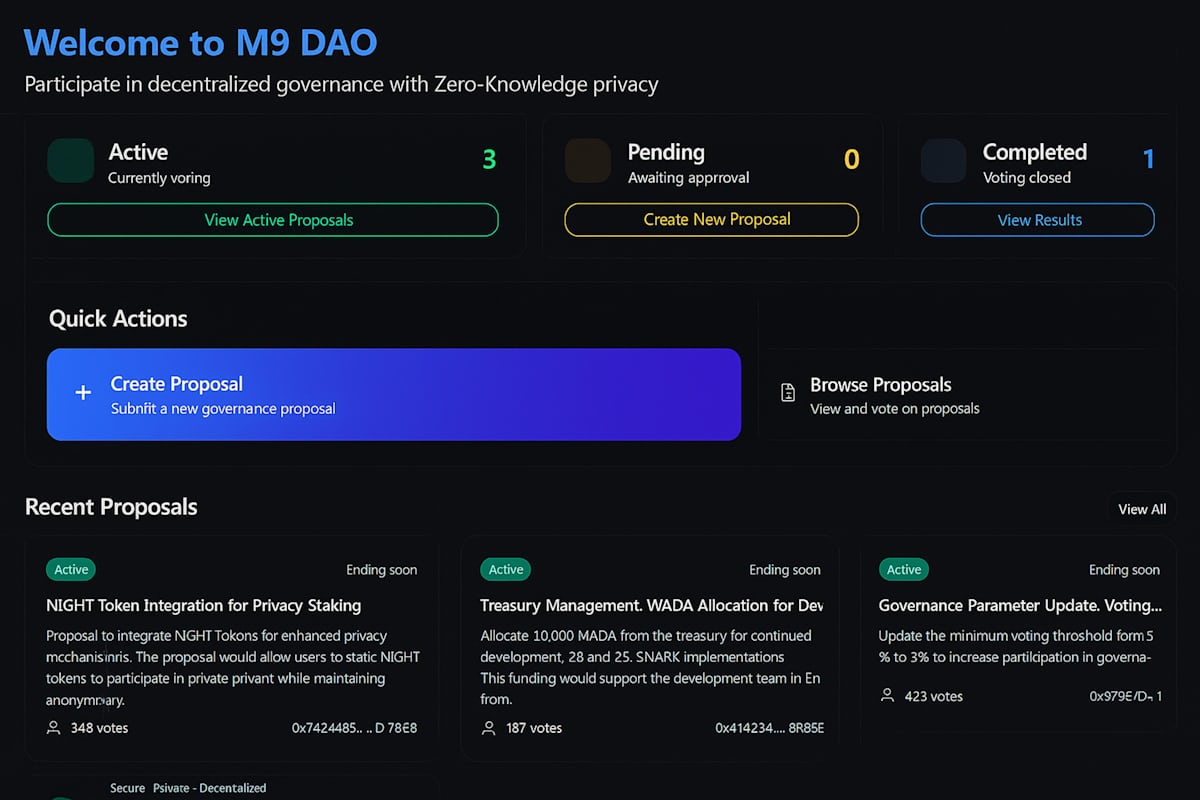
Exp app pre-build here: https://m9voting.netlify.app/
Technical Scope
- No backend development — frontend communicates directly with SDK via middleware
- UI/UX stack: TailwindCSS, optimized animations, responsive design
- Core application pages:
- Homepage
- DAO Dashboard
- Proposal View
- Voting Page (Commit/Reveal)
- Results Summary
- Profile (ZK identity-based)
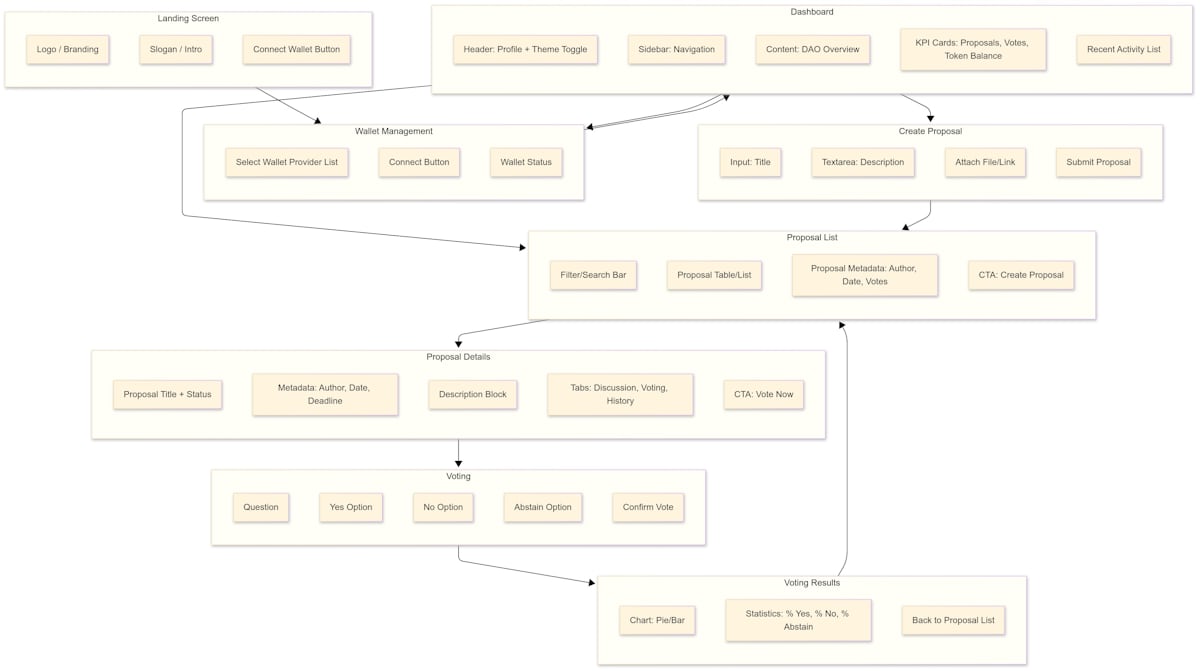
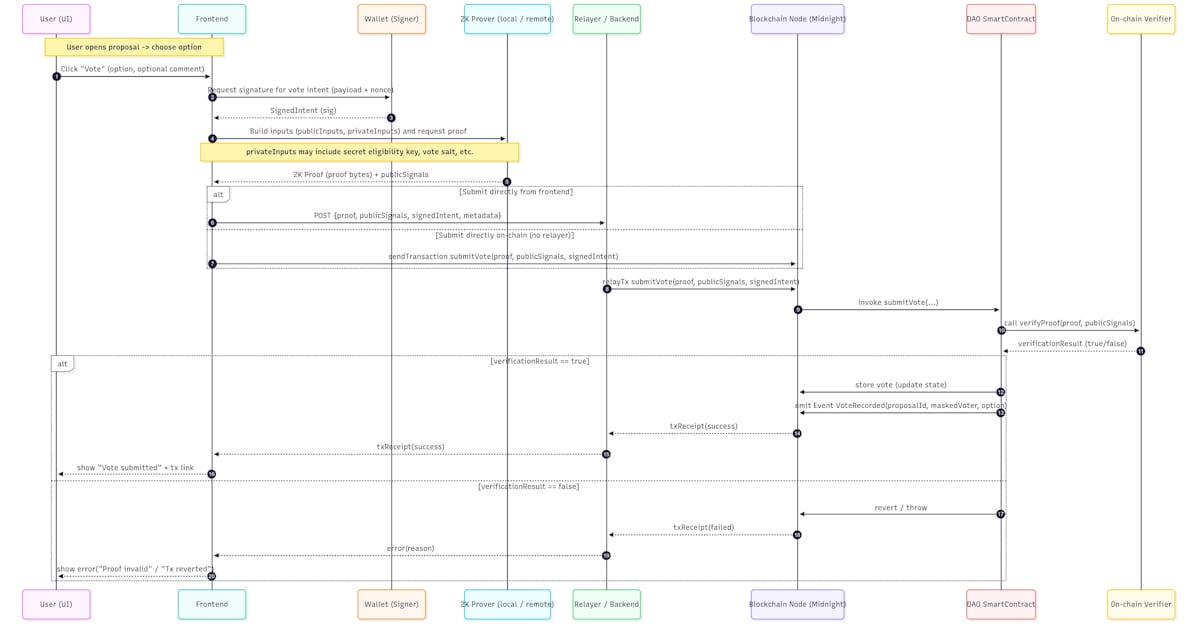
See pre-research app flow here: https://vcc.gitbook.io/m9dao-project/proposal/3rdstage-voting-app/technical-details/app-flow
[Your Project and Solution] Impact
Please define the positive impact your project will have on the wider Cardano community
1. Strengthening Cardano’s Position in DAO Infrastructure
This project introduces the first fully anonymous, zero-knowledge DAO voting dApp built natively for Cardano’s ecosystem via Midnight. It addresses one of the most critical governance gaps — the lack of privacy in voting — which has been a limiting factor for enterprise and sensitive community use cases.
2. Unlocking Enterprise & Sensitive Governance Use Cases
With full privacy and no traceable wallet addresses, DAOs on Cardano can now confidently handle votes on corporate strategy, treasury allocations, compliance decisions, and politically sensitive topics without risk of voter intimidation or trend manipulation.
3. Setting a Usability Standard for ZK on Cardano
By pairing ZK proofs with a clean, intuitive UI/UX, the project lowers the barrier for non-technical DAO participants. This serves as a reference implementation for developers building privacy-first tools on Cardano and Midnight.
4. Strengthening Cardano’s Competitive Edge
In an industry dominated by EVM-based governance tools, this project showcases Cardano’s ability to deliver privacy-preserving, production-ready DAO applications — positioning the ecosystem as a leader in decentralized governance innovation.
5. Game-Changer for Cardano Governance
This project is not just a voting tool — it is a proof of what’s possible when Cardano’s core strengths (security, scalability, and community governance) are combined with Midnight’s zero-knowledge privacy layer. By delivering a working, open-source, anonymous DAO voting dApp, we show the world that Cardano can lead in privacy-first, enterprise-ready governance — an area where no other blockchain currently offers a complete solution. This positions Cardano not only as a platform for open participation, but also as the go-to choice for secure, censorship-resistant, and future-proof decentralized decision-making.
[Your Project and Solution] Capabilities & Feasibility
What is your capability to deliver your project with high levels of trust and accountability? How do you intend to validate if your approach is feasible?
Our Capability to Deliver
Our team combines expertise in blockchain development, zero-knowledge cryptography, UI/UX design, and DAO governance consulting. Key members include:
- Blockchain Developer – Experienced with Cardano native smart contracts and integration of ZK proof systems.
- Solution Architect – Designed scalable architectures for privacy-focused dApps.
- UI/UX Designer – Delivered intuitive, accessible interfaces for Web3 platforms.
- DAO Consultant – Provides governance structure insights and real-world DAO deployment experience.
- Project Manager – Oversees milestones, coordinates stakeholders, and ensures timely delivery.
We are working and building:
- System architecture design for ZK-enabled DAO voting on Cardano + Midnight.
- Wireframes and user flows for all voting phases (proposal, commit, reveal, tally).
- Technical validation of integrating Midnight ZK proofs with Cardano wallet authentication (CIP-30).
Our pre-build doc: https://vcc.gitbook.io/m9dao-project/proposal/3rdstage-voting-app/technical-details/app-flow
Exp app pre-build here: https://m9voting.netlify.app/Exp our pre-build app:....
Feasibility & Validation Approach
- Prototype on Testnet – Deploy core voting features with ZK proof generation and verification on Cardano Testnet.
- User Testing – Involve both DAO operators and regular community members to validate UI/UX accessibility.
- Security Review – Conduct internal code audit focusing on privacy preservation and smart contract correctness.
- Public Documentation – Publish GitBook with technical details and governance use cases for transparency.
- Our track record of delivering blockchain-based tools, combined with a detailed milestone plan and testnet-first deployment, ensures a high level of trust, accountability, and technical feasibility for this project.
[Milestones] Project Milestones
Milestone Title
Research & UI/UX Design
Milestone Outputs
- UX wireframes & voting flow mockups covering the full user journey (commit–reveal–tally).
- Component structure documentation describing the UI component tree, data flow, and interactions.
- Tech stack & architecture plan for the frontend (framework, libraries, UI toolkit, animation framework, etc.).
- DAO voting system research brief analyzing ZK voting models, commit–reveal flows, and technical limitations on Midnight.
Acceptance Criteria
- The research brief must include at least 3 ZK voting models from Cardano and analyze their applicability to Midnight.
- Wireframes must illustrate the complete user journey from proposal creation → anonymous voting → result announcement, ensuring a coherent UX.
- The component tree must detail parent–child relationships and proposed state management.
- The chosen tech stack must clearly state selection rationale and compare at least 2 alternative options.
- The visual identity must define primary colors, typography, and animation style.
Evidence of Completion
- Figma link containing wireframes, mockups, and component tree.
- PDF/Markdown report: DAO Voting Research Brief & Tech Stack Plan.
- Frontend architecture diagram.
- Checklist mapping each Main Task to its delivered result.
Delivery Month
1
Cost
21338
Progress
20 %
Milestone Title
Commit Phase Development
Milestone Outputs
- Fully functional Commit phase interface allowing users to select proposals and commit their vote.
- Voting session controller with lock-time visuals and state handling.
- Proof-of-concept ZK commit logic implemented with placeholder cryptography.
- Front-end validation and UX feedback system (error states, animations, transitions).
- Unit tests for UI states and UX logic.
Acceptance Criteria
- Commit interface must be responsive and work on desktop and mobile.
- User can select a proposal and commit their vote, with confirmation feedback.
- Session state tracking must store slot number, lock time, and commit hash locally.
- ZK commit logic must generate a placeholder proof (not final cryptography) and integrate with the commit flow.
- All front-end edge cases must be handled (e.g., invalid input, timeouts, duplicate commits).
- UI animations must be smooth and follow the visual identity from Milestone 1.
- Unit tests must cover at least 80% of commit-phase UI logic.
Evidence of Completion
- Figma or deployed demo link showing the Commit interface in action.
- GitHub repository with Commit phase code, session controller, and proof generation module.
- Test logs or coverage report for unit tests.
- Screen recording of the full commit flow (proposal selection → commit confirmation).
Delivery Month
3
Cost
24182
Progress
30 %
Milestone Title
Reveal & Tally Implementation
Milestone Outputs
- Fully functional Reveal UI with verification logic for submitted votes.
- Final Tally view displaying results in a clear, user-friendly format.
- Slot-based voting lifecycle simulation covering start → commit → reveal → close stages.
- Feedback collection report from small-group community testing.
- Performance optimization log for interaction speed and mobile responsiveness.
- Private testnet preview of the full voting flow.
Acceptance Criteria
- Reveal UI must allow users to submit vote details (choice + salt) and verify them against the commit phase.
- Tally view must aggregate and display results accurately in real time.
- Lifecycle simulation must include epoch/slot timing and visually represent voting phases.
- Community feedback sessions must involve at least 5 testers and produce actionable recommendations.
- Mobile and desktop performance must meet sub-1 second UI response time for key actions.
- Private testnet demo must demonstrate the full commit–reveal–tally flow without critical errors.
Evidence of Completion
- Figma update or deployed preview link showing Reveal & Tally stages.
- GitHub repository with Reveal logic, Tally view, and lifecycle simulation code.
- Feedback report document summarizing tester input and next steps.
- Performance test logs before and after optimization.
- Screen recording of the full voting cycle on private testnet.
Delivery Month
5
Cost
25000
Progress
30 %
Milestone Title
Public Demo Launch & Documentation
Milestone Outputs
- Open-source GitHub repository containing frontend code and demo voting logic under an open license.
- Demo video with a clear narrative explaining the anonymous voting process.
- Deployed web demo connected to a testnet or mock environment for live interaction.
- Complete documentation for both developers and end-users.
- Project closing report for Catalyst, including a future improvement roadmap.
Acceptance Criteria
- Code in the open-source repo must be clean, documented, and functional, following best practices.
- Demo video must showcase the full voting flow (commit–reveal–tally) and explain it in accessible language.
- Public demo must be stable and accessible via a live link without critical bugs.
- Developer documentation must include setup, architecture, component references, and integration steps.
- User documentation must include step-by-step guides with screenshots.
- Catalyst closing report must summarize achievements, lessons learned, and next development steps.
Evidence of Completion
- GitHub link to the open-source repository with commit history and license file.
- Published demo video (YouTube, Vimeo, or Catalyst channel).
- Live demo URL running on testnet or mock environment.
- PDF/Markdown documentation package for both developers and users.
- Submitted Catalyst final report with roadmap attachment.
Delivery Month
6
Cost
18681
Progress
20 %
[Final Pitch] Budget & Costs
Please provide a cost breakdown of the proposed work and resources
Total Budget: 89,161 ADA
Breakdow by milestones
Milestone 1 – Research & UI/UX Design
- UX Designer (Figma & flows): 60 h x 40 ADA = 2,400 ADA
- Frontend Architect (structure planning): 40 h x 60 ADA = 2,400 ADA
- DAO Researcher : 80 h x 50 ADA = 4,000 ADA
- ZK/Privacy R&D (early phase): 70 h x 80 ADA = 5,600 ADA
- Project Manager & Review: 40 h x 50 ADA = 2,000 ADA
- Catalyst setup & reporting: 10 h x 50 ADA = 500 ADA
- Extended research & documentation: 25 h x 50 ADA = 1,250 ADA
Cost: 21,338 ADA
Milestone 2 – Commit Flow Development
- Frontend Developer (Commit UI): 120 h @ 60 ADA = 7,200 ADA
- ZK Developer (Commit logic): 60 h x 80 ADA = 4,800 ADA
- QA Tester (early phase): 50 h x 40 ADA = 2,000 ADA
- UI/UX animation & performance polish: 30 h x 60 ADA = 1,800 ADA
- Project Manager & Reporting: 12 h x 50 ADA = 600 ADA
- Bug fixes: 40 h x 60 ADA = 2,400 ADA
- Integration testing: 30 h x 60 ADA = 1,800 ADA
Cost: 24,182 ADA
Milestone 3 – Reveal & Tally Development
- Frontend Developer (Reveal UI): 100 h @ 60 ADA = 6,000 ADA
- ZK Developer (Reveal logic): 70 h @ 80 ADA = 5,600 ADA
- QA Tester (edge cases): 60 h @ 40 ADA = 2,400 ADA
- UI/UX polish & animation: 40 h @ 60 ADA = 2,400 ADA
- Community feedback & iteration: 60 h @ 50 ADA = 3,000 ADA
- Project Manager & Reporting: 20 h @ 50 ADA = 1,000 ADA
- Security & performance review: 76 h @ 60 ADA = 4,560 ADA
Cost: 24,960 ADA
Milestone 4 – Demo Launch & Documentation
- DevOps Engineer (testnet deployment): 40 h x 50 ADA = 2,000 ADA
- Technical Writer (documentation): 50 h x 40 ADA = 2,000 ADA
- Video Editor (demo showcase): 30 h x 40 ADA = 1,200 ADA
- Project Management & QA for demo: 60 h x 50 ADA = 3,000 ADA
- Community iteration: 50 h x 50 ADA = 2,500 ADA
- Marketing & outreach: 50 h x 50 ADA = 2,500 ADA
- Partner engagement & PR push: 55 h x 50 ADA = 2,750 ADA
Cost: 18,681 ADA
[Final Pitch] Value for Money
How does the cost of the project represent value for the Cardano ecosystem?
Value
- Lower Development Costs: Open-source privacy voting module reduces time and expense for other DAOs to implement secure voting.
- Increased Adoption & Transactions: Drives more DAOs to deploy on Cardano/Midnight, generating on-chain activity and transaction fees.
- Ecosystem Competitiveness: Positions Cardano as a leading platform for confidential governance, attracting new projects and investments.
- Catalyst Optimization: Provides a ready-to-use, cost-effective voting solution that can scale to Project Catalyst, saving resources on custom builds.
- Long-Term ROI: Open-source release ensures the tool can be reused, adapted, and improved without additional funding.
Budget Justification
Our budget is based on actual work requirements, fair hourly rates aligned with Cardano blockchain project standards, and a clear milestone scope. Work hours are derived from detailed task breakdowns, avoiding inflated estimates.
Buffers are minimal, covering only potential complexities in integrating Cardano with the Midnight privacy layer.
Every ADA is allocated to essential development, design, testing, and documentation — no vanity expenses. The open-source release maximizes long-term ROI, enabling the Cardano community to reuse and enhance the delivered tools.
[Required Acknowledgements] Consent & Confirmation
Terms and Conditions:
Yes
Team
Nguyen Van Thang
Role: Frontend Developer
Experience: 5 years of experience in backend (Node.js) and mobile app development. Worked at Viettel Post, BnK Solution, and Heligate as a full-time Mobile Developer. Proficient in JavaScript, React Native, Node.js, C#, and DevOps practices.
Duong Thanh Hieu
Role: Frontend Developer
Experience: A software developer with over 5 years of experience. He has worked at companies such as Sotatek and Famtech Global, taking on roles in mobile application development using React Native and ReactJS. Hieu holds an academic background in Information Technology from the University of Engineering and Technology – Vietnam National University, Hanoi. He possesses strong communication and project management skills, along with the ability to develop software that meets high-quality standards
Dang Xuan Hoang
Role: UX/UI Designer
Experience: 3+ years in UX/UI design for mobile apps and games, with a strong focus on dApp user experience. Skilled in wireframing, user research, prototyping, and building interactive UI.
VCC team
Role: Project management