Last updated 9 months ago
Multi-Level Document Approval Using Smart Contracts
Problem
Current document approvals lack transparency, are highly prone to tampering, rely on rigid centralized systems, and traditional digital signatures are cumbersome, centralized, and difficult to verify.
Solution
We will build a secure, transparent blockchain multi-level approval system with steps and approvers immutably stored and validated on-chain, replacing cumbersome centralized digital signatures.
Total to date
This is the total amount allocated to Multi-Level Document Approval Using Smart Contracts.
About this idea
[Proposal setup] Proposal title
Please provide your proposal title
Multi-Level Document Approval Using Smart Contracts
[Proposal Summary] Budget Information
Enter the amount of funding you are requesting in ADA
64342
[Proposal Summary] Time
Please specify how many months you expect your project to last
9
[Proposal Summary] Translation Information
Please indicate if your proposal has been auto-translated
No
Original Language
en
[Proposal Summary] Problem Statement
What is the problem you want to solve?
Current document approvals lack transparency, are highly prone to tampering, rely on rigid centralized systems, and traditional digital signatures are cumbersome, centralized, and difficult to verify.
[Proposal Summary] Supporting Documentation
Supporting links
- https://drive.google.com/file/d/1Guwssk1V-C-nVEo30vga6kxEk5Fm868n/view?usp=drive_link ,
- https://github.com/hugnt/NextJS-FE-Docmino-IncomingOutgoingDocumentManagement ,
- https://github.com/hugnt/.NET-Docmino-IncomingOutgoingDocumentManagement ,
- https://drive.google.com/file/d/1javrNi7vbRt2Cu4ouJitQwLhzkKW8L_J/view?usp=sharing
[Proposal Summary] Project Dependencies
Does your project have any dependencies on other organizations, technical or otherwise?
Yes
Describe any dependencies or write 'No dependencies'
Requires stable Cardano blockchain network, wallet integration (Eternl/Nami/Flint), Cardano node or API provider (e.g., Blockfrost), development libraries (MeshJS, Lucid), decentralized storage (IPFS/Arweave if used)
[Proposal Summary] Project Open Source
Will your project's outputs be fully open source?
Yes
License and Additional Information
The entire project's source code will be open-sourced under the MIT License. The repository will be publicly accessible on GitHub for the full project lifecycle, including frontend, backend, and smart contract code. Documentation, deployment scripts, and integration examples will also be available to encourage community contribution and adoption.
[Theme Selection] Theme
Please choose the most relevant theme and tag related to the outcomes of your proposal.
Governance
[Campaign Category] Category Questions
Describe what makes your idea innovative compared to what has been previously funded (whether by you or others).
Unlike previously centralized approval platforms or traditional digital signatures, which are prone to tampering, lack independent verification, and depend on third-party CAs, this system operates fully on Cardano. Each step and approver is immutably stored in datum and validated by smart contracts, ensuring transparency and tamper-proof history. It also embeds the on-chain transaction ID into the document, enabling offline verification by extracting the ID, checking it on the blockchain, and confirming document integrity without relying on the original system.
Describe what your prototype or MVP will demonstrate, and where it can be accessed.
The MVP will upgrade our web-based approval prototype (GitHub) by integrating Cardano smart contracts for full on-chain multi-level approvals. Users can upload documents, add metadata, create workflows with approvers and deadlines, and approve via blockchain transactions. Each transaction ID is embedded in the file for later on-chain verification and viewing signing history. A public Cardano testnet demo with wallet integration will be hosted at a URL provided in the technical documentation for community testing. Accessing the existed system: http://myerp.vn:7223/
Describe realistic measures of success, ideally with on-chain metrics.
Success will be measured by on-chain metrics during the MVP: at least 20 unique document approval workflows created, 50+ blockchain approval transactions, and 85%+ successful on-chain verifications. Each workflow includes immutable storage of steps and approvers in datum, validation via smart contracts, and transaction ID embedding. Community testers on Cardano testnet will verify documents by uploading signed files and checking full signing history.
[Your Project and Solution] Solution
Please describe your proposed solution and how it addresses the problem
1. How we perceive the problem
- Current approval processes rely on centralized systems or traditional digital signatures, which means records are stored off-chain and can be tampered with or lost if the backend fails.
- Users have to trust internal IT systems without any independent way to verify document authenticity, creating a single point of failure.
- Traditional digital signatures depend on third-party Certificate Authorities (CAs) , which centralize trust instead of distributing it.
- Many enterprises are forced to use USB tokens for signing, which are expensive, inconvenient, and difficult to scale across large organizations with thousands of employees.
2. Reasons for our approach
- By moving approval workflows fully on-chain, every approval step and approver is immutably recorded, preventing manipulation or unauthorized changes.
- Smart contracts provide** automatic enforcement of rules** such as deadlines, signing order, and role-based permissions, removing human error and manual control.
- Blockchain makes verification independent and universal: anyone can check the approval history directly on Cardano, without relying on CAs or internal IT.
- This approach removes the need for physical tokens**, reduces cost and complexity**, and offers a transparent, scalable solution for organizations.
3. Who the project will engage
- Government agencies and enterprises: Direct beneficiaries of transparent, secure, and verifiable approval workflows that comply with regulatory requirements.
- Sectors with high demand for transparency and security such as maritime authorities, warehousing, and logistics companies, where approval of documents (e.g., bills of lading, warehouse receipts, transport permits) must be convenient, tamper-proof, and reliable. Our solution ensures faster processing, reduced errors, and protection against fraud in critical supply chain operations.
- Cardano community testers: Members of the ecosystem will interact with the MVP on the testnet, providing open feedback before mainnet deployment.
- Blockchain developers: The entire codebase will be released open-source and professionally structured, allowing them to study, reuse, and extend the solution for governance and enterprise use cases.
4. Implementation & operation logic
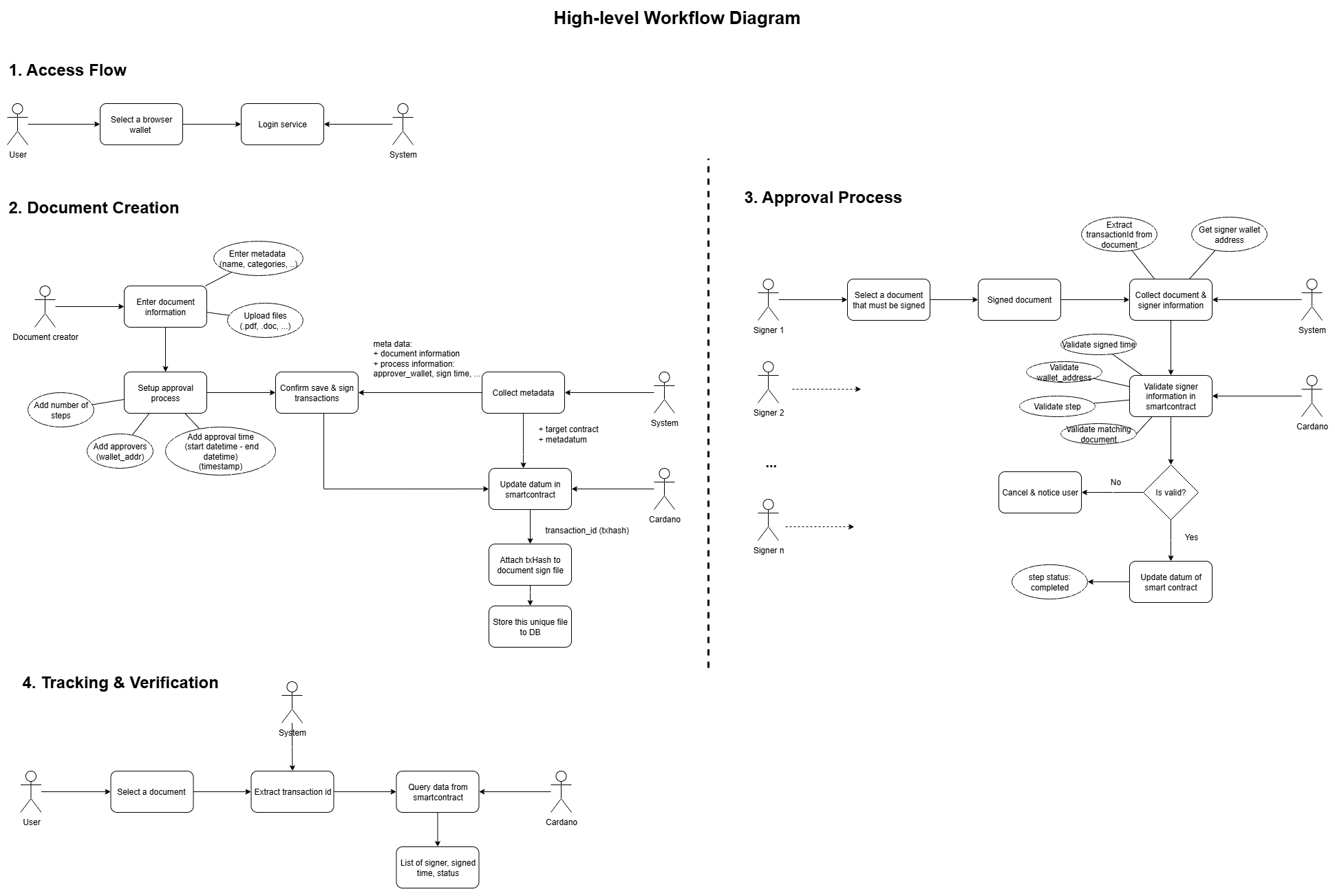
Access Flow: Users connect wallets (Eternl, Lace) to interact with the system.
Document Creation:
- Add metadata, upload file.
- Define multi-step approval workflow: approvers’ wallet addresses, start/end times for each step.
- System deploys a multi-signature smart contract with workflow rules and document hash stored in datum.
Approval Process:
- Approvers see assigned documents in their dashboard.
- When it’s their turn and within the deadline, they approve by signing a blockchain transaction.
- Smart contract validates and updates datum.
- Transaction ID is embedded into the file stored on IPFS.
Tracking & Verification:
- Users can upload a signed file or search by transaction ID.
- System extracts the embedded transaction ID, queries Blockfrost API, retrieves datum, and displays full signing history.
5. Demonstrating and proving impact
- On-chain metrics will track: number of workflows created, number of blockchain approval transactions, and % of successful verifications.
- Community testers will validate documents on Cardano testnet by scanning embedded transaction IDs and confirming signing history.
- This feedback loop ensures the system is robust, practical, and trusted before moving to mainnet
6. Why this is important to Cardano
- Demonstrates a real-world governance use case beyond DeFi, proving Cardano’s value in GovTech and enterprise adoption.
- Upgrades an existing platform (MyERP), already used by enterprises, into a blockchain-enabled solution, showing pioneering adoption of Cardano in real-world products that solve urgent customer needs.
- By releasing the project open-source with professional, production-grade code, we provide a reference for the Cardano developer community, enabling others to learn from, replicate, and adapt the solution across new contexts.
[Your Project and Solution] Impact
Please define the positive impact your project will have on the wider Cardano community
1. Value to the Cardano Ecosystem & Real-World Users
- Solving a real-world problem: Our existing document management platform (MyERP) is already in use by multiple enterprise clients. By integrating blockchain, we immediately deliver transparent, immutable, and easily verifiable approval processes to these organizations—without requiring them to change their established business workflows.
- Pioneering blockchain adoption in real products: This is not just a research initiative or proof-of-concept. It is a production-ready document management system with active customers, now being upgraded with blockchain to solve **a critical and urgent need—ensuring transparency, immutability, and trust in document approvals. **This positions Cardano as a pioneer in GovTech and enterprise blockchain adoption.
- Eliminating security risks: Every approval step is recorded on-chain, removing reliance on centralized backends or traditional digital signatures (USB tokens, Certificate Authorities) that are cumbersome and prone to manipulation.
- Increasing trust and accountability: Anyone can independently verify an approved document through its transaction ID, reducing fraud and enhancing accountability in both government and enterprise governance.
2. Direct Benefits for Organizations & Governments
- Enables government agencies and large enterprises to comply with legal frameworks on electronic documents (e.g., Vietnam’s Decree 30) in a modern, decentralized, and verifiable way.
- Reduces long-term costs by removing the need for complex CA infrastructure and large-scale USB token distribution.
- Improves efficiency by allowing fast, on-chain approvals directly through blockchain wallets (Eternl, Lace, Nami) instead of manual or legacy methods.
3. Value to the Cardano Community
- Clear governance use case: Demonstrates how Cardano can power secure, transparent approval systems for GovTech and enterprise sectors, expanding beyond DeFi.
- Reusable smart contract modules: The approval workflow logic can be adapted for voting, project management, contract execution, or any scenario requiring multi-step validation.
- Adoption showcase: Upgrading an existing real-world system to Cardano provides a **high-impact case study **to present to governments, enterprises, and regional markets such as ASEAN, boosting Cardano’s reputation in digital governance.
- Open-source with professional quality: All code (frontend, backend, and smart contracts) will be released as a professionally structured, production-grade codebase, enabling blockchain developers worldwide to learn from, reference, and reuse the implementation in their own projects.
4. Measuring Impact
On-chain metrics:
- At least 20 approval workflows created on testnet.
- 50+ blockchain approval transactions executed.
- 85%+ successful verification rate using transaction IDs.
User adoption metrics:
- At least 2–3 current MyERP enterprise clients participating in blockchain testing.
- Engagement from government or enterprise stakeholders exploring Cardano-based GovTech solutions.
Community engagement:
- Open-source code published on GitHub for reuse and learning.
- Public demo deployed on Cardano testnet.
- Reports, workshops, and community presentations to share results and encourage adoption.
[Your Project and Solution] Capabilities & Feasibility
What is your capability to deliver your project with high levels of trust and accountability? How do you intend to validate if your approach is feasible?
1. Existing Capabilities
Our team has extensive experience developing blockchain-integrated web applications, with prior projects in Next.js frontend and .NET backend for document management systems (GitHub repos available, Backend Repo).
Proficient in Cardano smart contract development using Aiken, Lucid, and MeshJS, with hands-on experience integrating wallet APIs (Eternl, Lace, Nami) and working with Blockfrost. Skilled in implementing IPFS/Arweave for decentralized file storage and embedding metadata for verification purposes.
In addition to blockchain expertise, our team has a strong background in CRM and document management solutions, having researched and delivered practical systems for enterprises. Reference: https://erpvietnam.vn/
A live version of our document management platform, already in use by multiple clients, can be accessed here: http://myerp.vn:7223/
At this stage, our goal is to integrate blockchain into the document approval process to minimize security risks, prevent unauthorized modification, and provide transparent, immutable approval history for organizations.
2. Why We Are Best Suited
- We already have a functional non-blockchain prototype, reducing development risk and accelerating delivery.
- Our technical stack is aligned with the Cardano ecosystem, enabling rapid integration of on-chain logic.
- Proven track record of delivering secure, user-friendly systems with multi-role workflows.
- One of our blockchain engineers has 2 years of hands-on experience with Cardano, and has achieved recognition in scientific research competitions focused on blockchain applications for auction systems and marketplaces.
- Recently, our team won 1st Prize (Main Track) at the Blockchain Hackathon Hanoi 2025, with the topic “Decentralized Model Training,” proving our ability to apply blockchain to advanced, real-world scenarios.
With these resources and achievements, we are fully equipped and aligned with the required capabilities to successfully develop and scale this platform.
3. Validating Feasibility
Initial MVP will be deployed on Cardano testnet for public testing before mainnet launch.
Functional testing will verify:
- Smart contract correctly enforces step order, approver roles, and deadlines.
- On-chain data matches file-embedded transaction IDs.
- Offline verification retrieves accurate approval history.
Feedback from community testers will guide adjustments to ensure robustness before production release
[Milestones] Project Milestones
Milestone Title
Requirements Analysis & System Architecture Design
Milestone Outputs
This milestone will deliver a complete and approved set of system requirements, covering both business workflows and technical specifications for the blockchain-based document approval system. The outputs will include:
- A comprehensive Requirements Specification Document detailing user stories, system use cases, and functional/non-functional requirements.
- A System Architecture Document illustrating the interaction between the frontend (Next.js), backend (.NET API), Cardano smart contracts, and IPFS storage.
- Detailed Smart Contract Logic Flowcharts for multi-signature approval steps, including timing restrictions and signer role definitions.
- A UI/UX Prototype showing the complete user flow from uploading a document to signing and verifying.
- Integration design plan for Eternal and Lace wallets.
Acceptance Criteria
The milestone will be considered complete when:
- All functional and technical requirements are reviewed and approved by the core team.
- The architecture fully supports the intended use cases, including multi-step, time-locked signing processes, on-chain verification, and IPFS-based document storage.
- UI/UX prototypes cover every required flow and pass initial usability review.
- Wallet integration approach for Eternal and Lace is validated as technically feasible.
Evidence of Completion
Completion will be evidenced by:
- A finalized Requirements Specification Document stored in a public GitHub repository, with commit history showing collaborative development and stakeholder review.
- A System Architecture Diagram in PDF and editable format, clearly illustrating the backend, frontend, smart contract, and IPFS integration layers.
- Screenshots and design files of UI/UX prototypes hosted on Figma or similar tools, with public view links.
- A milestone summary report uploaded to the Catalyst project page for transparency and community feedback.
Delivery Month
2
Cost
20224
Progress
20 %
Milestone Title
Backend API & Smart Contract Development
Milestone Outputs
This milestone will focus on developing the server-side logic and smart contracts to handle document management, approval workflows, and blockchain integration. Outputs will include:
- A .NET 8 Web API supporting document creation, metadata storage, workflow creation, and signer management.
- Integration with IPFS for storing files and transaction hashes.
- An Aiken Smart Contract implementing multi-signature approval logic with defined start/end approval periods for each step.
- Integration with Blockfrost API for querying transaction history.
- Unit and integration test coverage to ensure correctness and security.
Acceptance Criteria
The milestone is achieved when:
- API endpoints function reliably in a testnet environment and meet documented specifications.
- Smart contract logic correctly enforces signing order, timing constraints, and role-based permissions.
- Transactions update the datum on-chain with the correct approval state.
- All code passes security review and automated test coverage exceeds the agreed threshold.
- Blockfrost, MeshJs integration successfully retrieves and displays historical signing data.
Evidence of Completion
Proof will include:
- Publicly accessible GitHub repository containing all backend and smart contract source code, licensed for community review.
- Successful Testnet Deployment Transaction IDs for the Plutus smart contracts, verifiable via Cardano testnet explorers.
- Postman or Swagger API documentation showing working endpoints for document creation, workflow management, and blockchain interactions.
- Automated test reports with coverage metrics meeting the agreed target.
- Blockfrost API query logs demonstrating retrieval of on-chain signing history.
- Recorded demo video walking through the backend and contract logic in a running testnet environment.
Delivery Month
2
Cost
20634
Progress
50 %
Milestone Title
Frontend Development & Wallet Integration
Milestone Outputs
This milestone will produce a user-friendly, secure web interface that connects to the backend and interacts with Aiken smart contracts via browser wallets. Outputs will include:
- Next.js-based frontend with screens for document upload, metadata input, workflow configuration, approval step tracking, and on-chain verification.
- Integration with Eternal and Lace wallets to allow secure user authentication and transaction signing.
- Document scanning feature that extracts embedded transaction hashes and verifies them against the blockchain via Blockfrost.
- A dashboard for pending approvals showing deadlines and signing status.
- End-to-end functional testing with mock and real blockchain data.
Acceptance Criteria
This milestone is complete when:
- Users on testnet can perform the complete flow: upload → set workflow → sign on-chain → verify via document scan.
- Wallet integration supports secure transaction submission without exposing private keys.
- UI is responsive, accessible, and validated against the UX prototype.
- All interactions are fully functional in both desktop and mobile browsers.
- Verification feature reliably detects fraudulent or altered documents.
Evidence of Completion
Evidence will consist of:
- A publicly accessible demo website running on a testnet environment, accessible via a provided URL.
- GitHub commits and pull requests showing implementation of all frontend features, including document upload, workflow configuration, approval tracking, and verification.
- Wallet integration demonstration video showing Eternal and Lace connections, successful transaction signing, and update of on-chain state.
- Test cases demonstrating verification of an uploaded document by scanning its embedded transaction hash and retrieving signer history from Blockfrost.
- Screenshots and live test accounts proving that the dashboard displays pending approvals with accurate status and deadlines.
- Feedback logs from internal QA sessions and selected community testers.
Delivery Month
2
Cost
8094
Progress
80 %
Milestone Title
Testnet Deployment & Community Testing
Milestone Outputs
- Fully functional MVP deployed on Cardano testnet with all planned features: document upload, metadata entry, multi-step approval workflow, wallet-based signing, transaction ID embedding, and document verification.
- Public demo site URL (provided in the technical documentation) allowing community members to connect wallets, simulate approvals, and test verification.
- Feedback collection system (Google Form/embedded form) for testers to submit issues and suggestions.
- Initial performance and security assessment reports from internal QA.
Acceptance Criteria
- MVP is accessible on Cardano testnet via the published public URL.
- Users can perform the full workflow: upload document → create workflow → sign on-chain → verify via file scan.
- All transactions visible and verifiable on Cardano testnet explorer.
- At least 10 successful community tests completed with feedback submitted.
- No critical/blocker issues remain unresolved before moving towards mainnet preparation.
Evidence of Completion
- Public testnet deployment URL with access instructions.
- Screenshots and video recordings of the full workflow being executed by community testers.
- Cardano testnet transaction IDs linked to executed approvals, verifiable on testnet explorer.
- Public GitHub repository with the complete source code for backend, frontend, and smart contracts used in the testnet deployment.
- Consolidated feedback report from community testers including issues found, fixes applied, and improvement suggestions.
- Internal QA report summarizing performance and security findings.
Delivery Month
3
Cost
15390
Progress
100 %
[Final Pitch] Budget & Costs
Please provide a cost breakdown of the proposed work and resources
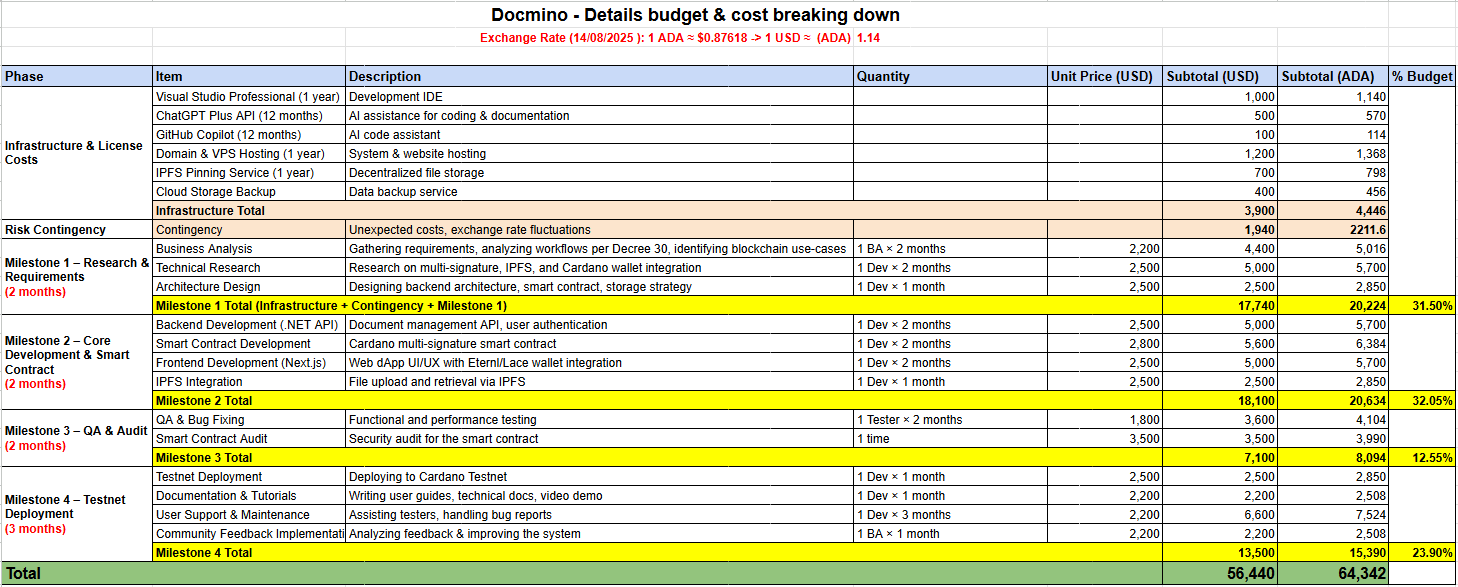
Budget Overview – Docmino Project
Exchange Rate (09/08/2025): 1 ADA = 0.87618 USD → 1 USD ≈ 1.14 ADA
Main Cost Items
- Milestone 1 – Research & Requirements (2 months, including Infrastructure setup & Risk Contingency): 20,224 ADA (~ 17,740 USD) ( 31.5%): Includes business analysis, technical research, architecture design, plus infrastructure setup and contingency to ensure smooth project initiation.
- Milestone 2 – Core Development & Smart Contract (2 months): 20,634 ADA (~18,100 USD) (32.05%): Backend API, Cardano multi-signature smart contract, frontend integration, IPFS integration.
- Milestone 3 – QA & Audit (2 months): 8,094 ADA (~7,100 USD) (12.55%): Functional testing, bug fixing, smart contract security audit.
- Milestone 4 – Testnet Deployment (3 months): 15,390 ADA (~13,500 USD) (23.9%): Testnet deployment, documentation, tutorials, user support & maintenance, community feedback implementation.
Total Budget: 64,342 ADA (~56,440 USD)
Full Budget Breakdown: https://docs.google.com/spreadsheets/d/1aLRPe71GLbVqJKcrwuauHbGb8PRmT6KO-b3qh9M5BDk/edit?usp=sharing
[Final Pitch] Value for Money
How does the cost of the project represent value for the Cardano ecosystem?
Our proposed budget reflects a careful balance between competitive industry rates, realistic resource requirements, and the high-quality standards expected within the Cardano ecosystem. Each cost item is directly linked to essential deliverables, ensuring that every ADA spent results in tangible advancements for the platform.
We benchmarked our rates against:
- Average market salaries for blockchain developers and software engineers in Vietnam (and globally), which range from $2,200 – $3,200 per month for skilled professionals with multi-year experience.
- Specialized blockchain audits, where smart contract security audits typically range from $3,000 – $8,000 USD depending on scope and complexity.
- Industry-standard infrastructure and licensing costs such as cloud hosting, IPFS pinning, and development tools, which are necessary for reliable, secure, and scalable deployment.
Key reasons this represents value for money:
1. Direct ecosystem impact:
Our blockchain-based document management system enhances transparency, security, and decentralization for government and enterprise workflows, expanding Cardano’s utility in real-world, high-trust environments.
2. Reusability & scalability:
The smart contract modules, integration code, and infrastructure setup can be adapted for future Cardano dApps, accelerating adoption across multiple domains.
3. Local and global collaboration:
By delivering an open, standards-compliant solution, we foster cross-border developer engagement and create opportunities for Cardano within the ASEAN digital governance market.
4. Cost efficiency:
The total requested budget (≈ 64,346 ADA / 56,440 USD) is proportionate to the 9-month development scope, with milestone-based payments tied to measurable outputs. No funds are allocated to non-essential activities.
5. Long-term ecosystem benefit:
Beyond project completion, the infrastructure and codebase will remain available for ongoing maintenance, community contributions, and adaptation by other Cardano projects, multiplying its impact.
In summary, our budget is lean yet comprehensive, ensuring the highest return on investment for the Cardano community by delivering a high-impact, fully functional dApp that addresses real-world challenges.
[Required Acknowledgements] Consent & Confirmation
Terms and Conditions:
Yes
Team
Project Team Members
1. Hung Nguyen Thanh – Project Lead, Full-Stack & Blockchain Developer
- Role: Leading the project end-to-end — from concept, architecture design, and full-stack development (Next.js, .NET) to blockchain integration (Cardano smart contracts, wallet connectivity, multi-signature logic, on-chain data management) and deployment.
- Background: Software Engineer at NashTech with 3+ years of experience in web development and 2+ years working on the Cardano blockchain ecosystem.
- Achievements:
- 1st Prize – Main Track, Cardano Blockchain Hackathon Vietnam 2025
- 1st Prize – Student Track, Solana Hackathon 13
- Profile
- Linkedin: https://www.linkedin.com/in/hugnt/
- GitHub: https://github.com/hugnt
2. Minh Nguyen Van - Business Analyst (BA)
- Role: In charge of requirements gathering, business process design, and ensuring compliance with legal frameworks such as Vietnamese Decree 30 on electronic documents. Also responsible for mapping document approval workflows into implementable technical specifications.
- Background: CEO of ERP Vietnam JSC, with extensive experience in enterprise software implementation, process optimization, and digital transformation consulting for government agencies and large corporations.
Additional Recruitment Plan
In later phases, the team will onboard a UI/UX Designer and QA Engineer to refine user experience and ensure platform stability before mainnet deployment.