Last updated a year ago
Hydra-Powered EV Battery DPP: Privacy + Transparency
Problem
The EV industry struggles with fragmented and opaque battery traceability. Without trusted, verifiable systems, the supply chain faces compliance gaps and risk losing control over sensitive data.
Solution
LW3 uses Cardano Hydra to provide scalable, low-cost, and secure EV battery traceability with verifiable tokens, ensuring fast, private, and transparent compliance across the supply chain.
Total to date
This is the total amount allocated to Hydra-Powered EV Battery DPP: Privacy + Transparency.
About this idea
[Proposal setup] Proposal title
Please provide your proposal title
Hydra-Powered EV Battery DPP: Privacy + Transparency
[Proposal Summary] Budget Information
Enter the amount of funding you are requesting in ADA
396000
[Proposal Summary] Time
Please specify how many months you expect your project to last
9
[Proposal Summary] Translation Information
Please indicate if your proposal has been auto-translated
No
Original Language
en
[Proposal Summary] Problem Statement
What is the problem you want to solve?
The EV industry struggles with fragmented and opaque battery traceability. Without trusted, verifiable systems, the supply chain faces compliance gaps and risk losing control over sensitive data.
[Proposal Summary] Supporting Documentation
Supporting links
- https://drive.google.com/drive/folders/1SoE3wYcLpOleSfdyE6YZAT3CWm7H5CG4?usp=sharing ,
- https://www.autocarpro.in/news/batx-energies-partners-with-lw3-for-sustainable-energy-storage-system-ess-solutions--123096 ,
- https://drive.google.com/file/d/1e1Mk-78g1iMYWJAFi43CkLeDTJVHec2-/view?usp=sharing ,
- https://www.pib.gov.in/PressReleasePage.aspx?PRID=2027193 ,
- https://cirpassproject.eu/wp-content/uploads/2024/03/CIRPASS-D3.1-Annex-V9_final.pdf
[Proposal Summary] Project Dependencies
Does your project have any dependencies on other organizations, technical or otherwise?
No
Describe any dependencies or write 'No dependencies'
No dependencies
[Proposal Summary] Project Open Source
Will your project's outputs be fully open source?
No
License and Additional Information
It will be private source code
[Theme Selection] Theme
Please choose the most relevant theme and tag related to the outcomes of your proposal
RWA
[Campaign Category] Category Questions
Describe your established collaborations.
LW3 has secured strong industry collaborations validating our Cardano-powered Battery Passport. Pilots with Mahindra trace 600kg 3W EV batteries under India’s BWM Rules. Attero, India’s largest recycler, integrates end-of-life traceability. With Mercedes-Benz R&D India, LW3 co-develops “Battery Aadhaar” for lifecycle valuation. BatX Energies enables a Recycled Material Passport (India/EU). Selected by the India–EU TTC WG2, LW3 bridges OEM, recycler, and regulatory adoption.
Recognized in the CIRPASS EU Project report as a solution provider for DPP. Supporting document links are attached.
Describe funding commitments.
- Product Development (40%): Engineering resources to release LW3 private network (dockerized), partner-ready APIs, and Hydra-enabled mainnet integration.
- Partner Pilots & Integrations (30%): Deployment with Mahindra, Attero, Mercedes-Benz R&D India, and BatX Energies.
- Regulatory Alignment & Market Readiness (30%): Ensuring compliance with EU Battery Regulation 2027 and India’s Battery Waste Management Rules, while preparing for multi-region rollouts.
Commitment: In addition to in-kind contributions from partners, LW3 is committing $50,000 from it's own fund.
Describe your key performance metrics.
- Cardano Network Adoption: Integration of a Tier-1 automotive partner for real-world deployment of the LW3 Battery Passport.
- Transactions: 1,000+ lifecycle events (minting, ownership transfers, service updates, recycling) recorded on Cardano/Hydra.
- Ecosystem Growth: Active pilots with OEMs, recyclers, and material passport partners demonstrating multi-stakeholder adoption.
- Regulatory Alignment: Compliance with EU Battery Passport (2027) and India’s BWM Rules validated through partner pilots.
[Your Project and Solution] Solution
Please describe your proposed solution and how it addresses the problem
LW3 delivers a blockchain-powered digital battery passport purpose-built for the automotive industry, ensuring scalability, trust, privacy, and cost-efficiency. Unlike generic data-sharing platforms, LW3 is battery-specific, directly addressing the requirements of the upcoming EU Battery Regulation (2027).
In our solution - each EV battery is issued a CIP-68 (user token + reference token) compliant token on Cardano, at the point of production. The user token resides with the owner of the battery while the reference token holds the updated data hash or signature that is derived from structured content of the battery passport (e.g. general information, supply chain, sustainability etc). This CIP-68 token acts as a verifiable, tamper-resistant digital twin. The digital transfer and update is executed in the hydra network securely as the battery moves across the supply chain: OEM → dealership → buyer → recycler.
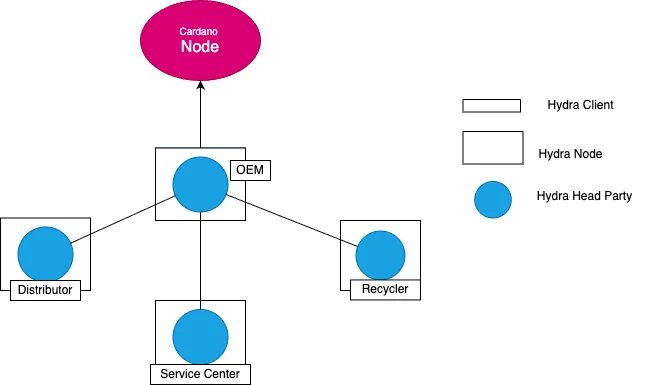
Cardano x Hydra Solution Architecture - Transparency with Privacy:
The proposed architecture, a central Hydra node, is operated by the EV OEM, with Hydra heads established between the OEM and each supply chain stakeholder - such as dealers, service centers, and battery recyclers - following a hub-and-spoke model. For every EV battery produced, the OEM mints a CIP-68 token on Layer 1, embedding EU Battery Passport - compliant data. Subsequent lifecycle events - such as changes in ownership, servicing, or status updates - are committed within the relevant Hydra head, where transactions are executed in real time with high scalability. Once a battery reaches its End of Life (EOL), the token is decommitted to Layer 1 and securely burned, ensuring traceability, compliance, and integrity across the entire supply chain. Architecture diagram of the solution is provided below -
Key Advantages of Using LW3’s Architecture
1. Hydra-Powered Scalability
LW3 leverages Cardano’s Layer 2 Hydra protocol to achieve near real-time, low-cost, and high-throughput transactions. Unlike traditional blockchains constrained by performance bottlenecks, it allows millions of updates to battery passports to be processed simultaneously. This ensures that large-scale compliance reporting does not translate into excessive costs or delays for OEMs and suppliers. In effect, Hydra transforms regulatory compliance into a seamless, invisible process, removing one of the largest adoption barriers for industry stakeholders.
2. Privacy + Transparency
As regulations are increasingly becoming more strict, a core challenge in automotive supply chains is balancing confidentiality with accountability. LW3’s architecture solves this by anchoring only verifiable cryptographic proofs on Hydra, while sensitive operational data remains fully under the control of participants. This approach ensures business-critical data is never exposed to competitors or unauthorized third parties, yet regulators and partners can still verify compliance in a trustless and tamper-proof manner. The result is a network where transparency and privacy coexist, fostering greater trust among supply chain actors.
3. Compliance Ready
LW3 is purpose-built to align with the EU Battery Regulation (2027), which mandates a digital battery passport covering lifecycle traceability, carbon footprint reporting, and recycling performance. By providing a secure and verifiable audit trail across the battery’s lifecycle - from raw materials to end-of-life recycling - LW3 enables OEMs, regulators, and recyclers to meet evolving legal requirements without adding operational complexity. This compliance readiness not only mitigates regulatory risks but also positions OEMs as leaders in sustainable and transparent mobility.
4. Interoperability
Adoption in the automotive sector hinges on integration with existing enterprise IT systems. LW3 has been architected for seamless interoperability with widely used ERP, PLM, and supply chain management platforms, ensuring minimal disruption to current workflows. This reduces onboarding costs, accelerates deployment, and supports scaling across global EV ecosystems. By acting as a layer of verifiable truth that complements existing infrastructure, LW3 minimizes friction and maximizes industry adoption potential.
Key Differentiation from Existing Battery Passport Solutions available
1. Orboo (IOTA-based)
Orboo leverages IOTA’s Directed Acyclic Graph (DAG) architecture for supply chain traceability, emphasizing lightweight data recording. While innovative in theory, IOTA’s DAG-based framework remains less mature for enterprise-grade deployment, particularly in high-volume automotive environments. Its lack of established integration standards with ERP and OEM systems, combined with unresolved scalability challenges under real-world industrial load, limits its immediate applicability. By contrast, LW3’s use of Cardano Hydra enterprise-ready integrations can offer up to 1M transaction per second, and compliance alignment with EU regulations, making it a more pragmatic solution for global automotive stakeholders.
2. Minespider (Ethereum-based)
Minespider provides a blockchain-based provenance protocol that has gained visibility in traceability pilots for raw materials and components. However, built on an Ethereum foundation, it faces the inherent limitations of high transaction fees, slower throughput, and cost unpredictability under network congestion. These constraints make large-scale traceability — where millions of updates are required for compliance — financially unviable. LW3 resolves this challenge with Hydra’s low-cost, high-throughput environment, ensuring that traceability at scale remains both operationally and economically sustainable.
3. Circularise (Ethereum-based with ZKPs)
Circularise has pioneered the use of zero-knowledge proofs (ZKPs) for privacy-preserving traceability, particularly within plastics, chemicals, and recently, battery passports. Its strength lies in enabling data minimization — ensuring sensitive details remain private while allowing verification. However, Circularise is still tethered to Ethereum’s limitations around scalability and cost, and its architecture does not natively optimize for battery-specific regulatory reporting. LW3 advances this approach by combining ZKP-style verifiable proofs with Hydra’s scalability, ensuring privacy, compliance, and cost-efficiency are all delivered within a single framework.
4. Catena-X (Federated Data Exchange)
Catena-X positions itself as the automotive industry’s federated data-sharing backbone, supported by major OEMs and aligned with Gaia-X principles. Its strength is in providing a broad ecosystem where companies retain ownership of their data and can exchange information via standardized APIs. However, the federated model requires heavy infrastructure and governance frameworks, making it slower and more resource-intensive to implement, particularly for smaller or emerging market players. LW3, in contrast, is lightweight, tokenized, and battery-specific, providing a faster-to-market, globally scalable alternative. By focusing narrowly on the EV battery lifecycle, LW3 avoids the complexity of ''one-size-fits-all'' ecosystems, delivering compliance-ready traceability with minimal overhead.
Strategic Advantage
LW3 positions Cardano as the decentralized backbone for EV battery traceability, creating a globally scalable, regulation-compliant framework. This not only addresses a €250B+ EV supply chain challenge but also anchors Cardano as the blockchain of choice for climate-tech, mobility, and sustainability-driven enterprise adoption.
[Your Project and Solution] Impact
Please define the positive impact your project will have on the wider Cardano community
The long-term value of a blockchain is intrinsically linked to the sustained, real-world utility it provides. The LW3 platform is architected to generate a predictable, growing, and economically significant stream of on-chain activity for Cardano, driven by the inexorable global transition to electric mobility. This impact can be quantified by modeling the on-chain transactions generated by the digital passport being printed for the batteries.
Modeling L1 Transactions from New EV Production
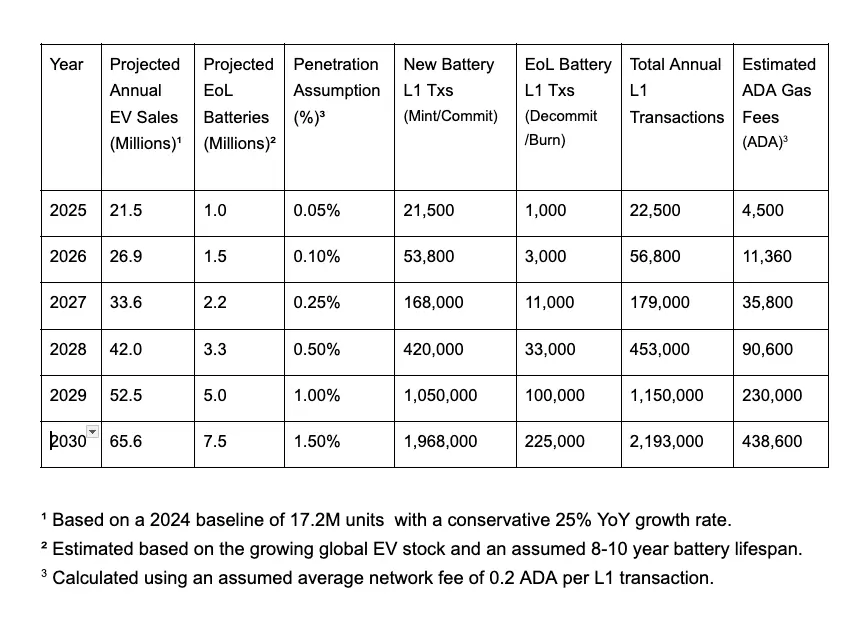
The global EV market is experiencing exponential growth. Projections for 2025 indicate annual sales of nearly 22 million units, a significant increase from the 17 million sold in 2024. This expansion provides a massive and growing addressable market for LW3's battery passport solution.
According to the LW3 Private architecture, every new battery onboarded by an enterprise client, such as a major Original Equipment Manufacturer (OEM), initiates a sequence of two fundamental transactions on the Cardano mainnet. These are the asset mint transactions and the transaction that commits the asset to the client's hydra (lw3 private) network. The volume of these Mint and Commit transactions is directly correlated with the number of new EVs produced by LW3's clients. By modeling a conservative, phased market penetration for the LW3 platform, it is possible to project a substantial and growing baseline of L1 network demand.
Modeling L1 Transactions from Battery End-of-Life (Decommit and Burn)
The second critical phase generating on-chain activity is the battery's end-of-life (EoL). As the global stock of EVs grows—expected to have reached 40 million by the end of 2023—the number of batteries reaching retirement is set to create a "tsunami" of EoL feedstock for the recycling industry. The EV battery recycling market is projected to grow at a compound annual growth rate (CAGR) of over 30%. While production scrap currently constitutes the majority of recycled material, EoL batteries are expected to become the dominant source by 2030, signaling a massive future increase in processing volumes.
The LW3 platform manages this final lifecycle stage with two corresponding L1 transactions, ensuring a complete and auditable history. These are the transactions that decommit the asset from the client's hydra network to layer 1 and the transactions that burn the asset for recycling.
The volume of these Decommit and Burn transactions will scale directly with the number of EoL batteries processed through the LW3 network, providing a second, powerful driver of long-term on-chain activity.
The Hydra Multiplier: Quantifying Total Ecosystem Engagement
The projected L1 transactions represent only the visible tip of the iceberg. They serve as the secure "bookends" for a battery's lifecycle, but the vast majority of operational activity occurs within the private, high-throughput environment of the Hydra L2 state channels. For every single battery NFT managed by the system, a multitude of off-chain L2 transactions will take place. These include ownership transfers between the manufacturer and dealerships, updates of service records, ingestion of Battery Management System (BMS) data, and countless other logistical events.
This high-frequency L2 activity demonstrates the platform's deep integration into the core operational workflows of its enterprise clients. It signifies that LW3 is not a superficial or occasional user of the blockchain but a deeply embedded, mission-critical solution.
While the L1 transactions generate direct, quantifiable revenue for the network in the form of gas fees, the immense volume of L2 activity serves as a powerful indicator of true ecosystem adoption and technological validation of the Hydra stack.
The following table provides a conservative forecast of the direct, on-chain impact of the LW3 platform, translating market growth into tangible network metrics for Cardano.
[Your Project and Solution] Capabilities & Feasibility
What is your capability to deliver your project with high levels of trust and accountability? How do you intend to validate if your approach is feasible?
LW3 has demonstrated a consistent ability to deliver high-impact, trusted solutions at the intersection of blockchain, traceability, and circular economy compliance.
Proven Institutional Backing: LW3 is supported by the Office of the Principal Scientific Adviser, Government of India, and the European Commission Research & Innovation Department through its selection in the India–EU TTC Working Group on Battery Recycling Technologies. These recognitions validate both our regulatory alignment and international trust.
Recognized by Global Innovation Platforms:
- Winner of Algorand Foundation Global Impact Pitch Competition (US, 2023)
- Top 6 global winners of India–EU EV Battery Technologies Challenge (2024)
- Top 3 global winners of Cardano Venture Hub (Switzerland, 2025)
- Top 10 startups selected for TechBBQ Copenhagen (DPIIT India contingent, 2025)
Funding & Execution Capability:
LW3 has successfully raised competitive grants and equity investments to the tune of USD 700k from global investors and have converted them into live deployments, demonstrating financial stewardship and delivery discipline.
Frontline Innovation in Traceability:
- EV Battery Passport Pilots: With Mahindra (reverse logistics, 600kg tracked) and Mercedes-Benz (Battery Aadhaar PoC).
- Recycler Partnerships: Attero and BatX for end-of-life tracking and recycled material passports.
- Cross-Sector Expansion: Digital Product Passports for Assamese Gamosa and Lakadong Turmeric exports, proving scalability beyond automotive.
Mission-Driven, Vision-Led:
LW3’s mission is to accelerate adoption of traceability through full-stack cryptographic systems, with the vision of becoming the world’s most trusted platform for traceability.
Together, these achievements reflect LW3’s ability to operate with high accountability, regulatory trust, and technical credibility—ensuring Catalyst funds are deployed with transparency and maximum impact.
Feasibility Validation:
The validation strategy for the LW3 Private network is a multi-phased approach, progressing from technical verification in poc to application with enterprise partners. This ensures that every component and process is rigorously tested to confirm our hybrid L1/L2 architecture is not only technically sound but also effectively solves the core problem of balancing high-velocity logistics with commercial privacy.
Poc Validation
The initial phase will focus on validating the core mechanics of the system in the proof of concept of the network
- Hybrid Model Functionality: We will first validate the fundamental interactions between Cardano's L1 and the Hydra L2 protocol. This involves repeatedly executing the primary lifecycle operations:
- Asset Genesis and Retirement: We will test the L1 Minting/Burning Service to ensure the creation of unique, immutable NFTs with metadata stored on IPFS, and their subsequent verifiable destruction on cardano.
- L2 Transitions: We will benchmark the process of committing NFTs to a Hydra Head and decommitting them back to L1, measuring transaction times and costs to confirm efficiency gains. This gains will then be modelled to figure out the best possible partner numbers for it to work
- Hub-and-Spoke Architecture Test: Since our solution to Hydra's static participant issue is the Hub-and-Spoke model, this is a critical validation point. We will simulate a manufacturer (Hub) operating multiple concurrent, bilateral Hydra Heads with various partners (Spokes). The test will validate the seamless transfer of an asset by decommitting it from one spoke's head (e.g., Manufacturer-to-Dealer) and recommitting it to another (e.g., Manufacturer-to-Recycler), confirming the viability of this L1-intermediated hand-off.
- Performance Benchmarking: We will measure key performance indicators against the problems outlined. This includes measuring the transaction finality speed and throughput within the Hydra Head to ensure it meets the "near-instantaneous" requirement for real-time logistics, a key failure of traditional L1-only solutions.
End-to-End Lifecycle Simulation Pilot
Following technical validation, we will conduct a full-scale simulation mirroring the entire lifecycle of a battery passport, as detailed in our process flow.
This end-to-end test will involve deploying all system components, including the Manufacturer Client App and Partner Client App, to simulate the complete journey of a battery NFT. [cite_start]We will follow the exact technical operations outlined in our documentation:
- Mint the NFT on the L1 mainnet.
- Commit the NFT to a Manufacturer-Dealer Hydra Head.
- Transfer ownership to the dealer privately within the L2 head.
- Decommit the NFT back to L1 to simulate a sale to a consumer.
- Burn the NFT on L1 to represent the battery's auditable end-of-life.
This pilot will validate not just the individual technical steps but the coherence of the entire business logic and data integrity throughout the process.
Partner Integration and Real-World Validation
The final and most crucial validation phase involves deploying the solution with a strategic enterprise partner, such as an automotive dealer or a battery recycling facility. This will test the system's real-world viability and usability.
- Operational Integration: We will validate the ease of deployment of the client application and hydra-node package in a partner's infrastructure.
- User Feedback: We will gather direct feedback on the client application's effectiveness in managing assets and interacting with the network via the WebSocket API.
**Problem-Solution Fit: **This phase will provide the ultimate validation that our solution correctly addresses the paradoxical enterprise need for both commercial privacy within the Hydra Head and regulatory transparency on the public mainnet. We will confirm that sensitive supply chain data remains confidential while the key lifecycle events (genesis and retirement) are publicly auditable.
[Milestones] Project Milestones
Milestone Title
Technical Analysis & Brand Strategy
Milestone Outputs
**Technical Outputs - **
- Release of detailed architecture for LW3 Private Network. This architecture should be followed by following -
- Release of a technical lightpaper explaining the architecture
- A detailed plan of tasks to be completed for the project
- Launch of a CLI based low fidelity prototype of LW3 private network with 3 participants. This will work as a demonstration for the core tech of the network
- Release of mainnet scripts that are needed for the network to work. This should contain both the hydra scripts required for committing the assets and the supporting scripts required for achieving other requirements of the system like asset mint/ burn and client management.
- Define the NFT metadata structure according to CIP-68 standards and set up an IPFS integration for decentralized storage of battery attributes using managed IPFS service
- For LW3 Agent architect the initial database schemas and data models required to eventually ingest and index data from L1 transactions and L2 state changes.
Business Outcome -
- Regulatory and Industry Alignment: Prepare a policy brief or whitepaper tailored to EU Battery Regulation (2027), Battery Aadhaar (India) stakeholders, linking LW3’s CIP-68 tokenization approach with compliance needs.
- Identify and engage with at least 1 or 2 regulatory or industry associations (e.g., EU Battery Alliance, Battery 360 Alliance, etc,) for early feedback loops.
- Conduct one regulatory alignment workshop (internal or external) to showcase how LW3 enables transparent but privacy-preserving compliance.
- Stakeholder Engagement and Partnerships:
- Secure Letters of Intent (LOIs) or MoUs from at least one EV OEM and one recycler for pilot exploration.
- Initiate discussions with dealership networks or service centers for reverse logistics proof-of-concepts.
Acceptance Criteria
- A comprehensive document outlining the full technical architecture of the LW3 Private network is publicly available. It must detail the L1/L2 hybrid model, the Hub-and-Spoke topology, and all core software components.
- A public-facing lightpaper is released, clearly explaining the system's architecture, technical implementation, and operational mechanics in an accessible format.
- A detailed project plan, outlining all sequential tasks, dependencies, and timelines for the project's completion, is made public.
- CLI-Based Low-Fidelity Prototype is released.
- The prototype must successfully run a network with three distinct participants: one Manufacturer Hub and two Partner Spokes.
- Users should be able execute the complete asset lifecycle via command-line interface commands.
- An NFT representing a battery can be minted on the L1 testnet.
- The minted NFT can be successfully committed from the Manufacturer's L1 wallet into a bilateral Hydra Head with one of the Partners.
- Ownership of the NFT can be transferred off-chain between the Manufacturer and the Partner within the open Hydra Head
- The NFT can be successfully decommitted from the Hydra Head back to the L1 testnet.
- The NFT can be burned on the L1 testnet.
- A repository with the scripts needed should be released
- It should contain functional and tested scripts for minting new battery passport NFTs and burning them
- It should contain the necessary scripts for initializing a Hydra Head, committing assets to it, and decommitting them back to the L1 mainnet.
- Supporting scripts for managing client needs, such as key generation for the multi-signature minting policy, are included and documented.
- Preliminary NFT integration is completed.
- The defined NFT metadata structure is published that fully complies with Cardano's CIP-68 standards.
- NFT is published with a managed IPFS url
Evidence of Completion
- Repository for the scripts needed is made public
- A video is shared for the low fidelity prototype working, that shows the function of the CLI solution
Delivery Month
2
Cost
70000
Progress
20 %
Milestone Title
Architecture Development and client onboarding
Milestone Outputs
Technical Outputs -
- Develop containerized (Docker) deployment packages for both the Manufacturer Hydra Node and the Partner Hydra Node
- Client applications for both the manufacturer and the partner, including the API integration for communicating with their local Hydra nodes is completed. This should come as a UI that is deployable by anyone on their infra.
- Implement the full L1/L2 asset transfer process with the help of scripts created in automated manner
- For LW3 Agent develop the initial data service to connect to the LW3 Private network. This service will listen for, consume, and index both L1 (mint/burn/decommit) and L2 (off-chain transfers) events into the agent's database
**Business Milestone - **
- Identify and onboard at least 1 OEM and 1 downstream partner (dealer or recycler) to prepare for closed pilot using containerized Hydra nodes.
- Deliver a LW3 client UI demo to selected pilot partners, showcasing ease of integration.
- Publish a short demo case study/whitepaper linking technical progress (L1/L2 asset transfers, data indexing) to EU and IN Battery Passport compliance.
Acceptance Criteria
- A demonstration should be made where a whole stack for a basic LW3 Private is deployed on a network that spins up three things-
- A Hydra node with the required keys generated for the client.
- A frontend UI for the client with which he can mint NFTs, commit them and move them.
- A dashboard to view the assets minted and the location of those assets
- Demonstrate the lw3 agent continuously listening to transactions created by the above system and outputting that to the console
- Deployment of the basic network in the infra of a partner
Evidence of Completion
- A video showing the one click deployment of the system that spins up the basic UI for a client
- The technical white papers are made publicly available
Delivery Month
2
Cost
70000
Progress
40 %
Milestone Title
Prototype Development
Milestone Outputs
**Technical Outputs - **
- Enhance the manufacturer's client application to -
- Manage multiple, concurrent bilateral Hydra Heads with different partners
- Handle minting of multiple assets and moving them to their network in one transaction
- Implement robust monitoring and automated recovery procedures to ensure the "always-on" liveness requirement for enterprise is met
- A one click deployment is achieved for the whole stack which deploys the solution for the partner
- In LW3 agent develop the core RAG solution that works using the transactions coming in and exposes a chat front for the client users
- In LW3 agent Build the reporting module to automatically aggregate data captured on the network and generate reports compliant with initial EU Battery Passport requirements
Business Outputs -
- Enterprise Pilot Launch – Roll out multi-party pilot with at least 1 OEM, 1 dealer, and 1 recycler using concurrent Hydra heads.
- Customer Value Demonstration – Showcase “one-click deployment” and enterprise-grade uptime to pilot partners, highlighting scalability and reliability.
- Compliance Advantage – Release automated EU Battery Passport compliance reports to demonstrate readiness for 2027 regulation.
- AI Differentiation – Launch LW3 Agent’s RAG-powered chat interface and reporting dashboard as customer-facing features, positioning LW3 as more than just traceability (intelligent compliance).
- Market & Investor Validation – Publish a pilot case study with measurable KPIs (assets tracked, uptime %, compliance reports generated); leverage for investor updates and IN - EU stakeholder outreach
Acceptance Criteria
- The client can concurrently open 3 Hydra Heads, perform a transaction via the UI, and successfully move assets to three different participants.
- The user can interact with the LW3 agent via a chat interface to query a specific asset's history and related transaction details.
Evidence of Completion
A Video would be released with:
- Logs showing the successful one-click deployment of the entire solution stack for at least three different partners.
- Transaction logs from the application UI proving that you can concurrently open at least three Hydra Heads and move assets to three different participants.
- A dashboard screenshot demonstrating the "always-on" liveness requirement, showing minimal to no downtime over a specified period.
- A sample of an automatically generated EU Battery Passport compliant report, showing the aggregation of data captured on the network.
For LW3 Agent:
- Screenshots or a short video clip of the client application's chat interface. The video should show a user successfully querying a specific asset's history and receiving relevant details.
- A screenshot of the reporting dashboard, showcasing the aggregated data and generated reports.
Case Study:
- A published case study detailing the pilot program's results, including key performance indicators (KPIs) like assets tracked and uptime percentage. This can be used for investor updates and stakeholder outreach.
Delivery Month
2
Cost
65000
Progress
50 %
Milestone Title
Dynamic BMS data integration and LW3 agent development
Milestone Outputs
Technical Outputs -
- Expand the client application APIs to allow for more granular data queries from the LW3 Agent, particularly regarding dynamic data from Battery Management Systems (BMS) and service records
- Complete the LW3 Private Network to work on scale and to be deployed on client’s side with the whole stack.
- Develop and use pre trained unsupervised machine learning models to analyze performance data for the batteries with transactions coming from LW3 private network
- UI for using LW3 agent for doing various tasks like chat support, creating reports, monitoring dashboards, chart creation et
Business Outputs -
- Expand OEM/recycler pilots to include BMS and service record integration, demonstrating richer insights beyond static passport data.
- Secure at least 1–2 paid pilot conversions or extended contracts, and prepare commercial pricing for analytics and compliance modules.
Acceptance Criteria
- The whole LW3 Private stack is deployed for a partner, and its put in usage for POC for the client
- A basic LW3 Agent UI is deployed for the user to connect with a local LW3 Private network and try out various features
Evidence of Completion
LW3 Agent UI and Functionality:
- Screenshots or video recordings of the deployed LW3 Agent UI on the client's side within the UI, specifically:
- Chat support interface in action, showing a user successfully querying for specific data.
- Monitoring dashboards and charts displaying real-time or historical battery performance data analyzed by the machine learning models.
- A sample of a generated report that utilizes the newly integrated BMS and service record data.
Client Validation:
- Signed acceptance documents or a formal confirmation email from the pilot partner, validating the successful deployment and their use of the system for the PoC.
- Documentation of at least 1-2 paid pilot conversions or extended contracts, which serves as concrete business validation of the solution's value.
Delivery Month
1
Cost
65000
Progress
70 %
Milestone Title
Launch the first version
Milestone Outputs
Technical Outputs -
- LW3 Private network released as a docker container that can be downloaded and run by anyone on their end that spins up all the necessary things on their end
- It should spin up the client UI and api that can be used by the client to mint a battery NFT and then do necessary actions on their end
- LW3 Agent first version is released and deployed for a partner to get the feedback
Business Outputs -
- Launch LW3 Private Network as a downloadable Docker package, enabling frictionless partner onboarding without LW3’s direct intervention.
- Allow partners to independently mint and manage battery NFTs through the client UI and API, demonstrating real-world usability.
- Release the first version of LW3 Agent to a pilot partner, capturing structured feedback on chat, reporting, and monitoring features.
- Publicly announce the Agent release milestone through a case study/blog/demo, strengthening brand credibility with OEMs, recyclers, and investors.
Acceptance Criteria
- Minimum 2 partners actively use the LW3 Private network with a deployed hydra network on their end, tracking multiple batteries at once.
- LW3 Agent being used by at least one partner with further plan created based on initial feedback from the users
- Documented brand success stories
- Media coverage in major publications, with emphasis on the brands deploying and using the hydra network
Evidence of Completion
- Publicly accessible Docker image(s) and repository with installation/run instructions
- Successful demonstration of the LW3 private network spinning up client UI and APIs locally
- Demo video showing minting of a battery NFT and subsequent lifecycle actions (e.g., ownership transfer, update, recycling) via the UI/API
- Partner deployment confirmation (e.g., OEM/dealer/recycler) of LW3 Agent v1, with feedback documented
- On-chain or private-network transaction logs proving NFT minting and updates
- Technical documentation covering setup, architecture, and usage of both the private network and the LW3 Agent
Delivery Month
1
Cost
66600
Progress
90 %
Milestone Title
Final Report and Project Completion
Milestone Outputs
- Deployment of LW3 battery passport solution on Cardano Hydra mainnet with real transactions
- Integration with at least 2 supply chain partners (e.g., OEM, dealer, or recycler)
- User dashboard and APIs showcasing real-time traceability (token minting, ownership transfer, servicing, recycling)
- Documentation of integration process, technical learnings, and partner feedback
Acceptance Criteria
- Live mainnet transactions demonstrating minting of CIP-68 tokens aligned with EU Battery Passport data model
- Successful Hydra head operations between OEM and at least two supply chain stakeholders
- End-to-end lifecycle demonstration (battery production → ownership transfer → service update → recycling entry)
- Partner confirmation of successful integration and usability
- Approval by grant committee after reviewing transaction records, integration reports, and demo
Evidence of Completion
- On-chain transaction hashes on Cardano mainnet
- Partner confirmation letters or statements (OEM, dealer, recycler)
- Public demo dashboard link showing real-time token lifecycle tracking
- Submission of technical documentation, integration report, and partner feedback
- Approval confirmation from grant committee
Delivery Month
1
Cost
59400
Progress
100 %
[Final Pitch] Budget & Costs
Please provide a cost breakdown of the proposed work and resources
- Cardano Hydra & Smart Contract Development – 120k ADA (30%)
- Development of Hydra head-based hub-and-spoke model for supply chain participants
- CIP-68 token design & lifecycle logic (minting, transfer, recycling updates)
- Testing and optimization of Hydra performance for high-volume events
- LW3 Private Network (Docker + APIs) – 80k ADA (20%)
- Engineering of dockerized LW3 private network (spin up UI + APIs)
- Developer tooling, technical documentation, and open-source support
- Maintenance & updates for wider adoption
- Partner Pilots & Integrations – 100k ADA (25%)
- Custom integration with Mahindra (OEM), Attero (Recycler), MBRDI (OEM R&D), BatX (Material passport)
- Feedback cycles, API adjustments, and proof-of-completion demos
- On-site technical support for partner deployments
- UI/UX & Client Applications – 40k ADA (10%)
- Design and implementation of web dashboard for lifecycle tracking
- Client-facing flows: minting, ownership transfer, service updates, recycling
- Usability testing with partner teams
- Regulatory & Ecosystem Readiness – 36k ADA (9%)
- Compliance mapping to EU Battery Regulation 2027 & India BWM Rules
- Engagement in India–EU TTC forums, policy validation workshops
- Alignment reports and ecosystem dissemination
- PR Campaign and Catalyst Reporting – 20k ADA (5%)
- Social media campaign
- Catalyst reporting, demo videos
[Final Pitch] Value for Money
How does the cost of the project represent value for the Cardano ecosystem?
The request for **396,000 **ADA for the LW3 project represents a highly strategic investment for the Cardano ecosystem, offering substantial value for money through a combination of direct financial returns, invaluable brand enhancement, and crucial technical validation of the Hydra scaling solution.
Financial Return on Investment: A Self-Funding Initiative
The most direct measure of value is the financial return generated for Cardano through transaction fees. The LW3 platform, by design, drives on-chain activity.
As explained in the impact for Cardano community answer, based on extremely conservative market penetration assumptions within the global EV and battery recycling markets (starting at just 0.05% in 2025 and growing to a modest 1.5% by 2030), the project is projected to generate significant transaction volume. The cumulative estimated ADA gas fees generated is projected to be 814,960 ADA.
This means that, based on conservative estimates alone, the initial investment of 396,000 ADA is not only recouped but is projected to deliver a greater than 2x return directly to the ecosystem within six years. This calculation doesn't even account for the countless Layer 2 (L2) transactions occurring within the Hydra-powered private networks, which represent the bulk of the activity and value locked within the LW3 ecosystem. This financial model demonstrates a sustainable, self-funding project that enriches the Cardano ecosystem rather than simply drawing from it.
Brand Value: Attracting Enterprise Giants
Beyond direct financial returns, the intangible brand value LW3 Private brings is immense. The project's explicit goal is to provide an enterprise-grade solution for major automotive manufacturers like Mercedes-Benz. Successfully onboarding a single global enterprise of this caliber onto the Cardano network would be a landmark achievement.
It would serve as a powerful testament to Cardano's capability to handle complex, real-world, industrial-scale applications. This is not just another NFT project; it is a sophisticated supply chain and data management solution that addresses critical business needs for some of the world's largest corporations. The marketing and reputational value of a headline like "Mercedes-Benz leverages Cardano for its EV battery lifecycle management" is worth far more than the initial funding request. It would instantly elevate Cardano's brand perception, attracting a new wave of enterprise clients and developers who may have previously overlooked the ecosystem.
Technical Validation for Hydra
LW3 Private is poised to be a perfect implementation of Hydra. While the technology is promising, it requires real-world, high-throughput applications to prove its stability, efficiency, and enterprise-readiness. LW3 Private provides the perfect test case.
By funding this project, Cardano is not just funding a single application; it is funding the validation of its core scaling strategy. A successful LW3 implementation will create a blueprint for other projects to follow, de-risking Hydra for the entire developer community. It will provide invaluable feedback, identify potential improvements, and serve as a powerful, working demonstration of how Cardano can achieve massive scale. This technical validation is a critical public good for the entire ecosystem, accelerating the development and adoption of other L2 solutions
In conclusion, the 396,000 ADA investment in LW3 is a strategic allocation of capital with a clear and compelling value proposition. It offers a direct and conservative path to financial profitability for the Treasury, provides an unparalleled opportunity to elevate the Cardano brand through enterprise adoption, and serves as a crucial catalyst for validating and showcasing the power of Hydra.
[Required Acknowledgements] Consent & Confirmation
Terms and Conditions:
Yes
Team
Abhijit Pegu – Co-founder & CEO (India)
Background: Ex-Accenture, Ex-KPMG, 10+ years in Technology, Consulting & Strategy. Currently on sabbatical from Numaligarh Refinery Limited.
Role: Provides strategic leadership, partnerships, and overall execution of LW3’s vision in traceability and reverse logistics.
Marungsha Brahma – Co-founder & CTO (India)
Background: Ex-College Duniya, Ex-Looklex, 5+ years in Software Engineering. Built OTT platform with 1 lakh+ downloads and scaled a global EdTech platform.
Role: Leads technology development, product architecture, and scaling of LW3’s blockchain and IoT infrastructure.
Abhinaav Saikia – Director & CFO (India)
Background: Ex-HDFC, Ex-KPMG, 8+ years in finance & consulting. Holds M.Tech in Electronics Engg.
Role: Manages financial strategy, compliance, and investment planning for LW3.
Miganq Rana Pegu – Business Development Lead (India)
Background: Consulting & operations experience with Noble House Consulting PTE, Jubilant Foods Pvt Ltd, etc. MBA from IIM Bodh Gaya.
Role: Drives business development, client acquisition, and market expansion.
Subhashis Goswami – Lead Blockchain Developer (Singapore)
Background: Ex-Ethereum Foundation, Polygon, Superform Labs. University of Waterloo (Canada).
Role: Leads blockchain protocol integration, smart contract development, and technical scalability.