Last updated 10 months ago
Kraft Heinz: Scaling Enterprise Food Traceability on Cardano
Problem
Fragmented systems and data hinder food sustainability, compliance, and origin verification. Brands like Kraft Heinz lack scalable, trusted traceability that meets tightening global regulations.
Solution
Open Food Chain and Kraft Heinz deploy enterprise-grade food traceability on Cardano, enabling secure, transparent, and scalable data across global food value chains.
About this idea
[Proposal setup] Proposal title
Please provide your proposal title
Kraft Heinz: Scaling Enterprise Food Traceability on Cardano
[Proposal Summary] Budget Information
Enter the amount of funding you are requesting in ADA
750000
[Proposal Summary] Time
Please specify how many months you expect your project to last
12
[Proposal Summary] Translation Information
Please indicate if your proposal has been auto-translated
No
Original Language
en
[Proposal Summary] Problem Statement
What is the problem you want to solve?
Fragmented systems and data hinder food sustainability, compliance, and origin verification. Brands like Kraft Heinz lack scalable, trusted traceability that meets tightening global regulations.
[Proposal Summary] Supporting Documentation
Supporting links
- https://chocolatemakers.openfoodchain.com/ ,
- https://youtu.be/FWxhSHtM1ak ,
- https://www.openfoodchain.com/demos/innocenttrace ,
- https://juicychain.org/ ,
- https://www.openfoodchain.com/Industries/Juice
[Proposal Summary] Project Dependencies
Does your project have any dependencies on other organizations, technical or otherwise?
Yes
Describe any dependencies or write 'No dependencies'
This project depends on close collaboration with Kraft Heinz, and supplier-level ERP systems. These dependencies are well mitigated due to existing partnerships, ongoing integrations, and formal commitments already in place. Kraft Heinz: Success depends on access to supply chain data, onboarding participation, and engagement of technical teams. Kraft Heinz has already confirmed interest and provided initial technical access pathways. Early data-mapping sessions have been completed. This reduces uncertainty for onboarding and ERP-level integration. ERP & Supplier Integrations Tomato suppliers use SAP and custom ERP systems. OFC has experience building ERP connectors for juice and cacao chains, lowering integration risk. Kraft Heinz’s Supplier Quality and Agricultural teams support supplier onboarding, ensuring operational readiness. In Summary , all key dependencies are actively engaged, already collaborating with OFC, and committed to the project. Integration frameworks are open-source and stable. Supplier onboarding risks are mitigated by Kraft Heinz’s internal compliance requirements and the standardized OFC onboarding process.
[Proposal Summary] Project Open Source
Will your project's outputs be fully open source?
Yes
Please provide details on the intellectual property (IP) status of your project outputs, including whether they will be released as open source or retained under another licence.
Yes. Proprietary partner data remains private; all infrastructure, cardano integrations and code are fully open source
[Theme Selection] Theme
Please choose the most relevant theme and tag related to the outcomes of your proposal
Supply Chain
[Campaign Category] Category Questions
Describe your established collaborations.
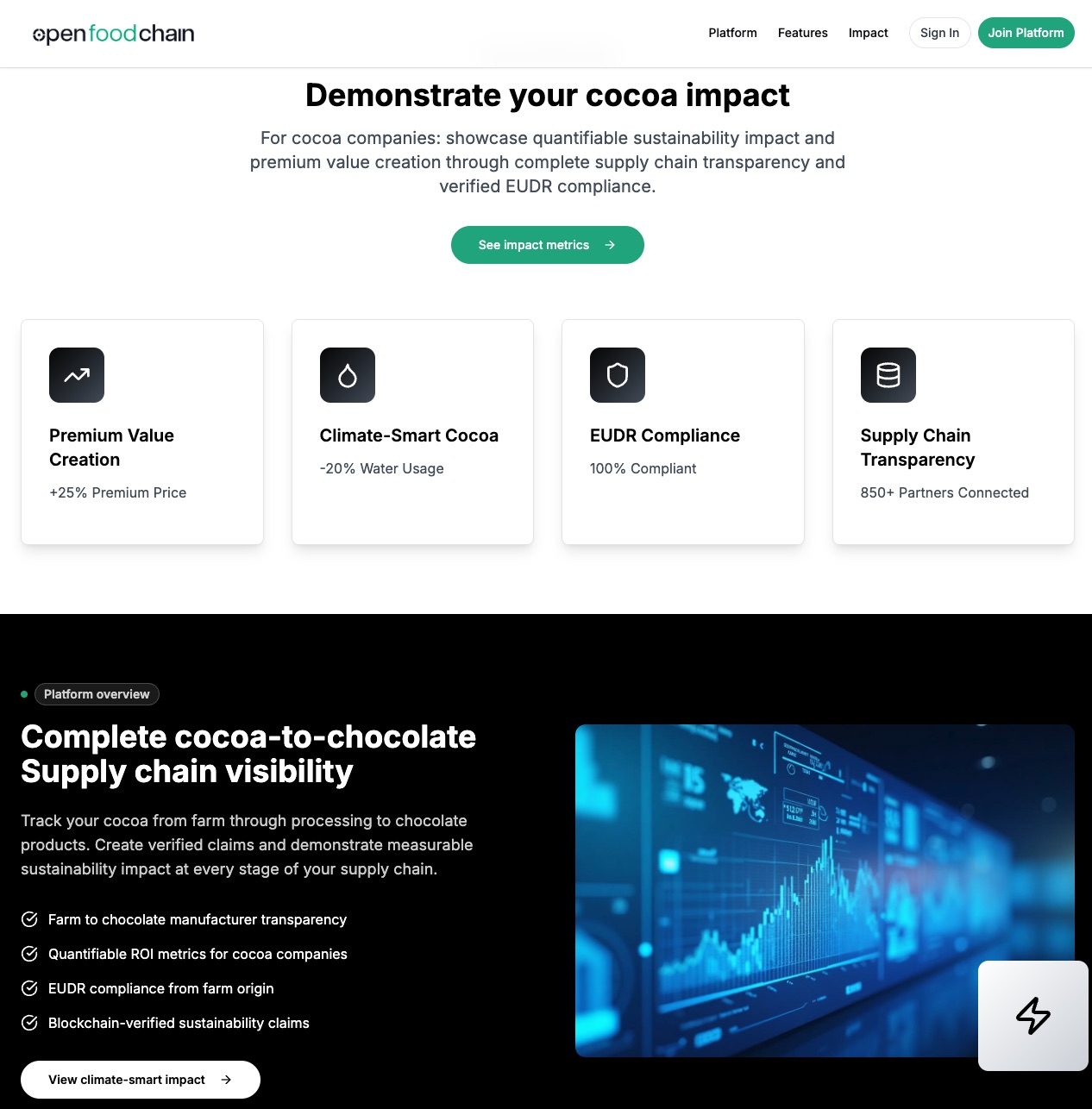
OFC has established, multi-year collaborations with enterprises such as Refresco, Innocent Drinks, Ekoplaza, Chocolatemakers, Belvas, Jungle Gold Bali, and multiple cooperatives across Latin America. These partners validated OFC’s technology in production environments across cacao and juice supply chains.
Kraft Heinz has been an active member of the Open Food Chain product board for multiple years, and is the principal enterprise consortium partner for the current Enterprise Tier-1 Integration proposal. Kraft Heinz is one of the world’s largest food companies ($25.85B annual revenue), with global sourcing networks covering tomatoes, legumes, sauces, beans, oils, meets and more. Tomatoes are a strategic ingredient, and the company actively invests in sustainable tomato agriculture, responsible sourcing, and supply chain transparency.
Additional collaborations include GS1 for product and organizational ID standardization, Global G.A.P., Global Forest Watch, Meridia, and other ESG verification partners. OFC is also working with the Cardano Foundation core integration team on the migration of current architecture to Cardano. These collaboration networks ensure regulatory alignment and enterprise readiness.
Describe funding commitments.
Kraft Heinz provides in-kind co-investment:
- Technical staff for ERP access and integration, validation workflows, supply chain onboarding support.
- A data interoperability and blockchain governance PhD researcher in collaboration with the VU University.
- Ensuring supplier organizations participation in data mapping, operational testing, and readiness verification.
The Open Food Chain will contribute:
- Co-funding of 50% of labour costs
Describe your key performance metrics.
Enterprise Adoption KPIs
- Number of active Kraft Heinz supply chain participants onboarded (farms, processors, QA teams).
- Percentage of targeted tomato volume digitized in pilot (e.g., 50–100k tonnes).
- Number of product batches/SKUs tracked end-to-end.
- Number of origin claims verified and published
- Optional: number of sustainability claims (SAP Manual / SAI FSA) verified and published.
On-Chain KPIs
- Number of digital batch anchors on Cardano
- Number of origin claims anchored.
- Optional: Number of additional claims anchored (sustainability, processing, quality).
- On-chain data completeness rate (% of required fields present).
- Number of transactions produced by the pilot, adjusted by batching model.
Operational KPIs
- Time-to-onboard per actor (in days).
- Number of successful ERP or data-system integrations.
- Data quality score (% data passing validation).
- Uptime and reliability metrics for nodes and APIs.
Scalability KPIs
- Number of reusable components created (APIs, connectors, schemas).
- Number of regions/value chain segments activated beyond initial pilot.
- Scalability-readiness score (ability to expand to X more farms/processors).
Consumer Engagement KPIs
- QR scan rate per batch/product.
- Click-through rate from QR landing page.
- Average engagement time on transparency page.
- Repeat scanner rate.
- (Optional) Sales uplift for traced SKUs, provided by Kraft Heinz.
[Your Project and Solution] Solution
Please describe your proposed solution and how it addresses the problem
This project integrates a subset of Kraft Heinz’s sustainably certified tomato suppliers into the OFC unified traceability platform, powered by Cardano. Tomatoes are one of Kraft Heinz’s highest-volume inputs and have sophisticated regulatory and ESG requirements. Their supply chain involves multiple transformations—farm → sorting → processing → tomato paste → ketchup—creating high-frequency data opportunities well suited to blockchain anchoring.
OFC captures verified, structured data from tomato growers, cooperatives, processors, logistics providers, and factories. Each tomato batch is represented by a tokenized digital twin, with primarily origin and hand-off points logged on Cardano and with additional ESG events following but beyond the current pilot scope:
- harvest and field metadata
- water usage and irrigation method
- pesticide/fungicide logs (EU MRL compliance)
- soil health and fertilizer management
- sustainability certifications (e.g., GlobalG.A.P.)
- quality metrics (Brix, acidity, contaminants)
- processing events (paste production, blending)
- logistics and batch transformations
- energy use and carbon indicators
Origin and ESG claims become publicly verifiable through Cardano’s public blockchain. The sustainability focus of Cardano and the deterministic UTXO transaction model and low fees make Cardano uniquely equipped for the high-volume nature of sustainable tomato agriculture.
[Your Project and Solution] Impact
Please define the positive impact your project will have on the wider Cardano community
This is Cardano’s first large-scale, Tier-1 enterprise integration in a globally consumed product category (ketchup). It demonstrates that Cardano can support mission-critical supply chain workflows for multinational companies.
Transaction Growth
Tomatoes create far more events per year than specialty commodities:
- harvest and sorting
- quality grading
- pesticide logs
- paste production
- blending
- bottling
- logistics and batch transformations
Each event is an on-chain opportunity, generating recurring, high-volume transactions.
Ecosystem Tools
Open-sourced modules (schemas, ingestion pipelines, dashboards, compliance tools) become reusable infrastructure for future enterprise integrations and represent long-term value.
Sustainability Leadership
The pilot anchors origin data and opens up the pathway for anchoring a much more extensive set of ESG-relevant data (water, soil, pesticides, carbon), positioning Cardano as the preferred platform for responsible sourcing and sustainability-aligned food systems.
Global Expansion Potential
Tomatoes are a globally grown crop. Once the pilot delivers, it can be replicated across regions and scaled to additional ESG related events and other Kraft Heinz commodities and to other enterprises.
[Your Project and Solution] Capabilities & Feasibility
What is your capability to deliver your project with high levels of trust and accountability? How do you intend to validate if your approach is feasible?
Open Food Chain brings four years of real-world deployment experience across cacao, juice, and meat value chains, with more than 3,000 farmers, cooperatives, processors, and retailers using the system across multiple continents. These deployments span ERP integrations (including SAP and custom systems), mobile and offline data capture, geolocation-linked sourcing, ESG and deforestation checks, and multiple end-to-end product journeys from producers to retailers. This proven track record demonstrates that OFC’s workflows, data structures, and onboarding processes are mature, scalable, and production-ready.
Technical Maturity & Readiness
OFC’s architecture has been redesigned to unify the previously separated industry-specific blockchains (e.g. our Juicy Chain and Cacao Chain) onto a single Open Food Chain seamlessly integrated with Cardano, providing a robust foundation for batch-level anchoring, claim verification, and interoperable global food supply-chain data. This redesigned architecture is already being validated through the near-complete migration of the Juicy Chain and Open Cacao Chain to Cardano, which implements:
- Wallet logic and batch representation on Cardano’s UTXO model
- Anchoring of traceability events on Cardano
- Batch and claim linking mechanisms
- Decentralized oracle structures for metadata and profile information
By the start of this pilot, the migration of OFC is completed and tested, enabling this project to focus specifically on configuring, integrating, and piloting the system with Kraft Heinz’s tomato value chain.
This ensures that the technical foundation is in place ahead of the pilot, while the Catalyst-funded work is clearly focused on enterprise-specific integration, data flows, and validation within Kraft Heinz’s operations.
Leadership & Expertise
The project is led by Marieke de Ruyter de Wildt(https://www.linkedin.com/in/marieke-de-ruyter-de-wildt/ ) a globally recognized AgTech expert with over 25 years of experience, including leadership roles at World Agricultural Forum (https://worldagricultureforum.org/ ) Wageningen University (https://www.wur.nl/en.htm ) and AgriPlace (https://www.agriplace.com/ ) Her experience ensures strong alignment with agricultural realities, corporate processes, and sustainability frameworks.
She is supported by a senior engineering and product team:
- Marieke de Ruyter de Wildt, CEO and industry expert (https://www.linkedin.com/in/marieke-de-ruyter-de-wildt/ ) a globally recognized AgTech expert with over 25 years of experience, including leadership roles at World Agricultural Forum (https://worldagricultureforum.org/ ) Wageningen University (https://www.wur.nl/en.htm ) and AgriPlace (https://www.agriplace.com/ ) Her experience ensures strong alignment with agricultural realities, corporate processes, and sustainability frameworks.
- Armin R. , CTO (https://www.linkedin.com/in/arminreiter/ ) – Over a decade of blockchain engineering experience, including building a custom EVM-based Layer 1 blockchain and large-scale tokenization systems for regulated industries. Leads architecture, node infrastructure, and enterprise data integrations
- Tegar Santosa, backend and blockchain engineer (http://linkedin.com/in/tegarsantosa/ ) – Cardano x DraperU Founder Residency alumni, with OFC for 3 years, blockchain development, Backend/API integration and ERP interoperability
- Chris van Maarseveen, blockchain engineer (https://www.linkedin.com/in/chris-van-maarseveen/ ) – With OFC for 5 years, blockchain development, smart contract implementation.
- Daniel Verweij, UX design & full stack engineer, (https://www.linkedin.com/in/daniel-verweij-7a5b158b/ ) – Cardano x DraperU Founder Residency alumni Crypto-native designer since 2012, experienced in building user-friendly blockchain tools for low-tech users such as farmers and cooperatives.
- Caspar Roelofs, Product Strategy and Management, (https://www.linkedin.com/in/caspar-roelofs/ ) – Award-winning decentralized systems builder with deep expertise in data interoperability, product research, and multi-stakeholder coordination, combined with 7 years of academic research in sustainable innovation systems.
This team combines enterprise integration capabilities, blockchain engineering strength, UX design for low-infrastructure environments, and experienced leadership in agriculture and sustainability.
Ecosystem Expertise & Strategic Alignment
OFC is an alumnus of the Cardano x Draper University Accelerator, with strong links to developers, governance experts, and infrastructure partners across the Cardano community—ensuring rapid coordination, visibility, and ecosystem support.
Enterprise Feasibility
The pilot is developed in direct collaboration with Kraft Heinz supply chain managers, IT specialists, and sustainability teams, providing access to:
- ERP batch identifiers and product structure
- Processing, paste, and ketchup batch definitions
- Supplier and agronomy data
- Sustainability credentials (e.g., SAP Manual compliance, SAI FSA benchmarks)
- ESG verification partners and data validation workflows (scaling beyond the current pilot scope)
This close collaboration ensures that the integration is grounded in real production data and reflects enterprise operating requirements.
In summary
This project is highly feasible due to:
- A proven OFC infrastructure already deployed across multiple value chains and in operation.
- A redesigned and deployed Cardano-native architecture.
- A senior team with deep expertise in blockchain engineering, ERP integrations, agrifood digitization, and multi-stakeholder system design.
- Active collaboration with Kraft Heinz teams, providing real data and operational involvement.
This combination of technical readiness, leadership strength, ecosystem support, and enterprise engagement ensures that OFC can deliver a robust, scalable Cardano-based traceability solution for Kraft Heinz—and demonstrate Cardano’s value as a leading blockchain for real-world enterprise adoption.
[Milestones] Project Milestones
Milestone Title
M1 – Pilot Design Finalisation
Milestone Outputs
This milestone finalizes the technical blueprint for the origin-focused tomato traceability pilot. It defines the system architecture, batch model, anchoring logic, and all data structures required to run the pilot reliably on Cardano.
Planned Outputs / Deliverables / Outcomes:
- Final pilot scope, KPIs, and architecture documented and approved.
- Complete tomato origin data schemas (farm → processor → factory).
- Defined batching and batch-linking logic for origin events.
- Configured Cardano ingestion and anchoring modules.
- Successful internal testnet anchoring of sample tomato batches.
- Security validation of ingestion endpoints and batch metadata.
- Developer documentation covering schemas, ingestion flows, anchoring steps, and transformation logic.
Acceptance Criteria
This milestone is accepted when all foundational design elements are formally validated and technically proven through internal testing.
Acceptance Criteria:
- Architecture and pilot scope jointly approved by OFC and Kraft Heinz.
- Origin data schemas validated by Kraft Heinz and internally QA-verified.
- A minimum of three batches successfully ingested, hashed, batched, and anchored on Cardano testnet.
- Security checks confirm proper authentication, endpoint reliability, and metadata consistency.
- Developer documentation completed and approved for use in subsequent integration steps.
Evidence of Completion
Completion is demonstrated through formal documentation, validated outputs, and recorded anchoring tests.
Evidence:
- Signed Architecture & Pilot Scope Document including KPIs and diagrams.
- Complete schema package (JSON/definitions) with Kraft Heinz approval.
- Anchoring test reports with transaction hashes and logs.
- Security validation summary with identified risks and mitigations.
- Developer documentation bundle (PDF + repository link).
Delivery Month
1
Cost
75000
Progress
10 %
Milestone Title
M2 – Kraft Heinz Pre-Onboarding & Supply Chain Mapping
Milestone Outputs
This milestone establishes a clear and complete understanding of the tomato origin supply chain and prepares all participating actors for integration and onboarding.
Planned Outputs / Deliverables / Outcomes:
- Full mapping of the origin pathway from farms → processors → paste factories → ketchup plant.
- Event taxonomy for origin tracking, including harvest, intake, processing, and transformation.
- Defined origin data fields and batch identifiers required for the pilot.
- Supplier readiness assessments covering ERP systems, identifiers, and data availability.
- Final onboarding plan including timelines, communication channels, and responsibilities.
- Documentation of data-submission workflows for SAP and custom ERP environments.
Acceptance Criteria
The milestone is accepted once all supply-chain information is validated and supplier readiness is confirmed.
Acceptance Criteria:
- Kraft Heinz approves the full supply-chain map, including participating suppliers and transformation logic.
- Event taxonomy validated, with all origin-relevant events defined and structured.
- Core origin data fields confirmed for all pilot suppliers.
- Supplier readiness assessments completed and validated by both technical teams.
- Final onboarding plan approved by OFC and Kraft Heinz with agreed rollout timelines.
Evidence of Completion
Evidence consists of the full mapping package and validated onboarding framework:
- Supply Chain Mapping Dossier with diagrams, tables, and flow descriptions.
- Approved event and data model documentation.
- Supplier readiness matrix summarizing ERP systems, identifiers, and data quality.
- Signed onboarding plan with responsibilities and schedule.
- Meeting minutes confirming Kraft Heinz approval.
Delivery Month
2
Cost
75000
Progress
20 %
Milestone Title
Tomato Supplier & ERP Integration
Milestone Outputs
This milestone delivers functioning ERP integrations that allow suppliers to automatically send origin data into OFC’s ingestion pipeline for validation and test anchoring.
Planned Outputs / Deliverables / Outcomes:
- SAP connector implemented and tested for origin-relevant batch fields.
- At least two custom ERP connectors implemented and configured.
- Fully functional ingestion pipeline processing harvest, intake, and processing events.
- Batch-identifier validation logic implemented for correct linking of transformations.
- Successful pre-production anchoring of several sample batches.
- Monitoring, error-handling, and retry logic established for data ingestion.
- Kraft Heinz IT review and validation of data accuracy and integration security.
Acceptance Criteria
The milestone is accepted when all integrations demonstrate stable, accurate origin data flow.
Acceptance Criteria:
- SAP and custom ERP connectors fully functional and capable of automated origin-data export.
- End-to-end ingestion validated using real or representative supplier data.
- At least three full batch flows anchored on Cardano testnet through the ingestion pipeline.
- Ingestion reliability reaches at least 95% in pre-production testing.
- Kraft Heinz IT provides written validation of integration and security compliance.
Evidence of Completion
Evidence is captured through logs, test reports, and formal approvals.
Evidence:
- ERP integration logs demonstrating successful origin-data ingestion.
- Ingestion validation report with error rates and success metrics.
- Testnet anchoring records with transaction IDs and timestamps.
- Kraft Heinz IT approval note confirming validation.
- Versioned connector code repositories.
Delivery Month
4
Cost
137500
Progress
40 %
Milestone Title
M4 – Enterprise Pilot Deployment: Tomato Origin Traceability
Milestone Outputs
This milestone deploys the live pilot across all participating suppliers and Kraft Heinz facilities, enabling full origin traceability from farm to finished ketchup batch.
- Planned Outputs / Deliverables / Outcomes:
- Live ingestion of origin data from all participating suppliers and processors.
- Full farm → processor → paste → ketchup transformation chain implemented.
- Mainnet anchoring of all pilot batches using validated batch aggregation logic.
- Supplier onboarding toolkit deployed and actively used.
- Production-level monitoring, issue resolution, and iterative improvements.
- Kraft Heinz validation confirming accurate and complete origin tracking.
Acceptance Criteria
The milestone is accepted when the end-to-end origin pilot is live, accurate, and functionally validated.
Acceptance Criteria:
- All pilot batches successfully ingested, processed, linked, and anchored on Cardano mainnet.
- Transformation chain verified from farm through to ketchup production.
- Supplier onboarding toolkit functioning and adopted by all pilot participants.
- System stability demonstrated through monitored uptime and error resolution.
- Kraft Heinz provides formal acceptance of the live pilot deployment.
Evidence of Completion
Evidence reflects live production readiness and mainnet anchoring.
Evidence:
- Live dashboard screenshots showing full origin paths and batch transformations.
- Mainnet anchoring logs with transaction IDs, hashes, and timestamps.
- Supplier onboarding reports confirming active usage.
- Pilot deployment report summarizing stability, issues resolved, and performance.
- Signed Kraft Heinz acceptance statement.
Delivery Month
8
Cost
225000
Progress
70 %
Milestone Title
M5 – Dashboards, Reporting & Scalability Validation
Milestone Outputs
This milestone delivers enterprise dashboards, reporting capabilities, and scalability validation required to support future multi-supplier or multi-region deployments.
Planned Outputs / Deliverables / Outcomes:
- Dashboards displaying batch origin paths, transformations, and completeness rates.
- Reporting engine generating origin-focused batch summaries.
- Supplier self-onboarding workflow enabled and validated for origin data.
- Load tests simulating high-volume tomato processing and anchoring.
- Stress testing of ingestion throughput and batch-processing stability.
- Dashboard and reporting review cycles with Kraft Heinz.
Acceptance Criteria
The milestone is accepted when dashboards, reporting tools, and scalability results meet enterprise requirements.
Acceptance Criteria:
- Dashboards reviewed and approved by Kraft Heinz for usability and correctness.
- Reporting engine generates accurate, exportable batch summaries.
- Self-onboarding workflow validated by at least two suppliers.
- Scalability tests demonstrate stable ingestion and anchoring under high volumes.
- Stress-test results show resilience and acceptable performance thresholds.
Evidence of Completion
Evidence demonstrates dashboard functionality and system robustness.
Evidence:
- Dashboard screenshots and feature inventory.
- Sample origin-report outputs used in review sessions.
- Walkthrough or demo of supplier self-onboarding workflow.
- Load and stress-test results with performance graphs.
- Kraft Heinz review notes confirming approval.
Delivery Month
11
Cost
125000
Progress
90 %
Milestone Title
M6 – Final Delivery, Validation & Open-Source Release
Milestone Outputs
This milestone finalizes the project with complete documentation, open-source releases, validation outputs, and a jointly produced communication package.
Planned Outputs / Deliverables / Outcomes:
Final technical documentation and completion report.
Open-source repositories updated with schemas, ingestion modules, anchoring logic.
Enterprise case study developed jointly with Kraft Heinz.
Expansion blueprint for scaling origin tracking across tomato regions.
Joint public communication (press release/article).
Formal project sign-off by Kraft Heinz and OFC.
Acceptance Criteria
The milestone is accepted when all components are delivered, validated, and published.
Acceptance Criteria:
- Final documentation complete and approved.
- All relevant modules published publicly with clear versioning.
- Kraft Heinz formally validates the pilot outcomes.
- Expansion blueprint reviewed and accepted.
- Joint publication approved for release.
Evidence of Completion
Evidence reflects finalization, publication, and approval of all deliverables.
Evidence:
- Final report and documentation package.
- Public GitHub repositories with version tags.
- Kraft Heinz formal sign-off letter.
- Expansion blueprint document.
- Published joint communication (press release/article).
Delivery Month
12
Cost
112500
Progress
100 %
[Final Pitch] Budget & Costs
Please provide a cost breakdown of the proposed work and resources
Total Budget Requested
750,000 ADA
Assumed ADA Rate: €0.36/ADA
Catalyst Budget in EUR: €270,000
Co-Investment Structure
Open Food Chain co-invests 50% of all labour costs.
This means:
- Actual total labour cost for the project: ~€540,000
- Catalyst contribution (50%): €270,000
- Open Food Chain co-investment (50%): €270,000
Hourly Rate Model
OFC uses a blended actual labour rate in line with European technical market norms of €65–€95/hour. For budgeting consistency, we apply:
- Current rate: €65/hour, leaving sufficient room for ADA to increase in Value within the market norms of €65–€95/hour.
- Catalyst-funded effective rate after 50% OFC co-investment: €32.50/hour (≈ 90 ADA/hour)
Total Hours and Budget
- Total labour hours: ~8,330 hours
- Actual total hours cost covered (including OFC co-investment):
- 8,330h × 180 ADA/h (full rate) = 1,499,400 ADA (≈ €540,000)
- Catalyst-funded hours: 8,330h × 90 ADA/h = 750,000 ADA
- Catalyst cost: €270,000
- OFC co-investment: €270,000
Cost Breakdown by Functional Area
The costs per functional area funded through Catalyst (50%) are:
- Engineering & Technical Development (60%): 450,000 ADA / €162,000
- Data Modeling & Architecture (10%): 75,000 ADA / €27,000
- Enterprise Coordination & Onboarding (10%): 75,000 ADA / €27,000
- QA, Testing & Reliability (5%) 37,500 ADA / €13,500
- Documentation & Open-Source (5%): 37,500 ADA / €13,500
- PM, Governance, Legal, Infra (10%): 75,000 ADA / €27,000
Detailed Costs by Milestone
The budget per milestone is:
- M1 – Design Finalisation, (830h): ADA75,000 / €27,000
- M2 – Pre-Onboarding (830h): ADA75,000 / €27,000
- M3 – ERP Integration (1,530h): ADA137,500 / €49,500
- M4 – Pilot Deployment (2,500h): ADA 225,000 €81,000
- M5 – Dashboards & Scalability (1,390h): ADA125,000 / €45,000
- M6 – Final Delivery (1,250h): ADA112,500 / €40,500
All milestone budgets reflect the expected complexity, required engineering effort, and delivery timelines. The detailed budget breakdowns within each milestone are as follows:
M1 – Pilot Design Finalisation
Budget: 75,000 ADA (€27,000)
Hours: ~830h
Workstream Hours:
- Architecture & Cardano design – 220h
- Origin schema & batch model – 180h
- Ingestion & anchoring prototype – 200h
- Security & QA – 100h
- Documentation – 80h
- Product & partner coordination – 50h
M2 – Pre-Onboarding & Supply Chain Mapping
Budget: 75,000 ADA (€27,000)
Hours: ~830h
Workstream Hours:
- Supply chain mapping – 200h
- Event taxonomy & origin data model – 160h
- ERP/BID review – 120h
- Onboarding plan design – 120h
- KH consultations – 130h
- Documentation – 100h
M3 – Supplier & ERP Integration (SAP + Custom Systems)
Budget: 137,500 ADA (€49,500)
Hours: ~1,530h
Workstream Hours:
- SAP connector – 410h
- Custom ERP connectors – 350h
- Ingestion pipeline & batch linking – 275h
- QA/reliability testing – 230h
- Supplier support – 215h
- Documentation – 50h
M4 – Enterprise Pilot Deployment
Budget: 225,000 ADA (€81,000)
Hours: ~2,500h
Workstream Hours:
- Mainnet anchoring pipeline – 450h
- Supplier deployment & onboarding – 420h
- Technical support & stabilisation – 400h
- Dashboard adjustments – 300h
- Product management – 300h
- QA for production validation – 250h
- Kraft Heinz coordination – 180h
- Batch-level data validation – 200h
M5 – Dashboards, Reporting & Scalability
Budget: 125,000 ADA (€45,000)
Hours: ~1,390h
Workstream Hours:
- Enterprise dashboards – 400h
- Reporting engine – 320h
- Load and stress testing – 220h
- UX for onboarding workflows – 120h
- PM/user validation – 120h
- Documentation – 80h
- Kraft Heinz review cycles – 130h
M6 – Final Delivery & Open-Source Release
Budget: 112,500 ADA (€40,500)
Hours: ~1,250h
Workstream Hours:
- Documentation & handover – 250h
- Open-source release prep – 280h
- Case study & expansion plan – 200h
- Joint communication – 120h
- Validation/QA – 150h
- Governance & project management – 250h
[Final Pitch] Value for Money
How does the cost of the project represent value for the Cardano ecosystem?
This project brings exceptional value to the Cardano ecosystem by establishing Cardano as the trusted, scalable, and sustainability-aligned infrastructure for one of the world’s largest and most complex industries: food. Through a Tier-1 enterprise collaboration with Kraft Heinz, this proposal delivers Cardano’s first end-to-end integration into a globally consumed, high-volume product—Tomato Ketchup—demonstrating real-world adoption in supply chains that operate year-round, across continents, and under strict regulatory oversight.
By anchoring the lifecycle of sustainably sourced tomatoes—one of Kraft Heinz’s most critical ingredients—onto Cardano, the project positions the network at the center of enterprise transformation, sustainability reporting, and global food system transparency. The long-term value is substantial: high trust, high visibility, recurring use, and a blueprint for future enterprise-scale integrations that can multiply Cardano’s real-world utility.
Cardano’s Value Grows Through Real, Recurring, Regulated Use
Cardano’s architecture is uniquely suited for food systems: it is scalable, low-cost, energy-efficient, and built for predictable, high-integrity data operations. Food companies operate continuously, generating structured data across growing seasons, processing cycles, quality checks, safety controls, and logistics events. Unlike speculative blockchain activity, supply chain data flows are real, mandatory, and repeatable.
For tomatoes, these flows include harvest metadata, pesticide and residue compliance, irrigation metrics, soil management logs, quality indicators (such as Brix and acidity), processing steps into paste, blending operations, cooking parameters, batch creation, and factory-level transformation events. Anchoring these data points onto Cardano through an enterprise-aligned, batch-based model creates a steady stream of meaningful, verifiable transactions that reflect real economic activity.
Every product batch represents a captured and verified supply chain history. As Heinz scales this approach across additional suppliers, regions, and ultimately additional commodities, Cardano becomes embedded in a global ecosystem with millions of annual batch processes.
Enterprise Adoption of Cardano
This collaboration with Kraft Heinz is one of the most strategically powerful enterprise partnerships ever introduced into a Catalyst proposal. Kraft Heinz is:
- a global Fortune 500 company
- a leader in consumer packaged goods
- an agricultural buyer with global influence
- a company deeply committed to sustainability and responsible sourcing
- a producer of one of the world’s most iconic food products
By integrating Cardano into the tomato supply chain—one of their highest-volume and most sustainability-sensitive ingredients—Cardano gains more than a new technical integration: it gains enterprise validation, which is a cornerstone for wider industry trust and adoption.
Enterprise partners watch each other closely. If Kraft Heinz demonstrates that Cardano is reliable, scalable, compliant, and operationally fit for food systems, it lowers barriers for dozens of other global companies across food, retail, logistics, certification, and regulatory technology. The multiplier effect for the ecosystem is significant.
A Blueprint for the Global Food Industry
Food is one of the most universally relevant blockchain applications. Every food product has:
- a traceable origin
- regulatory and safety checks
- environmental impacts
- labor and community implications
- processing steps
- logistics movements
- consumer-facing transparency requirements
Yet today, global food data is fragmented across non-interoperable systems, proprietary databases, and manual processes. Cardano provides something the industry has long lacked: a public trust layer for shared, verifiable supply chain data.
Tomatoes, in particular, represent an ideal proving ground:
- they are processed at high volumes
- they undergo many transformations
- they require strict pesticide residue compliance
- they have significant environmental footprints
- they feed into some of the world’s most consumed food products
- sustainability and responsible cultivation are high-priority areas for global brands
Demonstrating success with tomatoes naturally unlocks pathways to extend the model to Kraft Heinz’s broader commodities—including beans, cucumbers, spices, condiments, oils—and to other multinational food companies evaluating blockchain.
Sustainability Alignment Reinforces Cardano’s Identity
The global shift toward sustainability, carbon reduction, responsible sourcing, and transparent ESG reporting creates a major opportunity for Cardano. Tomatoes are highly regulated and ESG-sensitive:
irrigation and water use must be measured
soil management and fertilizer application must be documented
pesticide usage must meet EU 396/2005 MRL limits
energy use and carbon footprint must be tracked
worker conditions and certifications matter
quality and safety data are essential for recall prevention
Anchoring ESG-relevant datasets to Cardano, via hashed records batched per product batch, elevates Cardano’s role as a climate-aligned blockchain fit for corporate sustainability transformations. This strengthens Cardano’s positioning with enterprises seeking to digitize sustainability processes without increasing their carbon footprint.
Efficient, Realistic Use of Cardano Through Batch Anchoring
While food systems generate large amounts of data, not every event needs its own blockchain transaction. Instead, this project uses an optimized batch-anchoring model: dozens of operational events are aggregated, hashed, and anchored as a single blockchain entry tied to a specific tomato product batch.
This model:
- reduces cost
- preserves speed and efficiency
- increases throughput
- supports enterprise scalability
- ensures strong data integrity
- aligns with Kraft Heinz’s operational workflows
Batch anchoring still produces meaningful and recurring on-chain activity, especially when applied across suppliers, factories, and processing cycles. At scale, even aggregated batch-level anchoring produces large volumes of transactions tied directly to real economic activity—far more durable than market-driven or speculative blockchain usage.
Open-Source Modules Create Lasting Ecosystem Infrastructure
The project delivers open-source assets that become reusable for the entire Cardano ecosystem:
- ingestion pipelines
- data schemas for tomatoes and other commodities
- ESG data models
- reporting templates
- onboarding workflows
- dashboard components
- batch-anchoring logic
- Cardano integration modules
These assets reduce integration time for future partners and make Cardano more attractive as a platform for enterprise use. They also encourage interoperability between enterprises, certification bodies, auditors, sustainability frameworks, and regulators.
The result is a growing network of stakeholders building on a shared Cardano infrastructure—a flywheel effect where each new integration becomes easier and more impactful.
Catalyst Funding Unlocks Large-Scale, Long-Term Returns
Catalyst funds act as a catalyst—unlocking a high-impact enterprise integration that would otherwise require far more time and investment. Funding covers only the future development required to deliver the Kraft Heinz pilot. OFC’s prior infrastructure development, architecture consolidation, and Cardano migration have already been funded separately, reducing Catalyst cost and increasing cost-efficiency.
Meanwhile:
- Kraft Heinz contributes engineering, operations, and supplier access
- suppliers provide data, time, and process validation
- OFC contributes years of prior R&D, UX frameworks, supply chain experience, and 50% co-funding of all labour costs
This creates extraordinary leverage for the ecosystem. A modest Catalyst investment unlocks global enterprise adoption and reusable infrastructure for years to come.
Conclusion: High Impact, High Credibility, High Long-Term Value
This project positions Cardano as the trusted, efficient, sustainability-aligned platform for global food traceability—validated through a live Tier-1 deployment with Kraft Heinz. It generates recurring, meaningful on-chain activity tied to real economic processes, provides reusable infrastructure for future enterprise adoption, strengthens Cardano’s sustainability identity, and establishes a blueprint that can expand across products, geographies, and industries.
By integrating the tomato supply chain—a high-volume, high-impact, globally relevant commodity—this proposal delivers exceptional value for money and represents one of the strongest, most transformational enterprise opportunities for the Cardano ecosystem to date.
[Self-Assessment] Self-Assessment Checklist
I confirm that the lead applicant is a verified legal business entity.
Yes
I confirm that the lead org has a ≥2-year track record, and the consortium collectively has ≥$5M in verifiable annual revenue.
Yes
I confirm that evidence of collaboration with a qualified Tier-1 enterprise is provided.
Yes
I confirm that the proposer and all team members are in good standing with prior Catalyst projects.
Yes
I confirm that the proposal is for mature R&D or integration, not an early-stage concept or core infrastructure.
Yes
I confirm that evidence of a mature product is provided, with a clear integration plan if not already on Cardano.
Yes
I confirm that all key partners, including the Tier-1 collaborator, are clearly identified.
Yes
I confirm that a clear statement of the partner's in-kind or financial contributions is included.
Yes
I confirm that the proposal provides verifiable references (e.g., LinkedIn, portfolio) for key team members.
Yes
I confirm that the proposal includes clear KPIs for adoption (e.g., transaction volume, user growth). Forecast for projected on-chain transaction volume is provided with adequate justification.
Yes
I confirm that delivery is ≤ 12 months with clear milestones.
Yes
I confirm that the proposal includes a co-marketing or community engagement plan to amplify Cardano's visibility.
Yes
I confirm that the proposal budget is for future work only, not for completed tasks. No incentives, giveaways, private treasuries and regranting are included in the budget.
Yes
[Required Acknowledgements] Consent & Confirmation
I Agree
Yes
Team
The team includes experts in blockchain engineering, ERP integration, supply chain logistics, ESG analysis, food safety regulation, and enterprise deployments:
- Marieke de Ruyter de Wildt, CEO and industry expert (https://www.linkedin.com/in/marieke-de-ruyter-de-wildt/ ) a globally recognized AgTech expert with over 25 years of experience, including leadership roles at World Agricultural Forum (https://worldagricultureforum.org/ ) Wageningen University (https://www.wur.nl/en.htm ) and AgriPlace (https://www.agriplace.com/ ) Her experience ensures strong alignment with agricultural realities, corporate processes, and sustainability frameworks.
- Armin R. , CTO (https://www.linkedin.com/in/arminreiter/ ) – Over a decade of blockchain engineering experience, including building a custom EVM-based Layer 1 blockchain and large-scale tokenization systems for regulated industries. Leads architecture, node infrastructure, and enterprise data integrations
- Tegar Santosa, backend and blockchain engineer (http://linkedin.com/in/tegarsantosa/ ) – Cardano x DraperU Founder Residency alumni, with OFC for 3 years, blockchain development, Backend/API integration and ERP interoperability
- Chris van Maarseveen, blockchain engineer (https://www.linkedin.com/in/chris-van-maarseveen/ ) – With OFC for 5 years, blockchain development, smart contract implementation.
- Daniel Verweij, UX design & fullstack engineer, (https://www.linkedin.com/in/daniel-verweij-7a5b158b/ ) – Cardano x DraperU Founder Residency alumni Crypto-native designer since 2012, experienced in building user-friendly blockchain tools for low-tech users such as farmers and cooperatives.
- Caspar Roelofs, Product Strategy & Product Management, (https://www.linkedin.com/in/caspar-roelofs/ ) – Award-winning decentralized systems builder with deep expertise in data interoperability, product research, and multi-stakeholder coordination, combined with 7 years of academic research in sustainable innovation systems.