Last updated 10 months ago
SeaPort on Cardano: Processing Indian Port's 12M settlements
Problem
Indian ports like Cochin are in crisis. Due to outdated & slow systems, they move 830k containers instead of 1.2M/yr. These delays create $389M nationwide losses & add to 160Mt CO₂ global emissions.
Solution
Trivolve-Quixy are building Seaport on Cardano to stamp 12M settlements onchain for Port of Cochin, handling 830k+ containers/yr worth $12B+ to ensure traceability, integrity, & improved efficiency.
About this idea
[Proposal setup] Proposal title
Please provide your proposal title
SeaPort on Cardano: Processing Indian Port's 12M settlements
[Proposal Summary] Budget Information
Enter the amount of funding you are requesting in ADA
720000
[Proposal Summary] Time
Please specify how many months you expect your project to last
10
[Proposal Summary] Translation Information
Please indicate if your proposal has been auto-translated
No
Original Language
en
[Proposal Summary] Problem Statement
What is the problem you want to solve?
Indian ports like Cochin are in crisis. Due to outdated & slow systems, they move 830k containers instead of 1.2M/yr. These delays create $389M nationwide losses & add to 160Mt CO₂ global emissions.
[Proposal Summary] Supporting Documentation
Supporting links
[Proposal Summary] Project Dependencies
Does your project have any dependencies on other organizations, technical or otherwise?
No
Describe any dependencies or write 'No dependencies'
No dependencies
[Proposal Summary] Project Open Source
Will your project's outputs be fully open source?
No
Please provide details on the intellectual property (IP) status of your project outputs, including whether they will be released as open source or retained under another licence.
Our solution for the Port of Cochin will remain closed-source due to security and confidentiality concerns. Open sourcing could expose source code to bad actors, compromising both legal and individual privacy standards.
[Theme Selection] Theme
Please choose the most relevant theme and tag related to the outcomes of your proposal
Business Services
[Campaign Category] Category Questions
Describe your established collaborations.
Trivolve Tech leads blockchain integration, ensuring secure, traceable, and scalable anchoring of port operational settlements on the Cardano blockchain. Trivolve is responsible for designing and deploying the hashing, batching, and on-chain verification layers needed to support high-volume port activity.
Quixy, our key partner, brings deep expertise in no-code enterprise platforms and ongoing digital transformation work with the Port of Cochin, providing the operational automation layer.
Together, we combine blockchain engineering with proven process digitization capability, ensuring our solution, SeaPort Information and Management System (SIMS) on Cardano, is both technically robust and practically deployable within the Port of Cochin ecosystem.
Describe funding commitments.
Trivolve Tech is contributing through core development, deployment, and R&D efforts, taking responsibility for building and delivering the Cardano-based traceability and settlement verification components.
Quixy contributes by providing its no-code platform, operational workflow automation, and integration support across Cochin Port’s marine, yard, and transporter processes.
Funding commitments will be allocated collaboratively across project phases, with contributions adjusted according to actual execution needs. While specific internal amounts are not disclosed, Trivolve carries primary responsibility for blockchain delivery, while Quixy provides complementary platform and port process integration support.
Describe your key performance metrics.
Number of port operational modules successfully integrated with on-chain processes.
This includes marine operations, bay plans, yard movements, customs clearance and gate in or gate out events. The metric demonstrates how deeply blockchain anchoring is embedded into real port workflows.
High volume settlement throughput and batching efficiency to reliably process 12 million operational records.
These operational records come from about 834,000 containers each year, which generate approximately 278,000 import and export batches at an average of three containers per batch. Each batch contains around 44 verifiable items, including about 35 documents and 9 operational events that capture the full movement of every vessel and container.
This KPI evaluates the system’s ability to:
• Process, batch and settle all document and event records at scale without loss, duplication or delay
• Maintain stable anchoring performance on Cardano mainnet during peak operational periods
• Consolidate batch level data so each document and event is included, sequenced and stamped correctly before settlement
Key Documents Captured Per Batch
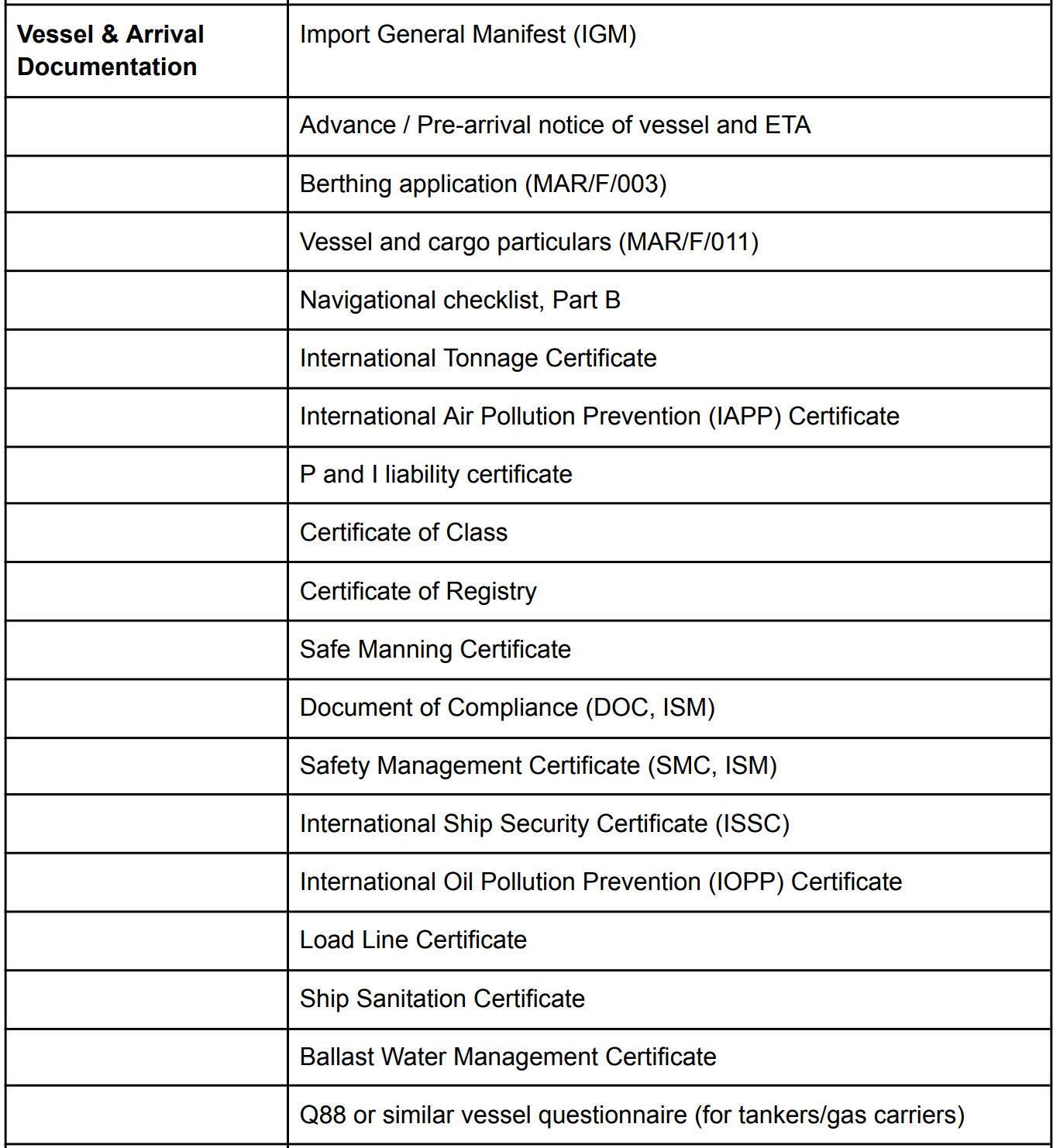
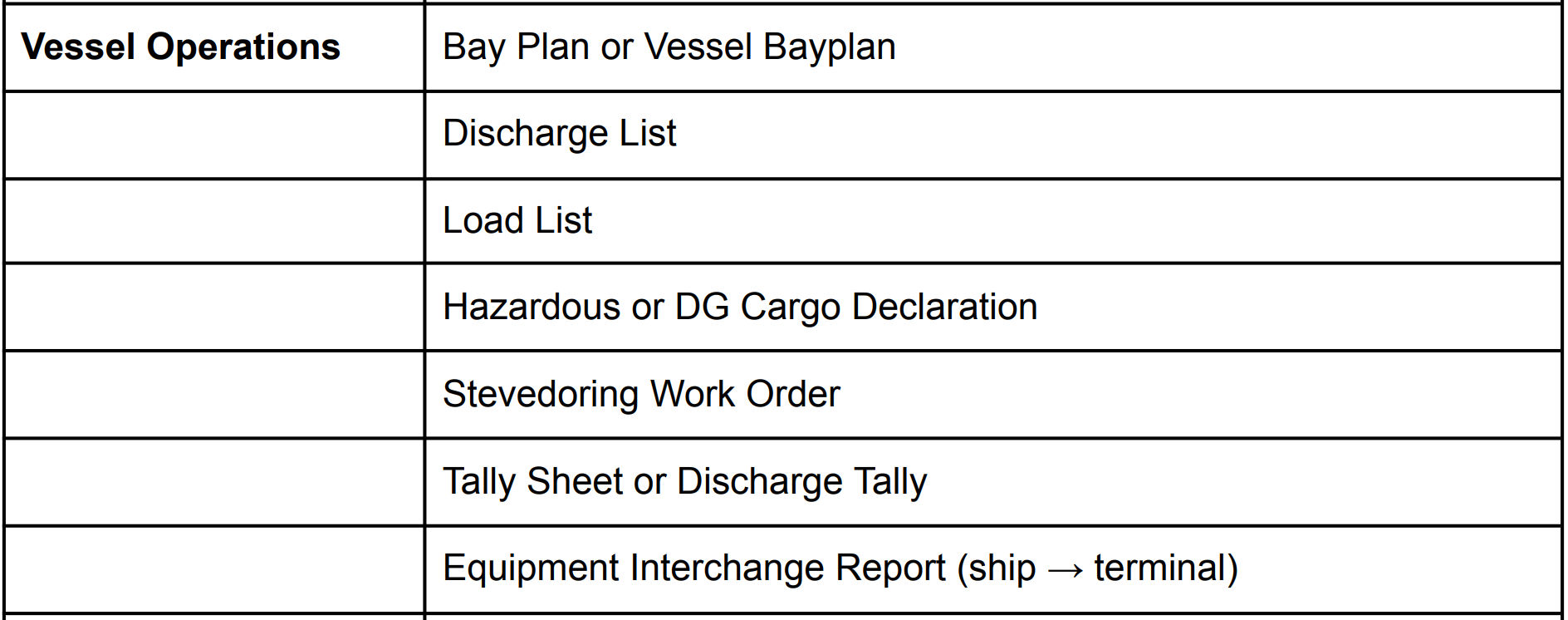
Import General Manifest (IGM), Advance or Pre Arrival Notice of Vessel and ETA, Berthing Application (MAR F 003), Vessel and Cargo Particulars (MAR F 011), Navigational Checklist Part B, International Tonnage Certificate, International Air Pollution Prevention Certificate, P and I Liability Certificate, Certificate of Class, Certificate of Registry, Safe Manning Certificate, Document of Compliance ISM, Safety Management Certificate ISM, International Ship Security Certificate, International Oil Pollution Prevention Certificate, Load Line Certificate, Ship Sanitation Certificate, Ballast Water Management Certificate, Q88 Questionnaire, Bay Plan, Discharge List, Load List, Hazardous or DG Cargo Declaration, Stevedoring Work Order, Tally Sheet, Equipment Interchange Report ship to terminal, Yard Inventory or Stack Assignment, Delivery Request, Bill of Entry or Shipping Bill reference, Regulatory NOC reference such as FSSAI or PQ, Delivery Order or electronic Delivery Order, Out of Charge or Export LEO status, Gate Pass or Release Order, Equipment Interchange Report terminal to truck or train, Final Port or Terminal Invoice, Vessel ETA Update or ATA Update, Pilot Boarding and Berthing Confirmation, Commencement of Cargo Operations, Completion of Cargo Operations, Customs Release or OOC or LEO Milestone, Container Readiness Status, Truck or Train Job Assignment and Slot Allocation, Gate In or Gate Out Movement Event, Final Batch Closeout and Billing Event
Successful stamping of 120,000 Cardano mainnet transactions within the first year from mainnet launch.
This is achieved by batching settlements derived from the 12 million records generated from about 834,000 containers, this shows that the system is capable not only of handling real-world throughput but also of delivering verifiable, tamper-evident records that strengthen trust across shipping lines, terminals, customs and port authorities.
[Your Project and Solution] Solution
Please describe your proposed solution and how it addresses the problem
.png)
Overview
India’s ports are the backbone of its trade economy, yet much of the maritime ecosystem still runs on fragmented systems, manual paperwork and scattered communication. Cochin Port is a clear example: strong physical assets but weak digital coordination. With this, cargo visibility breaks down, operations lose predictability, workers face stress and the value chain absorbs cost, delays and emissions.
Problems With Import/Export Cycle
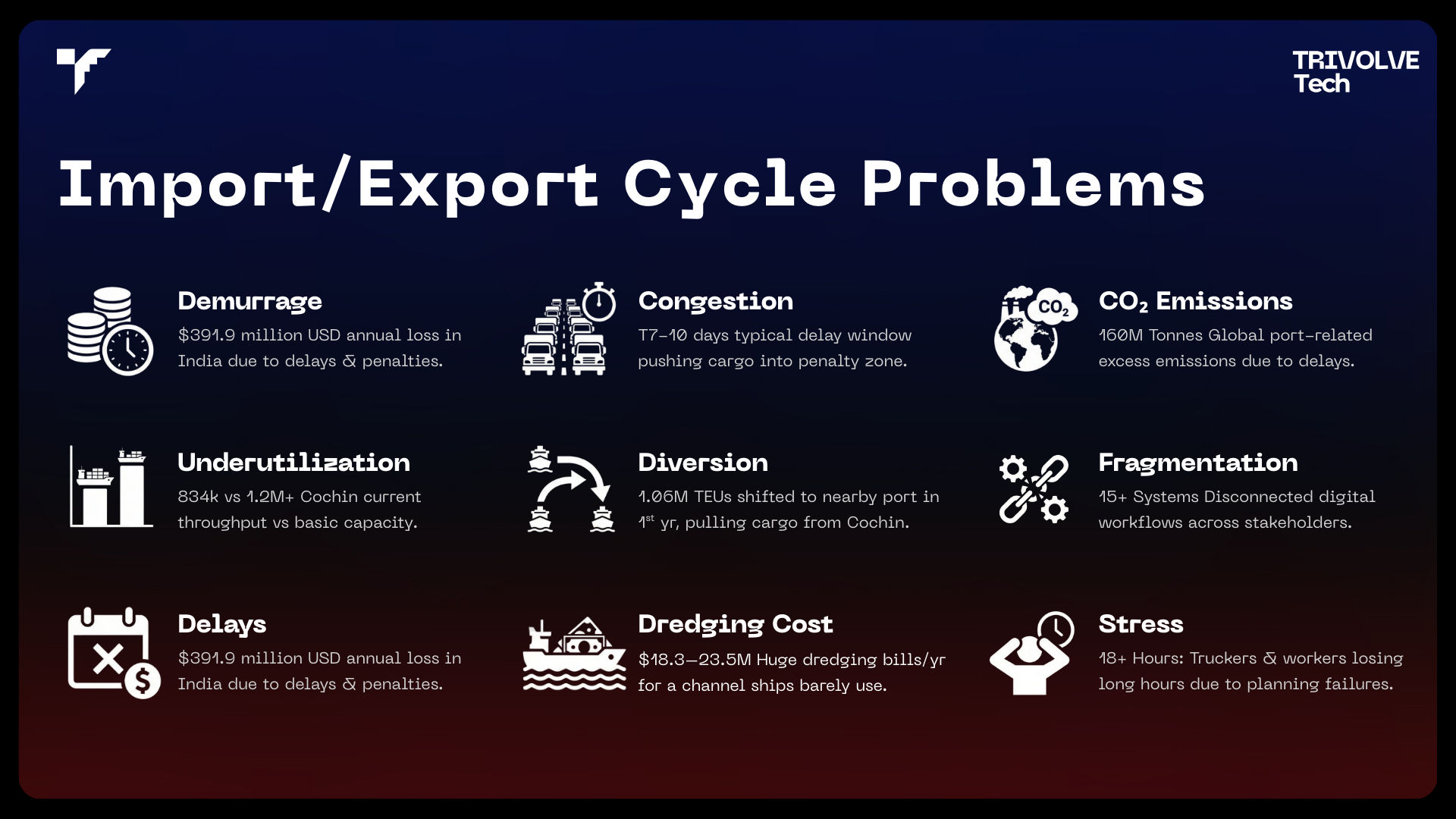
Cochin Port’s Challenges
The Indian Port of Cochin handles only 834,000 TEUs despite a 1–1.2M TEU capacity, while nearby Vizhinjam has already crossed 1.06M TEUs and absorbed mainline traffic. The problem isn’t infrastructure but fragmented digital processes. The operations rely on calls, emails, PDFs, gate passes and manual signatures across customs, terminals, CFS yards and shipping lines spread over 15+ systems, leading to mismatched statuses and poor cargo visibility.
This creates frequent disputes about which version of a document is final, who updated what, and when it changed. Operational decisions often depend on unverified information flows, making it difficult to establish a single, trusted truth across stakeholders.
Operational & Financial Impact
Much of Cochin’s operational data sits in siloed systems that don’t talk to each other: terminal TOS, customs, CFS yards, shipping lines and transporters operate on separate platforms. This breaks real-time planning, causes yard mismatches, creates stuck EIRs, and pushes trucks into long queues. Congestion easily adds 7–10 days to cargo readiness, pushing shipments into penalty zones. India loses USD 9.91M annually to demurrage and delay penalties.
These silos make it impossible to maintain an indisputable event trail, leaving room for inconsistencies, delays in verification, and difficulty proving the exact sequence of actions. Without a verifiable shared timeline, resolving operational disagreements becomes slow and heavily dependent on manual reconciliation.
Environmental & Cost Burdens
Poor coordination increases vessel idling and equipment waits, contributing to the global pattern of 160M tonnes of excess CO₂ emissions. Cochin spends USD 18.35M yearly on dredging (20–25% of operating cost), and deepening to 16m requires USD 70–82M upfront plus USD 23.5M annually yet none of this addresses the real bottleneck: the lack of a trusted, auditable sequence of operational events. Meanwhile, truckers and port workers face 48+ hour stress cycles due to unpredictable planning.
Our Solution: SeaPort Information Management System (SIMS) on Cardano
Overview
Our solution, SeaPort Information Management System (SIMS), fixes the core problem by capturing every document, update, and movement all at one place, that too in a trusted environment. Our solution provides a traceability dashboard where marine, terminal, customs, lines, and transporters all see the same live reality of what has arrived, what is pending, and what is ready. Each event is backed by a Cardano blockchain anchored audit trail, so the data is not only visible but also verifiable and reliable.
Here’s the full journey across each import and export cycle currently and our solution's role in it:
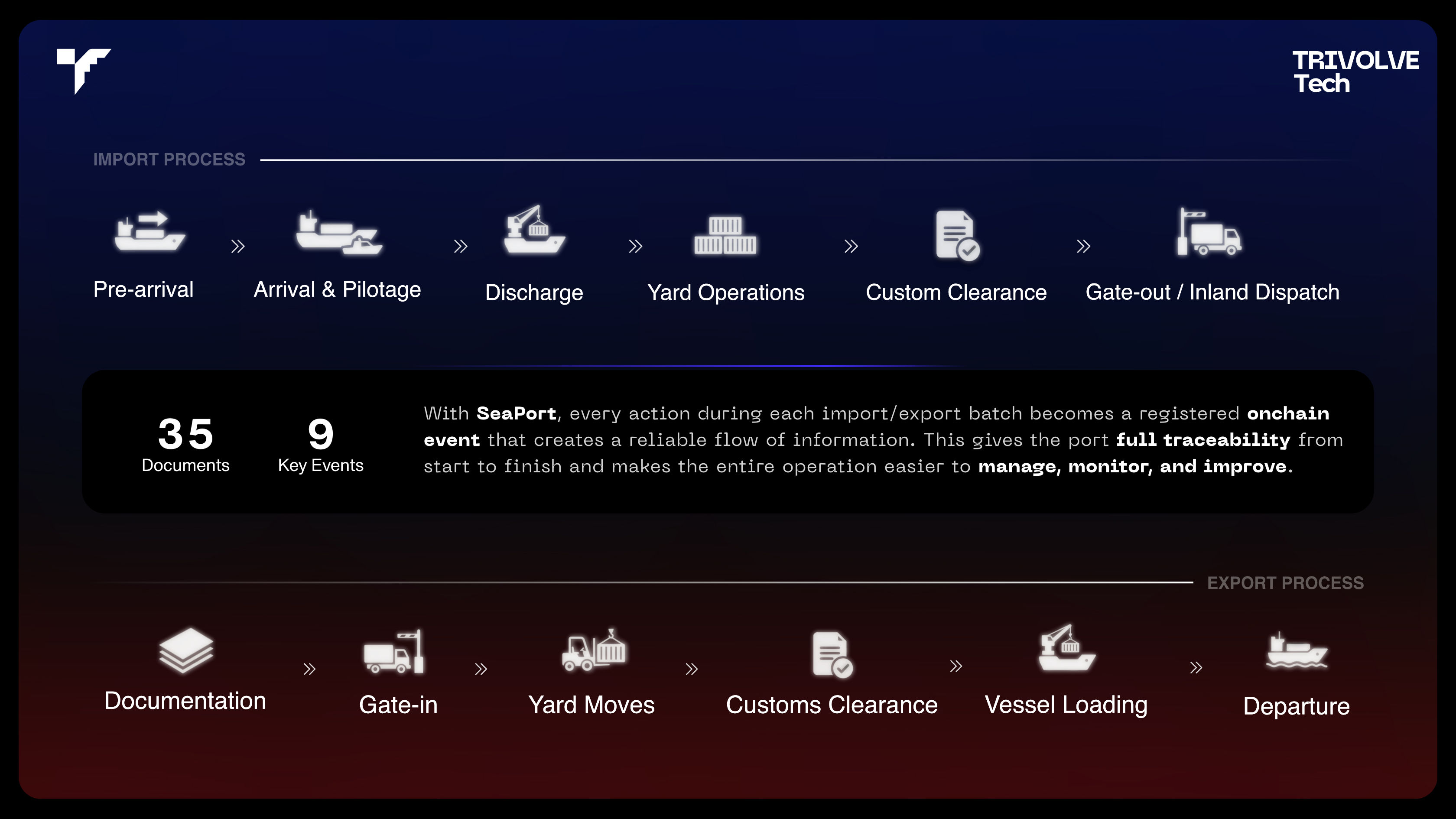
Now let’s dive into each step and see how the SeaPort Information Management System (SIMS) improves it.
1. Before and During Vessel Arrival
The Problem
Arrival information is scattered across calls, emails and PDFs. Different teams use different ETAs, berth requests, certificates and pilot/tug timings. Updates reach people late, causing confusion in berth planning and marine coordination.
Small discrepancies in timing or document updates often go unnoticed, and teams have no dependable way to confirm which submission was the definitive final one. Late adjustments also get interpreted differently across departments, leading to avoidable planning misalignment.
How Our Solution Fixes It
Creating a single Pre-Arrival Pack containing ETAs, berth requests, vessel particulars, certificates, navigation data and marine requirements. All items are anchored and stamped on Cardano Mainnet. Pilot/tug requests and berth confirmations become clear, time-stamped events shared instantly so everyone works from one reliable source.
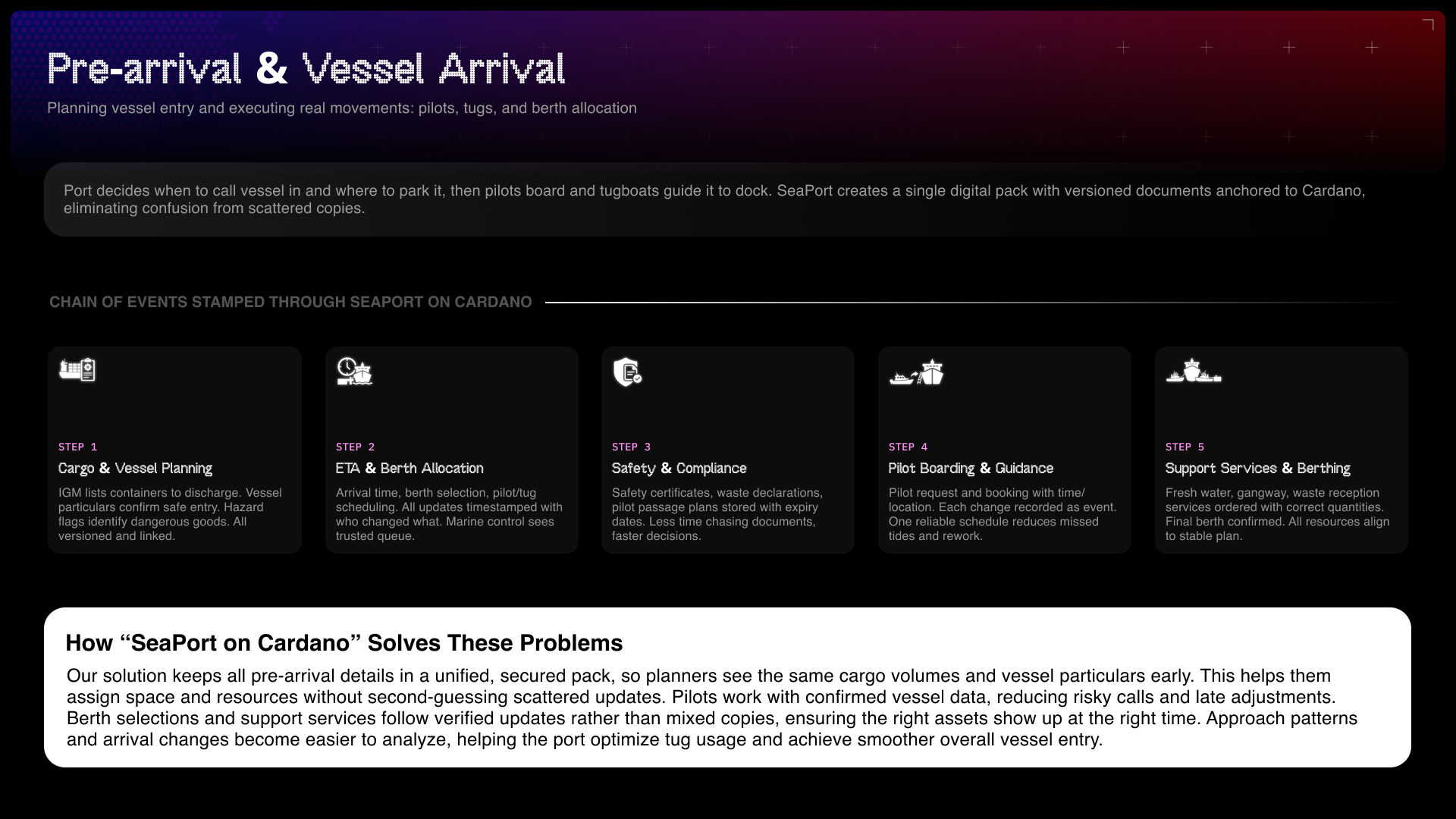
2. Vessel at Berth and Cargo in Yard
The Problem
Teams work with different versions of the bay plan, discharge list or DG details. Late updates interrupt crane operations and cause wrong moves. After discharge, containers may be misplaced or moved without proper logging, creating yard confusion.
When multiple versions circulate, it becomes difficult to trace which one guided the move at that moment, leading to operational disputes.
Rapid movements also outpace documentation updates, making reconciliation slow and error-prone.
How Our Solution Fixes It
Ties the bay plan, discharge list, load list and DG details to each container with complete version history. Every move from vessel to yard is recorded on a digital timeline anchored on Cardano. Delivery Requests connect to containers, allowing yard teams to prepare the right stacks and keep all movements traceable.
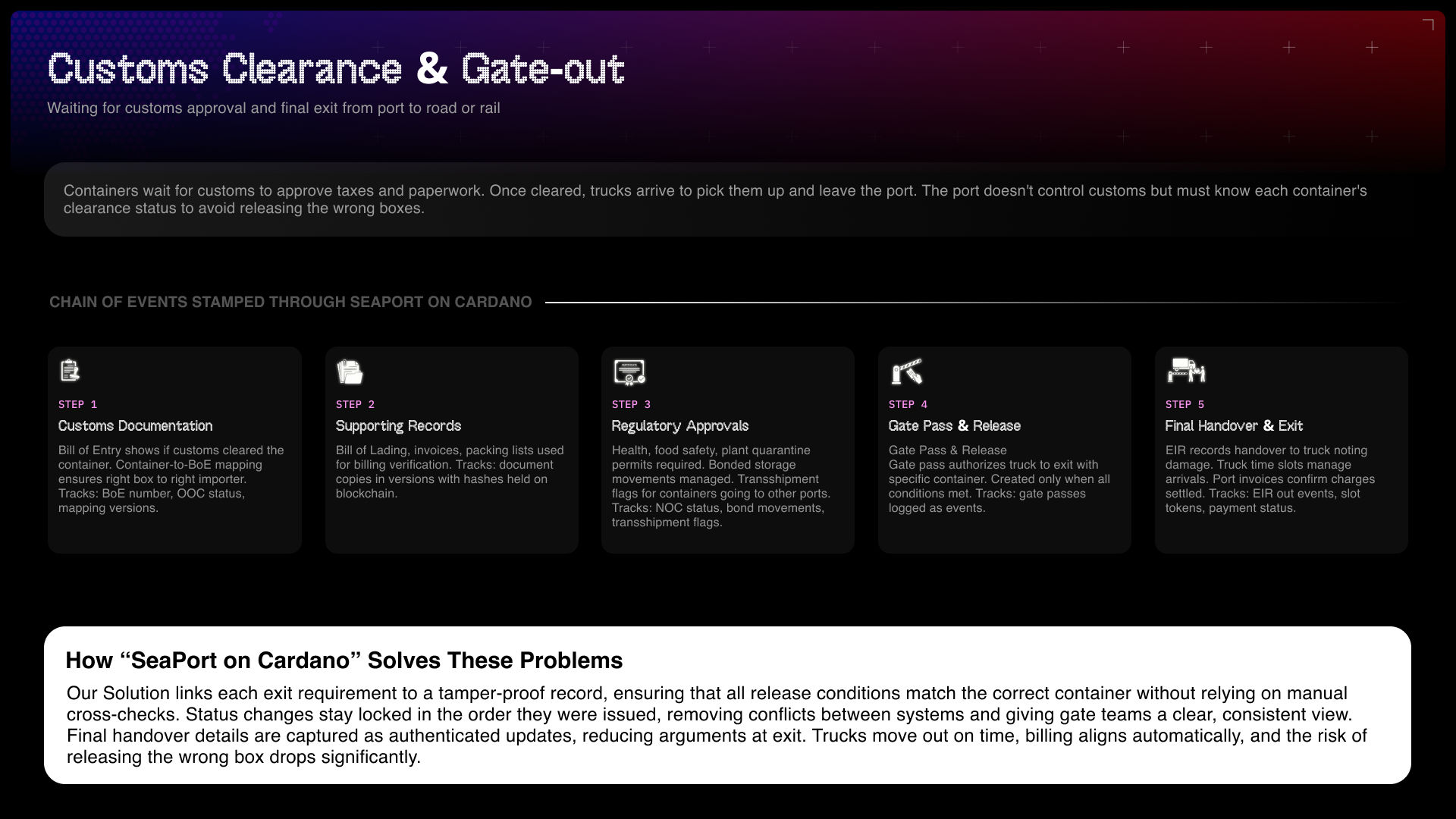
3. Customs Clearance and Gate-Out
The Problem
Customs may clear a container while the terminal system still shows it as pending. Missing No Objection Certificates (NOCs), mismatched Bill of Entry/Out of Charge (BoE/OOC) data, and paper-based checks slow gate processing and create handover disputes.
When updates reach different teams at different times, no one is fully sure which clearance is the latest or most accurate.
This leads to avoidable delays at the gate because officers must manually cross-check which instruction should be followed.
How Our Solution Fixes It
Connects Bill of Entry (BoE), Out of Charge (OOC) status, and all No Objection Certificates (NOCs) directly to each container and anchors every update on Cardano. A Gate Pass is generated only after all required clearances are verified. The exit Equipment Interchange Report (EIR) is added to the same on-chain timeline, ensuring the handover condition and details are captured accurately.
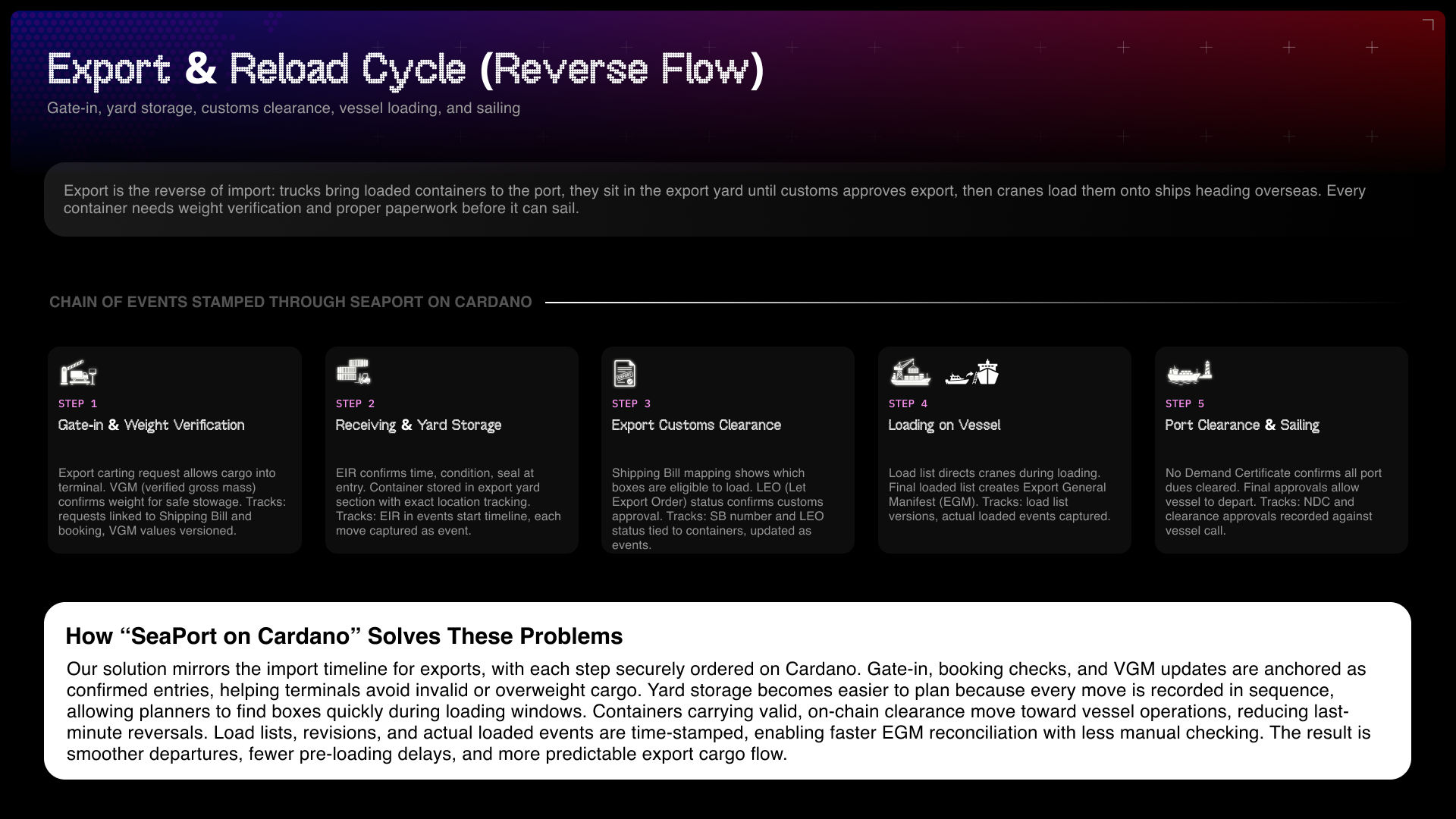
4. Export Cycle (Reverse Flow)
The Problem
Export cargo often gets delayed when paperwork is missing, customs status is unclear, or load list changes come in late.
When updates replace older ones, teams have no straightforward way to confirm the exact sequence of actions.
As a result, operations slow down while staff double-check which version should actually be followed.
How Our Solution Fixes It
Every step: gate-in, yard moves, customs, loading, and EGM (Export General Manifest) becomes a traceable event in a single timeline. This keeps the entire export flow in proper order and helps every team work with the correct and final information.
Key Documents & Events Traced Per Import / Export Batch
For every import or export batch, SeaPort Information Management System (SIMS) locks onto the specific documents and events that actually drive planning, safety, yard work, customs clearance and gate movement. Around 35 core document types are digitally stamped, versioned and anchored on Cardano for every batch, covering the full chain end-to-end.
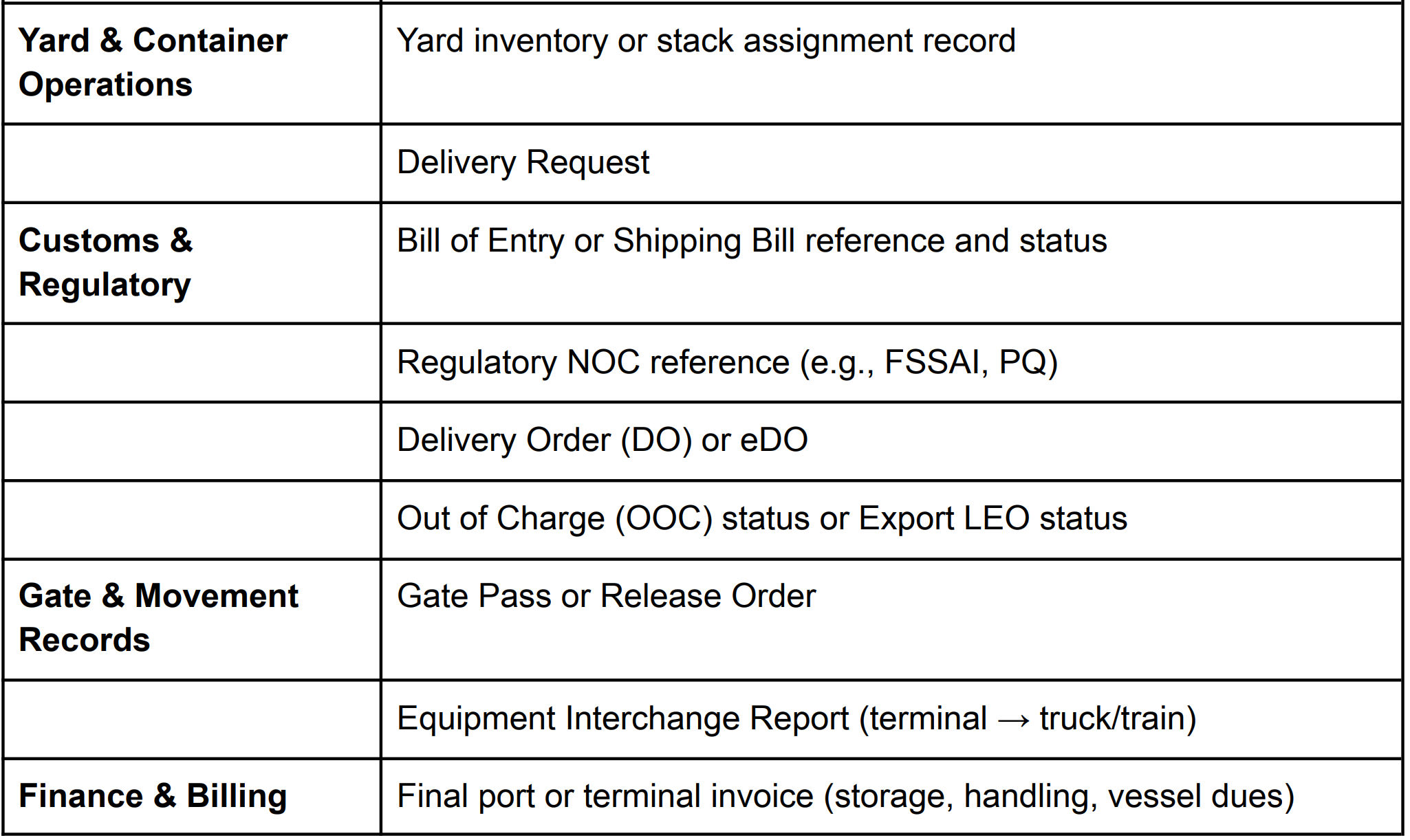
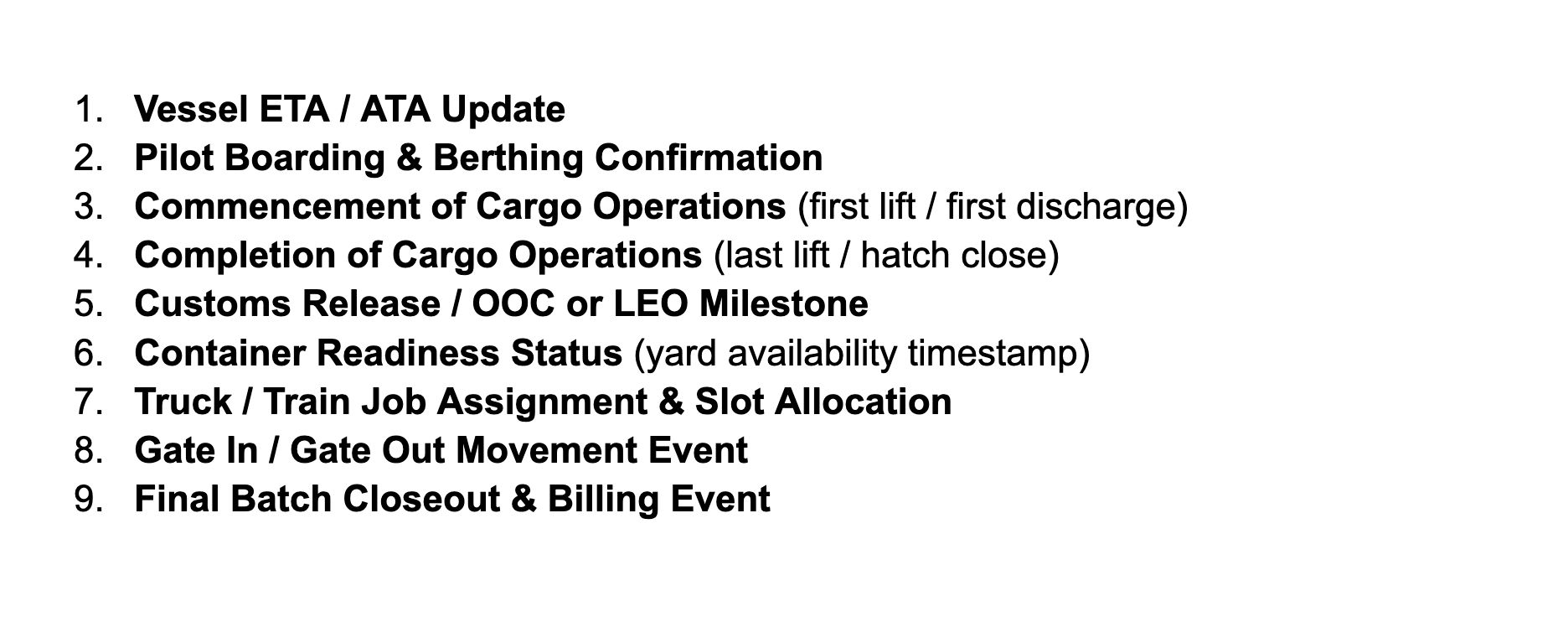
Each batch also generates a series of time-sensitive, operational moments that determine how smoothly cargo moves. SeaPort captures each one as a verifiable blockchain event.
Technical Overview
SeaPort Information Management System (SIMS) records every operational action as an on-chain event and stores all documents securely. Each event or file version generates a hash that is anchored on Cardano to guarantee integrity.
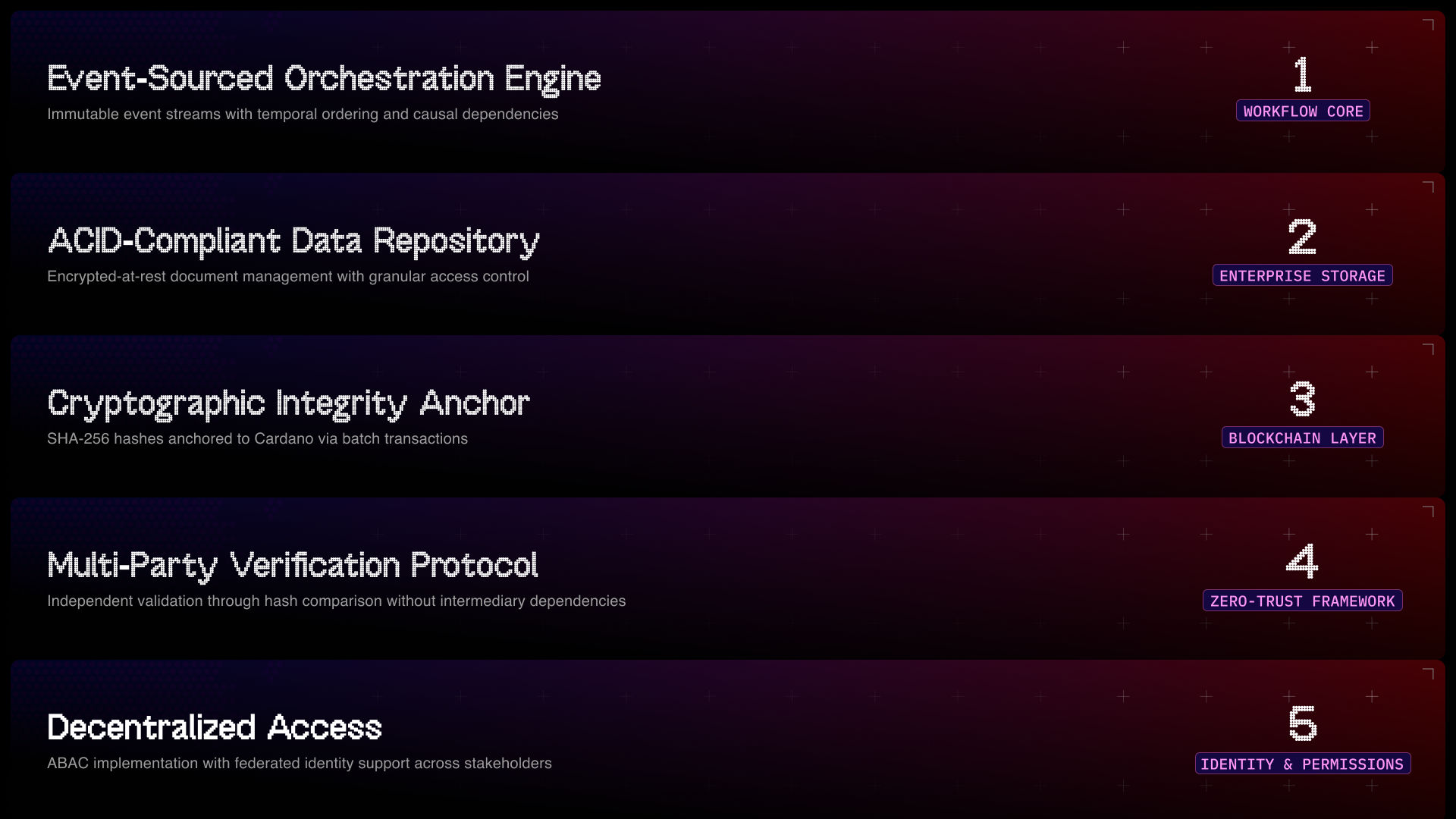
Users can instantly verify authenticity while all stakeholders share a tamper-proof, role-based history.
SeaPort Information Management System’s (SIMS) volume of on-chain settlements on Cardano Mainnet
A port like Cochin handles about 834,000 containers a year, which becomes roughly 278,000 batches at three containers each. With 44 verifiable items per batch (35 documents + 9 events), the system generates about 12+ million records describing the full movement of every vessel and container.
SIMS compresses these records into batched cryptographic hashes and stamps them on Cardano, keeping the data verifiable while keeping it efficient. This produces 120,000 of Cardano mainnet transactions in the first year from mainnet launch, each proving the integrity and sequence of thousands of operational actions.
[Your Project and Solution] Impact
Please define the positive impact your project will have on the wider Cardano community
SeaPort Information Management System (SIMS) on Cardano brings a high-scale, real-world usecase that positions Cardano as the integrity layer for a major Indian public sector infrastructure. By stamping 12M+ operational settlements through 120,000 Cardano mainnet transactions, the project demonstrates Cardano’s ability to support high volumes in national scale workflows while improving economic efficiency, environmental outcomes, and operational transparency.
1. Impact on the Cardano Ecosystem
A. A Flagship Production Deployment
SeaPort Information Management System (SIMS) becomes one of the largest enterprise use cases on Cardano, reliably anchoring:
- 12 million+ verifiable settlements on Cardano.
- 834,000+ containers traced.
- 278,000+ batches anchored.
- 120,000+ cardano mainnet transactions.
This validates Cardano’s capability to handle real industrial digitization, strengthening global confidence in its enterprise readiness.
B. Expanding Cardano’s Role in Global Trade Infrastructure
By securing vessel movements, yard logistics, customs interactions, and gate operations, Cardano gains visibility as a preferred chain for high-integrity supply chain and logistics systems in a USD 14 Trillion global sector.
2. Measurable Community Impact
A. Demonstrated High Throughput for Cardano
Anchoring millions of records provides:
- Increased mainnet utility.
- Demonstration of efficient L1 batching at a massive enterprise scale.
This positions Cardano as a cost-effective, high-performance blockchain for operational systems.
B. Boosting Cardano’s Reputation in India & Global Public Sector
Success of SeaPort Information Management System (SIMS) on Cardano creates:
- A blueprint for India’s 200+ ports.
- A reference model for global maritime authorities.
- A foundation for broader public-sector adoption (customs, rail, logistics hubs).
C. Environmental & Social Impact Enabled by Cardano
SeaPort Information Management System (SIMS) reduces delays, uncoordinated moves, and idling, contributing to:
- Reduced emissions, addressing a portion of the 160Mt global CO2 footprint across ports globally by making them more efficient due to delays.
- Improved working conditions for truckers and port staff.
- Reduced congestion and operational rework.
Cardano becomes the enabler of measurable sustainability improvements.
3. How We Will Measure Impact
- Number of batches stamped
- On-chain transactions and proofs
- Volume of verifiable records generated
4. Sharing Outputs With the Cardano Community
- Technical documentation on this large scale enterprise deployment
- Event timeline & schema models for port operations
- A full case study from the Cochin deployment
[Your Project and Solution] Capabilities & Feasibility
What is your capability to deliver your project with high levels of trust and accountability? How do you intend to validate if your approach is feasible?
The Trivolve Tech team has a strong track record in delivering high quality Cardano based solutions. Trivolve is a leader in open-source innovation, Real World Asset (RWA) tokenization, and government and enterprise adoption of Cardano, making it highly suited to execute this proposal. The team has also built a first of its kind forensic management system on Cardano mainnet which is successfully stamping and processing multiple thousands of transactions on Cardano mainnet currently. With over years of combined experience, the team possesses the technical knowledge required to build scalable, transparent solutions.
Trivolve has served multiple large enterprise clients across finance, identity, governance, and RWA tokenization, demonstrating consistent delivery of scalable, secure, and compliant systems.
We've established a partnership with Quixy to co-develop this together. Quixy is recognized as one of India's leading software companies, specializing in low-code enterprise solutions for governments and corporations worldwide. It has achieved remarkable milestones, including the development of over 27,000+ no-code apps and engaging more than 200,000 users across 15+ industries.
[Milestones] Project Milestones
Milestone Title
Project Kickoff
Milestone Outputs
Development of a comprehensive SeaPort on Cardano Project Kickoff Plan detailing the vision, scope, and execution roadmap for integrating Cardano-based blockchain solutions into Port of Cochin’s operational management system.
Acceptance Criteria
The milestone will be considered successfully achieved when a formally documented project kickoff plan is completed.
- Clearly define timelines, phases, and deliverables.
- Allocate resources and responsibilities across participating entities.
- Outline integration pathways between SeaPort on Cardano and Port of Cochin’s operational frameworks.
- Include risk assessments, mitigation strategies, and measurable KPIs.
Evidence of Completion
Completed SeaPort on Cardano project kickoff plan delivered in PDF format, detailing timelines, allocated resources, and core technical specifications required for effective project initiation and review.
Delivery Month
1
Cost
120000
Progress
20 %
Milestone Title
System Architecture Design
Milestone Outputs
Creation of a detailed backend tailored for SeaPort on Cardano’s requirements, ensuring secure record-keeping, container/event verification, and traceability on Cardano.
Production of user flow diagrams that illustrate system interactions, data workflows, and the lifecycle of port operational records and settlement tracking.
Acceptance Criteria
Completion of technical documentation for system architecture, incorporating all required functions for the Port of Cochin.
Validation of user flow diagrams by the technical team, ensuring alignment with SeaPort on Cardano’s goals and system requirements.
Evidence of Completion
Finalized system architecture documents detailing backend design and integration points with Cardano.
Completed and validated user flow diagrams for improved clarity and development alignment overall.
Delivery Month
3
Cost
150000
Progress
30 %
Milestone Title
SeaPort Information Management System (SIMS) Integration
Milestone Outputs
Development of a functional system integration with Quixy’s solution for the Port of Cochin, with key functionalities such as operational verification, secure data recording, and traceability powered by the Cardano blockchain.
Acceptance Criteria
The integration fulfills all predefined functional requirements, including efficient handling of core port operational data, settlement flows, and traceability.
Successful demonstration of the integration within Quixy’s testing environment.
Evidence of Completion
Recorded demo showcasing capabilities and integration with Cardano.
On-chain testnet transaction links validating system operations.
Delivery Month
5
Cost
200000
Progress
60 %
Milestone Title
Testnet Deployment
Milestone Outputs
Conducting pilot testing of the developed Cardano integration in collaboration with Quixy with 100 sample port settlements, including operational records and container/event workflows, to evaluate system performance, accuracy, and reliability.
Acceptance Criteria
System processes all test settlements without critical errors or failures.
Pilot testing indicates that the system meets operational standards and aligns with expectations specific to the Port of Cochin.
Evidence of Completion
Pilot testing report in PDF format summarizing results, including any identified issues and resolutions, along with detailed performance insights, validation outcomes, and recommendations for next steps.
Delivery Month
7
Cost
60000
Progress
70 %
Milestone Title
Marketing and Mainnet
Milestone Outputs
SeaPort Information Management System (SIMS) on Cardano live on mainnet with Quixy and Port of Cochin integration.
Roll out a marketing campaign to highlight the successful integration of SeaPort Information Management System (SIMS) on Cardano, emphasizing the role of Cardano in supporting port-scale operational integrity.
Implementation of system improvements based on pilot feedback to enhance functionality, usability, and user experience.
Acceptance Criteria
High engagement levels and feedback from the marketing campaign across selected media channels.
Completion of mainnet roll-out documentation with improvements in the system, aligning with pilot feedback.
Evidence of Completion
Marketing campaign report detailing reach, engagement, and impact.
Documentation of system updates, with a before-and-after analysis of mainnet roll-out.
Delivery Month
8
Cost
100000
Progress
80 %
Milestone Title
Project Closure
Milestone Outputs
Creation of comprehensive project closure documentation, summarizing each project phase, achievements, lessons learned, and the overall impact of SeaPort on Cardano.
Production of a project closure video and publicly made available.
Acceptance Criteria
A fully reviewed project closure document, encompassing all project insights and outcomes.
Project closure video effectively communicates SeaPort on Cardano’s achievements, benefits for port operations, and the impact on the Port of Cochin.
Evidence of Completion
Final project closure document.
Published project closure video available, demonstrating the success of SeaPort on Cardano and providing a comprehensive overview of outcomes and impact achieved in total.
Delivery Month
10
Cost
90000
Progress
100 %
[Final Pitch] Budget & Costs
Please provide a cost breakdown of the proposed work and resources
Milestone 1: Project Kickoff
Allocation: 120,000 ADA
Project management and initial planning: 120,000 ADA
Milestone 2: System Architecture Design
Allocation: 150,000 ADA
SIMS architecture and technical documentation: 75,000 ADA
Quixy-integration system architecture development: 75,000 ADA
Milestone 3: SeaPort Information Management System (SIMS) Integration
Allocation: 200,000 ADA
Development of functional system prototype: 170,000 ADA
Initial testing and iteration: 30,000 ADA
Milestone 4: Testnet Deployment
Allocation: 60,000 ADA
Setup and execution of pilot testing with 100 sample settlement processes: 30,000 ADA
Evaluation and quality assurance: 30,000 ADA
Milestone 5: Marketing and Mainnet
Allocation: 100,000 ADA
Roll-out of marketing campaigns: 70,000 ADA
Collection and implementation of user feedback: 30,000 ADA
Milestone 6: Project Closure
Allocation: 90,000 ADA
Final documentation and project closure activities: 30,000 ADA
Production and dissemination of closure video and final reports: 60,000 ADA
[Final Pitch] Value for Money
How does the cost of the project represent value for the Cardano ecosystem?
The investment in SeaPort Information Management System (SIMS) on Cardano for the Port of Cochin delivers significant value to the Cardano ecosystem while remaining aligned with the cost structures typical for large-scale digital modernization projects in India’s port and logistics sector. Key justifications include:
High Volume in Port Settlements
SeaPort Information Management System (SIMS) on Cardano integrates into Cochin’s operational systems, which manage ~834,000 containers annually, translating to ~278,000 batches and 12+ million verifiable documents and event records every year. Anchoring these at scale on Cardano generates 120,000 cardano mainnet transactions, creating substantial and recurring network activity.
Strategic Marketing & Industry Visibility
A targeted marketing campaign will highlight the successful deployment of SeaPort on Cardano across Indian and global logistics channels. This will emphasize Cardano’s pivotal role in enabling secure, tamper-proof port operations strengthening Cardano’s profile as a blockchain capable of supporting high-volume, mission-critical infrastructure.
This enhances Cardano’s reputation among port authorities, logistics providers, and government agencies.
Foundation for Nationwide Port Expansion
Implementing SIMS at the Port of Cochin establishes a blueprint that can be replicated across India’s 200+ ports. Given India’s rapidly growing maritime trade volume, SeaPort’s success creates a strong foundation for national-level adoption, potentially adding tens of millions of additional on-chain records annually to Cardano.
Cost Comparability & Efficient Delivery
The project budget aligns with the typical investment range for operational modernization projects undertaken by Indian port authorities. By leveraging Cardano’s highly efficient infrastructure and Quixy’s low-code operational stack, SeaPort delivers strong technical capability at a competitive cost without compromising security, scalability, or compliance.
Summary
This project’s costs are justified by its scale, impact, and replicability. This proposal on Cardano demonstrates how Cardano can serve as a foundational integrity layer for national logistics infrastructure, driving high-volume usage, establishing enterprise credibility, and unlocking future expansion opportunities across India’s port ecosystem.
[Self-Assessment] Self-Assessment Checklist
I confirm that the lead applicant is a verified legal business entity.
Yes
I confirm that the lead org has a ≥2-year track record, and the consortium collectively has ≥$5M in verifiable annual revenue.
Yes
I confirm that evidence of collaboration with a qualified Tier-1 enterprise is provided.
Yes
I confirm that the proposer and all team members are in good standing with prior Catalyst projects.
Yes
I confirm that the proposal is for mature R&D or integration, not an early-stage concept or core infrastructure.
Yes
I confirm that evidence of a mature product is provided, with a clear integration plan if not already on Cardano.
Yes
I confirm that all key partners, including the Tier-1 collaborator, are clearly identified.
Yes
I confirm that a clear statement of the partner's in-kind or financial contributions is included.
Yes
I confirm that the proposal provides verifiable references (e.g., LinkedIn, portfolio) for key team members.
Yes
I confirm that the proposal includes clear KPIs for adoption (e.g., transaction volume, user growth). Forecast for projected on-chain transaction volume is provided with adequate justification.
Yes
I confirm that delivery is ≤ 12 months with clear milestones.
Yes
I confirm that the proposal includes a co-marketing or community engagement plan to amplify Cardano's visibility.
Yes
I confirm that the proposal budget is for future work only, not for completed tasks. No incentives, giveaways, private treasuries and regranting are included in the budget.
Yes
[Required Acknowledgements] Consent & Confirmation
I Agree
Yes
Team
Rahul Konudula, CEO - Trivolve - https://www.linkedin.com/in/rahul-konudula-a28632125/
He has founded companies across real estate, international commodities, and mineral mining that have been running successfully for more than a decade with 8 figure annual revenue in USD. He has over eight years of experience in the RWA sector, focusing on bringing innovative solutions by integrating AI and Blockchain and consistently being one of the leading contributors to industry advancements in India.
Trivolve Tech - https://trivolvetech.com/
We are a prominent Blockchain & AI product development studio based in Dubai and India, specializing in creating innovative solutions globally. With a dedicated team of 42 professionals, we have been serving over 60 enterprise clients, including governments, venture capital firms, and Fortune 500 companies, for more than three years. Our expertise extends to consulting for leading Cardano projects, leveraging our extensive experience in product development. TrivolveTech is a leader in open-source innovation, Real-World Asset (RWA) tokenization, governments and enterprise adoption of Cardano.
Quixy - https://quixy.com/
Quixy, a leader in no-code/low-code application development and business process automation, recognized as one of India's leading software companies, specializing in low-code enterprise solutions for governments and corporations worldwide. It has achieved remarkable milestones, including the development of over 27,000+ no-code apps and engaging more than 200,000 users across 15+ industries.