Last updated 6 months ago
Aequitas: Hydra DeFi P2Pool Options Protocol for Cardano
Problem
Cardano lacks on-chain derivative products, and current Layer 1 solutions are slow. As a result, investors cannot efficiently hedge risks or speculate, which restricts DeFi growth.
Solution
We will build a Hydra-powered peer-to-pool options protocol, a new DeFi derivative product on Cardano: fast transactions, where users buy options and LPs provide ADA liquidity to earn higher returns.
About this idea
[Proposal setup] Proposal title
Please provide your proposal title
Aequitas: Hydra DeFi P2Pool Options Protocol for Cardano
[Proposal Summary] Budget Information
Enter the amount of funding you are requesting in ADA
120000
[Proposal Summary] Time
Please specify how many months you expect your project to last
12
[Proposal Summary] Translation Information
Please indicate if your proposal has been auto-translated
No
Original Language
en
[Proposal Summary] Problem Statement
What is the problem you want to solve?
Cardano lacks on-chain derivative products, and current Layer 1 solutions are slow. As a result, investors cannot efficiently hedge risks or speculate, which restricts DeFi growth.
[Proposal Summary] Supporting Documentation
Supporting links
- https://www.figma.com/design/oT8OpDj4xusn9PsfoQkpZa/Aequitas?node-id=0-1&p=f ,
- https://docs.google.com/document/d/1hYtFQ_6lhnuNBaK6-MFFcnfaurz6lE1X1EPC1f5_d_I/edit?tab=t.0#heading=h.9k0ydnxvgcfm ,
- https://v0-protocol-defi.vercel.app/ ,
- https://drive.google.com/drive/folders/1lRApwyMpRf13n_3OcrJk2I_fIFDondVb?usp=sharing
[Proposal Summary] Project Dependencies
Does your project have any dependencies on other organizations, technical or otherwise?
Yes
Describe any dependencies or write 'No dependencies'
The project relies on the Pyth Oracle services to provide real-time ADA/USD price data and the Hydra protocol to facilitate fast deposits and options purchases which is a critical dependency in our project
[Proposal Summary] Project Open Source
Will your project's outputs be fully open source?
Yes
Please provide details on the intellectual property (IP) status of your project outputs, including whether they will be released as open source or retained under another licence.
The project will be fully open source under the MIT license. All smart contract source code, backend services and frontend will be published on our Github. This ensures transparency, allows the community to find bugs and contribute.
[Theme Selection] Theme
Please choose the most relevant theme and tag related to the outcomes of your proposal
DeFi
[Campaign Category] Category Questions
Describe what makes your idea innovative compared to what has been previously launched in the market (whether by you or others).
Aequitas is the first Peer-to-Pool (P2Pool) options protocol designed from the ground up for Cardano's eUTXO architecture. The innovation lies in the following liquidity model:
- Unlike conventional P2P models that require buyers to find counter sellers, our P2Pool model aggregates liquidity from multiple LPs. This ensures there is always a seller (pool) available for buyers, solving the problem of fragmented liquidity.
- By tokenizing every option purchased into a CIP-68 compliant underlying asset, we turn the option from an abstract contract into a tradable asset. This opens up a secondary market, allowing users to resell their options on DEXs.
This is a foundational “DeFi piece” that is currently missing on Cardano, this model will provide real risk management tools.
Describe what your prototype or MVP will demonstrate, and where it can be accessed.
Our MVP (completed at Milestone 5) will be a fully functioning decentralized dApp on testnet. It will demonstrate the entire core flow:
- Liquidity Providers (LPs): Users will be able to supply liquidity (e.g. test-ADA, test-DJED) to the liquidity pool and receive LP tokens in return.
- Buyers: Users will be able to select the asset (ADA), option type call or put, strike price and expiry date, and then buy options directly from the pool.
- Pricing & minting: Users will watch the system automatically query the Oracle Pyth to calculate the premium and mint a CIP-68 token representing their option.
- Payment: User will be able to exercise the option at the time of expiration.
- The MVP will be publicly accessible via a web url and we will provide testnet assets for the community to experience.
Describe realistic measures of success, ideally with on-chain metrics.
The project's success will be measured by specific on-chain metrics:
- Number of interacting wallets: ≥ 200 unique participating wallets (including LPs and buyers) after mainnet launch 6 months.
- No tx failed due to script error or rolled back after confirmed in Hydra Head
- ≥ 95% of exercise or expire txs are processed correctly within ≤ 3 epochs from the expiration time
- Number of off-chain transactions via Hydra ≥ 200 after mainnet launch 6 months.
- There are > 3 different options (other than strike or expiry) minted simultaneously in the system
- At least ≥ 250 deposit transactions per month
- There are ≥ 150 withdraw transactions per month
[Your Project and Solution] Solution
Please describe your proposed solution and how it addresses the problem
Our solution is a fully decentralized on-chain Options Protocol on Cardano, operating on a Peer-to-Pool (P2Pool) model.
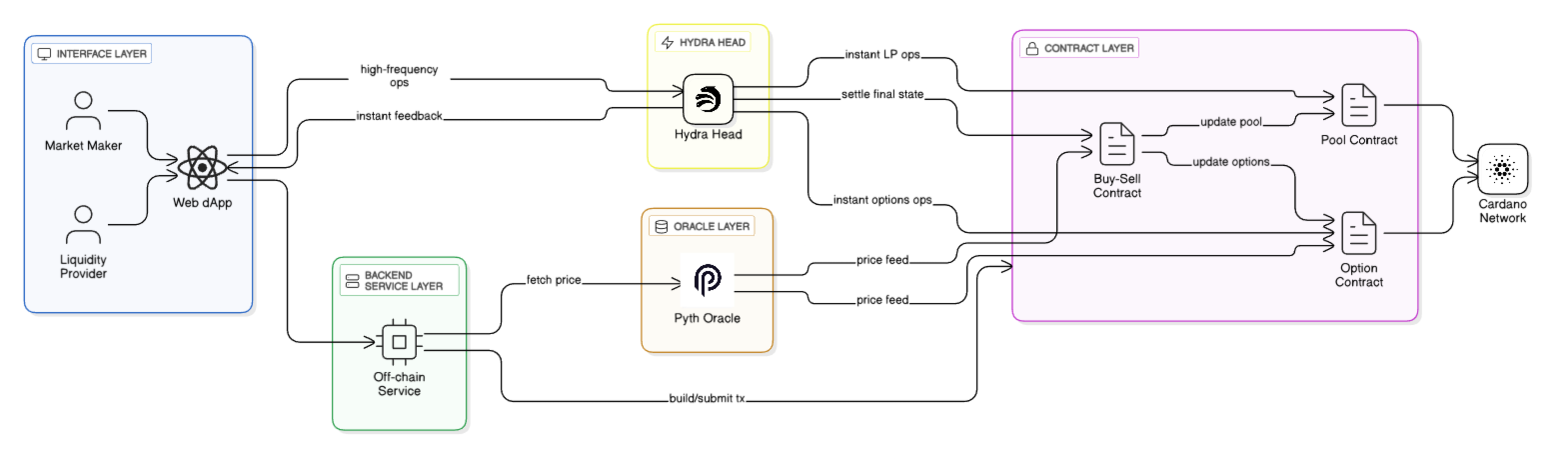
1. System Architecture
The system is structured into four main layers as follows:
1.1 Contract Layer
Main on-chain logic management:
- Pool Contract: LP deposits assets (ADA, Stablecoin) and receives LP tokens.
- Option Contract: Manages minting, execution and expiration of options.
- Buy-Sell Contract: Receives the final state from Hydra Head, verifies UTxO, commits LP and trades options and validity validation before minting or updating Pool Contract on-chain.
1.2 Oracle Layer
- Integrate with Pyth Oracle providers to securely retrieve on-chain price data. This data is crucial for premium pricing and settlement.
1.3 Backend Service Layer
- A lightweight off-chain service to perform complex calculations (e.g., Black-Scholes model for premium pricing) that are inefficient on-chain. This service also helps build transactions for users.
1.4 Interface Layer (dApp)
Web interface (React/NextJS) that allows users to:
- Provide or withdraw liquidity
- View the options list
- Manage their positions
2. Hydra Head integration (Layer-2)
Solve the latency and transaction fees on Layer-1 for high-frequency operations:
- Provide or withdraw liquidity
- Buy or write options
This allows these actions to happen almost instantly in a temporary Hydra Head. They are checked by the Buy-Sell Contract before settling on-chain.
Details of system architecture are as follows:
3. Technical Process
A. Liquidity Provider (LP) via Hydra Head (L2)
- Join Head: LP selects pool via dApp and joins Hydra Head.
- Off-chain transaction: LP commits UTxO to Hydra Head. Pool status updates immediately; LP receives temporary LP token (L2).
- Settle: When Hydra Head closes, the final status is sent to the Buy/Sell Contract => verify => update Pool Contract and mint official LP token (L1).
B. Charge & buy Option (Off-chain + L2)
- Charge: Buyer selects option parameters (call/put, strike, expiry). Backend queries Oracle and charges option fee via Black-Scholes.
- Buy via Head: Buyer commits UTxO in Hydra Head. Contract mints temporary CIP-68 token (L2) immediately.
- Settlement/settle: When Head closes => final status sent to the Buy-Sell Contract => verification => mint official CIP-68 token (L1) and confirm ownership.
C. Expiration & settlement (L1)
- Expiration: Option that expires out-of-the-money becomes worthless.
- Exercise: Options with intrinsic value are automatically sent to the Options Contract, checked with Oracle price, and profit will be paid from Pool. Buy-Sell Contract ensures token validity before making settlement.
Therefore, we will have some achievements deduced from the solution as follows:
- Instant speed: enabled by off-chain transactions through Hydra Heads
- Ultra-low fees: most transactions in Hydra are almost free
- High scalability: handle thousands of transactions/second without L1 congestion
- Attract both DeFi traders and traditional investors to Cardano
- Create the premise for more complex derivatives products (structured products, volatility trading, etc.)
- Contribute to making Cardano the strongest Layer 1 in on-chain derivatives DeFi.
- Bring options products derivatives tools the most important traditional finance derivatives go to Cardano for the first time
[Your Project and Solution] Impact
Please define the positive impact your project will have on the wider Cardano community
Aequitas will make a direct, measurable, and lasting impact by providing a missing foundational DeFi puzzle piece for Cardano.
The specific benefits for the Cardano ecosystem are as follows:
- For the first time, ADA holders, stakers, and investment funds can buy options to effectively hedge their portfolios against falling prices.
- Provide LPs with a new source of passive income (earn premium fees from price volatility) instead of relying solely on AMM contract swap fees on DEX exchanges.
- Allows traders to effectively use leverage (call or put) to speculate on price movements, attracting a new class of traders into the ecosystem.
- Our CIP-68 option tokens can be integrated into other DeFi protocols (e.g. Lending, DEX, etc.) to create more complex structured products.
- Helping to drive trading across the ecosystem is one of our core goals. The team sees that Cardano is currently under-traded compared to its potential and this project will be a catalyst for more on-chain interaction opportunities, from liquidity provision, options trading to tokenization. Every LP, every option buyer contributes to livening up the ecosystem, increasing trading volume and improving overall liquidity.
Key Metrics (KPIs):
KPI On-chain:
- Number of off-chain transactions via Hydra: ≥ 500 including deposit, withdraw after mainnet launch 6 months
- Number of unique wallets: ≥ 200 interactive wallets (including LPs + Buyers) after mainnet launch 6 months.
- No tx failed due to script error or rolled back after confirmed in Hydra Head
- ≥ 95% of exercise/expire txs are processed correctly within ≤ 3 epochs from the expiration time
- There are > 3 different options (other than strike or expiry) minted simultaneously in the system
- Target 1 - 1.5s per transaction per off-chain transaction
Community & adoption KPIs:
- Collect feedback from ≥ 25 testnet users through detailed forms.
- Publish a technical whitepaper explaining the pricing model and risk management.
How to measure & report:
We will deploy a public dashboard to track on-chain KPIs on the testnet in real time. Two monthly progress reports will be sent to the Catalyst community, with links to the dashboard and important transactions.
How to share results with the community
Source code and documentation: All code (smart contracts, backend, frontend) will be open sourced on Github from Milestone 2.
Reports & instructions: Publish detailed technical documents, user manuals for LPs and buyers.
Project closure report: Provide comprehensive demo video and final report as required by Catalyst.
[Your Project and Solution] Capabilities & Feasibility
What is your capability to deliver your project with high levels of trust and accountability? How do you intend to validate if your approach is feasible?
Feasibility:
The project has high technical feasibility because the core challenges have been clearly identified and solved by us:
- Smart contract: Our team has deep Aiken expertise to build secure contracts for liquidity pools.
- Integrate Oracle securely: We will use proven Oracle providers Pyth and follow best practices to ensure price data cannot be manipulated.
- Pricing model:The charging logic will be performed off-chain to ensure accuracy (using modelsfinancial standards) before being put into on-chain trading.
The 12 months plan allows us to develop carefully, have time for extensive internal testing, and refine the architecture before launching publicly.
Capacity:
Our team, has a proven and public track record of providing services within the Cardano ecosystem.
- Technical expertise: The team has programmers with extensive experience in Aiken, fullstack development (React, NextJS, Python) and financial analysis.
- Accountability: Sourcen capital will be managed responsibly. We are committed to transparent progress reporting, directly tied to key project milestones.
Additionally, we have some past achievements, including:
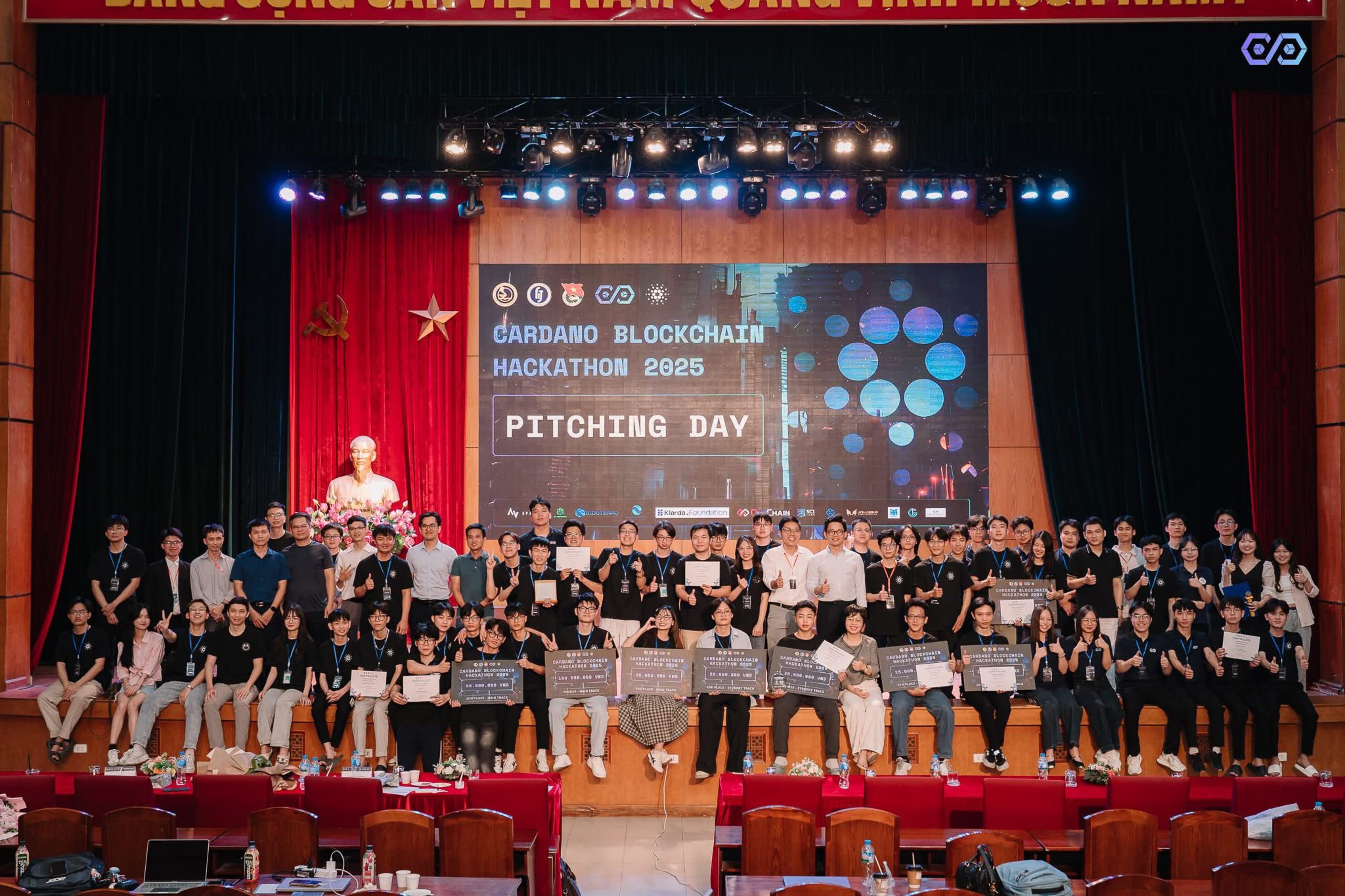
Participated in the CARDANO BLOCKCHAIN HACKATHON 2025 and won second place.
Along with that we also had some activities:
- Organize technical workshops on smart contract development and dApp building: https://x.com/bps_club/status/1987537831779287085?s=20
- Organize and teach blockchain courses to students and the community: https://x.com/bps_club/status/1978880718853017995?s=20
These steps demonstrate that our team creates a transparent, well-controlled environment, managing ADA assets with high reliability and accountability.
[Milestones] Project Milestones
Milestone Title
Develop Smart Contract v1 (Pool & Mint)
Milestone Outputs
- Develop and test Pool Smart Contract (via Hydra Head)
- Develop and test Mint Smart Contract (CIP-68)
- Detailed technical design document (TDD) for both contracts + initial pricing & risk model
- Extended unit testing report & off-chain Hydra logic optimization
Acceptance Criteria
- The Liquidity Provider (LP) flow is fully functional, enabling LPs to successfully deposit and withdraw assets via the complete Hydra Head lifecycle on the preprod testnet.
- Buyer can successfully mint a CIP-68 option token upon submitting the correct premium (initially calculated off-chain/manually) within the Hydra Head.
- The technical design document (TDD) is complete, defining the optimal EUTXO structures, including datum, redeemer, and context, for both the Pool and Mint contracts.
- The comprehensive unit test report confirms high code coverage and successfully validates complex off-chain state transitions (e.g., the integrity of state commitment during Hydra updates).
Evidence of Completion
- Public Github link to the Aiken contract source code (Pool and Mint).
- Testnet transaction hashes demonstrating successful open Head, off-chain LP deposits/withdrawals, and on-chain settlement.
- Testnet transaction hashes demonstrating successful CIP-68 option token minting via Hydra.
- Link to the finalized TDD document, including the chosen initial pricing/risk model definition.
- Comprehensive unit test report for all M1 contracts.
Delivery Month
3
Cost
27500
Progress
30 %
Milestone Title
Develop Smart Contract v2 (Logic Pool & Mint)
Milestone Outputs
- Develop and test exercise Smart Contract (L1 settlement)
- Develop and test expire Smart Contract (on-chain)
- Develop and test Buy-Sell Smart Contract (logic after close Hydra Head)
- Full-cycle integration test report (M1 + M2 contracts)
Acceptance Criteria
- A user can successfully submit an in-the-money CIP-68 option token and receive the calculated profit from the L1 pool, with correct financial validation during the transaction.
- The expire contract correctly handles all out-of-the-money expiration scenarios, ensuring the remaining collateral is secured and returned to the LP pool.
- The Buy-Sell contract logic (validating the transfer of the option token and premium payment) is functional and verified on the testnet, supporting P2P exchange scenarios for final settlement
- A full integration test cycle passes, confirming end-to-end functionality across all L2 and L1 contracts
Evidence of Completion
- Updated GitHub repository containing the source code for the Exercise, Expire, and Buy-Sell contracts.
- Link to testnet transaction hashes demonstrating successful "Exercise" execution on L1.
- Link to testnet transaction hashes demonstrating successful "Expire" execution on L1.
- Link to testnet transaction hashes demonstrating successful P2P Buy-Sell settlement/transfer logic execution on the testnet.
- Comprehensive integration test report covering all M1 (Hydra) and M2 (L1) flows.
Delivery Month
6
Cost
32750
Progress
60 %
Milestone Title
Backend & Oracle Integration
Milestone Outputs
- Developed backend service layer (API) v1 with Hydra Head management support (open, commit, close).
- Build an off-chain picing engine, deploy the model.
- Successfully integrated Oracle Pyth feed on preprod testnet.
Acceptance Criteria
- The backend API has an endpoint that returns the accurately calculated premium price based on Oracle testnet data and supports Hydra transaction construction (UTxO commit).
- The service can read asset prices from the Oracle testnet stably.
- Hydra Head operations (open, commit, close) can be triggered and simulated successfully through the backend API in a test environment.
Evidence of Completion
- Update the Github repository with the backend source code.
- The demo video or screencast shows the API taking a request (e.g. ADA call, $1 strike, 30 days) and returning the correct premium price based on the Oracle price and creating a draft tx to Hydra Head.
- A test log or recorded demo showing successful Hydra Head lifecycle operations (open => commit => close) executed via the backend API.
Delivery Month
8
Cost
21500
Progress
80 %
Milestone Title
Public Testnet Launch & Community
Milestone Outputs
- Develop and launch dApp MVP on Public testnet (Frontend/Client)
- Preprod testnet infrastructure (Hydra nodes, relay, monitoring)
- Full community access (faucet, guides) & Feedback collection
- Public video demo + instruction articles
Acceptance Criteria
- The dApp MVP is publicly accessible on the testnet without any access.
- The pre-production testnet infrastructure successfully maintains 100% Hydra Head uptime throughout the community testing phase.
- At least 100 unique wallets have successfully interacted with the system within a 30-day period (e.g., deposited LP or minted an option).
- All primary transaction flows are fully functional and verifiable: LP deposits/withdrawals via Hydra, option minting, and L1 exercise/expire settlements.
Evidence of Completion
- Public link to the dApp testnet.
- Public monitoring dashboard displaying real-time metrics for Hydra nodes and Total Value Locked (TVL).
- Preprod testnet transaction hashes proving genuine user activity across the core protocol flows.
- A comprehensive report summarizing community feedback and a list of all bugs successfully fixed during this period.
- Publicly published video demonstration and detailed instruction articles on how to use Aequitas on the testnet.
Delivery Month
10
Cost
19500
Progress
90 %
Milestone Title
Testing, Mainnet Deployment & Launch
Milestone Outputs
- Final testing (L1 + Hydra flow)
- Bug fixing based on testing report & final code preparation
- Mainnet infrastructure (Hydra nodes, relay, monitoring)
- Official mainnet deployment & smoke test
- Complete documentation, Close-out report & E2E mainnet video demo
Acceptance Criteria
- A public testing report is completed and made available.
- The mainnet dApp achieves and maintains 100% Hydra Head uptime for a minimum of 7 consecutive days following the official launch.
- Mainnet transaction hashes provide verifiable proof of all full-cycle core flows (LP deposit => option mint => exercise/expire) using real ADA.
- The final close-out report and the End-to-End (E2E) mainnet video demonstration are completed and published.
Evidence of Completion
- Link to the complete, final testing report.
- Link to the final, ready-for-production source code repository.
- Link to the official mainnet dApp.
- Public monitoring dashboard for the mainnet infrastructure.
- Testnet and mainnet transaction hashes demonstrating successful completion of all core flows.
- Final close-out report and E2E mainnet video demo (approximately 10–15 minutes).
Delivery Month
12
Cost
18750
Progress
100 %
[Final Pitch] Budget & Costs
Please provide a cost breakdown of the proposed work and resources
The total budget of 120,000 ₳ is evenly distributed across 6 milestones over 12 months, as detailed above.
Milestone 1: Develop Smart Contracts V1 – Pool & Mint Logic (22.92%)
Total: 27,500 ₳
- Develop and test Pool Smart Contract (via Hydra Head): 14,200 ₳
- Develop and test Mint Smart Contract (CIP-68): 9,800 ₳
- Detailed technical design document (TDD) for both contracts + initial pricing & risk model: 2,000 ₳
- Extended unit testing report & off-chain Hydra logic optimization: 1,500 ₳
Milestone 2: Develop Smart Contracts V2 – Settlement & Buy-Sell (27.29%)
Total: 32,750 ₳
- Develop and test exercise Smart Contract (L1 Settlement): 12,700 ₳
- Develop and test expire Smart Contract (On-Chain): 9,800 ₳
- Develop and test Buy-Sell Smart Contract (P2P on Hydra Head): 8,250 ₳
- Full-cycle integration test report (M1 + M2 contracts): 2,000 ₳
Milestone 3: Backend & Oracle Integration (17.92%)
Total: 21,500 ₳
- Develop backend service layer (API) V1 + Hydra Head Management: 9,675 ₳
- Build off-chain pricing engine service: 5,045 ₳
- Successful Pyth Oracle integration on preprod testnet: 6,780 ₳
Milestone 4: Public Testnet Launch & Community (16.25%)
Total: 19,500 ₳
- Develop and launch dApp MVP on preprod testnet (Frontend/Client): 7,000 ₳
- Preprod testnet infrastructure (Hydra Nodes, Relay, Monitoring): 7,000 ₳
- Full community access (faucet, guides) & feedback collection: 3,000 ₳
- Public video demo + instruction articles: 2,500 ₳
Milestone 5: Testing, Mainnet Deployment & Close-out (15.62%)
Total: 18,750 ₳
- Final testing (L1 + Hydra Flow): 4,000 ₳
- Bug fixing based on testing report & final code preparation: 3,000 ₳
- Mainnet infrastructure (Hydra Nodes, Relay, Monitoring): 7,000 ₳
- Official mainnet deployment & smoke test: 2,000 ₳
- Complete documentation, close-out report & E2E mainnet video demo: 2,750 ₳
The details are designed by us in the following document: https://docs.google.com/spreadsheets/d/1swzaNPGVxDUswrjk2_s-POG_PxlA4mQ62dcCqXNwQTo/edit?usp=sharing
The 120,000 ₳ budget for 12 months reflects the part-time commitment of a team of three. This allows for thorough and sustainable development of the MVP.
Note: Our budget covers the costs of developing, managing, and operating the testnet. The cost of an official third-party security audit.Are notare within the scope of this proposal and will be sought for funding in a Phase 2 proposal after a successful MVP testnet and community feedback is gathered.
[Final Pitch] Value for Money
How does the cost of the project represent value for the Cardano ecosystem?
This ₳120,000 investment will bring exceptional value to the Cardano ecosystem because:
- At the current exchange rate (~$0.40/ADA), the total project budget corresponds to approximately $48,000
- Cost breakdown: Distributed evenly over the 12 month period, the average operational expenditure is about $4,000 per month. This represents a lean bootstrap-level budget capable of sustaining a full-stack blockchain engineering team (experienced in Aiken and Hydra node operations) while maintaining essential production-grade infrastructure. It demonstrates the team’s long-term dedication to the Cardano
- This model has been designed to maximize value for the treasury, allowing for the development of a complex infrastructure at the most cost-effective level focusing on getting it right the first time.
- Additionally, we are not building a typical dApp, but a foundational financial infrastructure that Cardano currently lacks. Allowing controlled hedging and speculation is a must to attract serious liquidity.
- Ultimately allowing LPs to profit from volatility and allowing large investors to hedge their portfolios will increase confidence in participating in DeFi on Cardano, thereby boosting the overall TVL of the entire ecosystem.
All outputs are open source, providing long-term value that allows other developers to build and integrate on our protocol.
[Self-Assessment] Self-Assessment Checklist
I confirm that evidence of prior research, whitepaper, design, or proof-of-concept is provided.
Yes
I confirm that the proposal includes ecosystem research and uses the findings to either (a) justify its uniqueness over existing solutions or (b) demonstrate the value of its novel approach.
Yes
I confirm that the proposal demonstrates technical capability via verifiable in-house talent or a confirmed development partner (GitHub, LinkedIn, portfolio, etc.)
Yes
I confirm that the proposer and all team members are in good standing with prior Catalyst projects.
Yes
I confirm that the proposal clearly defines the problem and the value of the on-chain utility.
Yes
I confirm that the primary goal of the proposal is a working prototype deployed on at least a Cardano testnet.
Yes
I confirm that the proposal outlines a credible and clear technical plan and architecture.
Yes
I confirm that the budget and timeline (≤ 12 months) are realistic for the proposed work.
Yes
I confirm that the proposal includes a community engagement and feedback plan to amplify prototype adoption with the Cardano ecosystem.
Yes
I confirm that the budget is for future development only; excludes retroactive funding, incentives, giveaways, re-granting, or sub-treasuries.
Yes
[Required Acknowledgements] Consent & Confirmation
I Agree
Yes
Team
Tuan Ngo
Experience:
- Deputy Head of Engineering at Blockchain Pioneer Student Club
- Experienced in leading and managing projects, organizations and clubs.
- 2 years developing dApps on Cardano, specializing in writing smart contracts using Aiken.
- More than 2 years of experience in fullstack programming and directly building and operating solutions on the Cardano blockchain.
- Second Prize at the CARDANO HACKATHON BLOCKCHAIN 2025 competitions
- Third Prize at the CARDANO HACKATHON BLOCKCHAIN 2024 competitions
- Over 2 year of market research for DeFi projects on Cardano, solid understanding of non-tech concepts like AMM, LP, LPs, Staking, Yield Farming, etc.
- Contributed to the ecosystem as a Level 0 Community Reviewer (Fund 14)
Contact:
- Email: vantuan132005@gmail.com
- LinkedIn: https://www.linkedin.com/in/tuanngo205-dev/
- Github: https://github.com/vantuann205
Dong Duc Manh
Experience:
- More than a year of building and operating on the Cardano Blockchain platform.
- Over a year of experience as a back-end developer, proficient in back-end (Python/Java, C#), handling everything from design to deployment.
- Experience building Python SDKs with a focus on clean architecture, optimal performance, and extensive documentation.
Contact:
- Email: manhducdongyb@gmail.com
- LinkedIn: https://www.linkedin.com/in/manhducdong-b2366b330/
- Github: https://github.com/Manhddm
Hong Nhung Tran
Experience:
- Vice President of Logistics Club - University of Transport
- Head of Logistics at Blockchain Pioneer Student Club
- Top 5 Best Student Teams of Viet Nam Aptos Hackathon 2025
- First Prize of Scientific Research Competition – Faculty of Transport Economics, University of Transport (2024–2025)
- Main Pitching for National Innovative Startup Projects
- MC for academic events, seminars and competitions
- Communications Manager for YLI forum: Youth led Innovation, competition: Youth debate Logistics 2024
- Team leader in academic projects, event planning and communications strategy
- Fresher Data Analyst – YRC FTU
- Research direction: Finance, economics and communication in blockchain technology
Contact: