Last updated 7 months ago
Cardano Analytics Platform powered by LLM - MVP
Problem
Lack of an LLM-oriented analytics platform that unifies on-chain/off-chain data semantics and AI insights, leaving builders and users without accessible, intelligent tools for informed decision-making
Solution
Integration of Cardano onchain and off-chain data semantics, with a fine-tuned LLM into a multilingual, cloud-ready analytics platform with smart dashboards and natural-language insights for all users
About this idea
[Proposal setup] Proposal title
Please provide your proposal title
Cardano Analytics Platform powered by LLM - MVP
[Proposal Summary] Budget Information
Enter the amount of funding you are requesting in ADA
200000
[Proposal Summary] Time
Please specify how many months you expect your project to last
10
[Proposal Summary] Translation Information
Please indicate if your proposal has been auto-translated
No
Original Language
en
[Proposal Summary] Problem Statement
What is the problem you want to solve?
Lack of an LLM-oriented analytics platform that unifies on-chain/off-chain data semantics and AI insights, leaving builders and users without accessible, intelligent tools for informed decision-making
[Proposal Summary] Supporting Documentation
Supporting links
- https://github.com/mobr-ai/cap ,
- https://github.com/mobr-ai/cap-frontend ,
- https://drive.google.com/drive/folders/1yUfdtoN1bgbQQ44YcYgGu6B494h7VnRs?usp=share_link ,
- https://projectcatalyst.io/funds/13/cardano-use-cases-concept/cardano-analytics-platform-powered-by-llm ,
- https://cap.mobr.ai
[Proposal Summary] Project Dependencies
Does your project have any dependencies on other organizations, technical or otherwise?
No
Describe any dependencies or write 'No dependencies'
No dependencies
[Proposal Summary] Project Open Source
Will your project's outputs be fully open source?
Yes
Please provide details on the intellectual property (IP) status of your project outputs, including whether they will be released as open source or retained under another licence.
Project is already open source (see Supporting Documentation links) and will continue to be (under GPL-3.0).
[Theme Selection] Theme
Please choose the most relevant theme and tag related to the outcomes of your proposal
AI
[Campaign Category] Category Questions
Describe what makes your idea innovative compared to what has been previously launched in the market (whether by you or others).
The innovation behind CAP (https://cap.mobr.ai) is rooted in combining three domains that, until now, have existed as completely separate verticals within the Cardano ecosystem and the broader crypto analytics industry: fine-tuned LLM, large scale knowledge graphs (KG), and user-centric smart dashboards.
While many blockchain ecosystems have analytics platforms, none deliver an integrated, semantically rich framework that unifies natural language support with contextualized real-time data, structured blockchain and off-chain data, as well as dynamic dashboards, in a coherent, user-friendly system.
.
.
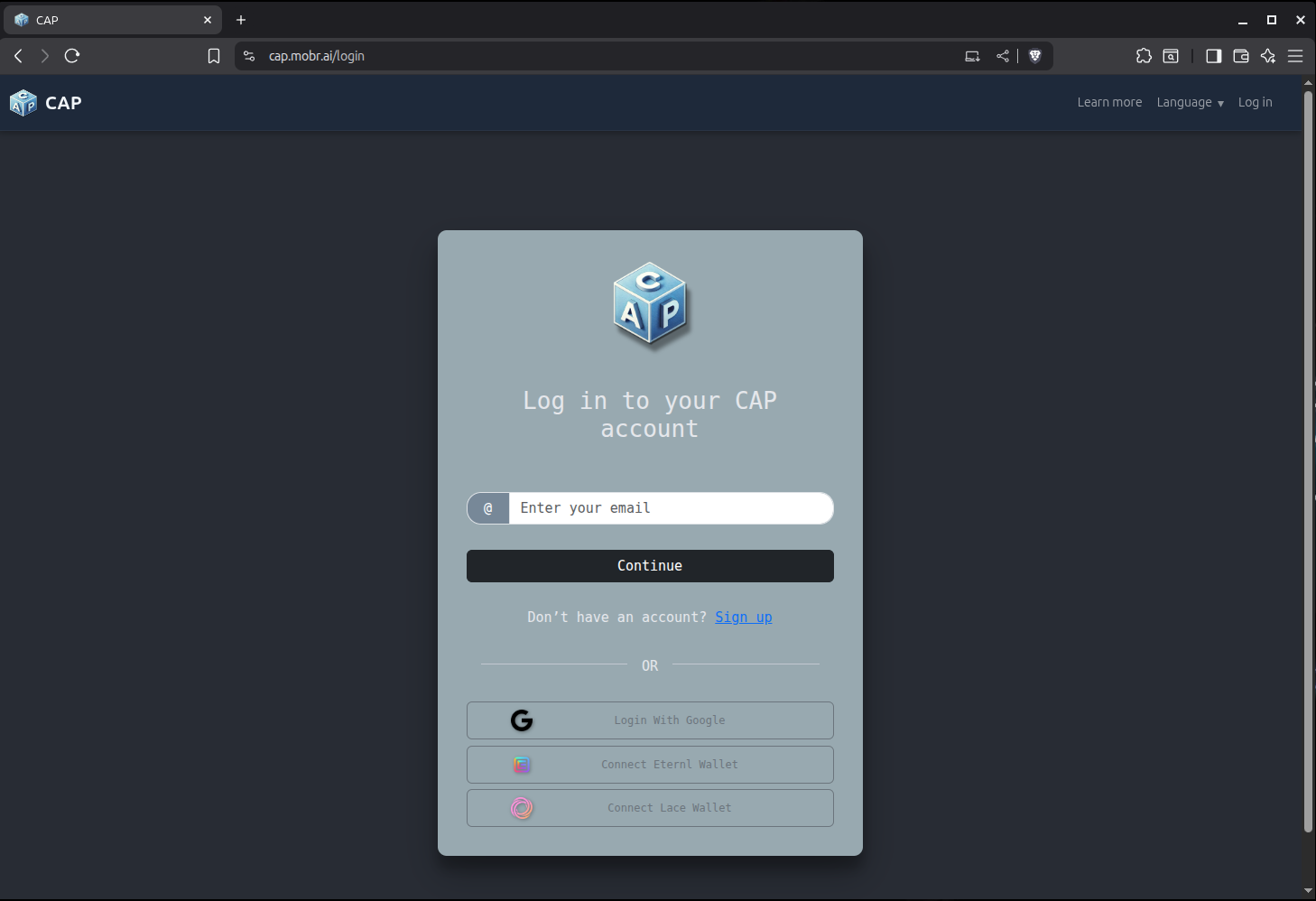
1. Fine-tuned LLM Reasoning (Vertical 1)
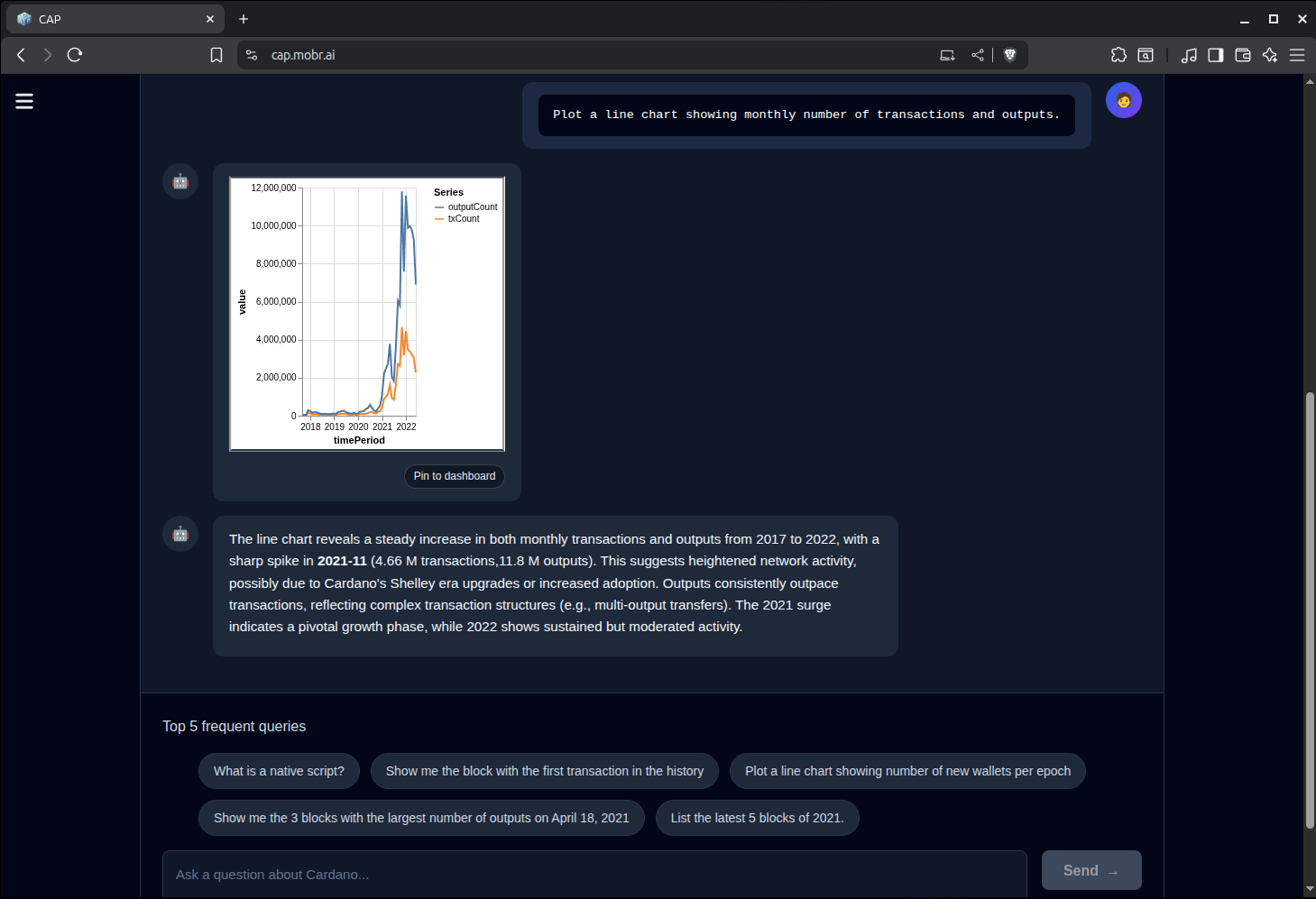
CAP’s first major innovation is the introduction of a large language model (LLM), with a proof of concept version delivered in the Fund13 project (see Supporting Documentation links). This model was specifically baked with the CAP Ontology and a few-shot training approach. In phase 2, we aim at fine tuning CAP’s LLM not only with the domain ontology, but also with off-chain data schemas (i.e., schemas for structuring offchain data extracted from anchors present in the cardano blockchain metadata, and other off-chain sources for governance, SPOs, and tokens).
Fine-tuning an LLM is like teaching a student through months of dedicated practice, while few-shot “baking” is like giving them a couple of example answers and hoping they generalize. With fine-tuning, the model actually learns new patterns and adapts its internal behavior, producing far more reliable and consistent results across many situations. Few-shot training only guide the model temporarily and can easily fail when the question changes slightly. However, fine-tuning is much harder: it requires preparing the class material for the students, running training jobs, evaluating performance, avoiding biases, and managing infrastructure, which is far more effort than just adding a few examples into a mode file configuration.
The result will be a model capable of delivering contextualized and explainable analytics, with an expected lower error rate when compared to the previously delivered baked model, as well as generic models (e.g., Grok, GPT, Claude, Llama, etc.) that have no realtime or inherent context of Cardano’s blockchain data records.
No equivalent is available in the Cardano ecosystem. There are developer-oriented agents, but none integrated with a semantic KG and off-chain data federation, and smart dashboards. CAP’s LLM will act not merely as a chatbot but as a semantic compiler, bridging human questions to executable queries across heterogeneous data sources.
.
.
2. Large-Scale Knowledge Graph (Vertical 2)
Having a knowledge graph is like giving an LLM a well-organized map of everything it needs to know, so instead of guessing, it can anchor its answers in clear, connected facts. This makes the model capable of handling questions related to dynamic data, such as blockchains. It allows the model to be more accurate, consistent, and explainable because it can follow structured relationships rather than relying on memory or pattern matching alone. But building this kind of solution is difficult: it requires defining a precise data model, cleaning and linking large amounts of real-world data, maintaining consistency across sources, and ensuring the graph stays up to date. All of which demand significant engineering, domain expertise, and careful design.
.
.
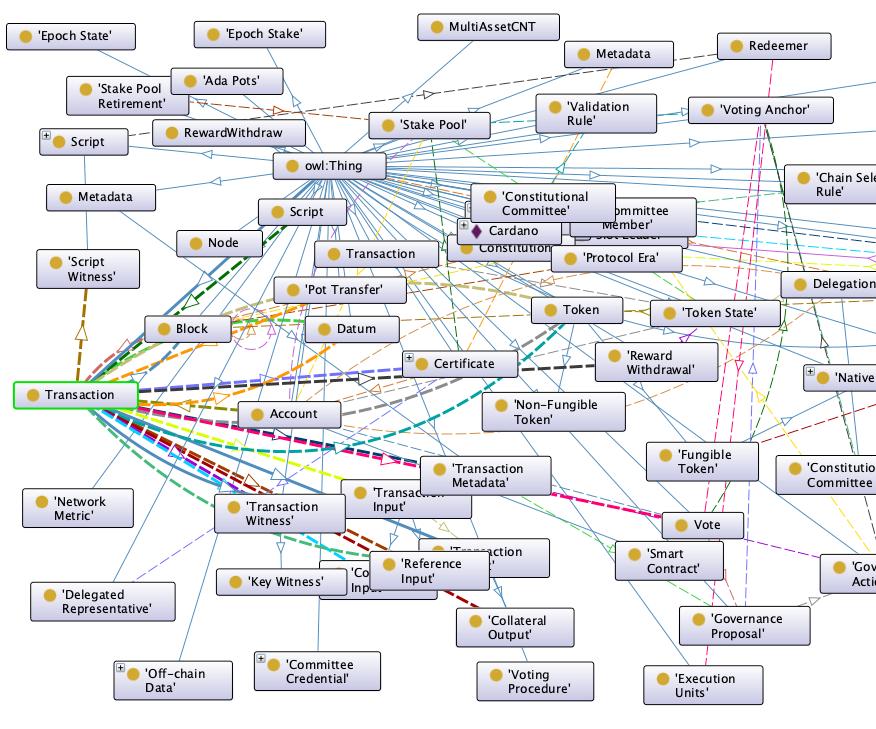
CAP's phase 1 delivered an ontology and a Cardano blockchain ETL to convert blockchain data into knowledge graph with a well defined formal conceptual map (i.e., the ontology).
A semantic knowledge graph is a better fit than a relational database in this approach because it represents relationships and meaning, not just tables and rows. Instead of forcing data into rigid structures, a knowledge graph connects concepts naturally, making it much easier for an AI to reason about how everything fits together.
The second main innovation will be the CAP’s large-scale Cardano Knowledge Graph (CKG). A large-scale Cardano knowledge graph gives the community a clear, connected picture of everything happening on the blockchain. Who interacts with what, how assets move, how eras evolve, and how the ecosystem grows. Instead of digging through raw data or relying on scattered tools, developers, researchers, and users get a structured source of truth that makes analysis easier, insights faster, and innovation more accessible. This shared foundation strengthens transparency, improves decision-making, and empowers the entire community to build smarter applications on top of reliable, well-organized Cardano data.
In addition, CKG will federate structured semantic triples from on-chain data with off-chain data. Having a federated knowledge graph that brings together both on-chain and off-chain data is like finally seeing the full picture instead of just half the puzzle. On-chain data shows what happens, but off-chain data can explain with human-readable details and how things connect in the real world. When these sources are linked, you get a complete, trustworthy view that no single database can provide, making everything from compliance to analytics to app-building far more accurate and meaningful. This unified perspective is crucial for real adoption, because most useful insights live at the intersection of blockchain activity and external context, not in either one alone.
Many blockchains have indexers or analytics datasets (e.g., BigQuery indexing for Ethereum, The Graph subgraphs, Dune SQL tables), but they are not semantically structured or ontology-driven. CKG represents blockchain entities and their relationships using a structured ontology, allowing machines and LLMs to reason contextually rather than syntactically.
This way the Cardano community will have access to a full, production-ready semantic knowledge graph capable of linking off-chain and on-chain data into a single resolvable knowledge layer.
.
3. User-Centric Smart Dashboards (Vertical 3)
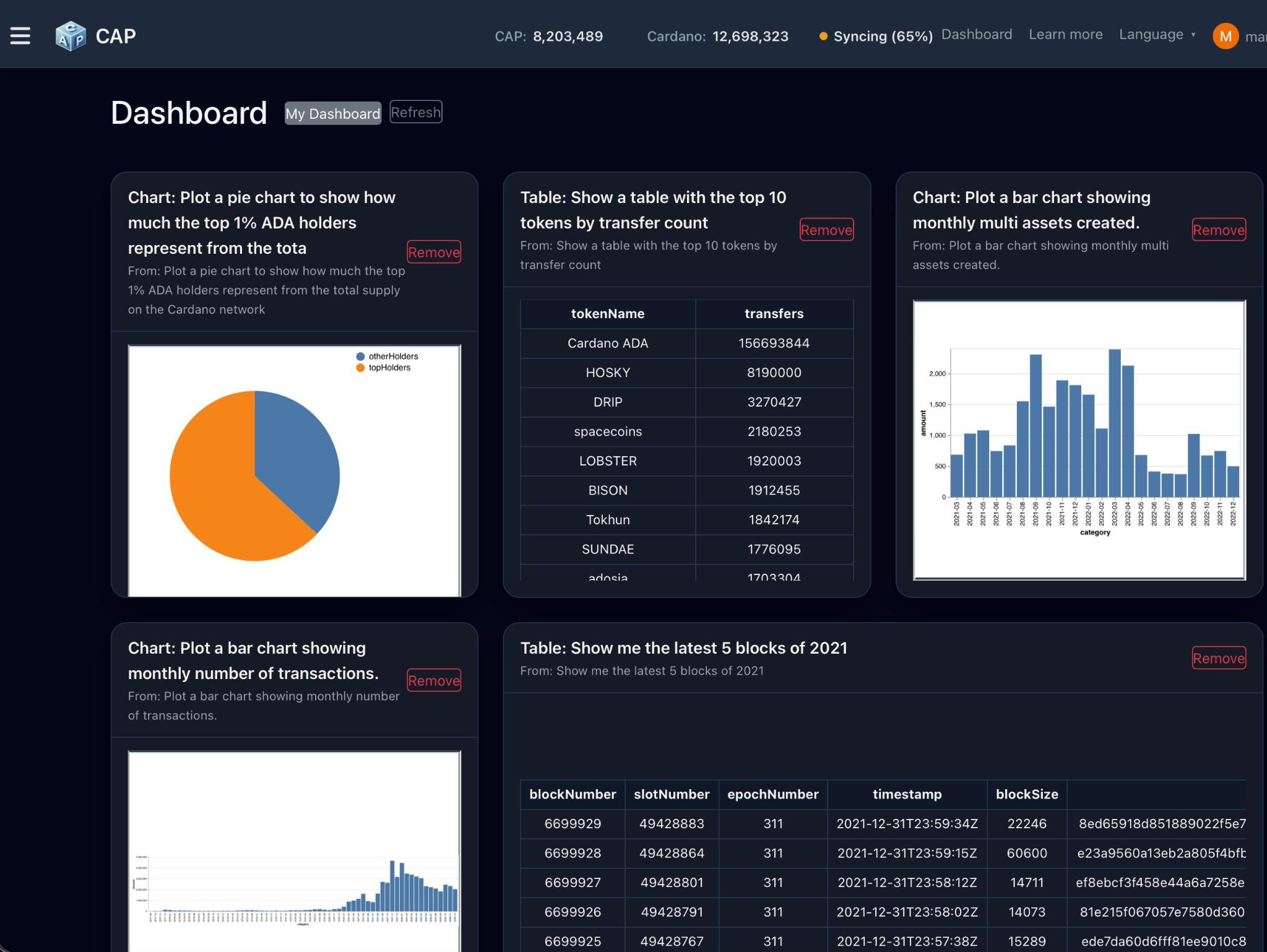
The third main innovation of this project lies in CAP’s Smart Dashboard framework. CAP's phase 1 prototype proved this concept by supporting the creation of static charts and the addition (pin) of these charts in a single and also static dashboard.
A smart dashboard is important because it turns complex blockchain information into simple, interactive visuals that anyone can understand at a glance. No coding, no queries, no technical background required. It acts like a control center where users can explore data, compare trends, and get answers instantly. But building such a dashboard is hard: it requires large scale and dynamic data integration, a flexible widget system, smooth interactions with multiple components, and a reliable backend capable of handling large-scale analytics. Combining all of this into a fast and intuitive interface is an engineering challenge.
CAP phase 2 will elevate the platform from a collection of static, developer-oriented charts into a fully dynamic, user-assembled analytics workspace. Instead of presenting predefined visualizations, the dashboard will empower each user to create, customize, arrange, and interact with their own dashboards composed of semantically driven widgets that directly reflect Cardano’s on-chain and off-chain knowledge graph.
This transforms the analytics experience from a passive view of charts into an intelligent, adaptive interface where insights can be constructed, compared, explained, and shared through natural-language commands, multilingual support, and interactive visual elements.
.
.
4. Landscape Overview
A solution that unifies the Cardano Knowledge Graph, LLM intelligence, and a smart dashboard gives users a seamless way to ask questions and instantly see meaningful answers. The knowledge graph ensures the information is up to date and accurate, the LLM translates that structured data into clear explanations, and the dashboard automatically transforms those insights into charts, tables, and interactive widgets. This makes complex blockchain analysis easy and intuitive, allowing anyone, from developers to enthusiasts, to explore Cardano’s data visually without writing code or dealing with technical details.
Most blockchain analytics solutions like Nansen, Messari, Artemis, Glassnode, or open-source explorers, focus on surface metrics such as blocks, volume, staking, and transactions. Cardano-specific tools like yaci-store and the recent yaci-MCP natural-language connector also operate on indexed relational data or direct API calls, offering structured access but no semantic understanding and seamlessly integrated LLM reasoning.
That is, these solutions lack a semantic layer that converts on-chain data into interconnected knowledge graphs representing high-level entities and relationships.
No blockchain platform today provides an integrated, ontology-backed analytics system with KG contextualization, fine-tuned LLM support, and user-centric smart dashboards.
From a business perspective, this integrated three-vertical solution is groundbreaking because it unites structured knowledge, AI reasoning, and real-time visual analytics in a way no traditional tool can. It transforms the vast complexity of Cardano’s ecosystem into a ready-to-use intelligence engine that delivers fast insights, stronger compliance, smarter product decisions, and more intuitive customer experiences. The result is a powerful competitive edge: community members, investors and organizations can understand the network more deeply, spot oportunities earlier, automate expert-level analysis, and build new data-driven services on top of a foundation that simply doesn’t exist elsewhere.
Describe what your prototype or MVP will demonstrate, and where it can be accessed.
CAP phase 2 will present a fully deployed, publicly accessible minimum viable product (MVP) demonstrating the practical integration of CAP’s three innovation pillars: (1) a fine-tuned, Cardano-specialized LLM capable of semantic interpretation and federated query execution, (2) the Cardano Knowledge Graph (CKG) providing an ontology-driven representation of both on-chain and off-chain Cardano data sources, and (3) a new Smart Dashboard environment enabling users to construct, explore, and share dynamic analytics workspaces. The MVP will run on a publicly accessible environment and use Cardano mainnet data, allowing any community member to interact with the system and independently experience CAP’s capabilities.
Regarding Vertical 1, CAP’s workflow will be fully operational: a user issues a natural-language question in multiple languages, the LLM interprets the question using the Cardano domain ontology, produces a valid federated datastore query, retrieves results from CKG and off-chain registries, contextualizes the results using LLM reasoning, and displays them in a dynamic widget, which can be pinned compose the user’s dashboard.
The MVP will demonstrate CAP’s next-generation LLM features, which will allow contextual query. For example, the MVP will support queries such as:
- “Show me logo, ticker, name and description of the top 5 tokens by transfer in the past week”
Off-chain data provides the human-readable information like logos and descriptions that aren’t stored on-chain, making the results understandable and visually meaningful.
- “Create a table showing pools where the anchored metadata differs from their on-chain registration certificates.”
Off-chain metadata contains descriptive info about pools, so differences with the on-chain record reveal updates or discrepancies.
- “List the top 5 meme tokens by transaction volume?”
Off-chain data provides the context (i.e., description) needed so the LLM can identify which tokens are “meme” tokens, which the blockchain alone cannot tell.
- “Compare voter turnout from governance proposals labeled as ‘critical’ with those labeled ‘minor’”
Off-chain metadata often includes proposal labels or categories; combining this with on-chain vote counts allows meaningful comparisons that wouldn’t be possible with on-chain data alone.
These are not simple lookup operations. They require federation between different sources, ontology-level contextualization, and multi-hop reasoning. That is, the MVP will demonstrate that CAP’s LLM acts as a semantic compiler, not merely a chatbot.
Considering Vertical 2, the CKG will also be fully operational in the MVP and accessible through a public read-only SPARQL endpoint. It will model Cardano’s conceptual entities such as blocks, transactions, eUTxOs, scripts, tokens, stake pools, delegation certificates, governance actions, and all meaningful relationships among them. The MVP will show how CKG federates off-chain data into the graph, enabling multi-hop analytic reasoning that cannot be expressed through traditional indexers or SQL-style query layers. Specifically, CKG will enable:
- Fine-grained relationships between relevant entities, such as blocks, transactions, eUTXOs, accounts, tokens, scripts, stake pools, governance, etc.
- Federated queries that combine off-chain data with on-chain activity
- Multi-source federation: on-chain data, governance, tokens, etc.
- Semantic validations and typed reasoning
From the Vertical 3 perspective, the Smart Dashboard framework will be a central part of the MVP. The MVP will demonstrate CAP's smart dashboard features, providing:
- New widget types (numerical indicator, gauges, etc.)
- Draggable, resizable, mergeable widgets
- Live data refresh synchronized with CKG
- Interactive chart modals for fine-grained exploration
- Support for multiple dashboards per user
- Shareable dashboards with unique URLs or embeds
The MVP will also demonstrate full multilingual support. All UI elements, data labels, LLM responses, and widget-level explanations will be available in multiple languages. Users will be able to type questions in either language and receive accurate, contextualized results.
This will be a step forward to broaden CAP’s global accessibility and support communities where Cardano adoption is strong.
From a deployment perspective, the MVP will be available at https://cap.mobr.ai, the same URL currently hosting the pre-alpha deployment. During the project, the site will be updated to serve the new LLM model, the enhanced CKG-backed query engine, and the new Smart Dashboard features. CAP’s SPARQL endpoint, LLM query endpoint, and dashboard interface will all be accessible, so community members, including SPOs, DApps, governance participants, researchers, and developers, can test and validate all features.
Describe realistic measures of success, ideally with on-chain metrics.
Success for CAP Phase 2 will be evaluated through a set of qualitative and quantitative dimensions that reflect progress across its three innovation pillars. These dimensions emphasize observable behaviors, measurable system performance, user adoption patterns, ecosystem engagement, and on-chain verifiability. The dimensions focus on categories of evidence and indicators that will naturally emerge as the MVP evolves and is tested by its users.
Success Dimension 1 — LLM Capability, Semantic Understanding, and Multilingual Reasoning
A foundational measure of success is the ability of the fine-tuned LLM to reliably interpret natural-language questions, grounded in Cardano’s ontology and off-chain data structures. As the model evolves, we expect to observe increasing consistency in how the LLM understands queries involving the Cardano domain. Indicators of progress include: the query engine’s ability to consistently execute valid federated queries; its increasing capacity to recognize Cardano-specific terminology; and its competence in explaining the reasoning process behind its answers. We will also observe the LLM’s multilingual accuracy by monitoring how well it interprets and answers questions in different languages, and how easily users in different linguistic communities engage with the system. Over time, improvements in these areas will reflect the LLM’s evolution into a reliable semantic interface for Cardano analytics.
Target: LLM produces ≥ 80% semantically valid queries and ≥ 70% accuracy on multilingual question interpretation.
.
Success Dimension 2 — Knowledge Graph Completeness, Semantic Integrity, and Reasoning Depth
The CKG serves as the project’s semantic backbone, enabling structured reasoning over Cardano on-chain and off-chain data. As the MVP is exercised by real users, we expect the graph to grow in completeness, covering more relationships among Cardano’s conceptual entities. Indicators of progress include: successful resolution of off-chain sources (e.g., consistency between Token Registry metadata and minting information); and the CKG’s ability to support multi-hop reasoning across federated datasets. We will also monitor the system’s adherence to the ontology. The ability of the CKG to answer complex federated questions is itself a measure of success, demonstrating that the semantic layer is functioning as intended and enabling insights that cannot be derived from relational indexers.
Target: CKG represents ≥ 90% of referenced off-chain metadata and supports reasoning with ontology-consistent contextualization.
.
Success Dimension 3 — Dashboard Usability, Flexibility, and Analytics Adoption
The Smart Dashboard environment is a key part of the MVP, and its success will be measured by how effectively users adopt and interact with it. Over time, we expect to observe indicators such as: increased creation of dashboards; diversity of widget types used; user engagement with interactive elements such as expandable chart modals; and the frequency with which users pin LLM-generated queries to their dashboards. The appearance of organically composed dashboards will indicate that users understand how to assemble meaningful analytics workspaces. The system’s ability to support multiple dashboards per user, and the emergence of shared dashboards distributed through unique URLs, will signal that CAP is being used not only for personal exploration but for collaborative knowledge sharing within the ecosystem.
Target: More than 50 unique dashboards with an average of ≥ 2 widget types per dashboard within the evaluation period.
.
Success Dimension 4 — System Stability, Performance, and Responsiveness
Another dimension of success is the system’s technical robustness under community use. We will observe system stability in real time. Indicators include: responsiveness of the LLM backend when processing queries; performance of the SPARQL endpoint under load; reliability of dashboard updates as the related data is refreshed. Monitoring logs from real users will naturally reveal whether the system scales efficiently, whether caching strategies are effective, and whether bottlenecks emerge as usage increases.
Target: query latency remains < 20 seconds on average.
.
Success Dimension 5 — Ecosystem Engagement and Community Feedback Loops
A crucial measure of success is the degree to which the Cardano community interacts with the MVP, provides feedback, and returns to the platform for further use. Observable indicators include participation rates in feedback channels like discussions in our recently created telegram group (https://t.me/cardanoanalytics) frequency of community-submitted insights, and collaborative evolution of ontology extensions.
Target: Community participation reaches ≥ 100 contributors across feedback channels.
.
Success Dimension 6 — Long-Term Ecosystem Alignment and Integrability
Another meaningful measure of CAP’s success is the extent to which other Cardano tools, DApps, SPO dashboards, governance platforms, or research projects find CAP’s semantic infrastructure valuable enough to integrate with. As CAP’s knowledge graph and LLM capabilities evolve, we anticipate natural demand for CAP’s query engine as an API, its ontology as a shared vocabulary, and its dashboards as embeddable analytics modules. Early signals may include requests from developers to reuse ontology components, references to CAP in research or governance reports, and the use of CAP-generated data in third-party applications. Over time, these integrability indicators will show that CAP is becoming a foundational analytics layer for Cardano.
Target: Contact at least 10 external Cardano teams to discuss use of CAP components and APIs.
[Your Project and Solution] Solution
Please describe your proposed solution and how it addresses the problem
CAP's MVP will be an integrated system that combines a fine-tuned domain-specific LLM, a federated Cardano Knowledge Graph (CKG), and a next-generation Smart Dashboard environment to give users contextual, explainable, and multilingual insights into both on-chain and off-chain Cardano data.
The MVP will directly address the problem identified: Cardano currently lacks a platform that unifies data semantics, reasoning, and visualization into a coherent user experience.
1. Fine-tuned Cardano-specialized LLM (Vertical 1)
The first component of the solution is the evolution of CAP’s large language model into a fine-tuned, domain-specialized reasoning engine.
Fine-tuning an LLM is like teaching a student through months of dedicated practice, while few-shot “baking” is like giving them a couple of example answers and hoping they generalize. With fine-tuning, the model actually learns new patterns and adapts its internal behavior, producing far more reliable and consistent results across many situations. Few-shot prompts only guide the model temporarily and can easily fail when the question changes slightly. However, fine-tuning is much harder: it requires preparing clean datasets, running training jobs, evaluating performance, avoiding biases, and managing infrastructure, which is far more effort than just adding a few examples into a prompt.
CAP's LLM will be trained on Cardano-specific ontology relationships, offchain schemas for governance data, token registry definitions, stake pool metadata structures, and offchain data from metadata anchors (pointers stored in the onchain metadata). The LLM will provide a natural language understanding, multilingual interaction, and semantic interpretation of user questions. It functions not as a chatbot, but as a semantic compiler that transforms natural-language questions into valid federated queries, grounded in Cardano’s conceptual ontology.
This addresses the core issue that existing analytics tools require users to understand Cardano’s data structures, indexing conventions, or query languages. The LLM removes those barriers, enabling any user to ask their questions.
2. Cardano Knowledge Graph (Vertical 2)
The second part of the solution is CAP’s Cardano Knowledge Graph (CKG), which transforms Cardano data into a semantic, ontology-driven graph. The graph will support federated queries that combine on-chain and off-chain information, enabling multi-hop reasoning that cannot be expressed in SQL or table-based indexers.
A federated knowledge graph is like a network of connected maps instead of just one big map. Each map (or dataset) is a different source of data that can represent different domains, but the graph links them together so you can see how everything relates across all sources. This means you can query and explore information from multiple source and domains at once, getting a complete picture without knowing the details of each source of data. It is especially useful when combining on-chain and off-chain data, because you can see connections and insights that would be invisible if each data source stayed isolated. A large-scale Cardano knowledge graph gives the community a clear, connected picture of everything happening on the blockchain. Who interacts with what, how assets move, how eras evolve, and how the ecosystem grows. Instead of digging through raw data or relying on scattered tools, developers, researchers, and users get a single structured source of truth that makes analysis easier, insights faster, and innovation more accessible. This shared foundation strengthens transparency, improves decision-making, and empowers the entire community to build smarter applications on top of reliable, well-organized Cardano data.
CKG addresses a critical gap in ecosystem tooling: while Cardano has excellent data availability through indexers, it lacks a semantic layer capable of modeling relationships between high-level concepts. It will enable complex questions that require integrated reasoning, making Cardano’s structure accessible and intelligible.
3. Smart Dashboard Platform (Vertical 3)
The third pillar of the solution is a flexible Smart Dashboard framework that will enable users to construct dynamic analytics workspaces.
A smart dashboard is key, since it turns complex blockchain information into simple, interactive visuals that anyone can understand at a glance. No coding, no queries, no technical background required. It acts like a control center where users can explore data, compare trends, and get answers instantly. But building such a dashboard is hard: it requires real-time data integration, a flexible widget system, smooth interactions with both the knowledge graph and an LLM, and a reliable backend capable of handling large-scale analytics. Combining all of this into a fast, intuitive, and error-free interface is a significant engineering challenge.
CAP’s dashboard will be an interactive environment where users can compose analyses from semantically linked widgets that reflect both on-chain and off-chain relationships. Users will be able to drag, resize, merge widgets, open visual modals, and share their dashboards through unique URLs. They can pin LLM-generated insights, compare cross-domain entities, and maintain multiple dashboards.
The dashboard component addresses another problem: existing Cardano analytics tools present predefined metrics that users cannot modify or extend. CAP will allow each user to create personalized dashboards that integrate analysis into a unified interface.
4. Unified Solution for Cardano analytics
A solution that unifies the Cardano Knowledge Graph, LLM intelligence, and a smart dashboard gives users a seamless way to ask questions and instantly see meaningful answers. The knowledge graph ensures the information is accurate, the LLM translates that structured data into clear explanations, and the dashboard automatically transforms those insights into charts, tables, and interactive widgets. This makes complex blockchain analysis easy and intuitive, allowing anyone, from developers to enthusiasts, to explore Cardano’s data visually without writing queries or dealing with technical details.
The three pillars will work in synergy:
- The LLM interprets natural-language queries using Cardano’s ontology.
- The CKG resolves multi-hop relationships across on-chain and off-chain data.
- The Smart Dashboard visualizes insights and allows interactive exploration.
The MVP will demonstrate CAP’s next-generation LLM features, which will allow contextual query. With the integration, the MVP will support queries such as:
- “Show me logo, ticker, name and description of the top 5 tokens by transfer in the past week”
Off-chain data provides the human-readable information like logos and descriptions that aren’t stored on-chain, making the results understandable and visually meaningful.
- “Create a table showing pools where the anchored metadata differs from their on-chain registration certificates.”
Off-chain metadata contains descriptive info about pools, so differences with the on-chain record reveal updates or discrepancies.
- “List the top 5 meme tokens by transaction volume?”
Off-chain data provides the context (i.e., description) needed so the LLM can identify which tokens are “meme” tokens, which the blockchain alone cannot tell.
- “Compare voter turnout from governance proposals labeled as ‘critical’ with those labeled ‘minor’”
Off-chain metadata often includes proposal labels or categories; combining this with on-chain vote counts allows meaningful comparisons that wouldn’t be possible with on-chain data alone.
From a business perspective, this integrated three-vertical solution is groundbreaking since it unites structured knowledge, AI reasoning, and real-time visual analytics in a way no traditional tool can. It transforms the vast complexity of Cardano’s ecosystem into a ready-to-use intelligence engine that delivers fast insights, stronger compliance, smarter product decisions, and more intuitive customer experiences.
The result is a powerful competitive edge: organizations can understand the network more deeply, spot opportunities earlier, automate expert-level analysis, and build new data-driven services on top of a foundation that simply doesn’t exist elsewhere.
[Your Project and Solution] Impact
Please define the positive impact your project will have on the wider Cardano community
CAP Phase 2 will deliver a transformative impact across multiple layers of the Cardano ecosystem by turning raw blockchain and off-chain data into contextual insights that are understandable, explainable, and actionable by all users. CAP is a tool to advance transparency and community engagement.
1. Impact on Accessibility and Knowledge Transparency
CAP eases access to Cardano analytics by allowing any user (technical or not) to query from simple to complex queries through natural language. This lowers the barrier, enabling Cardano community members to explore the ecosystem in ways that were previously limited to developers, reducing reliance on specialized tooling and central intermediaries.
2. Impact on Insight and Community Decision-Making
The community will gain the ability to examine relationships between the Cardano conceptual entities through transparent answers and visualizations. CAP will help explain on-chain and off-chain data, allowing more community members to meaningfully participate in Cardano’s ecosystem. This strengthens decentralization and informed decision-making.
3. Impact on Developers and Researchers
Developers will gain a semantic query layer for Cardano data, enabling richer analytics in dApps and off-chain services. Researchers will gain an ontology-based foundation for studying Cardano’s structure, which can be extended or reused across academic or industry initiatives.
4. Impact on Ecosystem Tools Integration
Because CAP is fully open-source, teams can integrate CAP’s query engine, ontology, or dashboard components into their own projects. It acts as a shared intelligence layer for off-chain and on-chain research tools.
5. Impact through Multilingual Support
The availability of multilanguage support expands Cardano’s accessibility in different communities, including where blockchain adoption is rapidly growing. This paves the way for easy extension for diversify future language support, aligning with Catalyst’s goal of fostering globally inclusive participation.
6. Impact on Long-Term Ecosystem Maturity and Standards
CAP will provide a semantic ontology for Cardano entities which can evolve into a community-driven standard. This encourages consistent data practices, improved metadata quality, and interoperability across analytics tools.
7. Business Impact
CAP Phase 2 delivers significant business value by transforming raw blockchain and off-chain data into actionable insights that are understandable, explainable, and widely accessible. By lowering the barrier to Cardano analytics, CAP will enable broader participation from community members, researchers, and developers, supporting informed decision-making and stronger ecosystem engagement. Its open-source architecture allows organizations to integrate CAP’s knowledge graph, query engine, and dashboard into their own products and services, accelerating innovation and creating new data-driven offerings. Multilingual support and a semantic ontology further expand reach and standardization, positioning CAP as a strategic foundation for long-term growth, operational efficiency, and competitive advantage within the Cardano ecosystem.
[Your Project and Solution] Capabilities & Feasibility
What is your capability to deliver your project with high levels of trust and accountability? How do you intend to validate if your approach is feasible?
CAP Phase 2 builds upon an already delivered and publicly demonstrated foundation from Fund13, where MOBR Systems delivered a functioning ontology-baked LLM, Cardano Knowledge Graph ETL pipeline, and an early dashboard interface. Our capability to deliver the next phase of development is grounded in a proven track record, established infrastructure, experienced team members, open-source transparency, and continuous community availability for testing.
1. Proven Delivery in Fund13
The team successfully delivered the CAP Phase 1 funded under Catalyst Fund13 (Proposal #1300034). This included:
- a functioning semantic ETL pipeline,
- an ontology-backed knowledge graph structure,
- a proof-of-concept LLM embedded with few-shot ontology prompts,
- a working dashboard preview,
- public pre-alpha deployment at https://cap.mobr.ai.
Our ability to complete complex technical milestones within a Catalyst-funded cycle demonstrates high reliability and trustworthiness.
In addition, MOBR Systems successfully delivered the Fund 13 Decentralized Fact-Checking Toolkit (MVP) (ID 1300076), which integrates AI-driven content analysis, semantic claim extraction, and functional Plutus provenance/governance validators. The system is live and demonstrates that the architecture works end to end.
2. Strong Backend and Infrastructure Capabilities
Our team, led by two PhDs in distributed systems, has extensive experience in AI and blockchain engineering, with Plutus, Lucid, smart contract integration, content-processing pipelines, and multilingual product design.
We operate Cardano-focused backend systems including Postgres DBs, FastAPI services, semantic triple stores, and a working deployment pipeline. We maintain ongoing operations for CAP’s backend running on a dedicated server, providing real-time availability for community testing. Our infrastructure and DevOps experience ensures we can scale and harden the system for broader public access.
3. Open Source Transparency and Community Validation
This project will remain fully available under GPL-3.0. This promotes accountability and enables peer verification of our work. External teams may audit, fork, or extend CAP, ensuring full transparency.
Our feasibility testing approach relies heavily on real-world community validation. The MVP will be publicly deployed and continuously accessible at https://cap.mobr.ai, where users can:
- submit natural-language queries,
- interact with dashboards,
- observe real on-chain and off-chain federation in action.
This immediate exposure will ensure bugs, inconsistencies, and ontology gaps surface early and can be corrected.
4. Validation Through LLM Evaluation and Benchmarking
We will evaluate the fine-tuned LLM using:
- natural-language → query datasets,
- governance/schema comprehension tests,
- script linkage reasoning tasks,
- multilingual prompt evaluation,
- human-in-the-loop quality reviews.
5. Validation Through Dashboard Usage Observation
We will observe user activity through opt-in analytics and on-chain logging signals. Metrics such as dashboard creation, widget interaction, federated query patterns, and session durations help validate usability and impact.
6. Risks and Mitigation Strategies
We will reduce risk by:
- building upon existing, proven architecture,
- incremental fine-tuning cycles for the LLM,
- modular ontology updates,
- query tests before mainnet federation.
It is important to highlight that the team has already delivered a live prototype for CAP phase 1, and has the technical expertise to execute CAP Phase 2 with high accountability and public visibility. Feasibility is validated continuously through open deployment, semantic validation testing, federated query execution, LLM benchmarking, community evaluation, and transparent open-source development.
[Milestones] Project Milestones
Milestone Title
Ontology Updates and Off-Chain Data ETL
Milestone Outputs
This milestone delivers all foundational semantic components needed to fine-tune the CAP LLM and expand the Cardano Knowledge Graph (CKG). It includes:
- Updated CAP Ontology covering metadata for governance, stake pool, and transaction anchors relationships, as well as token registry (i.e., cardano token registry).
- New off-chain ETL pipelines for:
- token registry
- anchor resolution for:
- Pool metadata
- Governance metadata
- Transaction metadata
- Test cases for ontology validation and CKG ingestion.
- Updated developer documentation describing the extended schema, federation logic, and new ETL sources.
Acceptance Criteria
- Ontology extensions validated through SPARQL query checks.
- Off-chain data ETL pipelines successfully ingest data and populate test knowledge graph instances.
- Integration tests confirm that federated data are resolvable and typed correctly within the CKG.
- Documentation updated and published in the repository.
Evidence of Completion
- Public link to updated ontology in GitHub.
- Public link to updated ontology documentation in GitHub.
- Public link to off-chain data ETL pipeline code in GitHub.
- Public link to off-chain data ETL pipeline documentation in GitHub.
- Screen recording video demonstrating tests, and correct ingestion of off-chain sources.
Delivery Month
2
Cost
40000
Progress
20 %
Milestone Title
Fine-Tuned LLM & Query Engine Integration
Milestone Outputs
This milestone delivers the fine-tuned LLM and its integration into CAP’s query engine. Outputs include:
- Fine-tuned domain LLM trained on updated Cardano ontology and off-chain metadata schemas.
- Multilingual reasoning support.
- Query engine capable of generating federated datastore queries from natural language.
- Semantic reasoning layer enabling multi-hop interpretation (i.e., answers containing off-chain and on-chain data).
- API endpoints for querying CAP.
Acceptance Criteria
- Fine-tuned LLM produces valid answers for the targeted queries.
- Query engine transforms NL to federated query in at least two languages.
- Query engine returns answers that combine on-chain and off-chain data.
- Tests demonstrate consistent retrieval across multi-hop queries.
- API endpoints deployed in development mode and accessible for reviewers.
Evidence of Completion
- LLM model is available on Ollama repository
- Link to query engine federation code in GitHub.
- Link to SPARQL query tests in GitHub.
- Link to tests code in GitHub and link to swagger online.
- Link to API endpoints code in GitHub and link to swagger online.
Delivery Month
6
Cost
70000
Progress
60 %
Milestone Title
Smart Dashboard Core: Layout Engine, Basic Widgets & Live Data Refresh
Milestone Outputs
This milestone delivers the foundational dashboard engine. Outputs include:
• Core dashboard layout engine: draggable, resizable, mergeable widgets.
• Base widget types: number indicators, gauge.
• Automatic widget data refresh linked to CAP updates.
• Widget customization (title and label edits, color selection) and extended metadata (query and associated insight).
• Initial multilingual UI integration.
• Persistence layer for multiple dashboards per user.
Acceptance Criteria
• Users can add/remove/resize/merge widgets.
• Users can ask queries that return number indicators and gauge widgets.
• Widgets automatically refresh when data updates.
• Users can customize widgets (at least: title and label edits, color selection) and see extended metadata (at least: query and associated insight).
• Dashboard UI works in at least two different languages.
• Users can create and persist multiple dashboards.
Evidence of Completion
• Link to core dashboard layout engine code in GitHub.
• Link to ReactJS widget code in GitHub.
• Link to dynamic widget data feed code in GitHub.
• Link to widget customization code in GitHub.
• Link to multilanguage support code in GitHub.
• Link to multiple dashboard management code in GitHub.
Delivery Month
8
Cost
30000
Progress
70 %
Milestone Title
Advanced Smart Dashboard: Merging, Sharing, URL-Linking & Multilingual Full i18n
Milestone Outputs
This milestone completes the advanced dashboard features. Outputs include:
• Interactive widget with merging features (for compatible charts and tables).
• Advanced widgets (governance views, script views).
• Dashboard sharing with unique URLs or embed codes.
• Internationalization of UI i18n.
Acceptance Criteria
• Users can merge widgets when compatible in the dashboard.
• Advanced widgets (governance views, script views) render correctly.
• Users can share dashboards with CAP users via URL.
• UI i18n works for all dashboard elements for at least two language.
Evidence of Completion
• Link to interactive widget merging code in GitHub.
• Link to advanced widgets code in GitHub.
• Link to dashboard-sharing implementation.
• Link to dashboard internationalization with i18n code in GitHub.
Delivery Month
9
Cost
30000
Progress
90 %
Milestone Title
Final Milestone
Milestone Outputs
This milestone finalizes CAP Phase 2 with a complete, publicly accessible MVP deployment. Outputs include:
- Public MVP release at https://cap.mobr.ai with all three innovation pillars active.
- SPARQL endpoint deployed for authenticated read-only queries.
- CAP available with multilingual NL support.
- Public testing and bug-reporting mechanism.
- Closeout Report
- Closeout Video
Acceptance Criteria
- MVP is accessible with authentication and supports all three innovation pillars.
- CAP’s API supports SPARQL queries.
- Users can make NL queries in at least two different languages using CAP’s MVP.
- Users can compose and share dynamic dashboards on CAP’s MVP.
- Users can submit feedback, and suggestions on CAP’s MVP.
- Closeout report is publicly available.
- Closeout video is publicly available.
Evidence of Completion
- Deployment available at https://cap.mobr.ai.
- Closeout report is accessible in GitHub.
- Closeout video publicly available on YouTube, showing, at least:
- SPARQL queries using CAP’s API from MVP’s URL.
- NL queries in at least two different languages using CAP’s MVP.
- Automatic visualizations updates on CAP’s MVP.
- Submission of issues, feedback, and suggestions on CAP’s MVP.
Delivery Month
10
Cost
30000
Progress
100 %
[Final Pitch] Budget & Costs
Please provide a cost breakdown of the proposed work and resources
The total requested budget is ₳200,000, supporting a **10-month **development cycle. Costs reflect personnel work, infrastructure, LLM compute, and documentation efforts to deliver a production-grade MVP that integrates NL querying, semantic reasoning, on-chain/off-chain federation, and dynamic dashboards.
Personnel Costs (Engineering & Architecture)
₳150,000
This includes:
• LLM fine-tuning engineer
• Ontology & semantic systems engineer
• Backend engineer (ETLs, SPARQL, API)
• Frontend dashboard engineer
• DevOps for public deployment
• UI/UX contributor
Personnel requirements:
• Ontology integration & federation design
• Creation of off-chain ETL schemas & pipelines
• Implementation of semantic compiler & NL→query engine
• CKG integration and validation
• Development of Dashboard 2.0
• LLM training cycles (Python/LLM frameworks)
• Documentation, and final improvements
This accounts for the majority of resources, as CAP Phase 2 is a highly technical project requiring specialized talent.
Infrastructure & Deployment
₳20,000
Infrastructure needs include:
• High-availability compute instance for CAP MVP (backend + frontend + triple-store + LLM inference)
• Storage for ontology, CKG, SPARQL indices, and ETL logs
• LLM inference hosting (Ollama or compatible)
• Periodic ETL loads for off-chain registries
• Monitoring & logging services
Improves uptime of https://cap.mobr.ai and testing by users.
LLM Fine-Tuning Compute & Evaluation
₳15,000
Costs include:
• Compute for fine-tuning the Cardano-specialized LLM
• GPU hours for multiple training rounds
• Evaluation cycles, multilingual tests, and benchmarking runs
This enables high-quality, domain-consistent reasoning.
Documentation, Close-Out Report & Video Production
₳10,000
Includes:
• User onboarding documentation
• Developer documentation (API, ontology diagrams, dataset structure)
• Catalyst Close-Out Report composition
• Professional-grade Close-Out Video demonstrating live queries, dashboards, and NL reasoning
This ensures transparency and community accessibility.
Contingency (Risk Buffer)
₳5,000
Allocated to absorb unexpected costs such as:
• ETL format changes in external registries
• Additional GPU hours
• UX adjustments during community testing
Total Budget: ₳200,000
The breakdown is consistent with the project’s technical scope, long development timeline, and significant need for high-level engineering across LLMs, semantics, and frontend systems.
[Final Pitch] Value for Money
How does the cost of the project represent value for the Cardano ecosystem?
CAP Phase 2 delivers value by providing a solution that enhances Cardano’s analytics capabilities and user experience. The investment builds long-term ecosystem foundations rather than short-term tooling, creating a reusable, open-source intelligence layer for Cardano.
A foundational semantic analytics layer for Cardano
The CKG (Cardano Knowledge Graph) extends the ecosystem with a fully ontology-driven representation of the blockchain and its off-chain registries. This becomes a reusable backbone for explorers, auditors, researchers, and governance reviewers.
The value is long-term and multiplies as other teams integrate with CAP’s API, ontology, or dashboard.
A fine-tuned, domain-specialized Cardano LLM
Instead of relying on generic models with shallow chain knowledge, the ecosystem gains:
• An LLM trained on Cardano ontology
• Reasoning that spans on-chain and off-chain data
• Multilingual analytics
• A semantic query engine that turns NL into executable semantic queries
This capability does not exist anywhere in Cardano or other blockchain ecosystems.
The first dynamic, NL-oriented dashboard system in Cardano
The Smart Dashboard gives every user the power to build analytics suited to their role using natural language.
For the cost of this project, the community receives a production-grade, open-source, LLM-integrated analytics solution.
Fully open-source deliverables
All work is GPL-3.0 and remains available to the community. The ecosystem obtains a foundation for future innovation.
Delivers an MVP for the entire community
For ₳200k, Cardano gains a live system, with continuous improvement, multilingual support, and open source.
High engineering value relative to scope
The project covers:
• Semantic ETLs
• Ontology engineering
• LLM fine-tuning
• Dashboard architecture
• Public infrastructure
• Documentation
• Frontend UX
• Federated data integration
The cost is significantly lower than equivalent enterprise-grade analytics or AI projects.
This represents outstanding value and lays the foundation for a new era of semantic, AI-powered analytics on Cardano.
Business Value
CAP Phase 2 delivers significant business value by transforming raw blockchain and off-chain data into actionable insights that are understandable, explainable, and widely accessible. By lowering the barrier to Cardano analytics, CAP enables broader participation from enthusiasts, researchers, and developers, supporting informed decision-making and stronger ecosystem engagement. Its open-source architecture allows organizations to integrate CAP’s knowledge graph, query engine, and dashboard into their own products and services, accelerating innovation and creating new data-driven offerings. Because the MVP architecture is already designed to handle multiple sources of data (i.e., both on-chain and off-chain), it can incorporate additional datasets in the future, such as market or pricing data. This flexibility opens the door to entirely new use cases, richer insights, and a potentially much larger user base, as more participants can access comprehensive, real-time information in a single, intuitive platform. Multilingual support and a semantic ontology further expand reach and standardization, positioning CAP as a strategic foundation for long-term growth, operational efficiency, and competitive advantage.
[Self-Assessment] Self-Assessment Checklist
I confirm that evidence of prior research, whitepaper, design, or proof-of-concept is provided.
Yes
I confirm that the proposal includes ecosystem research and uses the findings to either (a) justify its uniqueness over existing solutions or (b) demonstrate the value of its novel approach.
Yes
I confirm that the proposal demonstrates technical capability via verifiable in-house talent or a confirmed development partner (GitHub, LinkedIn, portfolio, etc.)
Yes
I confirm that the proposer and all team members are in good standing with prior Catalyst projects.
Yes
I confirm that the proposal clearly defines the problem and the value of the on-chain utility.
Yes
I confirm that the primary goal of the proposal is a working prototype deployed on at least a Cardano testnet.
Yes
I confirm that the proposal outlines a credible and clear technical plan and architecture.
Yes
I confirm that the budget and timeline (≤ 12 months) are realistic for the proposed work.
Yes
I confirm that the proposal includes a community engagement and feedback plan to amplify prototype adoption with the Cardano ecosystem.
Yes
I confirm that the budget is for future development only; excludes retroactive funding, incentives, giveaways, re-granting, or sub-treasuries.
Yes
[Required Acknowledgements] Consent & Confirmation
I Agree
Yes
Team
The project will be led by the two MOBR Systems co-founders Dr. Moreno and Dr. Brandao.
Dr. Moreno, a skilled software engineer and scientist with extensive experience in advanced IT systems, artificial intelligence, distributed systems, and Web3 technologies. At MOBR Systems, he has developed on-chain data analysis solutions, decentralized applications, and a fact checking toolkit. His work at IBM involved leading an R&D team to innovate in Distributed Systems and AI systems. He has also contributed to open-source projects and international standards.
Dr. Moreno LinkedIn profile: https://linkedin.com/in/marcio-moreno-phd-598a459a/
Dr. Brandão is a software engineer and researcher with a PhD in Human-Centered Computing, specializing in AI, semantic technologies, and distributed systems. He leads architecture and development at MOBR Systems, focusing on Cardano analytics, knowledge graphs, and LLM-based tooling. Rafael has published peer-reviewed research and contributes extensively to open-source projects in AI and blockchain.
Dr. Brandao LinkedIn profile: https://linkedin.com/in/rafaelrmb/
For a complete list of peer-reviewed published papers and granted US patents, please visit the following google scholar links
Marcio Moreno, PhD: https://scholar.google.com/citations?user=PfdmrPUAAAAJ
Rafael Brandao, PhD: https://scholar.google.com/citations?user=3ta0InEAAAAJ
Both co-founders have expertise in AI, Web3, and distributed systems.
Roles
Marcio Moreno, PhD
Serves as the principal architect and technical lead for CAP Phase 2. He oversees the system’s end-to-end architecture, including the Cardano Knowledge Graph (CKG), off-chain ETL pipelines, LLM integration, and the semantic query engine. Marcio led the development of CAP Phase 1 (Fund13), delivering the first ontology-backed Cardano LLM prototype and the initial knowledge graph architecture.
Core responsibilities include:
• Designing ontology extensions for off-chain data
• Architecting the federated query engine
• Leading LLM fine-tuning and multilingual reasoning logic
• Implementing semantic validation pipelines
• Overseeing deployment of the MVP
Rafael Brandão, PhD
Rafael leads the frontend architecture for CAP’s Smart Dashboard. He is responsible for implementing the dynamic widget system, drag-drop grid, multi-dashboard management, and visualization logic. He also manages frontend integration with CAP’s APIs, LLM responses, and the CKG data endpoints.
Core responsibilities include:
• Implementing Smart Dashboard (widgets, modals, sharing, layout engine)
• Integrating frontend UI with the federated query engine
• Developing data-linked chart/table components
• Implementing internationalization across the UI
• Ensuring responsive UI/UX across devices
• Implementing the “Pin to dashboard” workflow from NL queries
• Managing DevOps for CAP’s backend and triple-store infrastructure