Last updated 7 months ago
d-FCT: Decentralized Fact-Checking Toolkit (Phase 2)
Problem
Current fact-checking is slow, inconsistent, and often biased. Methods are unclear, results lack transparency, and contributors receive little incentive, limiting scale and trust in verification.
Solution
Cardano-powered system where users verify claims, contribute evidence, and participate in governance. AI extracts claims and concepts, while topics are organized through transparent provenance flows.
About this idea
[Proposal setup] Proposal title
Please provide your proposal title
d-FCT: Decentralized Fact-Checking Toolkit (Phase 2)
[Proposal Summary] Budget Information
Enter the amount of funding you are requesting in ADA
200000
[Proposal Summary] Time
Please specify how many months you expect your project to last
10
[Proposal Summary] Translation Information
Please indicate if your proposal has been auto-translated
No
Original Language
en
[Proposal Summary] Problem Statement
What is the problem you want to solve?
Current fact-checking is slow, inconsistent, and often biased. Methods are unclear, results lack transparency, and contributors receive little incentive, limiting scale and trust in verification.
[Proposal Summary] Supporting Documentation
Supporting links
- https://github.com/mobr-ai/dfct-cardano ,
- https://youtu.be/jdnXWIeVVYQ ,
- https://projectcatalyst.io/funds/13/cardano-use-cases-concept/d-fct-decentralized-fact-checking-toolkit-a-cardano-based-ecosystem-for-transparent-community-driven-fact-verification ,
- https://drive.google.com/drive/folders/1F1XNTSG84s3VP39oGLkYb45KkomJSbgP?usp=share_link ,
- https://dfc.to
[Proposal Summary] Project Dependencies
Does your project have any dependencies on other organizations, technical or otherwise?
No
Describe any dependencies or write 'No dependencies'
No dependencies
[Proposal Summary] Project Open Source
Will your project's outputs be fully open source?
Yes
Please provide details on the intellectual property (IP) status of your project outputs, including whether they will be released as open source or retained under another licence.
Frontend new components, smart contracts integration, and governance/provenance state-machines logic will be open source under the MIT License.
[Theme Selection] Theme
Please choose the most relevant theme and tag related to the outcomes of your proposal
RWA
[Campaign Category] Category Questions
Describe what makes your idea innovative compared to what has been previously launched in the market (whether by you or others).
d-FCT introduces a fundamentally new model for truth assessment: a decentralized, transparent, and verifiable fact-checking workflow governed by Cardano smart contracts and augmented by explainable AI. This stands in sharp contrast to existing fact-checking platforms, AI-generated “truth assessment” tools, and emerging Web3 experiments, all of which fall short in transparency, reproducibility, or governance. The project transforms fact-checking from a closed, subjective, editorial process or black-box AI judgment into a transparent, community-governed, blockchain-anchored verification protocol.
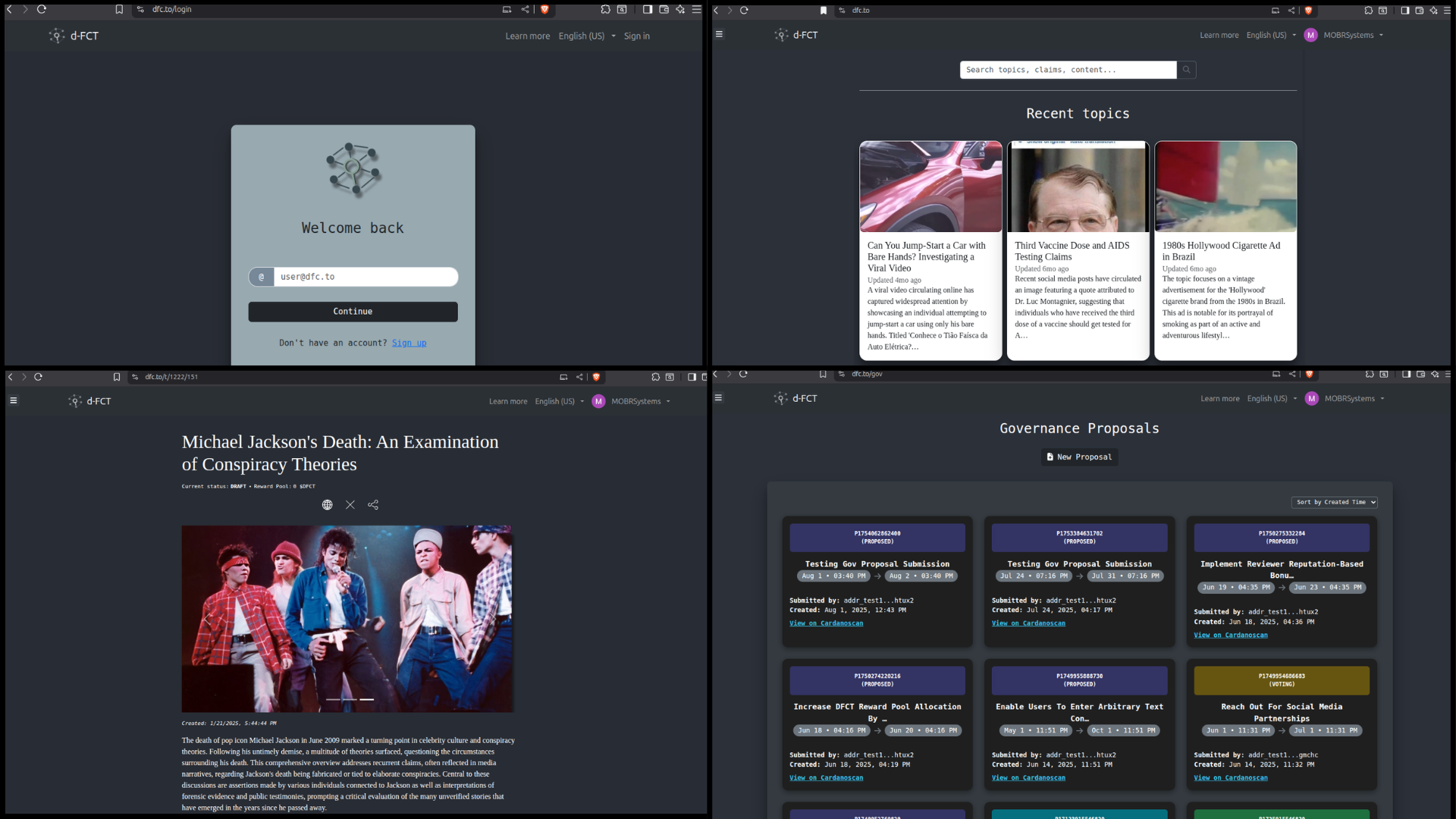
d-FCT offers the following differentiators:
A blockchain-enabled fact-checking lifecycle not seen in any existing product
Traditional fact-checking organizations (e.g., PolitiFact, Snopes, AFP, Aos Fatos, FactCheck.org, etc.) operate as fully centralized authorities. Their editorial processes, intermediate decisions, reviewer identities, evidence weighting, and reasoning pipelines are not publicly transparent. Users must simply trust the institution.
d-FCT replaces this opaque model with a state-machine, driven fact-checking lifecycle governed by Plutus validators. Every meaningful action (topic creation, claim extraction, evidence submission, contributor validation, governance voting, etc.) is registered via on-chain transitions, making the verification process transparent, immutable, and auditable.
Decentralization beyond community notes or tokenized attestations
Efforts such as X’s Community Notes and early Web3 initiatives like The Fact Protocol and FIBisD attempt to incorporate community participation or blockchain-based attestations. However, these systems remain limited by closed data models, centralized control over visibility or ranking, shallow verification structures, and a lack of explainable reasoning behind decisions.
d-FCT structures the entire verification lifecycle as a coherent, multi-step, consensus-driven process, where participants collaborate through explicit, on-chain phases defined by validator logic.
A hybrid AI–human verification system with full explainability
Recent AI-integrated tools, such as Grok’s “TruthGPT” mode or Grokipedia, attempt rapid claim evaluation through proprietary LLMs. While these systems are powerful at scale, their judgments are produced through opaque, closed-model reasoning that cannot be audited, reproduced, or challenged.
d-FCT takes the opposite approach:
- AI is used only to extract claims, identify concepts, summarize content, and assist contributors.
- Users contribute by adding evidence, verifying claims, tagging verdicts, and governance decisions.
- All intermediate AI outputs and human actions are logged, explainable, and verifiable on-chain, never hidden inside a model’s latent space.
This produces an inspectable chain of reasoning, where each step is transparent, accountable, and attributable.
Smart contracts that enforce rules, not centralized moderators
The verification process platform is structured by two cooperating d-FCT State Machines (dSM):
- dSM-Prov (Provenance): governs topic lifecycle, claim registration, contribution flows, and content provenance.
- dSM-Gov (Governance): governs proposals, voting, quorum checks, execution, and parameter updates.
Instead of trusting institutional board decisions or moderation teams, d-FCT relies on validator-enforced rules, ensuring all transitions follow predictable and publicly verifiable logic. This makes d-FCT a platform where the information verification workflow is algorithmically enforced, not editorially moderated.
A reward-based fact-checking economy tied to contribution
d-FCT introduces $DFC-powered reward pools, creating a transparent and incentive-compatible economic layer for fact-checking. Contributors are rewarded when their submissions are confirmed by the community, with additional incentives for early participation, high-quality evidence, and meaningful engagement in governance processes.
By aligning economic rewards with accurate verification, d-FCT creates a self-reinforcing ecosystem where contributors are encouraged to behave responsibly and collaboratively. No centralized fact-checking platform offers a model of incentives that is both fully transparent and cryptographically verifiable, making d-FCT’s blockchain-driven reward architecture uniquely positioned to promote sustainable participation.
Multi-modal content analysis integrated with transparent provenance
d-FCT handles URLs, images, videos, audio, and text to extract claims using a robust AI-backed pipeline:
- audio → transcription → semantic analysis
- video → frame extraction → visual inspection + transcript
- images → visual semantic extraction
- URLs → text + metadata + screenshot provenance
Extracted claims are registered and collaboratively verified, with on-chain provenance workflow. No similar solution, Web2 or Web3, provides end-to-end transparency across heterogeneous content types.
Not reliant on a single AI model
LLM systems like ChatGPT or Grok produce closed, model-dependent judgments. d-FCT instead treats AI as just one contributor. It is model-agnostic, meaning:
- Models can be swapped or improved without changing the verification rules,
- Users can compare outputs from different models,
- No AI model ever becomes the oracle of truth.
By separating content analysis (AI) from verification (prov+gov validators), d-FCT avoids the “algorithmic authority” trap.
Stronger than existing blockchain solutions
The Fact Protocol and FIBisD attempt to incorporate community participation or blockchain-based attestations. They store attestations, timestamps, or signatures, while d-FCT uses the blockchain to enforce structured decision-making, transparent provenance, decentralized governance, and incentive mechanisms. It turns Cardano into the backbone of a collective intelligence system for information assessment.
Describe what your prototype or MVP will demonstrate, and where it can be accessed.
The current prototype (see Catalyst Fund 13 supporting documentation link) proves that the core d-FCT architecture works: AI pipelines for content ingestion, media analysis, contract logic, wallet interactions, provenance workflows, and governance UI.
However, the frontend still uses temporary transaction flows, incomplete lifecycle logic, and lacks a polished, production-ready UX. Key contract interactions (full governance transitions, reward distribution, final provenance state changes) are only partially integrated. Without completing contract lifecycles, scaling infrastructure, and adding contributor-oriented quality-of-life improvements, d-FCT cannot yet deliver a seamless end-to-end decentralized verification and reward experience.
The current prototype available at https://www.dfc.to.
Phase 2 will convert the current prototype into an MVP, mainnet-ready decentralized fact-checking system. It will demonstrate the core architecture and end-to-end workflow. It will include key components of the d-FCT ecosystem: topic creation, content submission, claim verification contributions, and governance structures, all fully integrated with Plutus validators, enabling alpha/beta testing (testnet) and public launch (mainnet). Specifically, we will:
- Fully integrate Plutus-based governance and provenance state machines using Lucid + CIP-30 wallets.
- Enable users to create topics, submit evidence, vote, and manage proposals registered on-chain.
- Implement and deploy the $DFC minting policy.
- Implement automatic $DFC reward pool creation, distribution, and explorer-linked dashboards.
- Refine and deploy the provenance and governance state-machines (dSM-Prov and dSM-Gov).
- Refine responsive UI and multilingual UX.
- Harden the backend pipelines and content-processing workflows for real usage.
- Prepare documentation, community onboarding materials, community engagement mechanism, and deployment automation to ensure a stable public release.
Describe realistic measures of success, ideally with on-chain metrics.
Success for d-FCT is measured through both on-chain activity and off-chain metrics that reflect meaningful community engagement and the operational viability of decentralized fact-checking. Since the entire system is built around Plutus state machines, almost every significant action is inherently measurable on-chain.
1. On-chain Interaction Metrics (Primary KPIs)
These metrics come directly from validator spend events, UTxOs, metadata fields, and wallet interactions:
- Number of successful topic submissions on-chain: measures platform usage and content throughput.
- Number of governance proposals created: shows how community-driven the platform becomes.
- Total votes cast by unique wallets: a direct measure of decentralized participation.
- Reward pool distributions executed: signals functioning incentives and validator correctness.
- Total $DFC distributed: reflects community engagement, contribution volume, and ecosystem traction.
- Unique wallets interacting with d-FCT smart contracts: quantifies adoption and user diversity.
2. Engagement and Platform Usage Metrics
These metrics track the engagement of d-FCT beyond raw chain activity:
- Number of topics created per month
- Number of evidence submissions (files, URLs, screenshots) per topic
- Contributor retention rate (repeat contributions)
- Percentage of topic creation with validated verdict
These highlight whether the platform is becoming a trusted public good.
3. Technical Performance Metrics
These metrics ensure the infrastructure is scalable:
- Average pipeline processing time for images/videos/audio
- Task success/failure rate in AI processing workflows
- API response time under load
- Wallet transaction success/failure ratio
- Average transaction cost for user actions
High performance is key for real-world deployment.
4. Community and Growth Metrics
Beyond chain statistics, success is also seen through:
- New contributors per month
- New users per month
- Users visit per month
- International usage growth (EN/PT-BR)
- Social media interactions (via verified topics)
- Number of external projects referencing or integrating d-FCT
As the platform grows, these metrics indicate network effects.
[Your Project and Solution] Solution
Please describe your proposed solution and how it addresses the problem
The goal of this project is to transform d-FCT from a prototype into a fully integrated, mainnet-ready decentralized fact-checking system running on Cardano. While the current prototype has demonstrated the feasibility of combining AI-driven content analysis with basic Plutus validators, several key components remain only partially integrated. To address this, the proposed solution completes all smart contract interactions, hardens the backend and content-processing architecture, enhances the user interface, and introduces a robust, transparent incentive model governed on-chain.
The first major component of the solution is the refinement and full integration of provenance and governance Plutus state machines with the React-based frontend, using Lucid and CIP-30 browser wallets. This includes refining provenance and governance as mainnet-ready smart contracts, and the complete lifecycle for publishing and managing fact-checking topics, registering and validating contributions, and enabling users to interact with governance proposals (submit, vote, finalize, execute) directly through their wallets. The result is an end-to-end decentralized verification workflow where every action (i.e., topic creation, evidence submission, proposal changes, and governance decisions) is enforced by validator logic rather than platform administrators.
A second main pillar of the solution is the implementation of the $DFC reward mechanism. This involves creating and deploying the $DFC minting policy, as well as the $DFC token reward validator. In addition, this pillar comprises devising and integrating the front-end dashboard, backend services, and reward-distribution validator so that users receive token incentives for meaningful contributions. The reward model will include distribution flows based on contribution scores, which considers quality, community confirmation, and early participation in topic evaluation. The dashboard will allow participants to track their rewards, fees, and wallet balances ($ADA and $DFC), with direct links to transaction hashes on Cardanoscan or other explorers. This creates a transparent, incentive-compatible participation model that encourages accuracy, collaboration, and community engagement.
The project will also deliver a product-grade user experience. This includes full multilingual support in English and Brazilian Portuguese; responsive layouts for mobile and desktop; improved guidance, onboarding, and feedback elements; polished animations; and accessible interfaces. The objective is to provide a seamless interaction model where even non-technical users can easily understand and trust the verification process, navigate governance flows, and participate in community-based fact-checking.
Additionally, we will harden the backend infrastructure to support more robust and scalable content-processing pipelines. This involves improving Celery task orchestration, refining GPU/CPU allocation, enhancing monitoring and logging, and optimizing workflows for heavy media types such as videos, screenshots, and long-form articles. These upgrades ensure that d-FCT can reliably process content at higher volumes and serve a broader user base without bottlenecks.
By unifying governance, transparent provenance, AI-supported semantic analysis, and a structured incentive model into a coherent system, the proposed solution directly addresses the current prototype limitations: the lack of full on-chain integration and a fully productized experience. With these improvements, d-FCT becomes a ready-to-launch decentralized platform, capable of serving public good use cases in open knowledge curation and broader Web3 governance. Most importantly, the platform becomes a verifiable source governed by the community rather than centralized authorities or opaque AI systems.
[Your Project and Solution] Impact
Please define the positive impact your project will have on the wider Cardano community
d-FCT brings a new type of application to the Cardano ecosystem: a community-driven fact-checking platform powered by smart contracts and explainable AI. Its impact extends beyond a single tool, introducing an entirely new category of decentralized public goods built on Cardano.
The project generates direct on-chain activity by enabling users to publish topics, contribute evidence, vote on governance proposals, manage reward pools, and trigger validator-verified state transitions. Each of these actions creates transactions that increase Cardano’s usage, increases wallet adoption, and strengthens the ecosystem’s on-chain culture.
d-FCT also strengthens Cardano’s position as a leader in credible neutrality and verifiable knowledge systems. Cardano has a unique opportunity to offer a decentralized alternative grounded in auditability, fairness, community oversight, and cryptographic guarantees. By anchoring the fact-checking lifecycle to on-chain logic, d-FCT gives Cardano a novel social impact use case that resonates with community members.
The project promotes developer engagement and innovation by providing open-source backend components, validator scripts, and data models that can be extended by new teams. Builders can integrate additional modules such anti-Sybil mechanisms, cross-chain verification, topic indexing, or external data connectors. d-FCT thus can serve as a foundation for future research and development in decentralized governance and knowledge verification.
Within the community, the platform encourages participatory governance. Users are not passive consumers of verified information but active contributors who help shape the knowledge base by sharing evidence, voting on proposals, and influencing the reward model. This aligns strongly with Cardano’s ethos of decentralization, transparency, and inclusive governance.
Moreover, the project has significant public good value. A transparent, open-source, decentralized fact-checking protocol can help improve trust in digital discourse. Users seek verifiable methods to authenticate content, and Cardano becomes a viable platform for integrity-driven civic applications. Because d-FCT is multilingual and accessible, it can help bring the Cardano ecosystem to new user groups (particularly in Latin America) and other regions where centralized trust is a major societal challenge. By providing a verifiable, community-governed truth layer, d-FCT demonstrates how Cardano can support global public good infrastructures.
Finally, beyond its technical and social value, d-FCT creates a clear business impact for the Cardano ecosystem. By introducing a verifiable, incentive-driven verification marketplace, the platform enables new economic activity around content validation, reputation building, and decentralized governance services. Projects, media organizations, universities, and Web3 communities can leverage d-FCT to outsource verification workflows to a transparent Cardano-based system, driving recurring on-chain transactions and demand for wallet usage. The $DFC token economy, governed through open, auditable mechanisms, can support sustainable participation and long-term ecosystem retention. As a modular, extensible product, d-FCT positions Cardano as a viable infrastructure layer for integrity-focused applications, opening opportunities for partnerships, enterprise integration, and expansion into broader digital-trust markets.
[Your Project and Solution] Capabilities & Feasibility
What is your capability to deliver your project with high levels of trust and accountability? How do you intend to validate if your approach is feasible?
MOBR Systems has a strong, verifiable history of delivering projects within the Catalyst ecosystem, demonstrating both capability and reliability. We successfully delivered the Fund 13 Decentralized Fact-Checking Toolkit (ID 1300076), which already integrates AI-driven semantic analysis, multi-modal content ingestion, and initial Plutus provenance and governance validators. This prototype is live and demonstrates that the architectural foundation of d-FCT is technically sound, and operational. In parallel, we are actively delivering the Fund 13 Cardano Analytics Platform with LLMs (ID 1300034), currently at Milestone 5, with an alpha deployment available at https://cap.mobr.ai. This project demonstrates MOBR Systems’ ability to build and successfully deliver d-FCT Phase 2.
Our team consists of two PhDs with deep expertise in artificial intelligence, distributed computing, blockchain engineering, and full-stack development. We have hands-on experience with Plutus, Lucid, transaction builder logic, on-chain parameterization, and provenance/governance contract design. These technical skills ensure that we are well-equipped to finalize the full contract lifecycle for provenance, governance, and reward distribution required for d-FCT to operate at scale.
In addition to academic and professional expertise, the feasibility of this project is validated by the fact that the prototype is already functional and deployed. Users can test it by creating topics, uploading content, triggering AI pipelines, and interacting with early components. The backend architecture, including Celery task orchestration, content-processing workflows, and S3-based media handling, is tested under realistic conditions. The Plutus validators have been deployed on Cardano testnet, confirming that the underlying contract logic is correct and compatible with the system architecture.
To ensure feasibility during Phase 2, the project will rely on a combination of rigorous testing, continuous integration, and incremental milestone-based delivery. Before mainnet deployment, smart contract interactions will be validated on testnet environments using wallet flows, while backend pipelines will undergo performance and load testing to verify scalability. Frontend components will be tested across browsers and devices to ensure accessibility. Governance flows, reward distributions, and provenance transitions will all be recorded and inspected through explorer links, enabling transparent verification by Catalyst reviewers and the community.
Overall, MOBR Systems has already demonstrated the technical, organizational, and delivery capacity necessary to complete this project. The approach is not speculative: it builds directly on a functioning prototype, a history of successful Catalyst execution, and a team capable of delivering high-assurance, production-level decentralized systems. The requested funding will ensure the complete delivery of a mainnet-ready decentralized fact-checking platform that meets both user demands and Cardano’s standards for accountability and transparency.
[Milestones] Project Milestones
Milestone Title
Refinement and Integration of Provenance Contract (dSM-Prov)
Milestone Outputs
- Refined Plutus provenance validator
- Topic publishing flow connected to Plutus provenance validator
- Lucid-based transaction builders for publishing topics and contributing
- Frontend states for transaction progress
Acceptance Criteria
- Users can publish new topics on-chain (testnet) from the UI
- Users can add content evidence (URL/image/video/text) with proof recorded on-chain (testnet)
- Provenance contract interactions succeed on testnet
- Frontend reflects accurate state transitions
Evidence of Completion
- Link to topic creation and content submission Frontend code in GitHub.
- Link to refined provenance smart contract code in GitHub.
- Transaction hashes visible through Cardanoscan links.
- MVP available at dfc.to enable users to create and publish topics.
Delivery Month
2
Cost
60000
Progress
30 %
Milestone Title
Refinement and Integration of Governance Contract (dSM-Gov)
Milestone Outputs
- Refined Plutus governance validator
- Refined governance proposal submission UI
- Voting, finalization, execution flows connected to governance validator
- Lucid-based transaction builders for proposing and participating on governance
- UI updates for proposal states
Acceptance Criteria
- Users can create governance proposals on-chain
- Users can vote using browser wallets with proper redeemer formatting
- Governance lifecycle transitions reflect the validator’s on-chain state
- All governance actions produce valid testnet transactions
Evidence of Completion
- Link to proposal creation and vote Frontend code in GitHub.
- Link to refined governance smart contract code in GitHub.
- Transaction hashes visible through Cardanoscan links.
- MVP available at dfc.to enable users to create and vote on governance proposals.
Delivery Month
5
Cost
50000
Progress
50 %
Milestone Title
Reward Distribution Smart Contract & Reward Dashboard
Milestone Outputs
- Refined Plutus $DFC minting policy
- Design and implementation of $DFC reward distribution validator
- Reward pool dashboard
- Support for reward pool visualization, allocation, configuration and distribution
Acceptance Criteria
- $DFC can be minted and distributed
- Only authorized users can perform reward distribution actions
- All distribution actions produce valid testnet transactions
- Dashboard is integrated with reward distribution validator
- Enables reward pool visualization, allocation, configuration and distribution
Evidence of Completion
- Link to $DFC minting policy code in GitHub
- Link to $DFC reward distribution validator code in GitHub
- Link to reward dashboard code in GitHub
- Transaction hashes visible through Cardanoscan links.
Delivery Month
7
Cost
40000
Progress
70 %
Milestone Title
Productization, UX Enhancements & Localization
Milestone Outputs
- Finalized Plutus smart contracts (provenance, governance, $DFC, and reward distribution)
- Finalized UX/UI for desktop and mobile
- Finalized React frontend with English and Brazilian Portuguese fully implemented
Acceptance Criteria
- All tests for smart contracts pass (provenance, governance, $DFC, and reward distribution)
- All app routes fully localized (text + dynamic UI elements)
- Application tested across multiple browsers and devices
- No critical UI or backend issues blocking public usage
- Topics and governance proposals go through end-to-end flows without errors
Evidence of Completion
- Link to finalized smart contracts code in GitHub
- Link to tests for the smart contracts in GitHub
- Link to finalized Frontend code in GitHub
- Updated repository with translation files and frontend refinements
- MVP available at dfc.to enable users to navigate end-to-end flows.
Delivery Month
9
Cost
30000
Progress
90 %
Milestone Title
Final Milestone
Milestone Outputs
- Closeout report
- Closeout video
- Mainnet provenance, governance, $DFC minting, reward distribution validator smart contracts deployment
- Public MVP using mainnet release at https://dfc.to
Acceptance Criteria
- Closeout report is publicly available.
- Closeout video is publicly available.
- MVP is accessible at dfc.to using mainnet and with authentication and enables users to navigate end-to-end flows.
- Users can submit feedback, and suggestions on d-FCT’s MVP.
Evidence of Completion
- Deployment available at https://dfc.to
- Closeout report is accessible in GitHub.
- Closeout video publicly available on YouTube, showing, at least:
- Authentication/login
- Content submission and claim extraction
- Topic Breakdown page with structured contributions
- Reward dashboard
- Settings page
- Submission of feedback, and suggestions.
Delivery Month
10
Cost
20000
Progress
100 %
[Final Pitch] Budget & Costs
Please provide a cost breakdown of the proposed work and resources
The requested budget of 200,000 ADA covers the development, integration, testing, and launch activities required to deliver a mainnet-ready decentralized fact-checking platform built on Cardano. This scope includes finalizing the governance and provenance state machines, implementing $DFC minting policy and reward distribution validator. In addition, all contract interactions, refining and hardening backend AI pipelines, preparing the reward distribution mechanism, developing multilingual user interfaces, and deploying testnet and mainnet versions of the MVP.
The cost structure is designed to support a sustainable, high-quality release that meets production standards for reliability, transparency, and user experience. The following subsections break down the budget by workstream, team roles, and milestones, including deliverables associated with each cost category.
The d-FCT Phase 2 MVP integrates several advanced components: smart-contract governance and provenance state machines, Lucid-powered wallet flows, multi-modal AI content processing, multilingual user experience, and on-chain reward distribution. The requested budget is proportional to the high degree of specialization required and the substantial engineering already demonstrated in the Phase 1 prototype.
The following breakdown outlines costs by workstream and resource type, following the same structure used in CAP’s submission.
1. Personnel Costs (Engineering & Architecture)
₳150,000
This category covers the core engineering effort across the entire 10-month project. d-FCT Phase 2 requires a multidisciplinary team with deep expertise in:
Plutus smart contract engineering
Finalizing and refining provenance (dSM-Prov), governance (dSM-Gov), $DFC minting logic, and reward distribution validators; datum and redeemer structures; execution unit budgeting; mainnet deployment.
Backend engineers (FastAPI, Celery, AI pipelines)
Maintaining and hardening the multi-stage media-processing pipeline: image/video frame extraction, audio transcription, text analysis, concept graph extraction, structured claim breakdown, provenance metadata encoding, S3 storage, and GPU-based workloads.
Frontend engineers (React, hooks, Web3 UI patterns)
Implementing wallet interactions, transaction builders, signing flows, fallback logic, explorer integration, and fully-typed datum/redeemer generation.
Implementing the Topic Breakdown page, governance UI, reward dashboard, real-time transaction feedback, multilingual UX, responsive layout, accessibility improvements, and user onboarding flows.
DevOps & Infrastructure engineers
Ensuring stable deployment of the AI pipeline, workers, wallet integration proxies, logging/monitoring, S3 storage, GPU/CPU scaling, and testnet/mainnet environments.
UI/UX designer and localization contributors
Creating a polished, intuitive interface to navigate complex provenance/governance flows; finalizing English + Brazilian Portuguese translation; mobile-first refinements.
2. Infrastructure & Deployment
₳25,000
The platform relies on continuous compute and storage infrastructure to operate reliably during testnet and mainnet rollout. Costs include:
- High-availability backend deployment for the FastAPI server and Celery workers.
- GPU/CPU compute for image/video processing, audio transcription, and AI-driven content analysis.
- S3 storage for temporary content files, screenshots, hashes, provenance metadata, and topic assets.
- Mainnet/testnet node access or relays (where applicable).
- Monitoring, metrics, and application logging for contract interaction failures, worker performance, and task queuing.
- CI/CD pipelines for frontend and backend, ensuring stable updates and automated testnet deployment.
These resources ensure uptime for https://dfc.to as users test the MVP and as the community interacts with the governance mechanisms during the beta period.
3. Contract Testing, Simulation, & Validation
₳10,000
This category ensures correctness of the on-chain logic:
- Execution-unit estimation and script-size testing for all validators.
- Continuous verification on testnet.
- Lifecycle stress-tests for provenance, governance, minting and distribution.
These steps reduce the risk of failed transitions, script validation errors, or wallet compatibility failures on mainnet.
4. Documentation, Onboarding, Close-Out Report & Video Production
₳10,000
A public-facing MVP requires clear onboarding and transparent documentation. Costs include:
- Developer documentation covering datums, redeemers, Lucid flows, state machines, backend APIs, and deployment architecture.
- User onboarding for topic creation, claim verification, governance flows, and reward distribution.
- Multilingual documentation in English and Brazilian Portuguese.
- Catalyst Close-Out Report, including diagrams, architecture details, testing results, and governance validation.
- Close-Out Video showing the MVP in action: content submission, claim extraction, Topic Breakdown navigation, governance actions, and reward distribution.
These materials ensure that contributors, developers, and reviewers can clearly understand and build upon the project.
5. Contingency & Risk Buffer
₳5,000
Reserved for:
- Additional cloud compute for unexpected content workloads.
- Smart-contract refinements discovered during testnet stress-testing.
- UX adjustments after community feedback.
- Infrastructure scaling spikes during public beta.
A small contingency ensures stable delivery despite uncertain workloads and usage patterns.
[Final Pitch] Value for Money
How does the cost of the project represent value for the Cardano ecosystem?
The requested budget provides strong value for the Cardano ecosystem by delivering a fully operational decentralized fact-checking platform. Something not available on any other blockchain nor in mainstream Web2 ecosystems. d-FCT introduces a new category of high-impact, public-good infrastructure built natively on Cardano and designed to drive real-world engagement, on-chain activity, and ecosystem expansion. The return on investment extends across technical, social, economic, and ecosystem-development dimensions.
1. High Ecosystem Impact for a Modest Budget
For 200,000 ADA, Cardano receives a complete, production-ready dApp integrating:
- Full provenance and governance state machines
- Topic lifecycle management
- Contributor-driven claim verification
- Reward distribution and incentive alignment
- Wallet integration with multiple CIP-30 providers
- AI content-processing pipelines
- A multilingual, responsive interface
This represents an unusually high development output per ADA, especially considering the technical breadth (Plutus + Lucid + React + FastAPI + AI pipelines).
2. d-FCT generates sustained on-chain activity
The platform is designed so that core user actions require on-chain transactions, including:
- Publishing topics
- Submitting evidence and contributions
- Voting on proposals
- Executing governance transitions
- Minting $DFC
- Creating or distributing reward pools
- Managing provenance states
Each activity contributes to Cardano’s transaction volume, wallet engagement, and ecosystem growth. The system creates a high-frequency pattern of on-chain interactions, especially once community participation scales.
3. A new category of decentralized public good
d-FCT positions Cardano as a global pioneer in transparency-based verification systems. It offers blockchain-native solutions where traditional fact-checking falls short:
- Decentralized governance replaces opaque editorial processes.
- Cryptographically verifiable provenance replaces unverifiable contributions.
- Community incentives as opposed to undermotivated fact-checking teams.
- Transparent workflows replace closed, non-auditable decisions.
This creates tangible value for society, not just the blockchain ecosystem.
4. Long-term sustainability and token economy effects
The introduction of the $DFC token policy and reward mechanism shifts the system toward long-term sustainability:
- Users are compensated for contributing.
- Organizations may eventually stake or delegate rewards to incentivize verification.
- External partners could integrate d-FCT for content validation.
This could evolve into a verification marketplace built on Cardano, stimulating broader economic activity.
5. Strong reuse potential and composability
The project delivers open-source backend components and validator logic that other teams can extend. This enables:
- New research on decentralized fact verification
- Community-created modules (e.g., Sybil resistance, NFT-bound attestations)
- Interoperability with data oracles and off-chain feeds
- Cross-network fact-verification tools
- Enterprise integrations for truth auditing, journalism, and academic review
Every additional module built by the community compounds the utility of the original investment.
6. Attraction of new users and regions to Cardano
d-FCT’s multilingual support (English + Portuguese), mobile-friendly design, and global relevance position Cardano for broader adoption.
The platform is particularly relevant in regions where centralized trust systems are weak and community verification is essential. By introducing a verifiable, decentralized truth layer, d-FCT showcases Cardano as a global civic technology platform.
7. Value beyond Catalyst: positioning Cardano in global integrity markets
The digital-trust market (verification, identity, authenticity) is expanding rapidly. d-FCT positions Cardano at the forefront by:
- Demonstrating a real-world application with civic visibility
- Showcasing smart contracts as tools for verifiable knowledge
- Providing a modular framework that enterprises and institutions can adopt
- Offering a transparent alternative to opaque fact-checking institutions
This opens doors for external partnerships, grants, and collaborations, further multiplying the value of the initial investment.
d-FCT provides exceptional value for money by delivering a decentralized fact-checking platform deployed on mainnet, that could enhance Cardano’s reputation, expand on-chain activity, create a new category of public-good infrastructure, and position the ecosystem as a global leader in verifiable information systems. The 200,000 ADA investment creates enduring economic, social, and technical impact while offering a foundation for long-term ecosystem growth and high-value integrations.
[Self-Assessment] Self-Assessment Checklist
I confirm that evidence of prior research, whitepaper, design, or proof-of-concept is provided.
Yes
I confirm that the proposal includes ecosystem research and uses the findings to either (a) justify its uniqueness over existing solutions or (b) demonstrate the value of its novel approach.
Yes
I confirm that the proposal demonstrates technical capability via verifiable in-house talent or a confirmed development partner (GitHub, LinkedIn, portfolio, etc.)
Yes
I confirm that the proposer and all team members are in good standing with prior Catalyst projects.
Yes
I confirm that the proposal clearly defines the problem and the value of the on-chain utility.
Yes
I confirm that the primary goal of the proposal is a working prototype deployed on at least a Cardano testnet.
Yes
I confirm that the proposal outlines a credible and clear technical plan and architecture.
Yes
I confirm that the budget and timeline (≤ 12 months) are realistic for the proposed work.
Yes
I confirm that the proposal includes a community engagement and feedback plan to amplify prototype adoption with the Cardano ecosystem.
Yes
I confirm that the budget is for future development only; excludes retroactive funding, incentives, giveaways, re-granting, or sub-treasuries.
Yes
[Required Acknowledgements] Consent & Confirmation
I Agree
Yes
Team
The project will be led by the two MOBR Systems co-founders Dr. Moreno and Dr. Brandao.
Dr. Moreno, a skilled software engineer and scientist with extensive experience in advanced IT systems, artificial intelligence, distributed systems, and Web3 technologies. At MOBR Systems, he has developed on-chain data analysis solutions, decentralized applications, and a fact checking toolkit. His work at IBM involved leading an R&D team to innovate in Distributed Systems and AI systems. He has also contributed to open-source projects and international standards.
Dr. Moreno LinkedIn profile: https://linkedin.com/in/marcio-moreno-phd-598a459a/
Dr. Brandão is a software engineer and researcher with a PhD in Human-Centered Computing, specializing in AI, semantic technologies, and distributed systems. He leads architecture and development at MOBR Systems, focusing on Cardano analytics, knowledge graphs, and LLM-based tooling. Rafael has published peer-reviewed research and contributes extensively to open-source projects in AI and blockchain.
Dr. Brandao LinkedIn profile: https://linkedin.com/in/rafaelrmb/
For a complete list of peer-reviewed published papers and granted US patents, please visit the following google scholar links
Marcio Moreno, PhD: https://scholar.google.com/citations?user=PfdmrPUAAAAJ
Rafael Brandao, PhD: https://scholar.google.com/citations?user=3ta0InEAAAAJ
Both co-founders have expertise in AI, Web3, and distributed systems.