Last updated 7 months ago
HashiFlo - Intelligent AI Liquidity for Japanese Agri-RWAs
Problem
Japan’s agricultural producers lack AI-driven tokenization and liquidity tools, leaving real assets disconnected from Cardano and limiting adoption.
Solution
HashiFlo provides an AI liquidity layer that converts Japanese agricultural data into token-ready assets with valuation, onboarding, and automated flows linking producers to Cardano’s RWA ecosystem.
About this idea
[Proposal setup] Proposal title
Please provide your proposal title
HashiFlo - Intelligent AI Liquidity for Japanese Agri-RWAs
[Proposal Summary] Budget Information
Enter the amount of funding you are requesting in ADA
149500
[Proposal Summary] Time
Please specify how many months you expect your project to last
8
[Proposal Summary] Translation Information
Please indicate if your proposal has been auto-translated
No
Original Language
en
[Proposal Summary] Problem Statement
What is the problem you want to solve?
Japan’s agricultural producers lack AI-driven tokenization and liquidity tools, leaving real assets disconnected from Cardano and limiting adoption.
[Proposal Summary] Supporting Documentation
Supporting links
- https://www.sapientswarm.com ,
- https://github.com/Sapient-Predictive-Analytics/hashirwa ,
- https://github.com/Sapient-Predictive-Analytics/hashirwa/blob/main/docs/HashiFlo_OnePager_F15.pdf
[Proposal Summary] Project Dependencies
Does your project have any dependencies on other organizations, technical or otherwise?
No
Describe any dependencies or write 'No dependencies'
No dependencies
[Proposal Summary] Project Open Source
Will your project's outputs be fully open source?
Yes
Please provide details on the intellectual property (IP) status of your project outputs, including whether they will be released as open source or retained under another licence.
All HashiFlo deliverables will be published as open source under the MIT License. Third-party components such as Chainlink SDKs, Cardano libraries (Lucid and Mesh), and AI frameworks including PyTorch and scikit-learn will retain their original licenses, with full attribution documented in the repository.
[Theme Selection] Theme
Please choose the most relevant theme and tag related to the outcomes of your proposal
RWA
[Campaign Category] Category Questions
Describe what makes your idea innovative compared to what has been previously launched in the market (whether by you or others).
HashiFlo is the first AI-driven agricultural RWA tokenization pipeline focused on Japan, bringing technical capabilities not available in today’s Cardano RWA tools. While existing projects stop at metadata templates or basic listings, HashiFlo delivers a full valuation-to-liquidity workflow that mirrors real-world asset onboarding.
.
Its innovations span a complete tokenization and liquidity stack:
- AI valuation engine that analyzes lot size, region, crop grade, JAS/JGAP certification, and historical patterns to produce fair-value estimates before tokenization.
- Tokenization preview simulator that models supply, pricing, seasonal risk, and liquidity outcomes - allowing producers to understand economic implications before minting.
- On-chain transaction layer linking valuation → metadata → oracle-aligned pricing → minting → AI-guided liquidity actions, enabling transparent and automatable RWA flows.
- Japan-first bilingual design adapted to real agricultural stakeholders, with guided onboarding and documentation optimized for producers unfamiliar with blockchain tools.
.
By shifting the Cardano RWA model from static metadata to automated valuation, predictive token economics, and live testnet execution, HashiFlo sets a new benchmark for practical RWA utility and AI-driven liquidity intelligence on Cardano.
Describe what your prototype or MVP will demonstrate, and where it can be accessed.
The HashiFlo MVP will demonstrate a complete AI-powered tokenization and liquidity pipeline tailored for Japanese agricultural RWAs. It includes producer onboarding, AI valuation models, tokenization previews, and a fully functional testnet integration that shows how real assets move from data → valuation → metadata → mint/burn actions → liquidity routing.
.
Users will be able to:
• Create asset listings through a guided onboarding flow designed for real agricultural producers.
• View AI-generated fair-value ranges based on lot size, region, grade, certification, and historical trends.
• Simulate token supply, pricing, and risk signals, allowing producers and reviewers to preview token economics before issuing any asset.
• Execute on-chain testnet actions, including valuation calls, metadata registration, mint/burn flows, and AI-driven liquidity routing tests.
• Track all status changes through an investor dashboard that updates dynamically as AI and on-chain events occur.
.
The MVP will be accessible through a public testnet web demo, supported by full documentation and open-source code published on GitHub. This ensures full transparency, reproducibility, and independent verification by the Cardano community.
Describe realistic measures of success, ideally with on-chain metrics.
HashiFlo will measure success through transparent, verifiable on-chain activity that demonstrates real usage rather than theoretical output. By close-out, the MVP aims to generate 500–1,000 testnet transactions across the full lifecycle: asset registration, AI valuation calls, metadata submission, mint/burn flows, and liquidity-routing tests.
.
We also target 150+ unique wallet interactions during open beta, representing both producer-side and investor-side usage. This includes wallet-based listing creation, valuation previews, dashboard interactions, and testnet confirmations.
.
The MVP aims to process 20–30 agricultural assets end-to-end through the AI valuation → listing → metadata → testnet transaction pipeline, demonstrating that the system can handle real-world variation in asset type, grade, and certification.
.
These measurable indicators-high-volume on-chain activity, diverse asset processing, and multi-wallet participation-show genuine traction and highlight how agricultural RWAs can generate meaningful, verifiable utility for the Cardano ecosystem.
[Your Project and Solution] Solution
Please describe your proposed solution and how it addresses the problem
01. Problem & Opportunity
.
Japan’s Real-World Asset (RWA) market is accelerating due to regulatory reform and new digital-asset guidelines. Yet agriculture—one of Japan’s highest-trust export sectors—remains digitally fragmented and lacks an RWA-ready pipeline.
Key structural problems:
• Agricultural pricing varies widely across prefectures with no transparent benchmarks.
• Foreign investors face language barriers and non-standardized documentation formats.
• Producers and cooperatives lack simple, bilingual workflows for presenting asset data in a consistent way.
• Cardano currently has no Japan-focused agricultural RWA gateway to attract real producers.
Japan’s RWA momentum is well-documented:
• Digital-asset investment products in Japan grew 84% YoY in 2024 (CoinShares 2025).
• Tokenized real-asset AUM in Asia surpassed USD 3.5B, with Japan at ~18% (BCG × 21Shares 2024).
• Agricultural exports hit ¥1.4 trillion in 2024 (+14.3% YoY), the fastest growth in 10 years.(MAFF 2025)
• JFSA updated STO guidelines in 2024 to support broader tokenization adoption.
(JFSA 2024)
.
Opportunity:
Japan’s agriculture sector is entering a rare window of transformation. Producers face strong overseas demand, yet the path from a real farm asset to a digital and tradable financial instrument is still fragmented. Export-oriented producers lack standardised data formats, consistent valuation methods, and transparent digital workflows that can prove authenticity, quality, and origin. Japan’s push for digital transformation in food production is accelerating, but the available tools remain scattered across private platforms, local cooperatives, and long-standing certification bodies.
For global investors, agricultural real-world assets from Japan are highly attractive because the products are trusted, stable in quality, and supported by rising export growth. However, there is still no blockchain that provides compliant onboarding, verifiable provenance, and a predictable listing pipeline. Much of the opportunity remains locked behind manual steps, limited supply chain visibility, and the absence of a structured marketplace layer that lets producers list, validate, and transact with confidence.
This opens a clear opportunity for Cardano. No chain currently provides a complete pathway for Japanese agricultural assets. If Cardano enables a lean AI-assisted workflow that includes issuer onboarding, metadata validation, valuation intelligence, and secure tokenization, it becomes the first blockchain with an institutional-grade pipeline for one of Japan’s most trusted real-asset categories. This helps Cardano establish a leadership foothold in a trusted and rapidly expanding segment of Japan’s real-asset economy.
.
02. Our Approach
.
HashiFlo evolves the Fund 14 prototype into a bilingual, AI-driven agricultural RWA pipeline designed specifically for Japan.
Standardized workflow:
Producer → Data Entry → AI Valuation → Tokenization Preview → Investor Dashboard → On-Chain Testnet Transactions
This approach:
• Removes pricing ambiguity using AI-predicted fair-value ranges.
• Standardizes issuer metadata (prefecture, certification, grade, lot size, export channel).
• Provides clean, bilingual dashboards suited for global investors.
• Connects outputs to Cardano-native tokenization logic.
• Remains lean and implementable-no custodianship, lending modules, or complex market-maker design.
.
(Graphic 1: Producer Onboarding + AI Fair-Value Estimation)
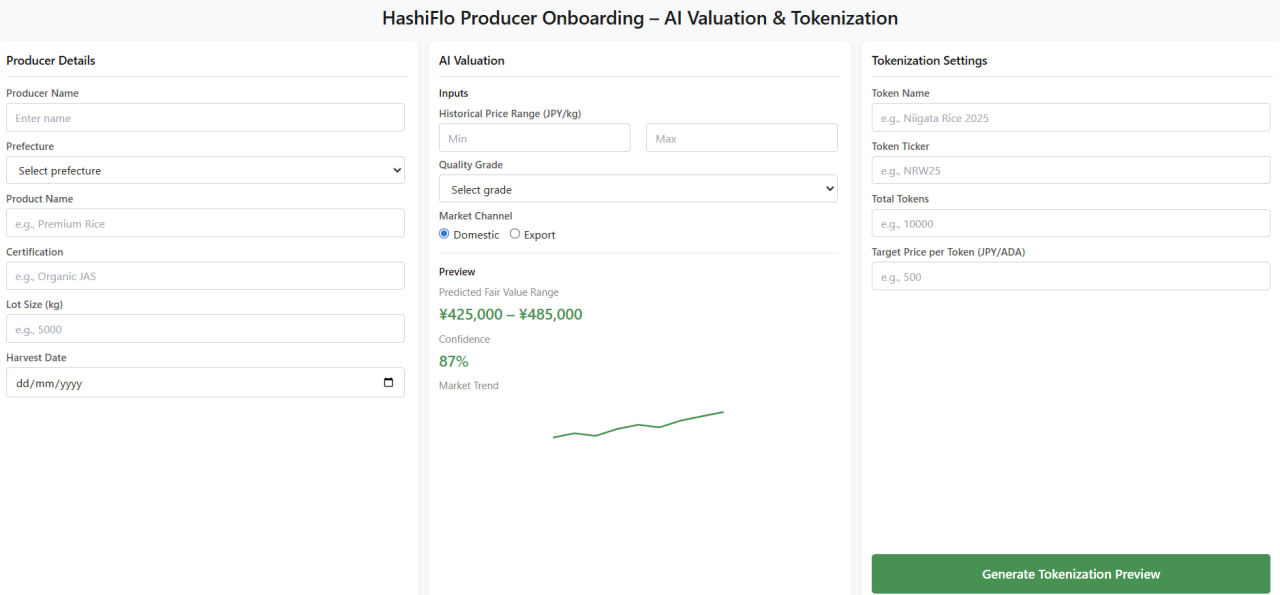
.
(Graphic 2: Internal Review Console - Asset Profiles and AI Price Ranges)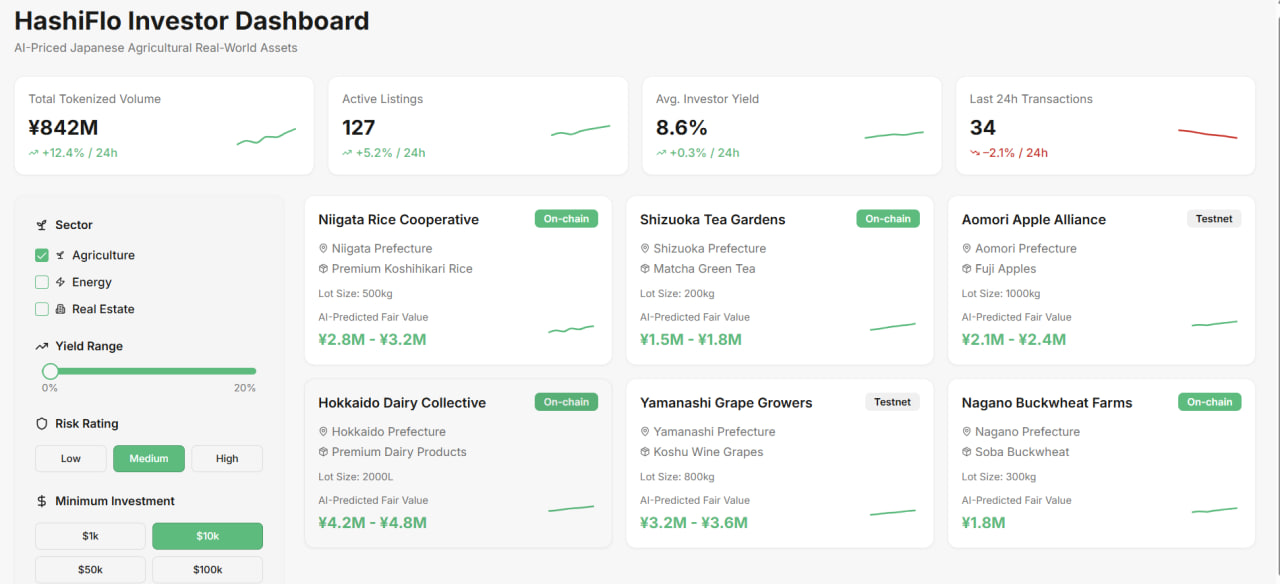
(Graphic 3: Simulated Marketplace View for RWA Listings) - Prototype Preview
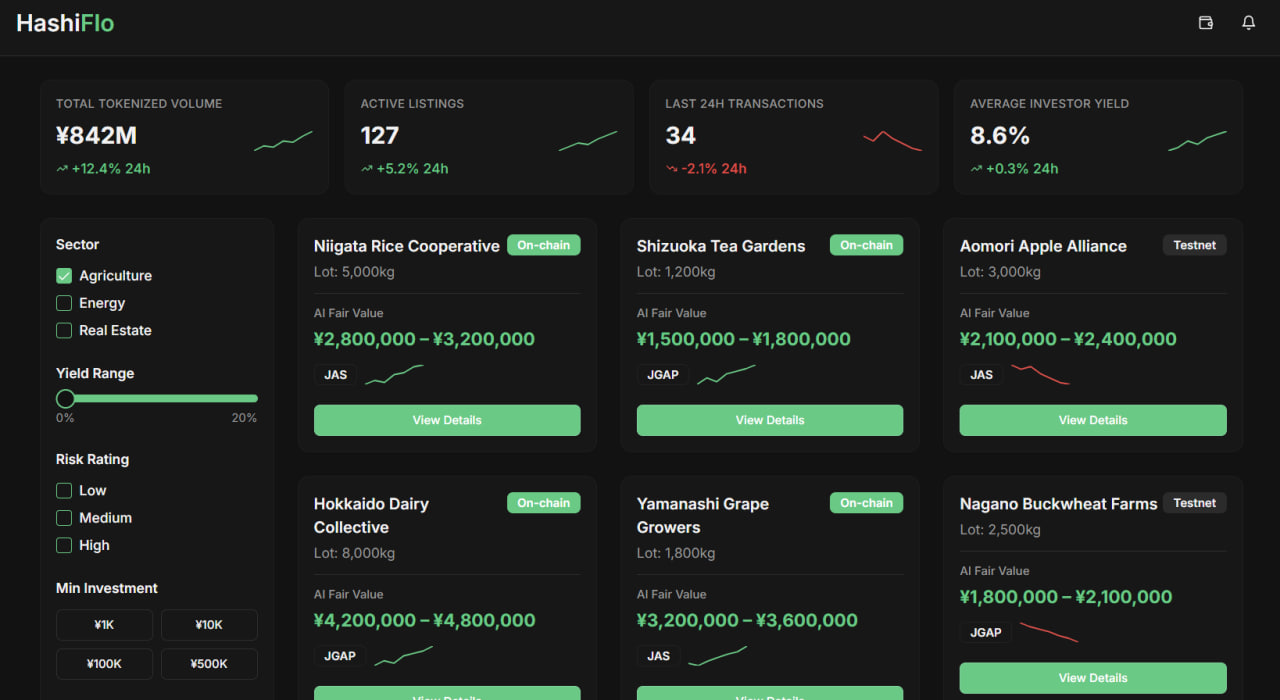
.
03. Key Features
.
AI-Based Valuation Engine
Predicts fair-value ranges, confidence scores, and trend indicators using historical data, quality grades, certifications, and regional patterns.
Tokenization Preview
Allows producers to simulate token supply, implied price, and risk signals before minting, reducing complexity and increasing trust.
Standardized Metadata (Japan-first)
Unified listing cards including JAS/JGAP certification, prefecture origin, product grades, yields, and export details.
Investor Dashboard v2
Live listings, bilingual filters, valuation charts, risk indicators, and upcoming on-chain status logic.
Proof-of-Listing (Testnet)
Verifiable registry entries on Cardano testnet as the first step toward regulated token issuance processes.
04. Implementation Plan
.
Months 1–2 : Data Calibration & Producer UI Polish (Milestone 1)
• Refine agricultural datasets (rice, tea, fruits, dairy) to ensure consistent inputs for AI valuation.
• Improve bilingual onboarding forms for Japanese producers, including clearer data definitions and export-related fields.
• Update tokenization preview logic to align with Japan-specific grade and certification requirements.
Months 3–4 : Marketplace Listing System & Metadata Engine (Milestone 2)
• Expand listing cards with structured metadata such as prefecture, certification (JAS/JGAP), and product grade.
• Implement standardized proof-of-listing logic and deterministic metadata generation.
• Conduct initial round of producer-side usability testing for listing submission and approval flow.
Months 5–6 : Dashboard, AI Liquidity Engine v1 & Simulation Layer (Milestone 3)
• Release the investor dashboard v2 with bilingual interface, filters, valuation charts, and live state indicators.
• Implement AI Liquidity Engine v1 to generate valuation predictions, fair-value ranges, and simulated liquidity signals.
• Build the simulation engine for mint/burn previews and integrate state changes with the dashboard.
Months 7–8 : Cardano Testnet Integration, AI Liquidity Execution v2 & Public Demo (Milestones 4 & 5)
• Integrate full listing → valuation → metadata → mint/burn → proof-of-listing transactions into the Cardano testnet.
• Upgrade AI Liquidity Engine to v2 so liquidity recommendations drive real testnet actions.
• Launch a stable public demo, publish documentation, and deliver Catalyst-required close-out report and video.
.
05. Long-Term Vision
.
HashiFlo aims to become the agricultural RWA entry point for Japan, connecting premium producers to global investors through verified data, transparent pricing, and simple onboarding.
Future directions include:
• Chainlink price feeds and proof-of-reserve workflows.
• Expansion to SMEs and renewable-energy RWAs.
• Yield-optimized bundles curated from multiple prefectures.
• API access for exchanges, funds, and platforms wanting Japan-origin RWAs.
HashiFlo is a deliberate step toward national-level adoption and positions Cardano as a credible technological base for Japan-focused RWAs.
.
06. Why This Fits the Category: Prototype & Launch
.
This proposal fits the Prototype & Launch category because:
• Fund 14 HashiRWA established the foundation, including datasets, UX patterns, metadata schema, and early interface prototypes.
• HashiFlo extends this work into a functional, testnet-ready MVP with a focused agricultural RWA pipeline for Japan.
• Producers will be able to trial the onboarding flow through a guided prototype environment.
• The full lifecycle - metadata intake, AI price estimation, tokenization preview, and testnet execution - will be demonstrated end to end.
• The deliverable is a publicly accessible prototype aligned with Cardano’s utility and decentralization goals.
HashiFlo strengthens Cardano’s RWA presence in one of Japan’s highest-trust real-asset categories and directly supports ecosystem growth.
.
Appendix – References
.
• CoinShares. Digital Asset Fund Flows Report, 2025.
https://www.coinshares.com/research/digital-asset-fund-flows
• BCG × 21Shares. The State of Tokenization Report, 2024.
https://www.21shares.com/research
• MAFF (Japan Ministry of Agriculture). Annual Export Statistics, 2025.
• JFSA (Japan Financial Services Agency). Revised Security Token Offering Guidelines, 2024.
[Your Project and Solution] Impact
Please define the positive impact your project will have on the wider Cardano community
Japan is rapidly emerging as a promising market for real-world digital assets. Government-backed digital transformation programs and rising global demand for high-quality agricultural exports are creating strong momentum for data-rich, traceable, and verifiable asset pipelines. Agriculture is among the earliest sectors where structured metadata, digital provenance, and price intelligence can be applied without entering regulated securities territory.
HashiFlo is designed to produce measurable and verifiable outcomes within Fund 15. It advances beyond static prototypes by generating real user behaviour, structured data flows, and testnet activity that strengthens Cardano’s position in Japan’s digital asset landscape.
* Direct Ecosystem Impact
- AI-guided price estimation for agricultural products creates a practical and clearly scoped entry point for Japan-origin RWAs on Cardano.
- The complete workflow of producer onboarding, metadata intake, valuation preview, and tokenization simulation generates a range of on-chain testnet events.
- Japan is accelerating digital asset experimentation, making agricultural metadata one of the most suitable early categories for tokenization pilots.
- HashiFlo builds a standardized data layer for Japanese agricultural assets including prefecture, certification, grade, lot size, and provenance information.
- The project establishes a reusable RWA pipeline that future Cardano teams, auditors, or oracle providers can adopt and extend.
We have already secured certified agricultural producer contacts who are supplying our team with detailed issuer datasets. This provides HashiFlo with real, verifiable agricultural inputs that strengthen valuation previews, metadata structures, and early tokenization simulations. Progress is ongoing and publicly traceable through our open-source GitHub repository and regular updates on X (@sapientswarm), enabling the community to monitor data expansion, prototype validation, and milestone delivery in real time.
* Expected Measurable Outputs
Testnet Activity
- 500 to 1,000 on-chain testnet transactions, including valuation calls, metadata publishing, tokenization previews, and simulated mint/burn flows.
This produces one of the largest open RWA testnet datasets available on Cardano.
Agricultural Assets Onboarded
- 20 to 30 agricultural products processed through the onboarding prototype.
Fund 14 already structured data for more than ten real Japanese products including rice, tea, apples, dairy, buckwheat, and matcha.
Fund 15 expands this dataset with complete metadata, fair-value estimates, and tokenization previews that form a consistent pipeline for future integrations.
Prototype Users and Testers
- At least 100 active beta participants, including producers, domain testers, and technical users interacting with listing previews and marketplace simulations.
This ensures early validation, broad data diversity, and a ready user base for post-Fund 15 development.
* Key Performance Indicators (KPIs)
Data & Issuer Onboarding
- 20–30 certified agricultural products supplied with complete metadata sets.
- ≥10 verified producer entities providing structured issuer datasets.
Testnet & Technical Activity
- 500–1,000 Cardano testnet transactions across core RWA workflows.
- ≥3 open-source components released (metadata schema, valuation logic, tokenization simulator).
User & Community Engagement
- 100+ prototype testers across agricultural and technical roles.
- Monthly progress updates via GitHub and X (@sapientswarm).
- ≥4 community demo sessions for feedback and iteration.
[Your Project and Solution] Capabilities & Feasibility
What is your capability to deliver your project with high levels of trust and accountability? How do you intend to validate if your approach is feasible?
HashiFlo is highly feasible because it builds directly on the groundwork already completed in Fund 14. The team has delivered structured agricultural datasets, metadata standards, bilingual producer workflows, early valuation logic, and a functional marketplace interface. These components form a mature foundation, allowing this proposal to focus on extending proven modules rather than creating new systems from scratch.
Technical Capability
• AI and Data Expertise
The team has hands-on experience preparing Japanese agricultural datasets and developing valuation logic that can be adapted for fair value estimation, quality scoring, and liquidity signalling. The data structures required for Fund 15 already exist in validated formats.
Sapient has successfully completed multiple Catalyst-funded AI projects, delivering Cardano-native machine learning systems, inference models, and data-driven tooling. These projects have already passed milestone review, proving our ability to design, implement, and ship highly specialized AI solutions within the Cardano ecosystem.
We successfully completed projects (https://milestones.projectcatalyst.io/projects/1100277 and https://milestones.projectcatalyst.io/projects/1100299) which proves our capability to deliver specialized AI solutions for the Cardano ecosystem. We developed Catalyst-specific language models and comprehensive data analysis platforms, demonstrating exactly the kind of machine learning expertise required for cybersecurity threat detection and behavioral analytics.
• Cardano Development Experience
Familiarity with Lucid, Mesh, CIP 68 and CIP 721 metadata, and workflow scripting enables seamless expansion of Fund 14 components into a valuation and token-ready pipeline. The team has previously demonstrated the ability to connect UI, Cardano logic, and metadata systems into a functioning prototype.
• Proven Catalyst Delivery
The team has completed Catalyst projects with on-time documentation, clear milestone evidence, transparent reporting, and consistent GitHub activity. This establishes a strong record of disciplined execution within the Catalyst framework.
• Japan-Aligned UX and Producer Insights
Prior producer outreach and bilingual interface work provide clear knowledge of the cultural and operational needs of Japanese agricultural stakeholders. This ensures an onboarding flow that remains simple, intuitive, and export-friendly.
Team Background
The team brings a balanced mix of skills across critical domains:
• A data and valuation lead with experience in predictive modelling, agricultural dataset calibration, and fair value modelling.
• A Cardano developer skilled in metadata standards, workflow integration, dashboard logic, and testnet operations.
• A product and operations lead with expertise in Japanese UX, documentation, process design, and milestone reporting.
This combination covers data science, blockchain engineering, agricultural domain knowledge, and international stakeholder coordination.
Validation of Feasibility
Feasibility is validated through multiple channels:
• Milestone-based outputs with clear and auditable proofs including valuation engine v1, metadata structures, prototype listings, and lifecycle demonstrations.
• Lifecycle testing that verifies valuation, metadata generation, and token-ready asset creation within a controlled environment.
• Producer usability feedback informed by prior Fund 14 interactions, which already demonstrated the viability of the onboarding flow.
• Transparent documentation maintained through GitHub, ensuring reviewers have direct visibility into code, workflows, datasets, and UI snapshots.
Risk and Mitigation
- Dataset Variation
Agricultural data may differ by region or product type.
Mitigation: Normalize formats and apply confidence scoring to support consistency.
- Producer Adoption
Some producers may be unfamiliar with digital onboarding.
Mitigation: Keep the workflow simple, bilingual, and guided with visual cues.
- Integration Complexity
Connecting valuation, metadata, and listing previews may require iteration.
Mitigation: Use a modular design that allows each component to be tested independently.
- Regulatory Sensitivity
Japan’s digital asset guidelines are evolving.
Mitigation: HashiFlo remains strictly a token-ready prototype and does not perform regulated issuance.
Why This Is Feasible in Eight Months
Fund 14 has already established the core direction, validated datasets, early UX patterns, and metadata standards. Fund 15 builds on these components to deliver the valuation engine, structured listing pipeline, and token-ready asset flows.
Fund 15 development focuses on extending existing modules into a unified valuation and token-ready pipeline, not recreating the system.
The eight-month schedule allows sufficient time for development, integration, refinement, testnet activity, producer testing, and clear milestone reporting. The team’s prior Catalyst performance further supports the reliability of this timeline.
[Milestones] Project Milestones
Milestone Title
Data Onboarding System & Issuer Schema
Milestone Outputs
- A complete agricultural issuer onboarding workflow capturing identity, farm details, product information, and supporting documents in a structured way.
- A finalized CSV schema with validation rules ensuring consistency across issuers, including format checks and field enforcement.
- A standardized GitHub proof-of-issuer folder structure with sample issuers, metadata, and documentation explaining how onboarding data is verified and stored.
Acceptance Criteria
- Onboarding form successfully records all required issuer fields and rejects incomplete or inconsistent entries during testing.
- CSV validator detects incorrect formats, missing fields, and invalid metadata, producing logs that show the validation process clearly.
- Proof folders pass a repository audit confirming correct naming, presence of issuer evidence, and reproducible validation outputs.
Evidence of Completion
- Screenshots or recordings of the live onboarding form capturing multiple sample issuer submissions.
- A validated issuers.csv file with multiple entries and logs demonstrating error detection.
- GitHub proof-of-issuer folders containing 8-12 sample issuer packages, each including metadata, form outputs, validation logs, and timestamped supporting documents to demonstrate diversity across different agricultural producer types.
Delivery Month
1
Cost
27500
Progress
20 %
Milestone Title
Marketplace Listing Workflow & Metadata Engine
Milestone Outputs
- A functional listing system enabling issuer submission, admin review, approval/rejection actions, and recorded state transitions.
- A metadata generator that produces deterministic JSON artifacts for agricultural tokens, passing schema validation reliably.
- Automated proof-of-listing files, including timestamps, hashes, and consistent folder organization for auditability.
Acceptance Criteria
- Listing module fully supports transitions (Pending, Approved, Rejected) and preserves a traceable activity history.
- Metadata generator outputs valid JSON following schema rules and maintains deterministic hashing across repeated runs.
- Proof-of-listing artifacts are automatically generated during listing approval and stored in the correct GitHub structure.
Evidence of Completion
- GitHub samples of 12–18 listing metadata files with fully matched proof-of-listing records, deterministic hashes, timestamps, and state-history logs to demonstrate the completeness of the workflow across diverse agricultural products.
- Admin dashboard screen recording demonstrating submission, review, and approval flows.
- Logs or screenshots showing successful JSON schema validation and deterministic hash production.
Delivery Month
3
Cost
31000
Progress
40 %
Milestone Title
Investor Dashboard, Simulation Layer & AI Liquidity Engine
Milestone Outputs
- A dual-theme investor dashboard (dark/light) with wallet login, watchlist, issuer cards, and real-time visual status indicators that reflect backend logic.
- A simulation engine that generates deterministic mint/burn proof hashes, maintains event history, and updates listing states consistently as simulated transactions occur.
- AI Liquidity Engine (v1) that analyzes issuer metadata, category patterns, product characteristics, and historical signals to produce automated liquidity recommendations. These signals influence simulated mint/burn actions and drive system behavior during pre-testnet operations.
Acceptance Criteria
- Dashboard supports wallet login, accurate issuer card rendering, and watchlist functions while updating UI states instantly in response to simulation or AI-driven events.
- Simulation engine produces reproducible proof hashes and updates listing states without manual triggers, demonstrating correct handling of all event sequences.
- AI Liquidity Engine (v1) outputs deterministic recommendations based on metadata inputs, triggering simulated liquidity responses such as mint/burn signals and enabling reviewers to observe how liquidity intelligence influences asset readiness.
Evidence of Completion
- GitHub frontend branch containing dashboard components, UI logic, configuration files, and documentation showing how the dashboard interprets both simulation and AI signals.
- Screen-recorded demo showing login, watchlist use, issuer interactions, simulated events, and AI-driven liquidity state changes visible through dashboard indicators.
- Logs of simulated mint/burn events, AI-generated liquidity recommendations, and proof hashes stored in GitHub, illustrating full integration between the simulation engine and AI module.
Delivery Month
4
Cost
30000
Progress
60 %
Milestone Title
Cardano Testnet Integration, On-Chain Proofs & AI Liquidity Execution
Milestone Outputs
- A complete end-to-end Cardano testnet workflow linking listing, metadata generation, minting, burning, and proof-of-listing transactions, integrated into the dashboard via real-time testnet queries.
- Documented smart contract logic or fallback mechanisms enabling testnet operations with clear explanation of how decisions, validation boundaries, and transaction sequences are structured.
- AI Liquidity Engine (v2) connected to testnet operations, converting AI-driven liquidity recommendations from Milestone 3 into actual testnet actions. The system executes on-chain actions such as mint/burn operations based on AI outputs, demonstrating how automated liquidity logic performs in real blockchain conditions.
Acceptance Criteria
- At least 500 structured testnet transactions must be executed, covering full listing, minting, burning, and proof-of-listing flows, including cases where AI-generated liquidity instructions influence transaction order or frequency.
- Dashboard must visibly reflect testnet activity, updating indicators in real time based on confirmed transactions, allowing users to verify how both system logic and AI-driven liquidity decisions manifest on-chain.
- Smart contract scripts or fallback logic must be fully documented, with explanation of how AI-generated instructions are validated, queued, and executed on testnet safely and reproducibly.
Evidence of Completion
- GitHub folder containing 500–1,000 representative transaction hashes, execution logs, and metadata outputs documenting how testnet transactions were triggered, including those initiated by AI-driven liquidity logic.
- A complete testnet walkthrough video demonstrating the sequence from listing → metadata → AI decision → on-chain mint/burn → dashboard confirmation, showing the interplay between AI logic and blockchain operations.
- Contract or fallback scripts with comments, architecture notes, and documentation explaining how AI liquidity signals are translated into safe, structured blockchain actions.
Delivery Month
6
Cost
31000
Progress
80 %
Milestone Title
Public Demo, Documentation, Close-Out Report & Final Video
Milestone Outputs
- A stable public demo environment combining the investor dashboard, metadata engine, issuer onboarding, and full Cardano testnet flow.
- Complete project documentation explaining onboarding rules, metadata standards, workflow diagrams, technical limitations, and integration steps.
- All final Catalyst close-out materials including the written close-out report and a comprehensive close-out demo video summarizing milestone achievements.
Acceptance Criteria
- Public demo URL accessible to reviewers without credentials, demonstrating end-to-end functionality clearly and reliably.
- Documentation fully covers issuer onboarding, listing logic, metadata rules, and testnet integration in a reviewer-friendly structure.
- Close-out report and final video must clearly present milestone achievements, deliverable completion, and system behavior using real workflow examples.
Evidence of Completion
- Public demo URL with working access, showing all modules behaving as documented.
- GitHub folder containing all Markdown documentation, workflow diagrams, integration instructions, and reference material.
- Final Catalyst close-out report and close-out video uploaded and included in the repository, demonstrating real system behavior end-to-end.
Delivery Month
8
Cost
30000
Progress
100 %
[Final Pitch] Budget & Costs
Please provide a cost breakdown of the proposed work and resources
We use 2 standardized hourly rates:
Development: 200 ADA/hour
Office & Project Management: 150 ADA/hour
Milestone Allocation
Milestone 1: Data onboarding flow + issuer schema finalized
(100 dev hrs + 50 PM hrs = 27,500 ADA)
- Includes onboarding form, CSV schema, validator, issuer proof folders.
Milestone 2: Marketplace listing workflow + metadata engine
(125 dev hrs + 40 PM hrs = 31,000 ADA)
- Covers listing states, metadata generator, proof-of-listing artifacts.
Milestone 3: Investor dashboard + simulation layer + AI Liquidity Engine (v1)
(120 dev hrs + 40 PM hrs = 30,000 ADA)
- Dashboard UI, simulation logic, AI-driven liquidity recommendations.
Milestone 4: Cardano testnet integration + AI Liquidity Execution (v2)
(125 dev hrs + 40 PM hrs = 31,000 ADA)
- On-chain mint/burn operations, testnet workflow, AI-triggered transactions.
Milestone 5: Public demo + documentation + close-out report & video
(120 dev hrs + 40 PM hrs = 30,000 ADA)
- Public demo environment, full documentation, Catalyst close-out materials.
Total = 149,500 ADA (within the 200,000 ADA cap).
In HashiFlo, project management hours already cover documentation, reporting, issuer coordination, and community outreach to Japanese agriculture stakeholders. These activities are included in the PM allocation, ensuring transparency and engagement without the need for a separate marketing budget.
[Final Pitch] Value for Money
How does the cost of the project represent value for the Cardano ecosystem?
HashiFlo delivers high output with disciplined use of funds by expanding the proven foundation from Fund 14 into a scalable, Japan-ready RWA onboarding pipeline. The project focuses strictly on data, infrastructure, and on-chain feasibility - avoiding marketing spend, token engineering, or speculative modules, ensuring every ADA directly advances ecosystem capability.
We maintain a transparent cost structure:
• 200 ADA/hour for technical development (validators, issuer pipeline upgrades, metadata automation, testnet integration).
• 150 ADA/hour for operations (issuer coordination, compliance preparation, documentation, community outreach).
Because Fund 14 already established the data pipeline, schema, and initial testnet feasibility, Fund 15 resources can concentrate fully on scaling verified assets, strengthening validation logic, and introducing automated liquidity intelligence - all without duplicating past costs.
The resulting deliverables - a reusable verification pipeline, issuer onboarding for Japan, early-stage AI-driven liquidity logic, and a working testnet prototype - provide immediate, shared utility for every future RWA project on Cardano.
With a proven delivery track record across multiple funds, HashiFlo offers high impact at low cost: each ADA contributes to real, verifiable, Cardano-native RWAs that other teams can build upon.
[Self-Assessment] Self-Assessment Checklist
I confirm that evidence of prior research, whitepaper, design, or proof-of-concept is provided.
Yes
I confirm that the proposal includes ecosystem research and uses the findings to either (a) justify its uniqueness over existing solutions or (b) demonstrate the value of its novel approach.
Yes
I confirm that the proposal demonstrates technical capability via verifiable in-house talent or a confirmed development partner (GitHub, LinkedIn, portfolio, etc.)
Yes
I confirm that the proposer and all team members are in good standing with prior Catalyst projects.
Yes
I confirm that the proposal clearly defines the problem and the value of the on-chain utility.
Yes
I confirm that the primary goal of the proposal is a working prototype deployed on at least a Cardano testnet.
Yes
I confirm that the proposal outlines a credible and clear technical plan and architecture.
Yes
I confirm that the budget and timeline (≤ 12 months) are realistic for the proposed work.
Yes
I confirm that the proposal includes a community engagement and feedback plan to amplify prototype adoption with the Cardano ecosystem.
Yes
I confirm that the budget is for future development only; excludes retroactive funding, incentives, giveaways, re-granting, or sub-treasuries.
Yes
[Required Acknowledgements] Consent & Confirmation
I Agree
Yes
Team
Thomas Wedler: project management and trading-related content
Experienced financial trader and entrepreneur. Ex Shell, Vattenfall, Masefield senior futures and options trader. Individual floor trader at Singapore Exchange. Tom has been building and deploying programs for automated market making and energy derivatives since 2014. 15 years Derivatives experience at multi-national organizations working closely with industry bodies and speaker at market conferences and workshops. Involved in crypto trading since 2014 and DeFi/oracles since 2018. Plutus Pioneer, Marlowe Pioneer and Atala Prism Pioneer.
Thomas is a certified Superforecaster with the Good Judgment Project and winner of the inaugural Hybrid Forecasting Challenge at SAGE / University of Southern California.
https://www.linkedin.com/in/thomas-wedler-18960/
Role in Catalyst: Challenge Team (Fund 8–10), Sub-circle3, Catalyst Coordinators (funded proposers), Veteran Proposal Assessor, Reviewer in funded project milestone reporting Fund 10–14.
June Akra: project management and risk-management related content, community
Sapient developer team: to provide UI front-end and API for the portal.
Founding member of BlockCarbon, financial market expert and academic with vast experience in risk management, derivatives and commodities. Experience for various risk functions in 2 billion-dollar AUM fund. Holder of Master degree in Investment with distinction and awarded Draper Prize. Certified Quantitative Finance (CQF) alumni London. Experienced video editor, content creator with combined 50,000 followers on social media, NFT collector and creator. Certified python AI practitioner, Plutus Pioneer & Atala Prism Pioneer.
https://www.linkedin.com/in/june-a-a3a0b4174
Role in Catalyst: Challenge Team (Fund 7–10), Sub-circle3, Catalyst Coordinators (funded proposers), Veteran Proposal Assessor, Reviewer in funded project milestone reporting (PoA pilot) Fund 9–14.
Sapient team members upon demand:
Data scientist, Senior fullstack developer / head architect, LLM engineer, data engineer