Last updated 5 months ago
HOTEL NFT - AI & Blockchain Integrated Booking System ✈
Problem
Current hotel booking lacks personalization, trust, and identity verification. Users need a transparent, AI-driven, on-chain booking system that prevents fraud and improves booking reliability.
Solution
HOTEL-NFT System uses AI + CIP-68 NFTs to create personalized, verifiable on-chain bookings with escrow, DID identity, and reputation—making reservations safer, transparent, and trustless.
About this idea
[Proposal setup] Proposal title
Please provide your proposal title
HOTEL NFT - AI & Blockchain Integrated Booking System ✈
[Proposal Summary] Budget Information
Enter the amount of funding you are requesting in ADA
114000
[Proposal Summary] Time
Please specify how many months you expect your project to last
7
[Proposal Summary] Translation Information
Please indicate if your proposal has been auto-translated
No
Original Language
en
[Proposal Summary] Problem Statement
What is the problem you want to solve?
Current hotel booking lacks personalization, trust, and identity verification. Users need a transparent, AI-driven, on-chain booking system that prevents fraud and improves booking reliability.
[Proposal Summary] Supporting Documentation
Supporting links
- https://github.com/DUALCORE-VuNam/HOTEL-NFT-AI-BLOCKCHAIN-CARDANO ,
- https://dualcore.gitbook.io/hotel-nft-dualcore-team/summary/quickstart ,
- https://dualcore.gitbook.io/hotel-nft-dualcore-team/summary/hotel-nft-whitepaper-1.0 ,
- https://dualcore.gitbook.io/hotel-nft-dualcore-team/summary/resources ,
- https://dualcore.gitbook.io/hotel-nft-dualcore-team/summary/budget
[Proposal Summary] Project Dependencies
Does your project have any dependencies on other organizations, technical or otherwise?
No
Describe any dependencies or write 'No dependencies'
No dependencies
[Proposal Summary] Project Open Source
Will your project's outputs be fully open source?
Yes
Please provide details on the intellectual property (IP) status of your project outputs, including whether they will be released as open source or retained under another licence.
Yes, the entire project will be released under the MIT License. The source code and datasets will be made public on GitHub from the first stages of the project.
[Theme Selection] Theme
Please choose the most relevant theme and tag related to the outcomes of your proposal
Tourism
[Campaign Category] Category Questions
Describe what makes your idea innovative compared to what has been previously launched in the market (whether by you or others).
The HOTEL-NFT prototype introduces a fundamentally new approach to the travel-booking industry by merging AI personalization, decentralized identity, and on-chain booking records through CIP-68 NFTs. Unlike traditional booking platforms—which store user data in centralized systems, lack transparent reputation scoring, and provide no verifiable ownership of a reservation—HOTEL transforms each booking into an upgradeable NFT that acts simultaneously as a ticket, contract, receipt, and trust passport.
This is the first prototype in the Cardano ecosystem to unify:
(a) AI-driven preference analysis that automatically builds a personalized booking profile,
(b) DID-based identity linking to reduce fraud and eliminate fake reservations,
(c) escrow-based booking settlement using smart contracts, and
(d) a dynamic reputation mechanism (CVC Score) that rewards reliable travelers with lower fees, better cancellation terms, and priority room benefits.
Existing hotel systems do not provide on-chain auditability or interoperable booking assets. Current travel NFTs are static collectibles, not functional identities or binding agreements. HOTEL leverages CIP-68 to create mutable metadata, allowing the NFT to update in real time at check-in, checkout, dispute resolution, and reputation scoring.
This innovation makes bookings verifiable, portable, programmable, and fraud-resistant—something no conventional OTA (Booking.com, Agoda, Airbnb) or current Web3 travel project has delivered at functional prototype level on Cardano.
Describe what your prototype or MVP will demonstrate, and where it can be accessed.
The MVP will demonstrate a fully functional booking workflow combining AI, DID, and blockchain:
• A live AI Recommendation Engine where users input travel preferences and receive a structured JSON profile.
• A Booking Smart Contract that creates an escrow, mints a CIP-68 NFT, and updates metadata through the user journey.
• A CIP-68 NFT Viewer showing the booking ticket, DID linkage, CVC Score, payment data, and dynamic status (Created → Checked_in → Completed).
• A user-facing booking interface with hotel listings, AI assistant, checkout screen, and wallet integration.
The MVP will be deployed on Cardano public mainnet, allowing anyone to interact with the smart contract using a supported wallet (Lace/Eternl). The prototype will be accessible via:
• A public URL (Next.js web app)
• GitHub repository containing open-source smart contracts
• Figma UI prototype for non-technical reviewers
Describe realistic measures of success, ideally with on-chain metrics.
Success for the HOTEL prototype will be measured through verifiable on-chain activity and real user engagement. Key metrics include:
• Number of testnet bookings created (CIP-68 NFTs minted)
• Number of booking NFT updates (status transitions: created → checked_in → completed)
• Volume of ADA settled through the escrow contract
• Percentage of AI-generated profiles converted to on-chain bookings
• Growth of user DID verifications linked to NFTs
• Adoption of CVC reputation score (how many users achieve score updates)
Additional qualitative success indicators:
• Community testers successfully completing full booking cycles
• Hotels or travel operators providing early feedback
• Demonstrated reduction of fraud vectors (e.g., duplicate bookings, identity mismatch)
• Clear performance benchmarks for moving toward Mainnet deployment in Fund15.
These metrics establish a transparent, verifiable foundation proving the feasibility, utility, and ecosystem value of an AI-driven on-chain booking system on Cardano.
[Your Project and Solution] Solution
Please describe your proposed solution and how it addresses the problem
*Summary of problems and solutions:
-General status of the Cardano ecosystem:
The Cardano ecosystem has advanced technically, but Real World Asset (RWA) adoption remains early-stage and limited. Existing RWA efforts focus mainly on real estate, credit, or agriculture, with almost no large-scale consumer service applications such as tourism or accommodation. The ecosystem also lacks impactful service-sector dApps—especially in booking—capable of delivering a seamless experience competitive with Web2 platforms. Many proposed PoC projects have not achieved real user traction, and the onboarding barrier for non-crypto users remains high.
-Despite the rise of digital travel platforms, hotel booking still faces major real-world barriers. Cross-border payments remain costly and inconvenient, with 2–5% conversion fees, unexpected card blocks, and slow refund times. Online fraud is widespread, from phishing sites to “virtual bookings” where customers pay but no reservation exists. User experience is fragmented as travelers navigate overwhelming choices, inconsistent information, and a lack of truly personalized recommendations. Meanwhile, high OTA commissions of 15–30% inflate prices, creating an inefficient system that burdens both users and hotels.
-Verification source:
*Solution:
HOTEL-NFT platform to overcome the limitations of traditional booking systems by combining AI personalization with blockchain security. AI analyzes budgets, preferences, habits, and booking history to generate optimized recommendations, eliminating the need for users to manually compare hundreds of options. Blockchain enables fast, low-cost, fraud-resistant international payments through ADA, while smart-contract escrow ensures fair cancellations and protects both guests and hotels. Each reservation is minted as a CIP-68 Booking NFT containing hotel details, payment proof, DID identity, and CVC reputation, with real-time metadata updates during check-in, room changes, and completion. This creates a transparent, automated, and verifiable booking ecosystem—something Web2 platforms cannot provide—delivering a smarter, safer, and more reliable next-generation travel experience.
*Proof of Concept:
Key features of HOTEL-NFT:
*AI Recommender Engine-Data analysis and personalization:
1. Collect & standardize customer data
-Budget, schedule, number of guests
-Preferred room type
-Interested amenities
-Travel style (luxury, resort, discovery…)
-Special conditions: refund/cancellation, early check-in, priority view…
-Data is standardized into Customer Preference Dataset (JSON).
2. Apply structured AI workflow
-Module Need Analysis – analyze trip goals
-Preference Weighting – assign priority weights
-Matching Engine – match with hotel data
-Reputation Check – check behavior history (CVC Score)
-DID Check – verify identity
3. AI creates Recommendation Profile
AI generates:
-Best matching room
-Match Score
-Price conditions
-Relevant cancellation policy
-Metadata JSON —> Aiken SmartContract
*Aiken-PlutusV3 SmartContract (Payment escrow ADA/Stablecoin):
1. Receive AI data (metadata JSON Input)
SC receives:
-CustomerProfile JSON
-HotelRoomProfile
-Condition rules
-Additional options
2. Process Escrow ADA payment
-Temporary ADA lock
-Record transaction ID
-Check delivery/refund/cancellation conditions
3. Mint NFT CIP-68 for customer
NFT contains:
-Personalized metadata
-DID hash
-CVC Score
-Booking information
-Payment proof
*NFT CIP-68 - Dynamic onchain state update:
CIP-68 allows updating:
-Confirmed booking
-Check-in successful
-Completed trip
-Cancelled
-Reputation CVC update
-HOTEL-NFT targets a broad and diverse audience beyond existing Web3 users, offering a more transparent, personalized, and reliable booking model suitable for the global tourism market. By providing on-chain reputation verification, price clarity, reduced cancellation risks, and AI-driven personalization, HOTEL-NFT benefits both travelers and service providers. The target audience is divided into three main groups: (1) direct users such as individual travelers, groups, and corporate clients; (2) hospitality businesses including hotels, homestays, and small-to-large accommodation providers; and (3) members of the Cardano ecosystem such as Web3 users, dApp builders, and the Catalyst community.
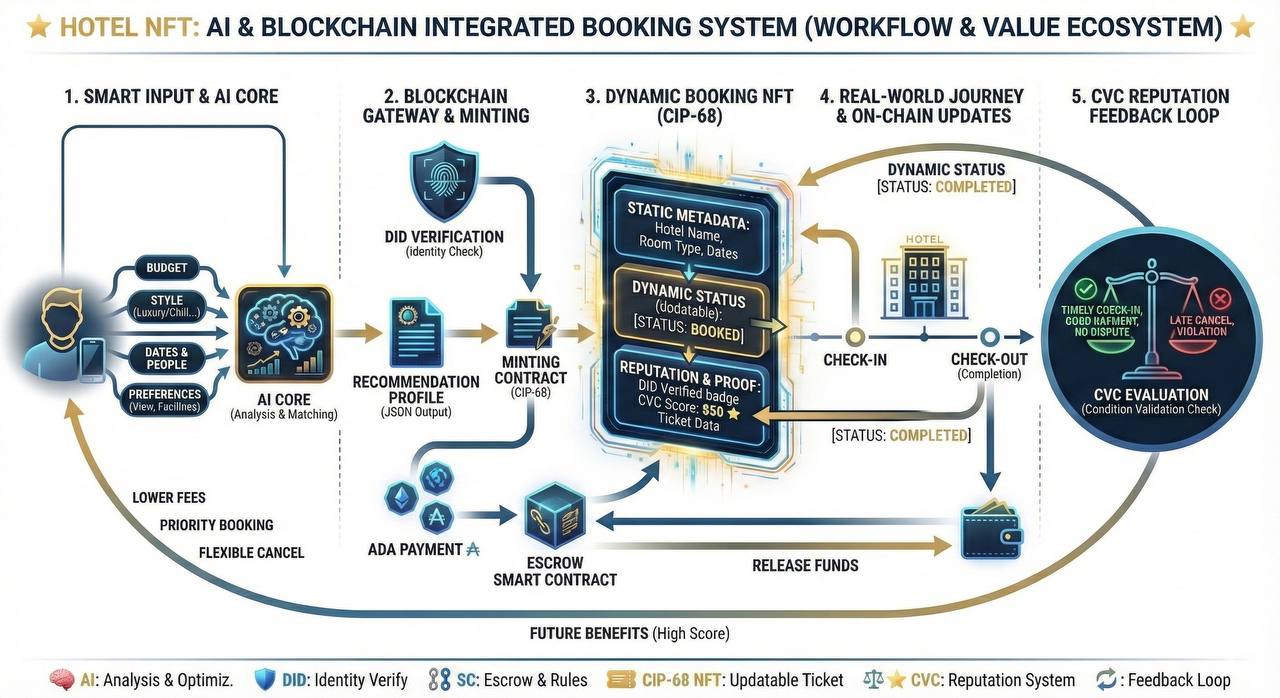
*Hotel-NFT platform general operating process:
1. Customer enters booking needs
The user inputs basic details such as dates, number of guests, budget, room type, and preferences. This data is sent to the AI Engine.
2. AI analyzes and recommends
AI processes all requirements and hotel data to generate an optimized “proposal profile,” showing the best room option and why it fits.
3. Customer selects and confirms
The user reviews the proposal, chooses a room, and submits the booking request. The system prepares the on-chain payment process.
4. Payment via SmartContract escrow
Instead of paying the hotel directly, the user deposits ADA into a secure escrow smart contract, ensuring transparency and preventing fraud or uncontrolled cancellations.
5. System mints the CIP-68 Booking NFT
Once payment is confirmed, the system mints a personalized NFT containing all booking metadata: ticket, receipt, room info, policies, DID proof, and CVC reputation.
6. NFT used throughout the trip
The NFT updates dynamically with real-time states such as Checked-In, Completed, Rewards, and Reputation updates—forming a verifiable travel profile.
7. Refund or cancellation
If the booking is canceled under policy, the smart contract automatically refunds the user. Any violations are handled transparently without manual intervention.
8. Trip completion and history saved
After checkout, the NFT is updated to Completed, and the customer’s CVC reputation adjusts accordingly. The NFT can be kept as a digital record or used for future rewards.
*Explanation of the meaning of AI Engine & Aiken SmartContract & NFT CIP-68 in the HOTEL-NFT model.
In HOTEL-NFT, the AI Engine, Aiken Smart Contract, and CIP-68 NFT automate the full booking flow. AI generates a structured user profile, which the smart contract uses to mint a CIP-68 NFT containing all booking data. Payments go through an ADA escrow for fast, secure, global settlement. The NFT updates dynamically from booking to check-in, completion, and review, creating a verified on-chain travel record. This stack provides personalization, transparency, and a tamper-proof booking asset beyond what Web2 can offer.
CVC Reputation Score:
CVC Reputation Score (0–100) rates user trust based on payments, spending, cancellations, and loyalty. Higher scores lower deposits and unlock perks, with tiers: Silver (0–30), Gold (30–60), Diamond (60–100). The score is transparent and updated each booking.
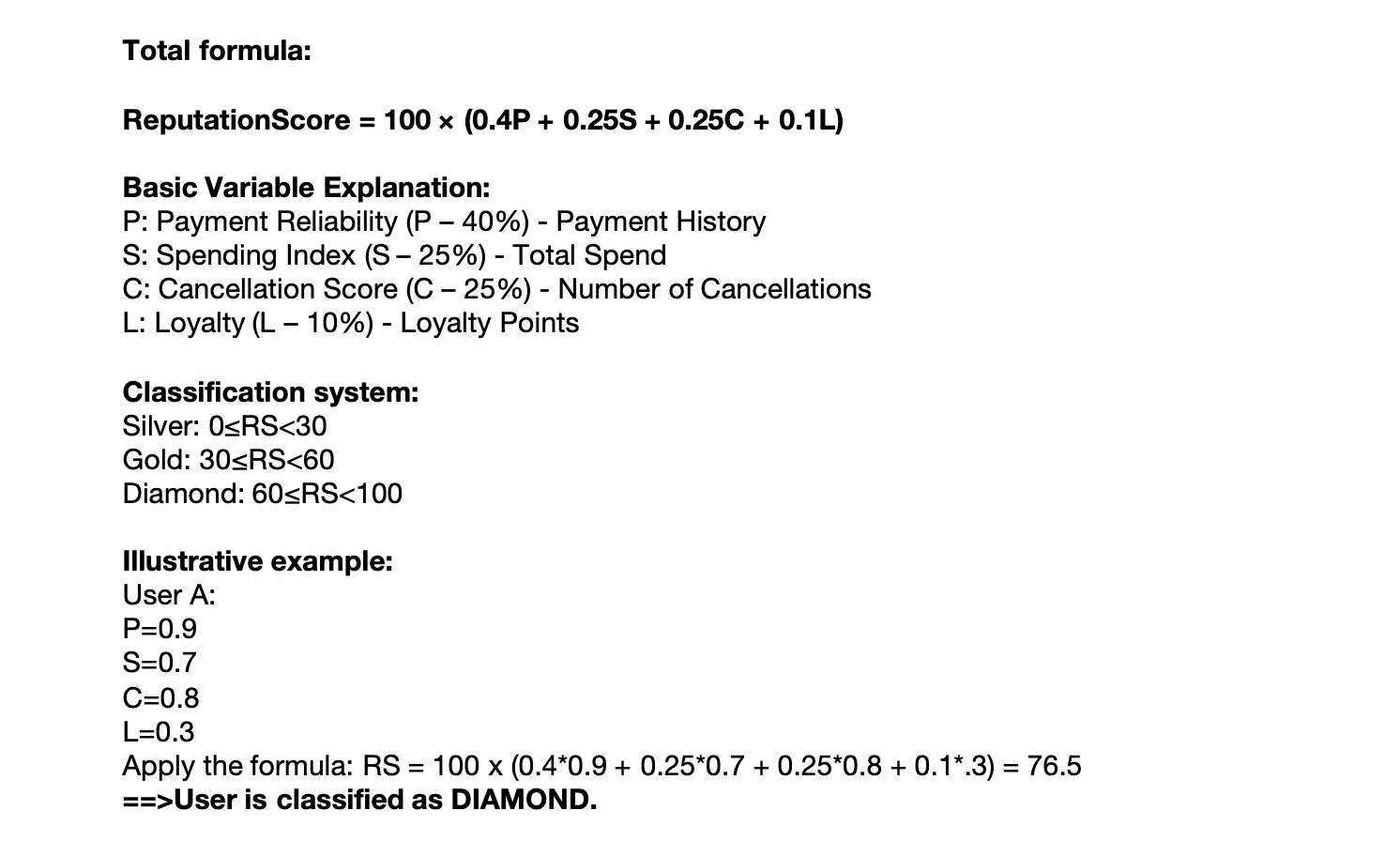
*Detailed explanation of CVC Reputation Score:
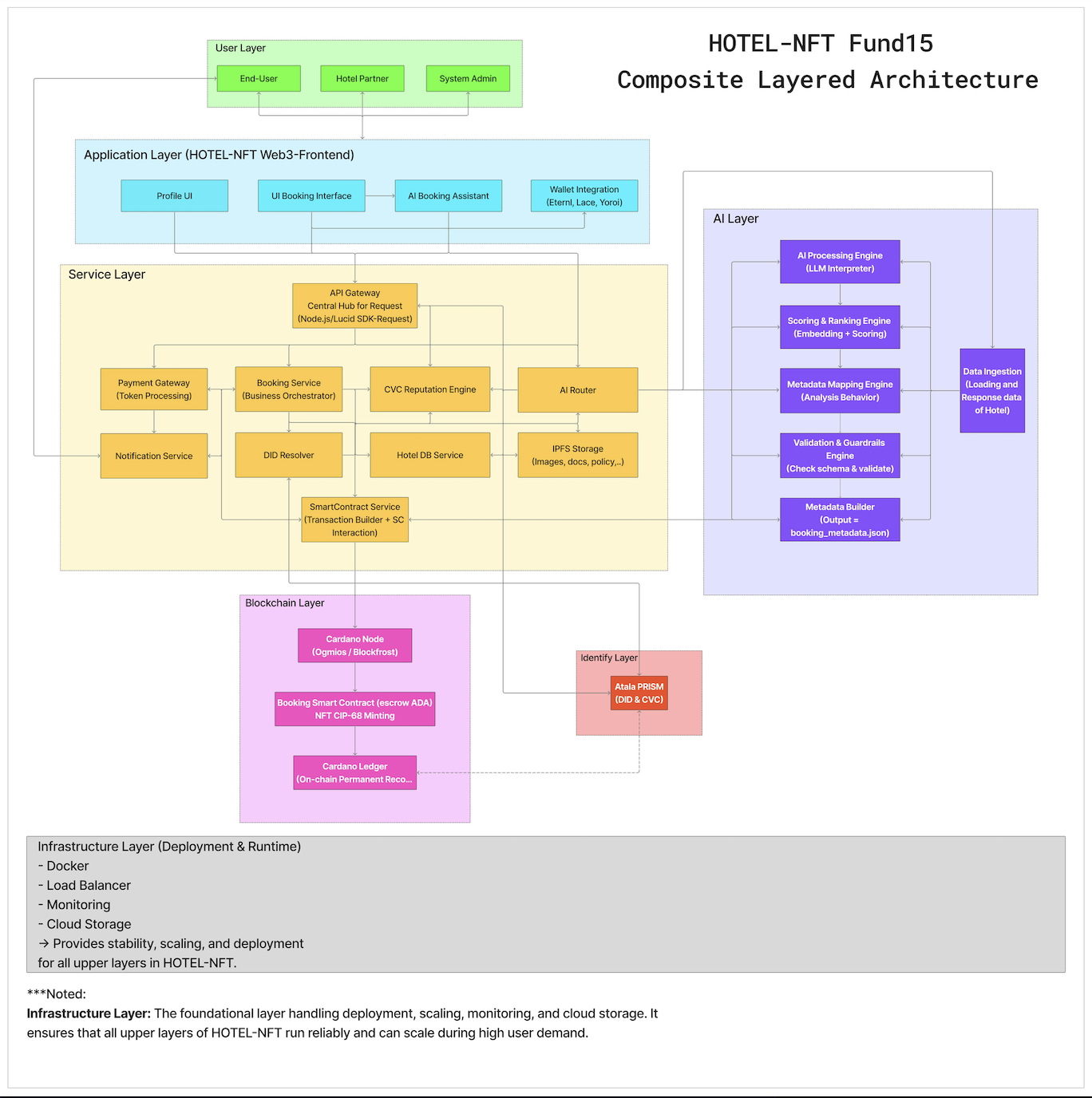
*HOTEL-NFT system layer architecture (Layer Architecture):
1.Application Layer HOTEL-NFT Web3 dApp (Frontend & User Interaction Layer)
Profile-Booking UI Interface - React / Next.js / Tailwind CSS
Wallet Integration - Lucid SDK
AI Booking Assistant - AI UI Module
2. Service Layer
API Gateway – Node.js/Lucid request handler
Payment Gateway – Token & payment processing
Booking Service – Core orchestration
CVC Reputation Engine
Hotel DB Service
AI Router – Recommendation & metadata builder
DID Resolver – Atala PRISM
IPFS – Store images, policies, logs
SmartContract Service – TX builder & SC calls
Notification Service – Booking/payment alerts
3.AI Layer (Recommendation & Behavioral Analysis Layer)
AI Processing Engine (LLM Interpreter)
Scoring & Ranking Engine (Embedding + Scoring)
Metadata Mapping Engine (Analysis Behavior)
Validation & Guardrails Engine (Check schema & validate)
Metadata Builder (Output = booking_metadata.json)
Data Ingestion (Loading and Response data of Hotel)
4.Blockchain Layer (Smart Contract + Ledger Layer)
Ogmios / Blockfrost — Cardano Node
Aiken / Plutus V3 — Booking Contract, Escrow Contract, NFT-CIP68 Contract
Reference Scripts CIP-33 — reduced transaction fees
Inline Datums CIP-32 — extended metadata booking
Cardano Ledger - On-chain Permanent Record
5.Identity Layer (Decentralized Identity Integration)
Atala PRISM DID
DID Verification + Binding to Wallet
DID-CVC Reputation Mapping
6.Infrastructure Layer (Core System & Deployment Layer)
Docker
Load Balancer
Monitoring
Cloud Storage
***Whitepaper HOTEL-NFT-Fund15:
https://dualcore.gitbook.io/hotel-nft-dualcore-team/summary/hotel-nft-whitepaper-1.0
[Your Project and Solution] Impact
Please define the positive impact your project will have on the wider Cardano community
*Impact:
The implementation of the HOTEL-NFT model on the Cardano blockchain platform not only brings direct value to travelers and hotels, but also creates a strong ripple effect for the entire Cardano ecosystem and the digital tourism industry.
HOTEL-NFT is a friendly bridge between traditional users and blockchain technology
HOTEL-NFT brings blockchain to real life through a familiar activity: booking a hotel room. Payment, guaranty and receiving NFT bookings are as simple as regular online transactions, helping Web2 users step into Web3 naturally. This expands Cardano adoption to travelers, hotels, travel agencies and the Web2 community.
HOTEL-NFT demonstrates the practical applicability of Cardano Smart Contract
Through Booking Contract, Escrow Contract and NFT CIP-68 Update Contract, the project shows that Cardano is fully capable of handling real-world commercial activities such as payment, escrow, verification and booking status updates.
HOTEL-NFT becomes a template model for Web3 Travel & Hospitality
The HOTEL-NFT model has the potential to be expanded into a Web3 standard for the tourism industry: NFT airline tickets, decentralized travel services, on-chain loyalty programs, anti-counterfeit consumer history and CVC Reputation system.
Increase transaction volume and TVL for Cardano
The continuous flow of booking transactions — ADA payments, escrow locking, minting/updating NFT CIP-68, check-in/out, refund/cancellation — creates a natural and sustainable transaction volume. This is a source of long-term growth for the ecosystem.
Supporting the digital transformation of the tourism industry
NFT Booking becomes a tamper-proof receipt, allowing cross-border payments without intermediaries. This reduces costs, increases transparency, and is especially suitable for developing countries and units that want to reduce their dependence on Web2 payment systems.
In previous Catalyst rounds, proposals related to the tourism, accommodation or booking sectors mainly focused on applying blockchain to create transparent transactions or using smart contracts to manage simple bookings. Although this is a reasonable approach at the early stage, that model often has limitations: it has not solved the problem of personalizing the customer experience, has not integrated digital identity (DID), lacks a reputation rating system, and does not create a real “digital asset” that represents the transaction. These projects only add blockchain as a technical layer but have not created new value for the travelity industry.
Our team's HOTEL NFT project approaches the problem at a higher level, combining AI - Blockchain - NFT CIP-68 - DID - Reputation CVC - Automation to restructure the entire booking journey, turning traditional booking into a smart, automated, transparent and globally scalable process.
1. AI Recommendation - Personalization that no project in Catalyst has done
The AI Core block of HOTEL NFT analyzes:
+Needs, budget, travel style, amenities;
+Risk level, customer behavior, room cancellation/change habits;
+Reputation history.
From there, the system creates a Recommendation Profile - a detailed dataset that accurately describes customer needs - something that previous recommendations did not have. With AI, customers are accurately suggested suitable services, hotels save operating costs and increase conversion rates.
→ This is a new value layer that most old proposals ignore, because they do not integrate AI as the foundation of the system.
2. NFT CIP-68 booking – the first time to assetize booking transactions
Instead of just recording transactions on the chain, HOTEL NFT creates Booking NFT CIP-68 that can be updated in real time, containing:
+All customer request metadata,
+DID verification,
+CVC credit score,
+Check-in/checkout status,
+Promotion history – reward points – risk level.
+NFT becomes e-ticket + receipt + reputation passport.
Previous projects only create static NFT or on-chain data, without the ability to update metadata according to CIP-68.
3. CVC Reputation – The first time to integrate reputation score into accommodation tourism
Almost no proposal has included a Reputation Score system based on travel behavior. CVC in HOTEL NFT evaluates reliability based on:
+Cancellation history,
+Payment,
+Check-in time,
+Disputes,
+Transaction completion rate.
This score directly affects:
+Discount level,
+Flexible cancellation rights,
+Deposit level,
+Room/voucher priority.
→ This is a mechanism to create positive incentives, reduce risks from bad-behavior guests - something that no proposal in Catalyst has implemented.
4. Automation & Smart Contract Booking - superior automation
Not just stopping at "escrow payment" like the old model, but:
+Smart contract self-builds metadata → mints NFT → updates status;
+Automatically processes payments, refunds, penalty terms;
+Automated onboarding with DID;
+Stores booking history across multiple hotels.
This level of automation turns booking into an on-chain pipeline, not just a single transaction.
5. Scalability – multi-chain services
With AI + DID + CIP-68 architecture, HOTEL NFT can become:
+A data standard layer for the entire hotel industry on Cardano;
+A tool to help hotels reduce marketing costs;
+A cross-ecosystem loyalty platform;
+An on-chain database that generates real transaction growth.
Uniqueness of the Proposal:
HOTEL NFT is not just another booking platform. We solve the above problems by combining the power of advanced Artificial Intelligence (AI) with the unique Cardano Blockchain technology (CIP-68). Here are the main differentiating advantages:
AI-Driven Personalization: Instead of just a search engine, Hotel NFT acts as a "Virtual Travel Assistant". Our AI analyzes behavior, preferences, history and budget to proactively suggest the most optimal room and itinerary options, helping users save time and make more accurate decisions.
Dynamic Booking NFT (CIP-68) - The "Ticket" Revolution: This is the most unique point. Other systems use electronic tickets (emails) or static NFTs (just images). We use Cardano's CIP-68 token standard to create "living" and updateable NFTs (Updateable Metadata).
**Differentiating benefits: **This NFT is a flexible digital record. It automatically updates the status from "Booked" -> "Checked in" -> "Completed". More importantly, it stores the user's reputation history right on the NFT itself after each trip, creating long-term cumulative value that legacy systems cannot do.
**Seamless Web3 experience for real services: **Combining AI (to simplify selection) and ADA payments via Smart Contract (to ensure safety and reduce fees), Hotel NFTs bring a truly efficient, transparent and trustworthy RWA booking experience on Cardano.
***We have confirmed pilot participation from 2 hotels, enabling real booking transactions on Cardano testnet. This ensures real adoption, real users, and verifiable on-chain impact, increasing the value delivered to the ecosystem.
Information about the hotel chain that will conduct a trial run:
Xing Ocean Vung Tau:
Xing City Hotel Da Lat:
[Your Project and Solution] Capabilities & Feasibility
What is your capability to deliver your project with high levels of trust and accountability? How do you intend to validate if your approach is feasible?
-Our team consists of young, dynamic, eager to learn developers with extensive experience in the fields of financial modeling as well as focusing on researching real-life models to apply to Cardano in particular as well as blockchain technology and Smart Contract applications in general. With the experience of operating real-life financial models, we have had objective views as well as general assessments through the process of operating these models. From there, we can exploit all the advantages and disadvantages of the difficulties, challenges and barriers. With a practical approach, our team has built and designed the idea for this proposed model to optimally exploit the advantages of real-life models as well as handle as thoroughly as possible the risk factors in financial models with the technological solutions that Cardano brings.
-Our development team consists of developers with a solid grasp of basic and advanced knowledge of blockchain technology, programming, AI data analysis, and a special focus on the Cardano ecosystem. With practical experience through the positions of vCR, Moderator and many contributions to many funds from Catalyst in the past to the present, we have a deep insight into the Cardano ecosystem as well as the blockchain generations that exist and develop in the market, from which we can build highly effective proposals for the community as well as bring real values to the Cardano ecosystem.
-With extensive skills and experience in operating business and financial models, combined with the ability to analyze, program, apply technology through practical experiences and in-depth assessments from experts who accompany us, this will be the basis for us to be able to commit to the capacity to implement this project.
*Risk Mitigation Plan:
1. Technical & Smart Contract Risks
Risks:
Smart contracts that process bookings, escrow payments, or update NFT-CIP68 may have logic errors (wrong status, wrong metadata updates, wrong refund conditions).
Solution:
Apply property-based testing, test cases that simulate the entire booking lifecycle: booking, payment, check-in/check-out, cancellation.
Internal peer-review and code audit by Plutus/Aiken experts before mainnet.
Deploy a long testnet phase, with simulated user data + pilot community to detect errors before public announcement.
Use reference scripts (CIP-33) + inline datum (CIP-32) to reduce the risk of incorrect operations.
2. AI Engine & Data Integrity Risks
Risks:
AI system misanalyzes user needs, suggests incorrect rooms or creates inconsistent metadata → affects the experience and quality of NFT booking.
Solution:
Apply AI Validation Layer: check consistency, limit errors and re-validate before sending via Metadata Builder.
Store suggested configuration (AI audit log) for analysis and adjustment.
Allow users to re-confirm all information before signing on-chain transactions.
Gradually fine-tuning according to actual user behavior data.
3. Payment Escrow & Blockchain Settlement Risks
Risks:
Transaction errors, incomplete payments, failed NFT mints or escrow does not lock the correct amount of ADA.
Solution:
Transaction-retry mechanism on the frontend when the Cardano network is crowded.
Auto-verify: if escrow lock fails → cancel transaction and do not mint NFT.
Log all tx-hash for easy reconciliation between guests and hotels.
4. External Data Risks
Risks:
Room price or availability data is not synchronized between backend and hotel → leading to incorrect booking.
Solution:
Use dual-validation between Hotel DB and partner hotel API.
Temporary cache 30–60s to limit race-condition.
When data changes during the transaction → AI Router asks user to reconfirm.
If API does not respond → system switches user to "Manual Verify" mode.
5. Identity & Reputation Risks (DID + CVC)
Risks:
DID cannot be authenticated, user does not have reputation history, incorrect reputation data affects discount/promotion.
Solution:
Add fallback: if DID is not working → use local-wallet identity + email/pin authentication.
CVC is recorded on-chain and reviewed periodically to avoid bias.
Do not use CVC for high-risk financial decisions (no credit-scoring), only use for incentives/priorities.
6. Legal & Regulatory Risks
Risks:
Some countries have strict legal frameworks for tokens, NFTs or international booking services.
Solution:
HOTEL-NFT operates decentralized – non-custodial, does not hold money on behalf of users.
NFT is a booking certificate, has no financial or investment functions.
Consult legal advice in key markets before deploying widely.
Personal data is GDPR compliant and regional privacy standards.
7. User Adoption & Usability Risks
Risks:
Internet/Web2 users have difficulty getting familiar with blockchain wallets, NFT bookings, or on-chain operations.
Solution:
Provide video tutorials, testnet sandboxes for beginners.
UI/UX is step-by-step, with little technical jargon.
Enable bookings in “Guest Mode,” requiring only wallet signing at the end.
8. Delivery & Milestone Risks
Risks:
Deployment progress is slow due to the relatively complex AI + blockchain workload.
Solution:
Each Milestone is broken down into verifiable deliverables.
Published GitHub repo, tx-hash, diagram, and weekly progress.
Optimize the process with CICD, unit testing, and a dashboard to track dev progress.
9. Infrastructure & Operations Risks
Risks:
Server congestion, storage errors, or downtime can cause the system to become unstable.
Solution:
Multi-zone cloud deployment.
Periodic backup of DB + IPFS pinning service.
Auto-scaling and load-balancer to maintain service speed during peak traffic.
***We will conduct a pilot deployment on 2 facilities Xing Ocean & Xing Hotel in VietNam: Two hotel partners will join the pilot test, ensuring real-world validation of booking flows, escrow conditions, check-in/out signatures, and NFT CIP-68 updates. This collaboration significantly increases the project’s feasibility and reduces technical risk.
[Milestones] Project Milestones
Milestone Title
System Architecture & AI–Blockchain Foundation
Milestone Outputs
- Build a complete system architecture of HOTEL-NFT (6 Layer Architecture).
- Design and simulate the entire Smart Contract logic: Booking – Escrow – Refund – NFT CIP-68 Update.
- Build Figma UI prototype (Booking UI + AI Assistant UI + NFT Viewer).
Acceptance Criteria
- Complete system architecture that fully demonstrates all operational flows:
- Application → Service → AI → SC → Blockchain → Identity.
- Complete the simulation of the Smart Contract booking cycle: booking → payment → mint NFT → update → settle.
- Public UI prototype (Figma link).
- Public GitHub repo to initiate the project and architectural documentation.
Evidence of Completion
- Link to Diagram: HOTEL-NFT Layer Architecture (6 layers).
- Link to Diagram: Booking Smart Contract Flow (booking/payment/escrow/refund).
- Link to Figma UI prototype (AI chat, booking form, NFT viewer).
- Link to GitHub Repo (folder structure, README, MIT License).
Delivery Month
1
Cost
18000
Progress
20 %
Milestone Title
AI Engine + Smart Contract Prototype Deployment
Milestone Outputs
- Build a complete AI Booking Engine: Scoring, LLM Processing, Metadata Builder.
- Complete Smart Contract booking/escrow/NFT CIP-68 (Aiken/Plutus V3).
- Deploy the HOTEL-NFT prototype version to testnet.
- Design a booking flow simulation with real user data (at least 20 people).
Acceptance Criteria
- User survey dataset (>=20 people): room search behavior, priority criteria, affordability.
- AI Engine generates valid JSON metadata for 100% of collected test cases.
- Smart Contract achieves 100% of basic test cases: booking, escrow, refund, NFT update.
- 5 Test Cases simulate full booking cycle (AI → SC → NFT → refund/settle). Prototype works on testnet with ≥20 complete transactions.
Evidence of Completion
- Link to user survey file + analysis report (anonymized).
- Link to AI Engine source code (public GitHub).
- Link to Smart Contract repo (Aiken/Marlowe).
- Link to 5 video test cases (90–120s).
- Link to full booking cycle flowchart (AI → SC → NFT).
- Link to HOTEL-NFT testnet tx-hash list.
Delivery Month
2
Cost
30000
Progress
40 %
Milestone Title
Security Audit & Scalability Documentation
Milestone Outputs
- Complete security mechanism: SC validation, NFT CIP-68 update security, DID binding.
- Perform internal audit + external audit.
- Write Security Policy & Privacy Policy document according to Web3 standard.
- Scaling & Performance document.
Acceptance Criteria
- Minimum 10 property-based test cases pass with stable rate.
- Testnet achieves at least 50 stable transactions.
- Audit report achieves ≥90% code coverage, no critical errors.
- Complete Security & Privacy Policy document.
- Complete the system scalability report.
Evidence of Completion
- Link to internal/external audit document.
- Link to tx-hash testnet list.
- Link to Security & Privacy Policy (public GitHub).
- Link to Scaling & Performance document.
Delivery Month
1
Cost
24000
Progress
60 %
Milestone Title
User Testing, Feedback & Final Reporting
Milestone Outputs
- Plan user testing for the community.
- Deploy test runs on 2 storage chains Xing Ocean Vung Tau & Xing Hotel City Dalat.
- Collect feedback from users, evaluate AI accuracy and UX of booking flow.
- Analyze user behavior + acceptance level of NFT booking model.
- Perform HOTEL-NFT Impact Report Fund 15 summary report.
Acceptance Criteria
- Complete and public user testing plan + feedback reward.
- Synthesized document report for the test run process at 2 facilities of the Xing Hotel chain.
- Collect ≥80% positive feedback (survey, feedback form, interview).
- HOTEL-NFT achieved KPI with ≥30 complete testnet bookings.
- Synthesized report of the process, data, adoption & impact index.
Evidence of Completion
- Link to user behavior analysis report.
- Link to the summary report for the Xing Hotel test run event
- Link to on-chain transaction data (Cexplorer: tx-hash list).
- Link to the pilot community video or media article (Catalyst, Forum, X…).
- Link to Impact Report PDF.
Delivery Month
2
Cost
24000
Progress
80 %
Milestone Title
Mainnet Deployment & Production Launch
Milestone Outputs
- Deploy all Smart Contract Booking/Escrow/NFT CIP-68 to Cardano Mainnet.
- Test actual operation with real users (production-mode).
- Optimize performance, reduce transaction fees, stabilize response speed.
- Complete user manual and technical instructions for hotel partners.
- Release official product to community & Catalyst.
Acceptance Criteria
- Smart Contract (Booking, Escrow, NFT CIP-68) successfully deployed to Mainnet.
- 100% features:
– Booking
– Payment Escrow
– Mint NFT CIP-68
– Update metadata (Check-in, Check-out, Refund)
- At least 20 successful test bookings on Mainnet.
- Complete the User Guide and Technical Documentation (Integration Guide).
- Publish the official announcement (Catalyst, Forum, X, Telegram).
Evidence of Completion
- Link to the Smart Contract Mainnet address (SC Address).
- Link to the Mainnet booking transaction Tx-hash list.
- Link to the public “HOTEL-NFT Mainnet User Guide” document on GitHub.
- Link to the “Integration Guide for Hotel Partners” document.
- Link to the Mainnet booking demo video (60–90s).
- Link to the Mainnet Launch announcement on the media channels (Catalyst / X / Forum / Telegram).
Delivery Month
1
Cost
18000
Progress
100 %
[Final Pitch] Budget & Costs
Please provide a cost breakdown of the proposed work and resources
HOTEL-NFT – Full Budget (114,000 ADA)
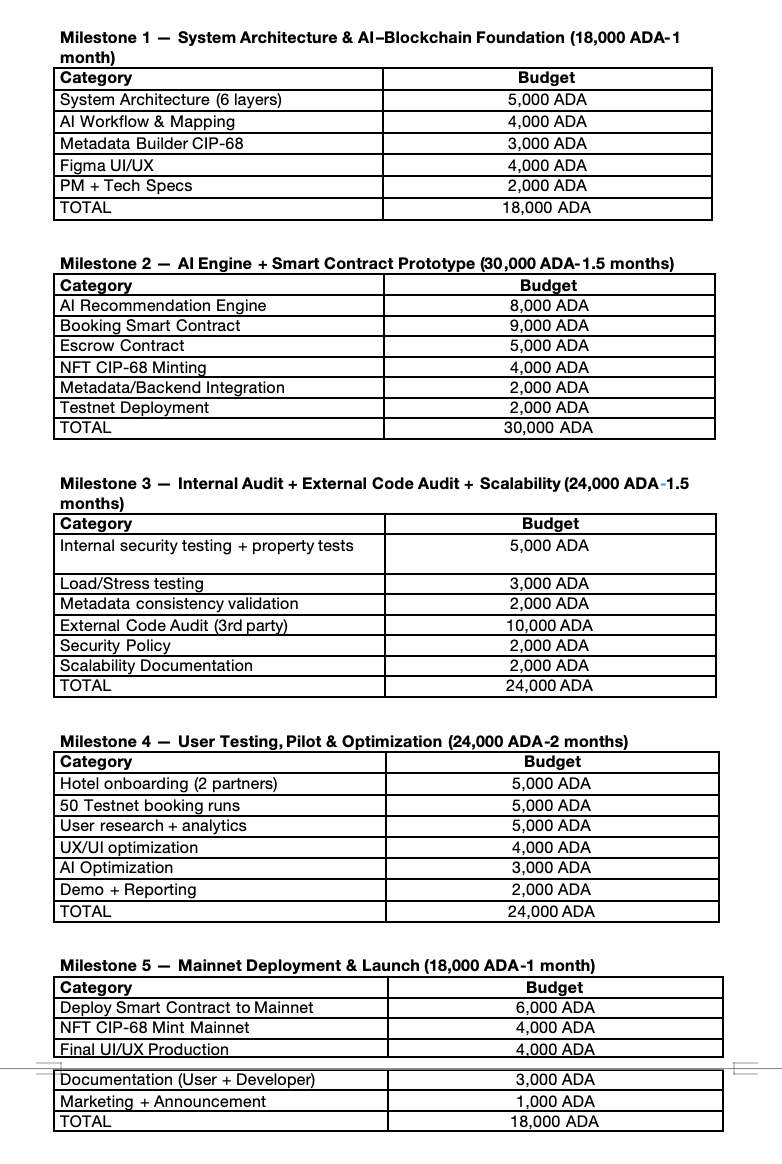
***Summary Budget Table – Full Budget Document
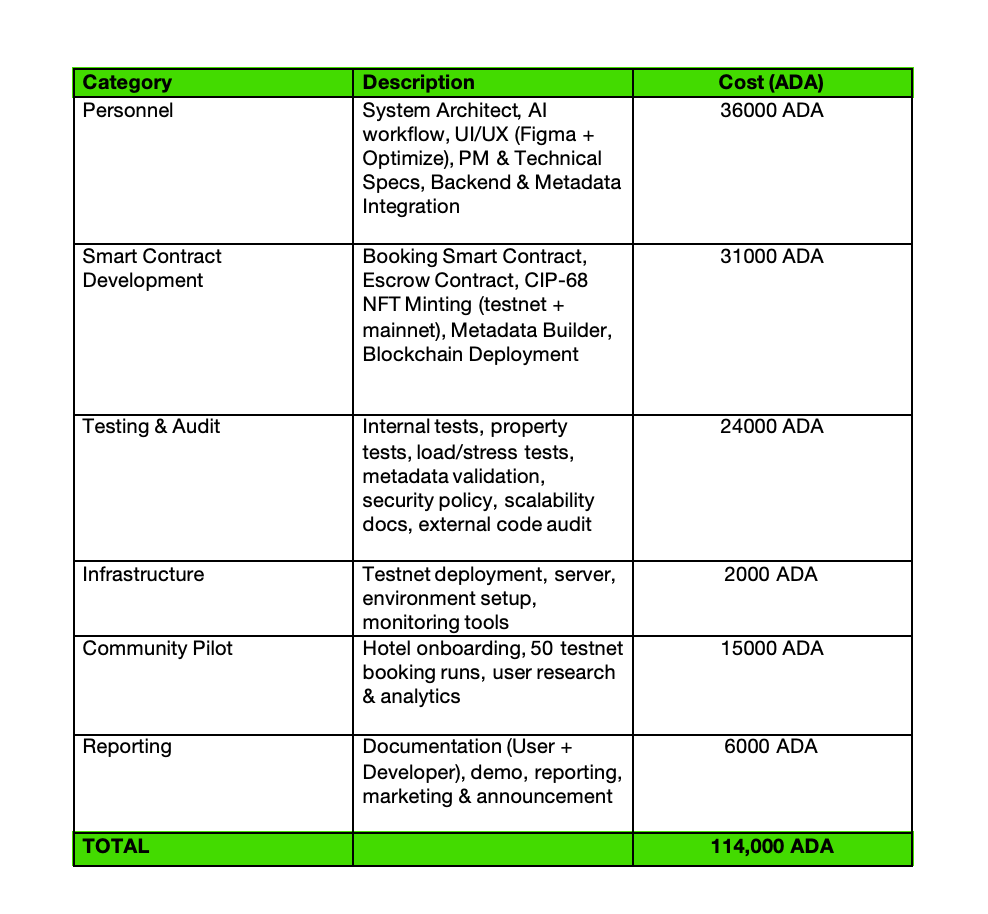
-LINK BUDGET: https://dualcore.gitbook.io/hotel-nft-dualcore-team/summary/budget
[Final Pitch] Value for Money
How does the cost of the project represent value for the Cardano ecosystem?
Project Value Plan & KPI 6 Months After Mainnet – HOTEL-NFT
I.KPI 6 Months Mainnet – Summary Table
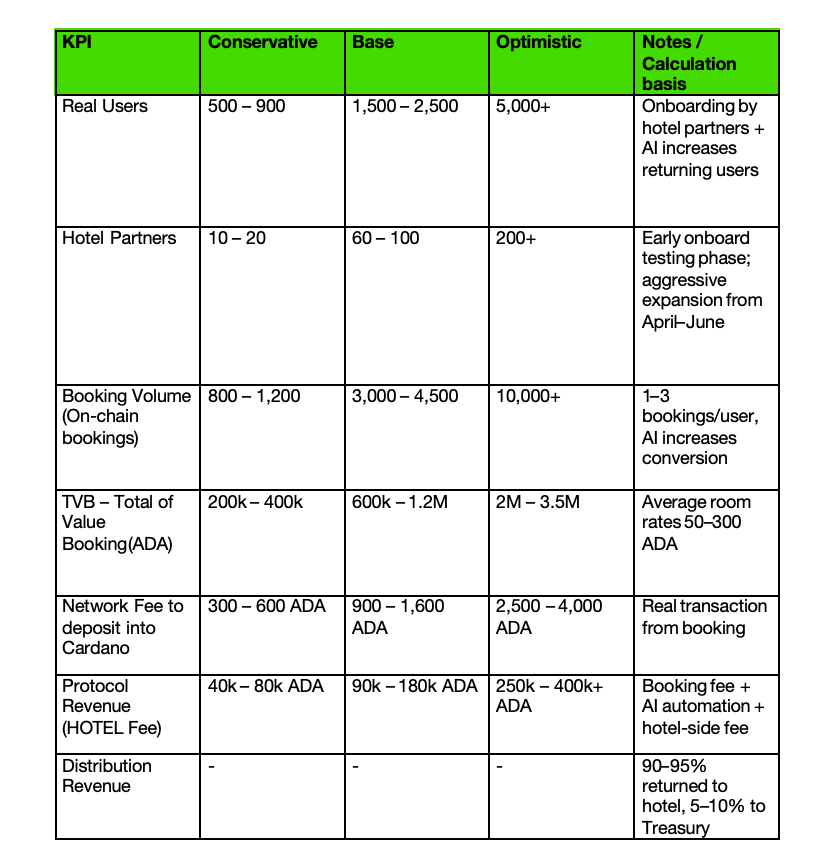
II. Conclusion Value – HOTEL NFT (First 6 Months of Mainnet)
500 – 5,000 real users from the travel market – not based on incentives.
10 – 200+ integrated hotels, creating dynamic room & price data sources verified by CIP-68.
800 – 10,000+ on-chain bookings → increase real traffic on Cardano.
200k – 3.5M ADA total transaction value from real travel activities.
300 – 4,000 ADA network fee directly contributed to Cardano.
40k – 400k ADA Protocol Revenue.
→ 90–95% returned to hotels, 5–10% to Treasury.
Key Differences:
- First AI Booking Engine on Cardano
- NFT CIP-68 represents rooms & bookings
- Transparent Escrow Contract, no middleman
- Automation reduces OTA costs by 20–40%
- Verifiable data
- Generate real revenue from the tourism industry
- Architecture expands to Airlines / Tours / Events
III. Summary of project value for money:
The human resource cost for the HOTEL NFT project is built on the average salary of programmers and technology experts in Vietnam, ranging from 2,000 to 3,000 USD per month for senior roles in the fields of blockchain, AI and full-stack. This is a cost level that has been assessed by experts and is considered appropriate, competitive and reflects the complexity of the project. Using the unit price of human resources in Vietnam also allows us to deploy a highly complete product with an optimal budget, demonstrating responsibility and commitment to using Catalyst capital in a transparent and efficient manner.
The project's budget not only covers the development team but also includes essential investments in infrastructure, platform design, AI booking engine, NFT CIP-68 metadata and testing - auditing process to ensure the safety and reliability of the system. In addition, the project also plans to cooperate with experienced experts in the field of blockchain and tourism products to ensure the highest quality. All of these expenses directly serve the goal of building a decentralized booking platform that operates smoothly, transparently and can expand to the international market.
The value of the capital is clearly demonstrated in the ability to transform a very familiar model in life - hotel booking - into a practical application of blockchain. HOTEL NFT not only replaces the traditional booking process with a transparent and automated escrow system using smart contracts, but also incorporates AI to optimize the experience, and applies NFT CIP-68 to represent each room, room price and dynamic attributes. All of these factors contribute to bringing depth and practical application to the Cardano ecosystem, opening up new use cases beyond the scope of purely financial models such as lending/borrowing that are already familiar. The project aims to create a more dynamic consumer space for the ecosystem, contributing to important indicators such as transaction volume, real users, TVL, network fee revenue - factors that are vital to the long-term development of Cardano.
HOTEL NFT also brings benefits not only on a technical level but also has the ability to attract a large number of Web2 and Web3 users from the travel market. The tourism industry is one of the sectors with high transaction volume and high frequency of repetition, and building an on-chain booking model can scale to hundreds of millions of potential users. As the scale of users and transactions increases, the demand for ADA in payment, staking, room management and AI payment automation also increases, contributing to the value and stability of ADA.
Since the price of ADA can fluctuate during the development period, the project has prepared flexible plans to ensure progress. In case ADA drops sharply, we can activate reserve funds from partners and supporting organizations to ensure the implementation process is not interrupted. On the contrary, if ADA increases beyond expectations, the difference will be reinvested in the project, prioritizing advanced items such as extended external code audit, data analysis dashboard, improved AI recommendation engine, multi-language expansion and group hotel management. This makes the platform not only more complete but also ready for the next steps of development after the mainnet launch.
[Self-Assessment] Self-Assessment Checklist
I confirm that evidence of prior research, whitepaper, design, or proof-of-concept is provided.
Yes
I confirm that the proposal includes ecosystem research and uses the findings to either (a) justify its uniqueness over existing solutions or (b) demonstrate the value of its novel approach.
Yes
I confirm that the proposal demonstrates technical capability via verifiable in-house talent or a confirmed development partner (GitHub, LinkedIn, portfolio, etc.)
Yes
I confirm that the proposer and all team members are in good standing with prior Catalyst projects.
Yes
I confirm that the proposal clearly defines the problem and the value of the on-chain utility.
Yes
I confirm that the primary goal of the proposal is a working prototype deployed on at least a Cardano testnet.
Yes
I confirm that the proposal outlines a credible and clear technical plan and architecture.
Yes
I confirm that the budget and timeline (≤ 12 months) are realistic for the proposed work.
Yes
I confirm that the proposal includes a community engagement and feedback plan to amplify prototype adoption with the Cardano ecosystem.
Yes
I confirm that the budget is for future development only; excludes retroactive funding, incentives, giveaways, re-granting, or sub-treasuries.
Yes
[Required Acknowledgements] Consent & Confirmation
I Agree
Yes
Team
MR.Vu Van Nam - Project Manager:
Bachelor of Industrial Management at HCMC University of Technology and Education.
5 years working at MEX-DN Commodity Trading Company Limited.
4 years of experience in business.
3 years of experience in blockchain.
Complete course credits:2 course of Marlowe ,Lucid, Aiken, Cardano-CLI, CBCA.
Blockchain Fundamentals
Credential ID:
62aabf58-6f41-4d14-8e29-dca4c236e9fc
Cardano Blockchain Certified Associate (CBCA)
Credential ID:
96b3a3c6-3ec2-42f3-91de-5988cd3608ab
Policy NFT Certificate : 51964ec5764252718ddfe92a9145bf0d085b3a9d61c01fe9b0808635
Fingerprint: asset1u4dfl4psa6xnvtlr6lat6e3qvvssqza54hw9wn
Completed Course of Project Management: https://www.coursera.org/account/accomplishments/specialization/certificate/AOXJVU4J1OB4
Active contributor to Catalyst since F9, holding the positions of vCR and Moderator.
Github: https://github.com/DUALCORE-VuNam
Linkedin: https://www.linkedin.com/in/vu-nam-5922682a7/
Telegram: https://t.me/namcoitiensinh
Roles:
Project Manager.
Human Resources Direction.
Build project framework and roadmap.
Responsible for project monitoring and promotion.
In-depth research on real-life models applying smart contracts.
Model analysis, prototype contract building, debugging when applied to smart contracts.
MR.Nguyen Van Tai - Product Analyst:
Bachelor of Information Technology at BRVT University.
Leader of Prudential Finance.
8 years freelance experience in financial modeling.
6 years of experience in blockchain and AI.
Proficient in using AI tools: n8n, Genspark, claude, gemini,....
Complete course credits: Marlowe Mastery, Lucid, Aiken, Cardano-CLI, CBCA.
Blockchain Fundamentals
Credential ID:
d5ceac97-d9ab-46f7-9167-b35a07d5c89c
Cardano Blockchain Certified Associate (CBCA)
Credential ID:
37bea67c-48b6-4d92-b918-e554be7d4430
Policy NFT Certificate : 51964ec5764252718ddfe92a9145bf0d085b3a9d61c01fe9b0808635
Fingerprint: asset1h7fczhjcyndg6lwevh8xmphprr053xhf038znn
Completed Course of Generative AI.
Completed Course of Product Innovation.
Active contributor to Catalyst since F11, holding the positions of vCR and Moderator.
Github: https://github.com/taiwoan5
Linkedin: https://www.linkedin.com/in/tai-nguyen-287513336/
Telegram: https://t.me/taiwoan
Roles:
Product Data Analysis.
AI Data Analysis.
Detailed Model Research.
Develop Project Scalability and Performance.
UX/UI Design and Build.