Last updated 10 months ago
Hydra Migration Platform: SolanaPE/Avalanche Subnet to Hydra
Problem
Migrating workloads from Solana SPEs and Avalanche Subnets onto Hydra L2 stack is non-trivial, touching data portability, contract redesign, governance changes, and day-to-day operational overhead
Solution
A migration platform that streamlines transitions from Solana PEs and Avalanche Subnets to Hydra by seamlessly automating smart contract redeployment, asset tokenization, and governance adaptation.
About this idea
[Proposal setup] Proposal title
Please provide your proposal title
Hydra Migration Platform: SolanaPE/Avalanche Subnet to Hydra
[Proposal Summary] Budget Information
Enter the amount of funding you are requesting in ADA
170000
[Proposal Summary] Time
Please specify how many months you expect your project to last
6
[Proposal Summary] Translation Information
Please indicate if your proposal has been auto-translated
No
Original Language
en
[Proposal Summary] Problem Statement
What is the problem you want to solve?
Migrating workloads from Solana SPEs and Avalanche Subnets onto Hydra L2 stack is non-trivial, touching data portability, contract redesign, governance changes, and day-to-day operational overhead
[Proposal Summary] Supporting Documentation
Supporting links
- https://dextrlabs.com/ ,
- https://x.com/dextr_labs ,
- https://github.com/DextrLabsDev/f15/blob/main/hydra-migration-platform.pdf ,
- https://v0-hydra-l2-migration-tool.vercel.app/migrate
[Proposal Summary] Project Dependencies
Does your project have any dependencies on other organizations, technical or otherwise?
No
Describe any dependencies or write 'No dependencies'
No dependencies
[Proposal Summary] Project Open Source
Will your project's outputs be fully open source?
Yes
Please provide details on the intellectual property (IP) status of your project outputs, including whether they will be released as open source or retained under another licence.
MIT License
[Theme Selection] Theme
Please choose the most relevant theme and tag related to the outcomes of your proposal
Cross-chain
[Campaign Category] Category Questions
Describe what makes your idea innovative compared to what has been previously launched in the market (whether by you or others).
First dedicated Hydra-based migration path into Cardano
Purpose-built to move projects from Solana SPEs and Avalanche Subnets into Hydra heads anchored on Cardano, instead of generic “any-to-any” bridges or manual consulting work.
Standardizes what is currently an ad-hoc, risky, and highly bespoke process into a repeatable, tool-driven migration pipeline.
End-to-end automation of contracts, tokens, and governance
Goes beyond simple token bridges by converting smart contracts into Cardano-compatible languages (e.g., Aiken), adapting token standards, and translating governance models in one flow.
Existing tools typically stop at asset transfer or contract re-deployment; our platform treats the entire application stack—logic, assets, permissions, and parameters—as a single migratable unit.
Security-first data and state migration for Hydra
Builds encrypted, integrity-checked pipelines for moving state, configuration, and application data from Solana/Avalanche into Cardano and Hydra heads.
Instead of “start from scratch on Cardano,” projects can preserve history and state while gaining Cardano-grade settlement security and Hydra-level throughput.
Hydra-aware orchestration instead of just “deploy on Cardano”
Configures and manages Hydra heads as part of the migration, so projects land directly in a scalable L2 environment rather than only on L1.
This couples base-layer settlement with high-throughput execution from day one, reducing latency and fees for end-users without extra integration work.
Reusable migration platform, not a one-off service
Provides a CLI, documentation, and reference flows that any project can reuse, instead of closed, one-time consultancy scripts.
By lowering the technical and resource barriers to migration, it enables a broader class of teams—startups, DAOs, and enterprises—to move to Cardano + Hydra and, in doing so, expands the overall Cardano ecosystem.
Describe what your prototype or MVP will demonstrate, and where it can be accessed.
- Migrate a reference project from Solana / Avalanche to Cardano + Hydra L2
- Take a sample DeFi / token app running on a Solana SPE or Avalanche Subnet.
- Parse its contracts, token configs, and governance settings.
- Run them through our migration pipeline to produce Aiken/Plutus scripts, Cardano-native tokens, and Hydra-ready configs.
- Demonstrate automated smart contract and token conversion
- Show contract translation into Cardano-compatible code with a generated build + deployment manifest.
- Automatically map SPL / ARC-20 style tokens into Cardano native assets, preserving metadata and initial balances.
- Show secure state + data migration into a Hydra head
- Import state (token balances, key configuration values) from the source chain snapshot.
- Prove integrity via checksums and migration logs visible in the CLI.
- Governance and access control translation
- Migrate a simple DAO / multisig-style governance model into Hydra equivalents.
- Demonstrate that only authorized keys can update parameters post-migration.
User-facing flows
- Let users interact with the migrated app on Hydra L2 (e.g., transfer tokens, call a contract method) and see settlement anchor back to Cardano testnet.
- Provides platform (and scripts) to re-run the entire migration for the reference project.
Where it can be accessed
- Public deployed on testnet
- A live Hydra head instance with the migrated demo app, reachable via published API/CLI endpoints.
Open-source repository
- Code for the migration tool (CLI), Hydra orchestration scripts, example configs for Solana/Avalanche source projects, and Cardano/Hydra deployment artifacts.
- Documentation & demo UI
- Online docs with a step-by-step walkthrough of:
- source dApp → migration pipeline → Hydra head deployment → Cardano testnet settlement.
- A lightweight web UI where users can connect a Cardano testnet wallet and try the migrated demo (e.g., send a token or invoke a migrated contract) and see the corresponding Cardano transaction.
Describe realistic measures of success, ideally with on-chain metrics.
On-chain & Hydra migration activity
- ≥ 2000 Hydra transactions generated by migrated dApps (token transfers, contract calls, governance actions).
- ≥ 100 Cardano transactions related to migrations (token minting under new policy IDs, Hydra head commits/closures, governance updates).
Migration efficiency & reliability
- ≥ 60% reduction in manual migration steps compared to a documented “from-scratch” port.
- ≥ 90% migration success rate (end-to-end runs that finish without critical errors or rollbacks).
- 100% data integrity pass rate for checksum/validation checks on migrated state and token metadata.
- Public demo usage
- ≥ 20 unique wallets interacting with the migrated demo dApp on Hydra.
- ≥ 100 successful user actions (e.g., token transfers, contract calls) executed via the CLI or web UI.
- ≥ 3 completed feedback submissions rating ease of migration, clarity of docs, and dApp performance.
Developer & open-source adoption
- ≥ 3 reference migration configs (e.g., one Solana SPE app, one Avalanche Subnet DeFi app, one NFT/DAO app) published in the repo.
- At least 1 public workshop / tutorial showing a live migration from Solana/Avalanche to Cardano + Hydra, shared with the Cardano community.
[Your Project and Solution] Solution
Please describe your proposed solution and how it addresses the problem
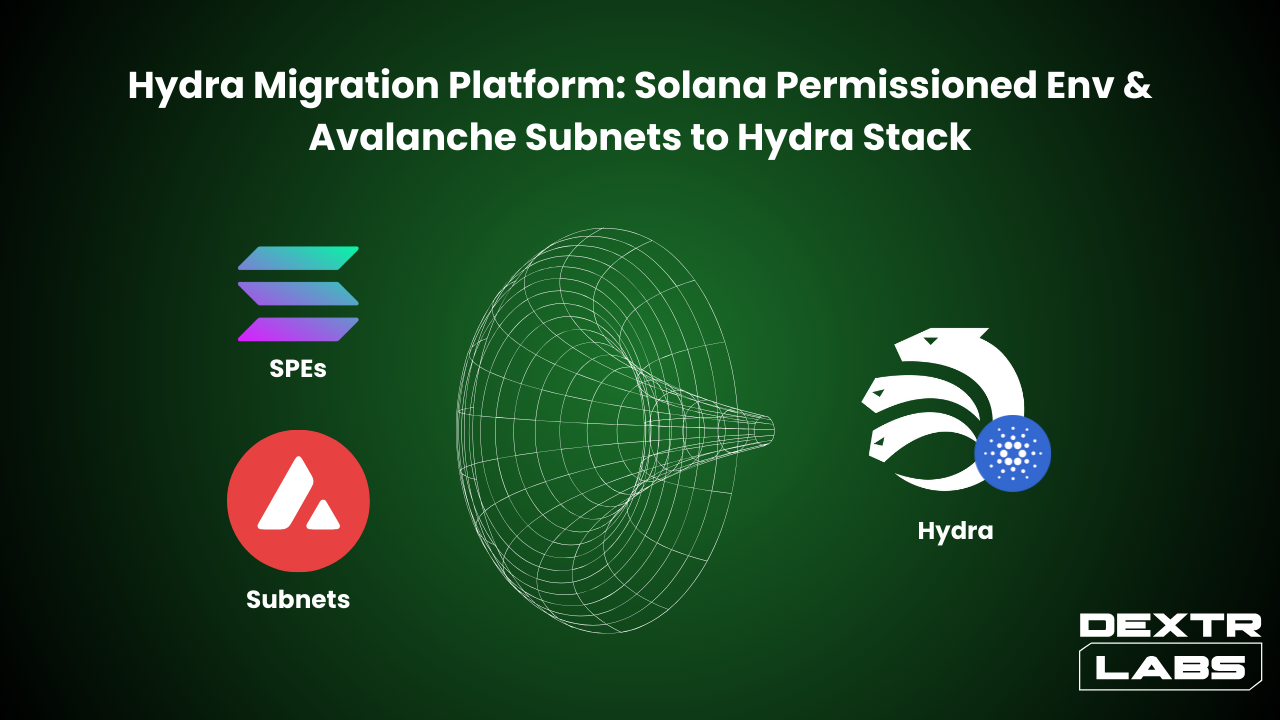
Projects built on platforms like Solana SPEs and Avalanche Subnets face challenges when attempting to transition to Cardano and Hydra stack. Our Hydra L2 Migration Tool is designed to streamline the migration process from Solana SPEs and Avalanche Subnets into Hydra heads anchored on Cardano.
The Hydra Migration Platform offers a secure and scalable solution for transitioning projects from Solana SPEs and Avalanche Subnets to Cardano’s Hydra L2 environment. By automating critical migration processes and ensuring seamless interoperability with Cardano, our tool addresses key challenges faced by blockchain projects, fostering ecosystem growth and innovation. This solution not only benefits individual projects and developers but also significantly contributes to the expansion and strengthening of the Cardano network, positioning it as a leading platform in the decentralized landscape.
Key Issues
Technical Complexity:
Migrating smart contracts, adapting token standards, and reconfiguring governance structures across different execution models (monolithic L1s to Cardano + Hydra L2) involves intricate technical processes that can lead to downtime or security vulnerabilities if not handled meticulously.
Interoperability Barriers:
Differences in blockchain architectures and protocols impede seamless data and asset transfer, limiting the ability of projects to leverage the unique advantages of multiple platforms.
Resource Intensive:
Manual migration processes require significant time, expertise, and financial resources, posing a barrier for smaller projects or those with limited technical teams.
Risk of Data Loss or Security Breaches:
Ensuring the integrity and security of data during migration is paramount. Existing methods may expose projects to risks of data corruption or unauthorized access.
How the Hydra L2 Migration Tool Addresses These Challenges
Smart Contract Conversion and Redeployment
AI Translation Assistance:
Converts smart contracts from Avalanche and Solana’s programming languages into Aiken (or other Cardano-compatible languages), ensuring they can be executed within a Cardano + Hydra L2 architecture.
Token Standard Adaptation
Standard Compliance:
Automatically adapts existing token standards (e.g., ERC-20, SPL) to Cardano’s native token standards, enabling those assets to be used securely within Hydra heads and facilitating seamless asset transfer and interoperability.
Metadata Preservation:
Ensures that all token metadata, such as ownership details and relevant transaction histories, is accurately migrated and preserved on Cardano while remaining usable in Hydra L2 contexts.
Governance Configuration
Customizable Governance Models:
Translates existing governance structures to align with Cardano’s on-chain governance mechanisms and off-chain patterns suitable for Hydra heads, enabling projects to maintain or enhance their decision-making processes.
Access Control:
Implements robust access control measures so that only authorized entities can manage and modify governance settings and Hydra-related parameters post-migration.
Data Migration
Secure Data Transfer:
Utilizes encrypted channels to securely transfer state, configuration, and application data, minimizing the risk of data breaches or loss.
Integrity Checks:
Incorporates checksum and validation processes to ensure data integrity throughout the migration process from Solana and Avalanche to Cardano and Hydra L2.
User-Friendly CLI
Intuitive CLI:
Provides a centralized command-line interface for managing migration tasks, configuring Hydra heads, monitoring progress, and troubleshooting issues.
Comprehensive Documentation:
Offers detailed guides, reference examples, and support resources to assist users throughout the migration journey.
Beneficiaries
Blockchain Projects and Developers:
Gain the ability to transition to Cardano + Hydra L2 effortlessly, leveraging Cardano’s robust base-layer security and Hydra’s high-throughput, low-latency execution.
Cardano Ecosystem:
Benefits from an influx of diverse projects now capable of operating at L2 scale while settling on Cardano, enhancing network effects and overall utility.
End-Users:
Experience improved performance, security, and functionality from migrated applications running on Hydra L2 while retaining Cardano-grade settlement guarantees.
Enterprises and Institutional Players:
Access a secure and scalable environment where governance, compliance, and operational requirements can be modeled on Cardano and executed efficiently via Hydra L2.
Our Approach
Our approach leverages automation and deep integration with Cardano and Hydra to address the multifaceted challenges of blockchain migration. By focusing on:
- Smart contract conversion
- Token adaptation
- Governance configuration
- Secure data migration
- Hydra head setup and orchestration
we deliver a holistic solution that minimizes human error, accelerates the migration timeline, and enhances overall security. This method not only reduces resource expenditure but also democratizes access to advanced migration capabilities, enabling a broader range of projects to transition to Cardano’s Hydra L2 seamlessly.
Demonstrating and Proving Impact
To demonstrate the efficacy and impact of our Hydra L2 Migration Tool, we will implement the following strategies:
Pilot Migrations
Conduct initial migrations with select projects from Avalanche and Solana, showcasing the tool’s capabilities for deploying on Cardano and Hydra L2, and gathering feedback for refinement.
Performance Metrics
Track key performance indicators such as:
- Migration speed
- Success rate
- Reduction in manual intervention
- Resource utilization
to quantify improvements over manual migration processes.
User Testimonials and Case Studies
Document success stories and gather testimonials from early adopters to illustrate real-world benefits and build credibility within both the Cardano and broader multi-chain communities.
Continuous Monitoring and Support
Provide ongoing support and updates to address any issues post-migration, both at the Cardano base layer and within Hydra deployments, ensuring long-term reliability and user satisfaction.
[Your Project and Solution] Impact
Please define the positive impact your project will have on the wider Cardano community
Facilitating the migration of projects to Cardano’s Hydra is crucial for expanding Cardano’s ecosystem, attracting diverse projects, and enhancing its competitive edge in the blockchain space. Our migration tool not only lowers the barriers for projects to adopt Cardano plus Hydra but also ensures that they can do so with minimal disruption and maximum efficiency. This strategic initiative supports Cardano’s vision of fostering an inclusive, interoperable, and scalable blockchain environment, ultimately contributing to its long-term growth and sustainability.
To measure the impact of our migration tool, we will utilize a combination of quantitative and qualitative metrics. Quantitatively, we will track the number of successful migrations, reduction in migration time, cost savings, and user adoption rates to assess the tool’s efficiency and reach. Qualitatively, we will gather user feedback.
These metrics will provide a comprehensive understanding of the tool’s effectiveness and areas for improvement. To share our outputs and opportunities, we will maintain an open-source repository for transparency and collaborative development. By actively engaging with the Cardano community and providing accessible resources, we ensure that the benefits of our Hydra migration tool are widely disseminated, driving sustained growth and reinforcing the broader Cardano ecosystem.
[Your Project and Solution] Capabilities & Feasibility
What is your capability to deliver your project with high levels of trust and accountability? How do you intend to validate if your approach is feasible?
Dextr Labs - https://dextrlabs.com/
We have 25 developers working as industry experts. We have been successfully running this company for two years and have completed various products and services during that time. Our team members have more than five years of experience in various industries. We have deep expertise in developing SPEs and Subnets, through are involvement in various projects that requires appchains. We have a 100% delivery rate for the services and products we have committed to over the years, which has led to loyal clients who comfortably keep coming back to us with different products and consultations. The same approach has been used in other EVM blockchains, and that has helped them attract many good businesses and individuals. Our team can deliver it with the utmost care and stay accountable through the opensource repositories and constant updates on social media.
[Milestones] Project Milestones
Milestone Title
Project Initiation
Milestone Outputs
Project Launch Document:
Evaluation of Current Migration Solutions:
In-depth assessment of existing migration tools for Solana SPEs and Avalanche Subnets, highlighting their advantages and shortcomings.
Technical Assessment:
Analysis of Cardano’s Hydra L2 infrastructure to determine compatibility and necessary modifications for smooth migration into Hydra heads anchored on Cardano.
Requirements Documentation:
Comprehensive outline of both technical and functional specifications based on identified migration challenges and project goals.
Stakeholder Mapping:
Identification and categorization of primary stakeholders, including blockchain developers, project teams, and partners within the Cardano and Hydra ecosystems.
Acceptance Criteria
Completion of Launch Document:
Detailed Analysis:
Provides a thorough examination of the technical hurdles, interoperability issues, and resource demands associated with migrating to Cardano’s Hydra.
Defined Project Boundaries and Goals:
Clearly articulates the scope, objectives, and anticipated benefits of the Hydra migration platform for the Cardano network.
Identified Challenges and Preliminary Solutions:
Presents key obstacles specific to transitioning into Hydra heads and initial strategies to effectively address them.
Evidence of Completion
Launch Document: A finalized and comprehensive report uploaded to the project repository, reviewed, and approved by all relevant stakeholders.
Delivery Month
1
Cost
30000
Progress
20 %
Milestone Title
Architectural Planning
Milestone Outputs
Feasibility Assessment Report:
Migration Workflow Description:
Detailed explanation of the migration steps, including smart contract transformation, token standard conversion, and governance restructuring for deployment on Cardano with Hydra.
API and Integration Identification:
List of necessary APIs, data pathways, and integration points with Cardano Hydra infrastructure, wallets, and decentralized applications (dApps).
Security and Scalability Strategies:
Proposed methods to ensure secure migration processes, data integrity, and system scalability when operating with Hydra.
Risk Evaluation:
Identification of potential technical risks accompanied by mitigation plans.
System Architecture Blueprint:
Comprehensive Diagrams:
Visual representations of the migration tool architecture, detailing smart contract components, data migration flows, Hydra-related interactions, and user interface elements.
Component Descriptions:
Detailed explanations of each architectural element and their interactions within the overall system, including how components coordinate with Hydra on Cardano.
Acceptance Criteria
Validation of Feasibility:
Requirement Fulfillment:
Demonstrates that the proposed architecture satisfies all technical and functional requirements outlined in the launch document.
Effective Risk Mitigation:
Clearly identifies technical dependencies and robust strategies to minimize potential risks.
Architectural Blueprint:
Integration Readiness:
Ensures the design facilitates seamless integration with existing governance tools and Cardano’s Hydra.
Robustness and Security:
Adequately addresses scalability and security considerations, guaranteeing reliable performance during and after migration using Hydra.
Evidence of Completion
Feasibility Assessment Report: A comprehensive report submitted and validated by the technical team, confirming the practicality of the migration platform.
System Architecture Blueprint: A completed architectural document available in the project repository, sanctioned by key stakeholders.
Delivery Month
2
Cost
30000
Progress
40 %
Milestone Title
Core Migration Prototype Creation
Milestone Outputs
Migration Tool Prototype
Smart Contract Transformation Module:
A functional component that translates smart contracts from Solana and Avalanche languages to Cardano’s Aiken language, designed to be compatible with Hydra-based execution patterns.
Token Standard Conversion Module:
An automated system that adjusts ERC-20 and SPL tokens to Cardano’s native token standards, ensuring metadata retention and suitability for use alongside Hydra.
Governance Structure Module:
A tool that adapts and configures existing governance frameworks to align with Cardano’s governance systems and workflows that can operate with Hydra.
Data Transfer Module:
Secure processes for data migration and integrity verification integrated into the prototype, including support for the state required for Hydra-based deployments.
Acceptance Criteria
Operational Core Features:
The prototype successfully showcases smart contract transformation, token conversion, governance restructuring, and secure data migration.
Seamless Integration:
Demonstrates smooth interaction between the migration tool and Cardano with Hydra, as well as compatible wallets and dApps.
Evidence of Completion
Prototype Documentation:
Detailed guides outlining the prototype’s functionalities, usage instructions, and technical specifications, accessible in the project repository.
Delivery Month
4
Cost
50000
Progress
70 %
Milestone Title
Testing Environment and Sandbox Validation
Milestone Outputs
Testing Environment
Secure Testing Framework:
A controlled setup designed to evaluate all core functionalities of the migration tool, including smart contract transformation, token conversion, governance mapping, and data migration for Hydra-oriented deployments.
Comprehensive Test Scenarios:
A wide range of test cases that simulate various migration scenarios to validate tool performance and security when moving projects from Solana and Avalanche to Cardano with Hydra.
Acceptance Criteria
Reliable Testing Sandbox
Stable Performance:
The sandbox operates consistently without significant bugs or security flaws.
Accurate Scenario Simulation:
Effectively replicates diverse migration situations, ensuring data integrity and system reliability during transitions to Cardano with Hydra.
Evidence of Completion
Testing Sandbox Report:
Comprehensive documentation of testing procedures, results, and security validations performed within the sandbox environment.
Delivery Month
5
Cost
50000
Progress
90 %
Milestone Title
Mainnet Integration and Project Conclusion
Milestone Outputs
Final Project Report and Closure Document
Comprehensive Project Overview:
Detailed documentation covering all project stages, from initiation to Hydra-based mainnet deployment on Cardano.
Achievements and Insights:
Summary of major accomplishments, challenges overcome, and key learnings throughout the design, implementation, and rollout of the Hydra solution.
Performance Review:
Evaluation of project outcomes against the initial Key Performance Indicators (KPIs) and objectives defined for the Hydra deployment.
Mainnet Deployment
Operational Migration Platform:
Full deployment of the Hydra Migration Platform on the Cardano mainnet, ensuring complete functionality and production readiness.
Integration Best Practices:
Detailed guidelines and recommended practices for integrating the Hydra Migration Platform with wallets and dApps within the Cardano ecosystem.
Acceptance Criteria
Thorough Documentation
Detailed Closure Report:
Comprehensive documentation that captures the project’s technical successes, strategic insights, and overall influence of the Hydra-based solution on the Cardano ecosystem.
KPI-Based Evaluation:
Includes an assessment of the project’s success in meeting predefined KPIs and objectives for the Hydra implementation.
Successful Mainnet Deployment
Fully Functional Tool:
The Hydra migration platform operates reliably and is fully integrated with Cardano, ready for production use in Hydra Heads.
Accessible Integration Guides:
Comprehensive usage and integration instructions for developers and platforms are available, facilitating easy adoption of the Hydra migration tool and its integration with existing Cardano-based applications.
Evidence of Completion
Final Project Report and Presentation:
An extensive report submitted to the project repository, accompanied by a presentation that highlights project results and significant achievements of the Hydra-based solution.
Mainnet Deployment Documentation:
Detailed developer guides, ensuring easy accessibility and usability to migrate infrastructure onto the Hydra stack on Cardano.
Delivery Month
6
Cost
10000
Progress
100 %
[Final Pitch] Budget & Costs
Please provide a cost breakdown of the proposed work and resources
Milestone 1:
Total: 30,000 ADA
SPE & Subnet Dev: 7,875 ADA
Senior Cardano Developer: 22,125 ADA
Milestone 2:
Total: 30,000 ADA
SPE & Subnet Dev: 7,875 ADA
Senior Cardano Developer: 22,125 ADA
Milestone 3:
Total: 50,000 ADA
SPE & Subnet Dev: 13,125 ADA
Senior Cardano Developer: 36,875 ADA
Milestone 4:
Total: 50,000 ADA
SPE & Subnet Dev: 13,125 ADA
Senior Cardano Developer: 36,875 ADA
Milestone 5:
Total: 10,000 ADA
SPE & Subnet Dev: 2,625 ADA
Senior Cardano Developer: 7,375 ADA
[Final Pitch] Value for Money
How does the cost of the project represent value for the Cardano ecosystem?
This project represents a high-leverage, cost-efficient investment for the Cardano ecosystem by delivering the first open-source, production-grade Hydra L2 Migration Platform for projects coming from Solana SPEs and Avalanche Subnets. Instead of funding one-off consulting engagements, the requested budget produces reusable infrastructure: automated smart-contract translation pipelines, token-standard adapters, governance configuration templates, secure state and data-migration flows, a Hydra-aware CLI, and comprehensive documentation that any team can use. Once built, this stack can be reused across many incoming projects and verticals without repeating the initial R&D and integration cost.
The budget is focused on essential delivery only: protocol and smart-contract engineering for Cardano and Hydra heads, migration tooling and orchestration logic, infrastructure and security work for running Hydra environments, and developer documentation and onboarding materials. Work is carried out by a small, specialized engineering team rather than large agencies, and we rely heavily on existing open-source components from Cardano, Hydra, Solana, and Avalanche SDKs instead of building everything from scratch. Day rates are benchmarked against typical senior blockchain, Rust/Haskell/Aiken engineers and DevOps freelance rates in the EU/US, meaning the requested funding aligns with market compensation for highly specialized roles rather than inflated “research grant” or corporate consultancy pricing.
In return, the ecosystem gains a strategic capability: a standardized, secure path for high-quality Solana and Avalanche projects to migrate onto Cardano and operate at Hydra L2 scale. This directly lowers the technical and financial barrier for teams considering Cardano, increases the number and diversity of dApps settling on Cardano, and accelerates real usage, fees, and TVL flowing into the network. Enterprises and institutional users benefit from a repeatable, auditable migration process that makes Cardano + Hydra a credible option for regulated or large-scale deployments, strengthening Cardano’s positioning as an interoperable, high-throughput platform.
Because the Hydra L2 Migration Platform is modular and fully open source, additional source chains, migration templates, and domain-specific workflows can be added later at low marginal cost. The initial investment therefore lays down a reusable blueprint, codebase, and tooling that the community can extend, compounding the return on ADA spent as each new project migrates more cheaply and quickly than the last and further expands Cardano’s application and liquidity ecosystem.
[Self-Assessment] Self-Assessment Checklist
I confirm that evidence of prior research, whitepaper, design, or proof-of-concept is provided.
Yes
I confirm that the proposal includes ecosystem research and uses the findings to either (a) justify its uniqueness over existing solutions or (b) demonstrate the value of its novel approach.
Yes
I confirm that the proposal demonstrates technical capability via verifiable in-house talent or a confirmed development partner (GitHub, LinkedIn, portfolio, etc.)
Yes
I confirm that the proposer and all team members are in good standing with prior Catalyst projects.
Yes
I confirm that the proposal clearly defines the problem and the value of the on-chain utility.
Yes
I confirm that the primary goal of the proposal is a working prototype deployed on at least a Cardano testnet.
Yes
I confirm that the proposal outlines a credible and clear technical plan and architecture.
Yes
I confirm that the budget and timeline (≤ 12 months) are realistic for the proposed work.
Yes
I confirm that the proposal includes a community engagement and feedback plan to amplify prototype adoption with the Cardano ecosystem.
Yes
I confirm that the budget is for future development only; excludes retroactive funding, incentives, giveaways, re-granting, or sub-treasuries.
Yes
[Required Acknowledgements] Consent & Confirmation
I Agree
Yes
Team
Dinesh Kumar, SPE & Subnets Specialist - https://www.linkedin.com/in/dinesh4u2k/?originalSubdomain=in
Previously worked at NORDECK as Senior Blockchain Developer, he has have over six years of experience in blockchain development and one year of experience developing Subnets and SPEs for their clients with various application use cases.
Sam Jeffrey, Cardano Technical Advisor - https://www.linkedin.com/in/sam-jeffrey-m-2091731a7/ An active member of the cardano developer and open source community, has helped many successful projects for their technical requirements.