Last updated 10 months ago
Hydra One – The First HFT-Ready Perpetuals DEX on Cardano
Problem
Cardano lacks a high-performance perpetuals platform. Layer 1 latency, high fees, and low throughput make trading slow, costly, and unsuitable for HFT or active traders.
Solution
Hydra One delivers sub-second, low-fee perpetual trading by moving execution into Hydra Heads while keeping final state on L1. Fast, secure, and optimized for pro traders and LPs.
About this idea
[Proposal setup] Proposal title
Please provide your proposal title
Hydra One – The First HFT-Ready Perpetuals DEX on Cardano
[Proposal Summary] Budget Information
Enter the amount of funding you are requesting in ADA
200000
[Proposal Summary] Time
Please specify how many months you expect your project to last
6
[Proposal Summary] Translation Information
Please indicate if your proposal has been auto-translated
Yes
Original Language
vi
[Proposal Summary] Problem Statement
What is the problem you want to solve?
Cardano lacks a high-performance perpetuals platform. Layer 1 latency, high fees, and low throughput make trading slow, costly, and unsuitable for HFT or active traders.
[Proposal Summary] Supporting Documentation
Supporting links
[Proposal Summary] Project Dependencies
Does your project have any dependencies on other organizations, technical or otherwise?
Yes
Describe any dependencies or write 'No dependencies'
Although most of the project’s architecture and codebase can be implemented independently, there are several critical technical dependencies related to the ongoing development of Hydra maintained by IOG. However, this risk is already well-mitigated thanks to our team’s direct hands-on experience working with the Hydra Core Team at IOG
[Proposal Summary] Project Open Source
Will your project's outputs be fully open source?
Yes
Please provide details on the intellectual property (IP) status of your project outputs, including whether they will be released as open source or retained under another licence.
All smart contracts of Hydra One will be open under the MIT License.
[Theme Selection] Theme
Please choose the most relevant theme and tag related to the outcomes of your proposal
DEX
[Campaign Category] Category Questions
Describe what makes your idea innovative compared to what has been previously launched in the market (whether by you or others).
Hydra One introduces the first perpetuals trading model on Cardano that is built natively on Hydra—an unprecedented approach in the ecosystem. Instead of processing transactions on Layer 1 with 5–20 seconds of latency and high costs, Hydra One moves the entire flow of order matching, PnL calculations, margin, and funding rate computation into a Hydra Head to achieve sub-second execution, near-zero fees, while still preserving Cardano L1 security through finality.
Key innovations:
- The first high-speed Perpetual DEX running entirely inside Hydra.
- Hybrid security model: off-chain execution speed + on-chain security guarantees.
- Instant execution suitable for HFT, scalping, and bot trading—capabilities never before available on Cardano.
- A modular Liquidity Engine supporting multi-asset and multi-pool expansion.
- Standardized Hydra integration patterns that make it easier for other dApps to migrate to Layer 2.
Hydra One is not only an innovation in UX—it demonstrates how to build the next generation of DeFi on Hydra, creating a strategic breakthrough for Cardano’s scalability.
Describe what your prototype or MVP will demonstrate, and where it can be accessed.
The MVP of Hydra One will demonstrate the full perpetuals trading workflow running directly inside a Hydra Head, including: opening positions, closing positions, margin updates, real-time funding rate calculations, and instant order matching. The MVP also includes a basic Liquidity Pool, a simplified Risk Engine, and a web interface for traders.
The MVP will prove:
- Sub-second latency for all executions inside Hydra.
- Near-zero transaction costs with no batcher fees or block competition.
- Final state fanout to Layer 1 to guarantee immutability.
- Real-time order execution with clear technical evidence.
- An API for bot trading that partners can test immediately.
The MVP will be accessible via:
- A test Hydra Head node operated by the team.
- A web interface.
- A public GitHub repository containing all smart contracts.
Reviewers will be able to directly test transactions in a real Hydra environment, ensuring transparency and demonstrating feasibility.
Describe realistic measures of success, ideally with on-chain metrics.
Practical Success Metrics
Hydra One defines success through measurable, real-world data, including:
Hydra Metrics
- ≥ 10,000 transactions executed inside a Hydra Head during community testing.
- ≥ 200 user wallets interacting directly with the MVP.
- ≥ 500+ positions opened/closed within Hydra.
- ≥ 1–3 experimental liquidity pools running stably.
- ≥ 90% successful Commit / Decommit operations back to Cardano L1.
Adoption & Developer Metrics
- ≥ 3–5 developer teams integrating or testing the project’s API.
- ≥ 1 whitepaper and 1 technical documentation set published and cited by the Hydra/Cardano community.
- ≥ 1,000 visits to the demo page.
Performance Metrics
- Average latency < 1 second per transaction.
- Transaction failure rate < 2%.
- Transaction cost ≈ 0 ADA inside the Hydra Head.
These metrics are fully realistic, precisely measurable, and will be publicly reported in the final project disclosure to ensure transparency.
[Your Project and Solution] Solution
Please describe your proposed solution and how it addresses the problem
Cardano currently lacks a high-performance derivatives trading platform capable of competing with fast ecosystems like Solana, Arbitrum,... and especially with custom ultra-fast trading chains such as Hyperliquid, Aster ... Transactions on Cardano Layer 1 require 5–20 seconds to confirm, with higher network fees and limited throughput, making opening and closing positions slow, costly, and unsuitable for HFT strategies, scalping, or bot trading.
Hydra One is a Perpetuals derivatives trading platform designed to fundamentally overcome the core limitations of Cardano Layer 1: high latency, high transaction costs, and low throughput. Our solution combines the power of smart contracts with the ultra-fast execution of Hydra Layer 2 to deliver an experience comparable to centralized exchanges—while preserving Cardano’s security, transparency, and decentralization.
We move all high-speed operations—order matching, margin updates, PnL and funding rate calculations—into a Hydra Head, where transactions finalize almost instantly (sub-second) with zero block fees. Layer 1 is used solely to record essential state transitions (Commit / Decommit), ensuring immutability, auditability, and absolute asset security for users.
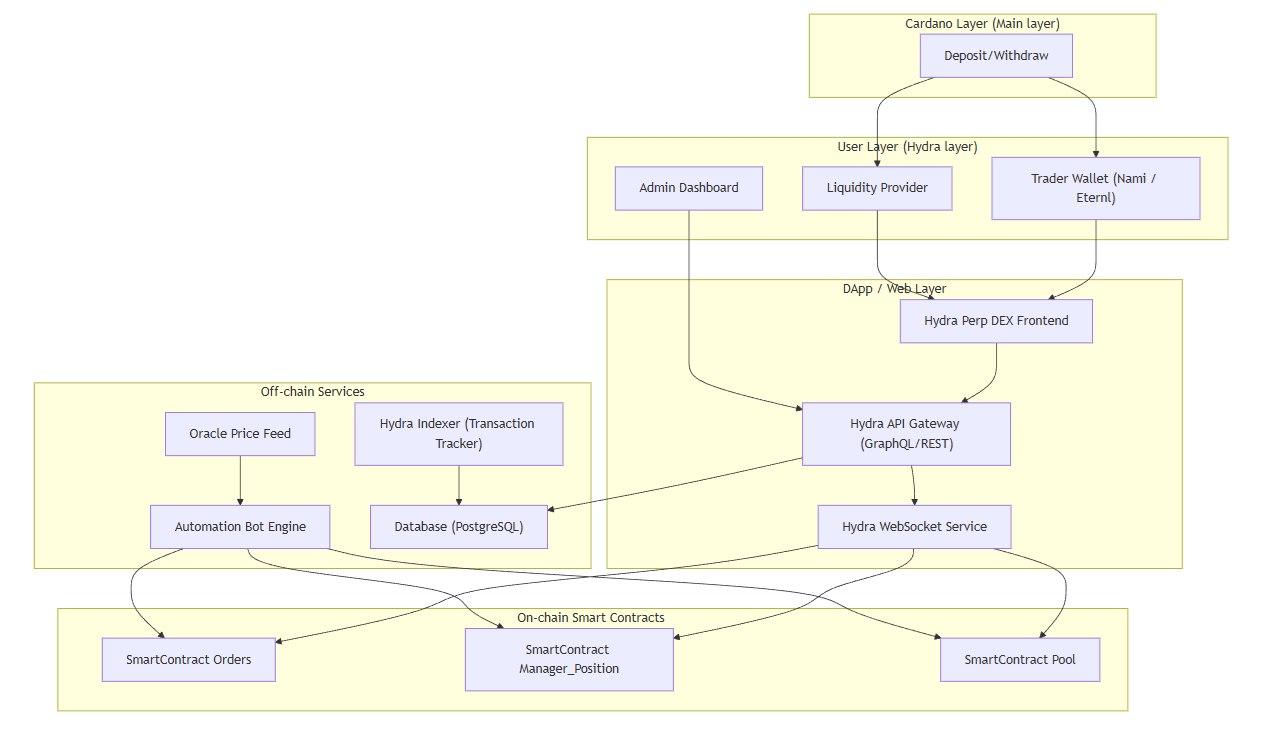
Hydra One is built on four core components:
- Smart Contract: Manages assets, positions, liquidation logic, and ensures consistency and transparency.
- Hydra Head Execution: Enables high-speed execution, real-time computation, and supports HFT and bot trading.
- Liquidity Pool Engine: Transparent liquidity provisioning, fee distribution based on volume, and automated risk management.
- Backend & API Layer: Connects the system to the UI, provides analytics data, and offers public APIs for partners and trading systems.
Below are the key documents we have carefully researched, designed, and validated for Hydra feasibility:
- Business Requirement Document (BRD)
- Software Requirements Specification (SRS)
- System Flow Document (SFD)
- Technical Overview
- UI Screenshots & Feature Showcase
- Use Case Document
See full details at:
https://github.com/Vtechcom/hydra-one-docs/blob/main/README.md
Hydra One directly addresses the pain points of traders (5–20 seconds latency, high fees), liquidity providers (low returns due to high costs), and the broader Cardano ecosystem (lack of high-speed dApps and real trading volume). The solution establishes next-generation DeFi infrastructure for Cardano—driving TVL, liquidity, trading activity, and enabling more dApps to build on Hydra.
We will demonstrate impact through an MVP running on a public Hydra Head, allowing the community to open/close positions in a real Hydra environment, benchmark performance, and verify feasibility. Hydra One sets a new standard for high-speed trading on Cardano and serves as a significant technical milestone for the ecosystem’s Layer 2 development trajectory.
User interface
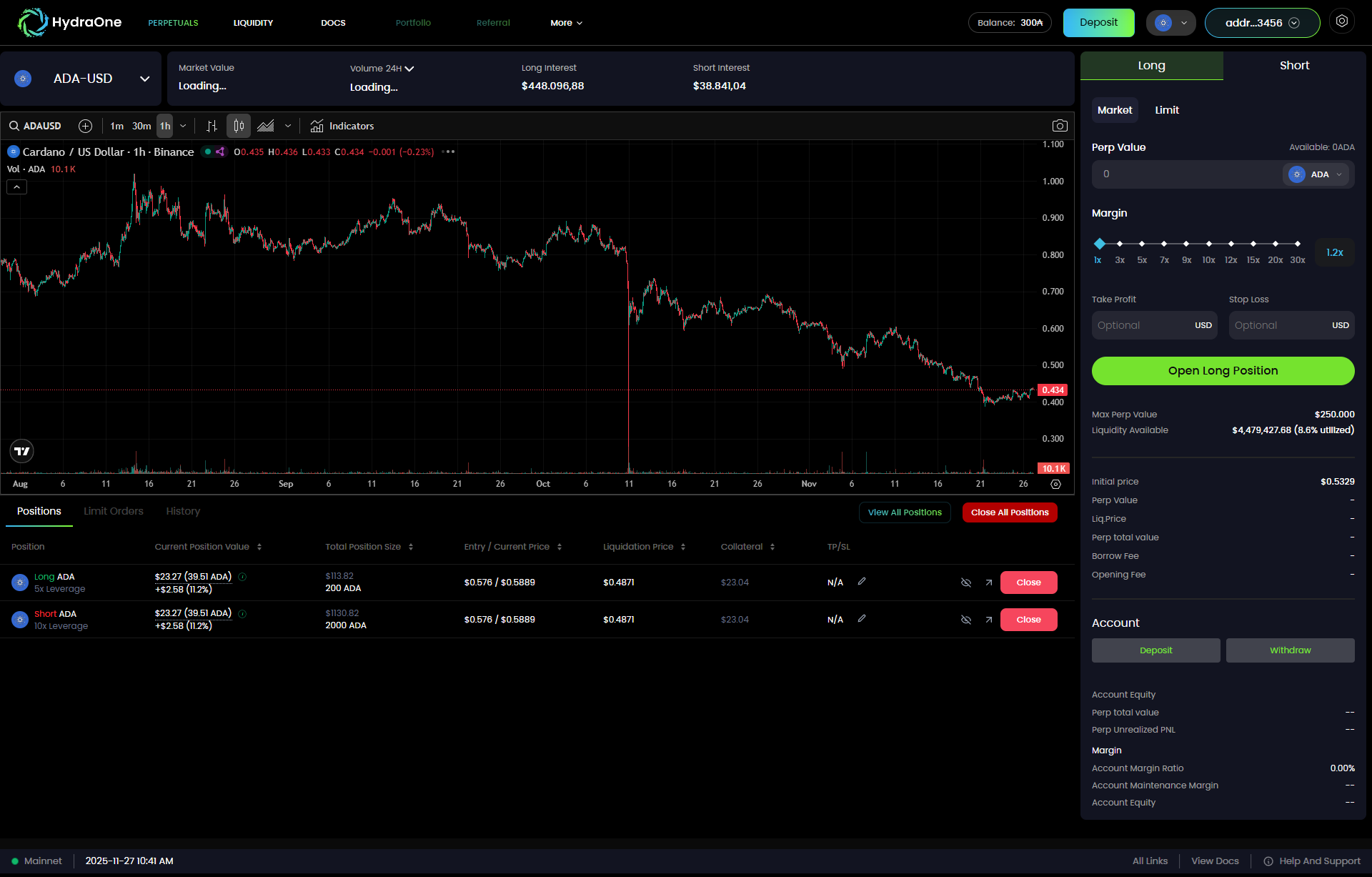
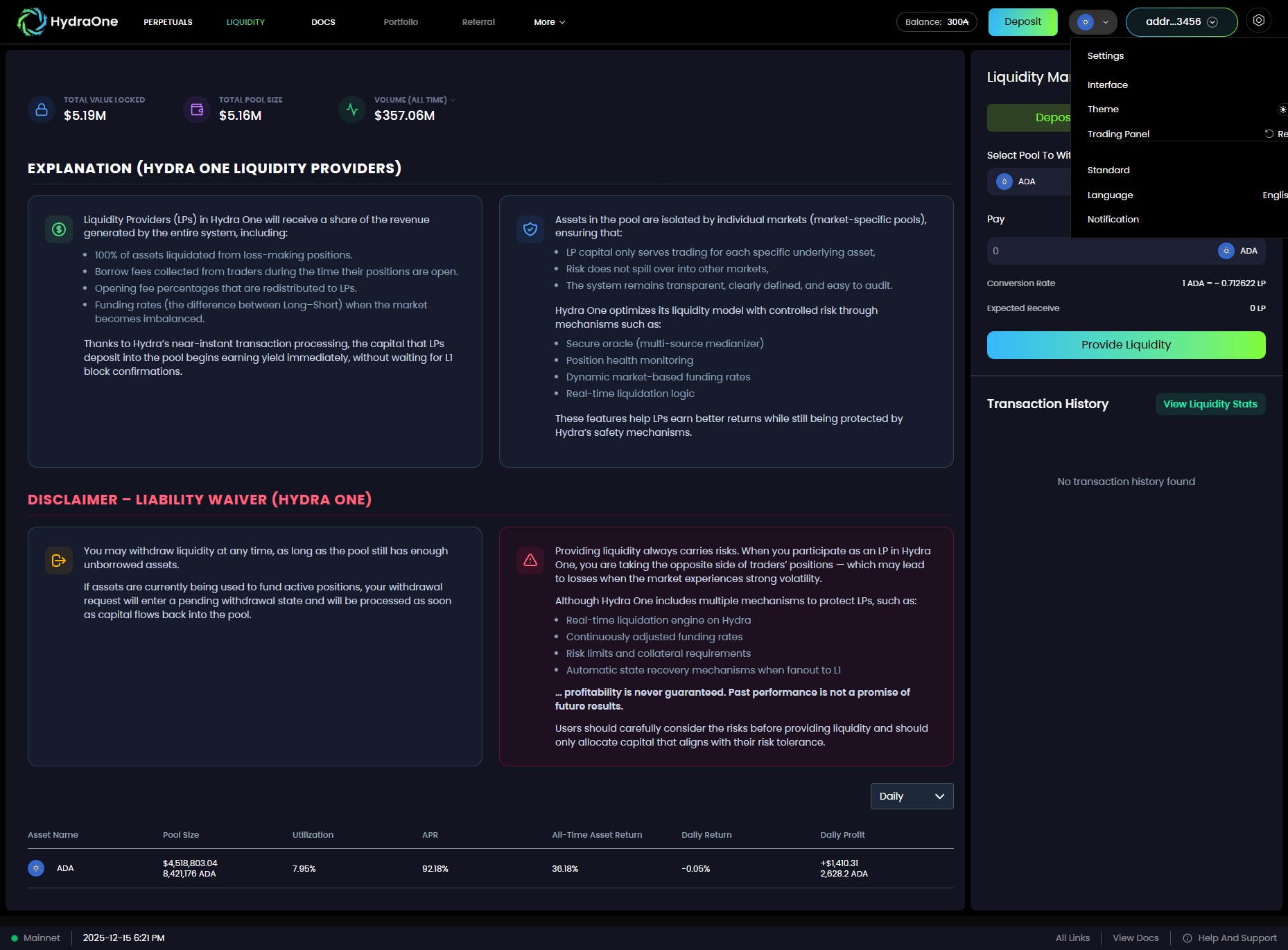
High‑Level Architecture Diagram
[Your Project and Solution] Impact
Please define the positive impact your project will have on the wider Cardano community
Hydra One will create significant positive impact for the Cardano ecosystem by delivering the first high-speed Perpetuals trading platform running natively on Hydra Layer 2.
It demonstrates Cardano’s competitiveness in the DeFi market against fast ecosystems such as Solana and Arbitrum, and especially against specialized ultra-fast Layer 2 trading platforms like Hyperliquid, Aster, Lighter....
The project also showcases Cardano’s scalability through sub-second execution, near-zero fees, and a CEX-like trading experience that remains fully decentralized. This not only addresses the limitations of Layer 1 but also opens a completely new application layer for the community.
With Hydra One, traders can execute transactions in a DeFi environment as fast as centralized exchanges while retaining on-chain security. Liquidity providers gain access to transparent liquidity provisioning with fee rewards from higher trading volume, improving capital efficiency within the ecosystem. Development teams can learn from and reuse Hydra One's architecture to build their own Layer 2 applications, accelerating Hydra adoption across Cardano.
Impact will be measured through on-chain and Hydra-specific metrics such as:
- Total transactions executed in Hydra Heads,
- Number of wallets interacting with the MVP,
- Number of positions opened/closed,
- Size and stability of experimental liquidity pools,
- Commit / Decommit success rate,
- and community participation during testing.
Off-chain indicators such as demo traffic, number of developers integrating the API, and technical feedback will further validate the project’s effectiveness.
All results, technical documentation, smart contract source code, and the MVP demo will be made publicly available through GitHub, the project website, and Cardano community channels. We will collaborate with developers, researchers, and the Hydra community to share knowledge, host workshops, and guide teams in building dApps on Hydra.
Hydra One establishes the foundation for widespread Hydra adoption—driving growth in liquidity, TVL, trading volume, and the number of dApps in the ecosystem. It provides practical contribution toward Cardano’s scalability goals and positions Cardano as a competitive platform in the high-performance DeFi market.
[Your Project and Solution] Capabilities & Feasibility
What is your capability to deliver your project with high levels of trust and accountability? How do you intend to validate if your approach is feasible?
Hydra is a powerful technology with unique characteristics in speed and cost efficiency, creating strong appeal not only for developers but also for investors exploring Cardano. We felt the same—two years ago, we were extremely curious about Hydra and were drawn to its remarkable potential for building next-generation applications.
However, Hydra still requires significant advancement in technical components, infrastructure, and developer tooling before it can be adopted at scale. Over more than a year of research, direct collaboration, and continuous support from our amazing friends at IOG and the wider community, we began developing a suite of tools and infrastructure solutions for the Hydra ecosystem, including:
- Hydra SDK (a development toolkit for building dApps on Hydra), available at: https://hydrasdk.com/
- Hydra Playground (a transaction builder to support app development), available at: https://play.hydrasdk.com/
- Hydra HTLC demo (a solution for transferring assets across Hydra Heads), completed and open-sourced at: https://github.com/Vtechcom/hydra-htlc-demo
- Hydra Wallet, Hydra Explorer, and several experimental game applications available at: https://hydrawallet.app/
- And especially Hydra Hexcore and the Hydra Hub Infrastructure Solution, which provide automated deployment of Hydra Nodes / Hydra Heads and offer the most cost-efficient Hydra Head hosting for developers. These are being finalized and prepared for production launch at: https://hydrahub.io.vn/
These tools and products have already begun to be used by the community and various development teams. Our team has directly supported participants at the Cardano Hackathon Vietnam 2025 and will continue supporting teams at the upcoming Cardano Hackathon Asia 2025 – IBW Edition in India: https://indiablockchainweek.com/
At this event, we provide a fully configured Hydra Head environment, guide teams to integrate Hydra SDK, support off-chain/on-chain transaction handling, and help them build complete dApps within a short timeframe.
This capability demonstrates our team’s deep understanding of Hydra architecture, L1–L2 state synchronization, and optimal smart contract design for Layer 2.
In addition, we continue to invest time in exploring, debugging, proposing new functional ideas, and actively contributing code to improve and refine the Hydra protocol alongside the IOG Hydra Core Team: https://github.com/cardano-scaling/hydra/issues?q=author%3Aaniadev
Furthermore, the feasibility of Hydra One is strengthened by the technical foundation already in place:
- Automated Hydra infrastructure system (Hydra Node Orchestrator — Hydra Hub)
- Hydra SDK (TypeScript)
- Hydra Head monitoring & debugging tools — Hydra Explorer
- Full project documentation including BRD, SRS, SFD, Technical Overview, UI/UX, and Use Cases, all carefully prepared https://github.com/Vtechcom/hydra-one-docs/blob/main/README.md
These components serve as concrete evidence of our capability to execute this project.
During the MVP phase, we will deploy a public Hydra Head testnet, perform sub-second latency benchmarks, run simulated transaction loads, and execute Commit / Decommit operations to Layer 1 to validate the reliability of our design. All progress, technical documentation, source code, and experimental results will be transparently published on GitHub, GitBook, and Cardano community channels.
By combining real-world Hydra experience, a fully developed infrastructure, and a clear project management framework, we are confident that Hydra One is fully feasible — and that our team is the right one to deliver this project at a production-ready scale for the Cardano ecosystem.
[Milestones] Project Milestones
Milestone Title
Smart Contract Core
Milestone Outputs
We will start by building smart contracts on Hydra for the project including:
- Complete Perpetuals smart contract suite (Orders, Manager, Pool, Liquidation).
- LP Pool contract (mint/burn LP tokens).
- Full Aiken unit test suite + technical documentation.
Acceptance Criteria
- All smart contracts compile successfully using aiken build.
- 100% of core modules have passing test cases.
- Funding logic & liquidation logic function correctly across test scenarios.
- Contracts have undergone internal auditing (internal review).
- Open-source repository published on GitHub (smart contracts only).
Evidence of Completion
- Public GitHub link: full contracts + test suite.
- Video demo showcasing test scenarios.
- Internal audit report (PDF).
Delivery Month
2
Cost
45000
Progress
20 %
Milestone Title
Hydra Integration & Off-chain Engine
Milestone Outputs
Stable Hydra Head environment deployed on testnet.
Off-chain Engine connected to Hydra to execute:
- Open position
- Close position
- Auto-close
- Liquidation
- LP deposit/withdraw
- Performance benchmarks (TPS & latency).
Acceptance Criteria
- Hydra Node runs successfully and synchronizes smart contract state.
- Bot Engine sends and receives Tx within sub-1-second execution.
- Multi-head configuration operates with at least 2 Hydra Heads.
- Benchmarks meet: latency < 1s, 1000+ simulated transactions.
Evidence of Completion
- Demo video: bot engine interacting through Hydra Head.
- Benchmark performance report (PDF).
- 48-hour continuous Hydra runtime logs.
Delivery Month
3
Cost
55000
Progress
50 %
Milestone Title
Backend, Indexer & Trading UI
Milestone Outputs
Backend & Indexer:
- Position indexer.
- Funding engine (off-chain).
- Real-time PnL engine.
- Risk engine + WebSocket API.
Frontend:
- Complete Trading UI (Long/Short, leverage, TP/SL).
- LP Dashboard (add/remove liquidity).
- Portfolio + analytics + charts.
Acceptance Criteria
- REST + WebSocket APIs remain stable during a 24-hour load test.
- Trading UI connects to backend in real-time.
- Indexer updates PnL/margin every cycle ≤ 500ms.
- UI fully supports Long/Short orders with TP/SL.
- Public GitHub repositories for frontend + backend.
Evidence of Completion
- Staging UI deployment link.
- API documentation (Swagger + GitBook).
- UI walkthrough video.
- Indexer performance logs.
Delivery Month
3
Cost
55000
Progress
70 %
Milestone Title
Testnet Open Beta & Community Testing
Milestone Outputs
In this phase, we will provide users with a testnet experience, collect bug reports, and optimize performance. Specifically, the deliverables will include:
- Stable public testnet available for users.
- Bug fixes and system-wide performance optimization.
- User and developer documentation.
Acceptance Criteria
The acceptance criteria that we commit to delivering in this phase are:
- Minimum 200 users testing the testnet.
- All critical and high-severity bugs resolved.
- Beta uptime ≥ 99% over 7 consecutive days.
- Completed testnet documentation + tutorial videos.
Evidence of Completion
- Public testnet URL + analytics dashboard.
- Bug reports & patch notes.
- Step-by-step trading tutorial video.
- Community feedback summary report.
Delivery Month
1
Cost
30000
Progress
90 %
Milestone Title
Close-out Report & Video
Milestone Outputs
This will be the phase in which we develop reporting documents and user guides, establish support channels, and plan for the next stages of expansion and further development.
- Complete Project Close-out Report.
- Full demonstration video covering all Hydra One features.
- Aggregated testnet metrics + risk analysis.
- Post-Catalyst maintenance & expansion plan.
Acceptance Criteria
The acceptance criteria that we commit to delivering in this phase are:
- All previous milestones approved by the Reviewer.
- Report meets Catalyst standards (format + content).
- Clear POC demo video (UI + Smart Contracts + Hydra Engine).
Evidence of Completion
- PDF file: Project Close-out Report.
- Video evidence uploaded to YouTube.
- GitHub final release link.
- Final confirmation from Milestone Reviewer.
Delivery Month
1
Cost
30000
[Final Pitch] Budget & Costs
Please provide a cost breakdown of the proposed work and resources
The budget is allocated based on:
- The workload of each milestone
- Personnel costs (full-time team)
- Hydra/Backend infrastructure
- Documentation, testnet operations, and community support
- Catalyst reporting & project management
1. Personnel Costs:
65% of the budget – 130,000 ADA
2. Infrastructure & Tools:
15% of the budget – 30,000 ADA
3. Testnet, Documentation & Community Support, Catalyst Reporting:
10% of the budget – 20,000 ADA
4. Contingency for ADA price volatility (to ensure stable funding for salaries and infrastructure):
10% of the budget – 20,000 ADA
Total Requested Budget: 200,000 ADA ~ 80k$
Exchange rate: 1 ADA = 0.4 USD
[Final Pitch] Value for Money
How does the cost of the project represent value for the Cardano ecosystem?
Hydra One represents a high-value investment for the Cardano ecosystem, delivering a technologically sophisticated product comparable to multi-million-dollar derivatives platforms in other ecosystems. The proposed budget is optimized thanks to the advantage of a highly skilled but cost-efficient engineering team in Vietnam, combined with the proven execution capability of a team that has worked directly with Hydra and Cardano.
Hydra One will serve as a reference implementation for all future dApps looking to deploy on Hydra, including:
- High-speed DEXs
- Real-time GameFi
- Orderbook-based trading
- Real-time microtransactions
This creates foundational, long-term value for the entire Cardano ecosystem.
Hydra One delivers exceptional cost efficiency relative to its complexity:
Smart Contracts + Hydra Engine + Backend + Trading UI.
The project encompasses the full stack of an advanced DeFi system:
- Aiken smart contracts for Perpetuals
- Hydra off-chain execution engine
- Multi-head synchronization
- Real-time backend PnL engine and risk engine
- A full trading UI comparable to a centralized exchange
- Indexer + Analytics + LP Dashboard
- Community testing on testnet
Hydra provides long-term ecosystem value by increasing Hydra adoption and driving TVL and trading volume across Cardano.
Hydra One generates direct economic value for Cardano:
- Attracting traders & LPs from other ecosystems
- Creating real trading volume and boosting on-chain metrics
- Driving increased ADA demand as collateral
Hydra One helps Cardano move closer to:
- A high-performance DeFi ecosystem
- Competitiveness with platforms like Solana, Arbitrum, Hyperliquid, Aster, and Lighter.
[Self-Assessment] Self-Assessment Checklist
I confirm that evidence of prior research, whitepaper, design, or proof-of-concept is provided.
Yes
I confirm that the proposal includes ecosystem research and uses the findings to either (a) justify its uniqueness over existing solutions or (b) demonstrate the value of its novel approach.
Yes
I confirm that the proposal demonstrates technical capability via verifiable in-house talent or a confirmed development partner (GitHub, LinkedIn, portfolio, etc.)
Yes
I confirm that the proposer and all team members are in good standing with prior Catalyst projects.
Yes
I confirm that the proposal clearly defines the problem and the value of the on-chain utility.
Yes
I confirm that the primary goal of the proposal is a working prototype deployed on at least a Cardano testnet.
Yes
I confirm that the proposal outlines a credible and clear technical plan and architecture.
Yes
I confirm that the budget and timeline (≤ 12 months) are realistic for the proposed work.
Yes
I confirm that the proposal includes a community engagement and feedback plan to amplify prototype adoption with the Cardano ecosystem.
Yes
I confirm that the budget is for future development only; excludes retroactive funding, incentives, giveaways, re-granting, or sub-treasuries.
Yes
[Required Acknowledgements] Consent & Confirmation
I Agree
Yes
Team
Hydra One will be developed by a team of experienced Hydra and Cardano engineers, including:
Position: Project Manager (PM)
Lead: Tony Thanh
LinkedIn: https://www.linkedin.com/in/nguyenvietthanh/
Responsibilities:
- Manage project execution plans and product quality.
- Coordinate across teams: smart contract, backend, frontend, DevOps, and QA.
- Control risks, track progress, and ensure full compliance with Catalyst processes.
Position: Lead Hydra Engineer
Lead: Pham Hai
LinkedIn: https://www.linkedin.com/in/phamhai99/
Responsibilities:
- Design the Layer 1 + Hydra Layer 2 architecture, execution flow, and order-matching mechanisms.
- Directly develop the Hydra Execution Engine, handling PnL/Margin/Funding workflows.
Position: Senior Smart Contract Engineer
Lead: Do Trung Nhan
LinkedIn: https://www.linkedin.com/in/nhantd292/
Responsibilities:
- Develop Aiken smart contracts: Position, Pool, Order, Liquidation.
- Build collateral, asset management, and PnL/margin/funding rate logic.
- Verify security and optimize contracts for execution inside Hydra Heads.
Position: Frontend Lead / UI-UX Engineer
Lead: Vu Quoc Huy
LinkedIn: https://www.linkedin.com/in/huyvu-dev/
Responsibilities:
- Design UI/UX for the Trader Dashboard, LP tools, and Analytics interface.
- Build the Next.js frontend, real-time charts, orderbook, and trading panel.
- Optimize UX for sub-second trading performance on Hydra.
Position: Backend Lead
Lead: Trinh Manh Cuong
LinkedIn: https://www.linkedin.com/in/c%C6%B0%E1%BB%9Dng-tr%E1%BB%8Bnh-m%E1%BA%A1nh-241446385/
Responsibilities:
- Develop backend services, APIs, indexer, and funding/fair-price data.
- Synchronize L1–L2 states and handle high-precision DeFi logic.
- Build APIs for bot trading and partner integrations.
Position: DevOps & Hydra Infrastructure Engineer
Lead: Cong Nghia Khiem
LinkedIn: https://www.linkedin.com/in/congnghiakhiem/
Responsibilities:
- Deploy and operate Hydra Nodes / Hydra Heads.
- Build automated node orchestration systems.
- Manage logging, monitoring, load testing, and sub-second benchmarking.
Position: Tester Lead
Lead: Hong Quyen
LinkedIn: https://www.linkedin.com/in/hong-quyen-383653118/
Responsibilities:
- Write test cases for smart contracts, Hydra Engine, backend, and UI.
- Conduct stress tests for high-speed transaction execution in Hydra Heads.
- Verify risk logic, liquidation, and PnL accuracy for system stability.
Position: Community Support & Developer Documentation
Lead: Nguyen Thao
LinkedIn: https://www.linkedin.com/in/lylynguyen13/
Responsibilities:
- Manage user guides and documentation.
- Support the developer community and assist users.
- Organize workshops and share Hydra One with Cardano builder groups.
Team Scalability
During development, we may expand the team by adding:
- 01 Aiken Engineer
- 01 Frontend Engineer
- 01 Data Engineer responsible for analytics
These roles have already been identified and can be filled from the existing talent pool at Vtechcom Labs.
All team members are full-time staff at Vtechcom and have formally committed to participating in the project.