Last updated 10 months ago
HydraQuantum: IBM Qiskit-Integrated Quantum Platform w/Hydra
Problem
Cardano lacks any open-source platform to run or verify quantum computations, with no IBM Qiskit integration, leaving quantum workloads unverifiable and unusable for trustless apps.
Solution
An open-source Hydra-based platform that integrates IBM Qiskit, enabling Cardano users to run, verify, and settle quantum computations transparently on L2 for trustless applications
About this idea
[Proposal setup] Proposal title
Please provide your proposal title
HydraQuantum: IBM Qiskit-Integrated Quantum Platform w/Hydra
[Proposal Summary] Budget Information
Enter the amount of funding you are requesting in ADA
170000
[Proposal Summary] Time
Please specify how many months you expect your project to last
6
[Proposal Summary] Translation Information
Please indicate if your proposal has been auto-translated
No
Original Language
en
[Proposal Summary] Problem Statement
What is the problem you want to solve?
Cardano lacks any open-source platform to run or verify quantum computations, with no IBM Qiskit integration, leaving quantum workloads unverifiable and unusable for trustless apps.
[Proposal Summary] Supporting Documentation
Supporting links
- https://dextrlabs.com/ ,
- https://x.com/dextr_labs ,
- https://github.com/DextrLabsDev/f15/blob/main/hydraquantum.pdf ,
- https://claude.ai/public/artifacts/31788941-b26c-44c6-9729-d91e3af5bdd0
[Proposal Summary] Project Dependencies
Does your project have any dependencies on other organizations, technical or otherwise?
No
Describe any dependencies or write 'No dependencies'
No dependencies
[Proposal Summary] Project Open Source
Will your project's outputs be fully open source?
Yes
Please provide details on the intellectual property (IP) status of your project outputs, including whether they will be released as open source or retained under another licence.
MIT License
[Theme Selection] Theme
Please choose the most relevant theme and tag related to the outcomes of your proposal
Infrastructure
[Campaign Category] Category Questions
Describe what makes your idea innovative compared to what has been previously launched in the market (whether by you or others).
First “quantum-enabled” Hydra layer on Cardano
- Uses Hydra heads not just for fast L2 payments, but as an execution and verification layer for quantum circuits.
- Moves Cardano from only being quantum-resistant to actively using quantum computation in dApps.
Tight integration of Qiskit with Cardano infrastructure
- Quantum circuits are submitted through a standard API, executed via Qiskit (simulators or real devices), and then verified before being anchored to Cardano.
- This creates a repeatable, auditable pipeline: circuit → execution → verification → on-chain commitment.
Verifiable quantum results, not just “black-box” off-chain compute
- Adds a verification layer (re-execution / statistical checks) and records result hashes and metadata on-chain.
- Anyone can independently re-run the circuit and confirm the on-chain commitment matches the reported outcome.
Reusable platform, not a one-off demo
- Provides open-source Hydra extensions, smart contracts, SDK, and example dApps so other teams can easily plug quantum jobs into their own applications (DeFi, RNG, research, optimization, etc.).
- Reduces the barrier for Cardano builders to experiment with quantum without needing to manage their own quantum infrastructure.
Clear step beyond previous work
- Existing projects either focus on quantum-resistant cryptography or generic off-chain computation.
- HydraQuantum combines Hydra, Qiskit, and verification into a dedicated, Cardano-specific framework for trust-minimized quantum computation, something not previously available on the network.
Describe what your prototype or MVP will demonstrate, and where it can be accessed.
- A running HydraQuantum Hydra head that can:
- Accept IBM Qiskit circuits via a public API / CLI.
- Execute them on a Qiskit simulator and, where possible, an IBM Quantum backend.
- Perform verification (re-execution / statistical checks) of returned results.
- Commit the result hash and metadata on-chain via the Hydra snapshot → Cardano script flow. Example dApps (e.g. quantum RNG / simple optimizer) showing:
- How a Cardano dApp can request a quantum job.
- How it reads the verified result and on-chain commitment. End-to-end flow: circuit → execution → verification → Hydra snapshot → on-chain commitment.
Public testnet deployment of a HydraQuantum head, with:
- REST/gRPC endpoints published in the documentation.
- Example scripts for submitting circuits and checking on-chain commitments.
Open-source repository, including:
- Hydra head extension code, smart contracts, and verification logic.
- Reference dApps and sample circuits for developers.
Public demo website for non-technical users, featuring:
- A simple UI where users can connect a Cardano wallet and trigger predefined demo circuits (e.g., quantum RNG / small optimization examples).
- Automatic display of the resulting transaction / commitment on Cardano testnet.
- Clear explanations and walkthroughs so non-technical community members can experience “quantum on Cardano” without installing any tooling.
Describe realistic measures of success, ideally with on-chain metrics.
On-chain & Hydra activity
- ≥ 2,000 Hydra transactions related to HydraQuantum (circuit submissions, result messages, settlements).
- ≥ 50 Cardano testnet transactions committing quantum result hashes and metadata.
Quantum workload usage
- ≥ 5 quantum jobs executed end-to-end through the platform.
- Jobs span at least 3 use-case types (e.g., randomness, optimization, simulation / research).
- For each job, verification data (logs / stats) stored and publicly inspectable.
Public demo website
- ≥ 10 unique wallets connect to the hosted demo site.
- ≥ 3 successful demo runs (e.g., quantum RNG or optimizer) initiated via the web UI.
- Basic feedback form completed by ≥ 30 users to rate clarity and usability.
Developer & open-source adoption
- ≥ 3 reference dApps released (RNG, simple DeFi/optimizer prototype, research/demo app).
- At least 1 recorded workshop / tutorial published and shared with the Cardano community.
[Your Project and Solution] Solution
Please describe your proposed solution and how it addresses the problem
Problem Perception:
Cardano currently has no open-source platform to execute, verify, or integrate quantum computations into its ecosystem. Developers cannot run IBM Qiskit circuits within Cardano workflow, validate quantum-generated outputs, or build trustless applications that use quantum-enhanced algorithms. This gap limits research in quantum-safe cryptography, prevents experimentation with hybrid classical/quantum dApps, and leaves Cardano behind ecosystems already building verifiable off-chain compute layers. Without a standardized framework, quantum computation remains siloed, unverifiable, and unusable for Cardano’s L2 scaling architecture.
Proposed Approach:
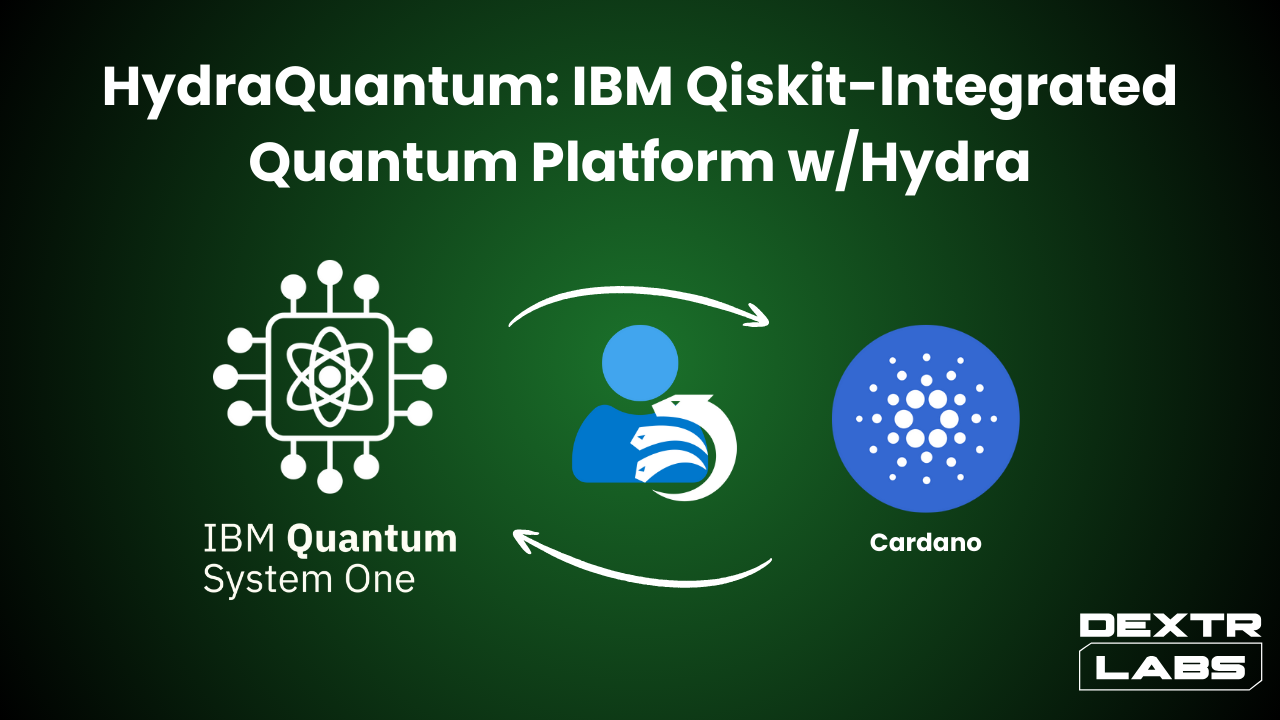
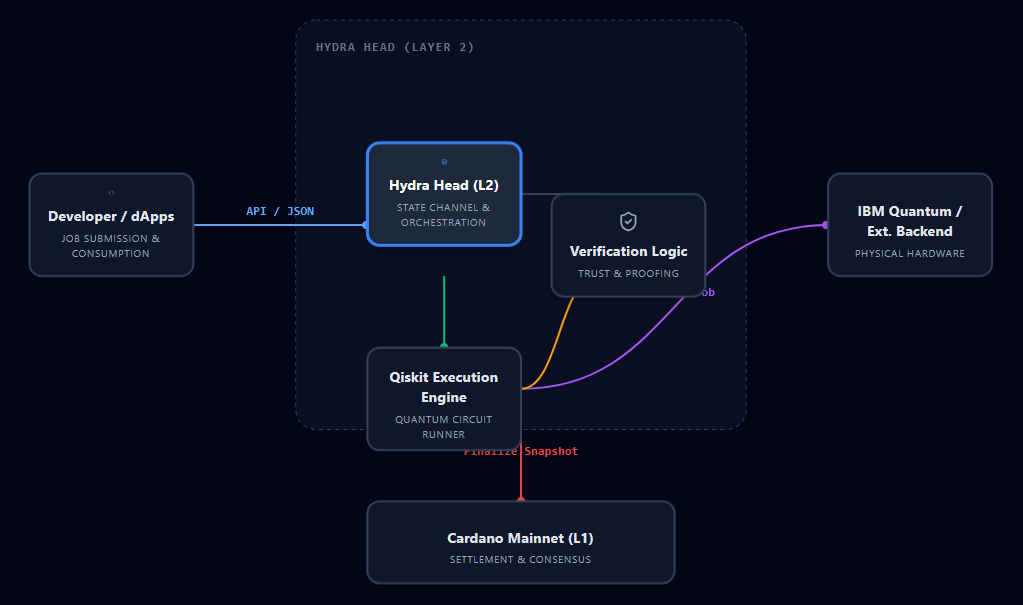
HydraQuantum is an open-source Hydra-based platform integrated with IBM Qiskit. It provides a fully open-source environment where quantum circuits can be executed, verified, and settled through Layer 2 Hydra heads. The architecture connects Qiskit’s quantum backends with Hydra’s high-throughput off-chain state channels, enabling reproducible quantum execution, statistical result verification, and transparent commitments recorded on Cardano. This design makes quantum workloads trustless, inspectable, and readily usable by any dApp developer within the ecosystem.
How It Works:
Inside a Hydra head:
- A containerized Qiskit execution engine runs quantum circuits using simulators or IBM Quantum platform.
- Outputs are verified through reproducible simulation, statistical validation, and commit-hash proofs.
- A Hydra protocol extension supports quantum job submission, retrieval, and settlement between participants.
On the Cardano main chain:
- Verification circuit result hashes are committed through Hydra’s snapshot finalization flow.
- Smart contracts record circuit commitments, result digests, and optional metadata for reproducibility.
- Developers can call the HydraQuantum API from dApps to request quantum execution on demand.
Result:
Quantum computation becomes a verifiable L2 service with transparent, auditable payment flows. dApps can request quantum jobs, verify outputs, and settle costs trustlessly, enabling accountable, quantum-powered interactions within the Cardano ecosystem.
Key Features:
Quantum Execution System:
- Qiskit-powered circuit execution inside Hydra nodes.
- Batch, parallel, and deterministic compute modes for reproducible results.
Verification & Proofing:
- Statistical result verification and circuit re-execution for trustless validation.
- Commit-hash proofs anchored to Cardano for auditability and reproducibility.
Developer Integration:
- Unified API & SDK for submitting circuits and retrieving proofs.
- Example dApps demonstrating quantum-enhanced workflows.
- Tools for integrating quantum compute into DeFi, identity, governance, modeling, and research apps.
Hydra Synergy:
- Hydra handles L2 speed, state synchronization, snapshot settlement, and participant agreement.
- Off-chain quantum workloads finalize on-chain with minimal cost and high transparency.
Engagement & Impact Proof:
We will collaborate with:
- Open-source Cardano contributors for development and feedback.
- The Cardano community on Twitter/X for updates and engagement.
- Developer communities through workshops and documentation.
Impact will be validated by:
- Open-source releases demonstrating full circuit → verification → settlement flow,
- Public HydraQuantum testnet,
- Metrics such as circuits executed, verification proofs generated, and number of dApps integrating the SDK,
- Developer adoption through tutorials, examples and documentation.
Uniqueness & Importance to Cardano:
HydraQuantum is the first initiative to make Cardano quantum-enabled rather than merely quantum-resistant. Unlike generic off-chain compute frameworks, HydraQuantum provides:
- Verifiable quantum execution directly within an L2 Hydra environment,
- Trustless proofing of quantum outputs anchored to Cardano,
- A modular API reusable across research, DeFi, governance, identity, and modeling,
- An open-source blueprint for quantum-classical hybrid applications
[Your Project and Solution] Impact
Please define the positive impact your project will have on the wider Cardano community
HydraQuantum makes quantum computation verifiable service in the Cardano ecosystem. By wiring IBM Qiskit into Hydra heads, it lets users run, verify, and settle quantum circuits as cheap, fast L2 interactions instead of opaque off-chain experiments. This brings quantum-safe cryptography, optimization, and simulation workflows directly into Cardano’s state and governance rather than leaving them in disconnected research silos.
For builders, HydraQuantum provides a execution and verification platform for DeFi, identity, governance, and modeling. Developers can submit Qiskit circuits, receive statistically verified outputs plus proofs, and commit result hashes on-chain through Hydra, all with open documentation and examples. That lowers the barrier to building hybrid quantum/classical dApps and gives Hydra a concrete, high-value use case beyond payments and simple off-chain compute.
For the wider community, the project positions Cardano as quantum-enabled rather than merely quantum-resistant. Transparent proofing of quantum outputs, open-source infrastructure, and auditable payment flows allow researchers, institutions, and ecosystem partners to safely experiment with quantum-enhanced applications on Cardano. This attracts new technical contributors, encourages collaboration with quantum research groups, and strengthens Cardano’s reputation as a scientifically grounded, future-ready ecosystem.
Value to the Cardano Community:
HydraQuantum will increase Cardano’s technical depth and research relevance by delivering a verifiable quantum execution layer on Hydra. This will:
- Enable dApps to request, verify, and settle quantum computations as trustless L2 services.
- Provide a standardized, open-source framework for quantum-safe cryptography research and hybrid quantum/classical protocols anchored to Cardano.
- Strengthen Hydra adoption by showcasing a concrete high-throughput use case beyond payments or generic off-chain compute.
- Attract quantum-computing researchers, students, and institutions into the Cardano ecosystem through practical tooling and integrations with IBM Qiskit.
How We Will Measure Impact:
Quantitative:
- Number of circuits executed and verification proofs generated through HydraQuantum.
- 2000+ Hydra transactions processed by HydraQuantum heads.
- At least 5 distinct quantum jobs executed on the platform.
- On-chain metrics such as quantum-job settlement transactions and committed result hashes.
- Open-source activity: GitHub stars, issues, pull requests, and external contributors.
Qualitative:
- Developer feedback on integration ease, documentation quality, and performance.
- Case studies of quantum-enhanced dApps (e.g., optimization, cryptography, identity, or governance prototypes).
- Interest and collaboration from academic or industry quantum research groups working on Cardano.
How We Will Share Outputs and Opportunities:
- All core code & Hydra extensions released under an open-source license in a public GitHub repository from project start.
- Comprehensive documentation, architecture diagrams, and “circuit → verification → settlement” walkthroughs published on a public docs site.
- Example dApps and reference integrations (DeFi, identity, governance, research) to demonstrate concrete use cases.
- Regular progress updates, demo videos, and technical write-ups shared via X.
- Public workshops and recorded tutorials for Cardano developer communities to accelerate adoption and collaboration.
[Your Project and Solution] Capabilities & Feasibility
What is your capability to deliver your project with high levels of trust and accountability? How do you intend to validate if your approach is feasible?
Dextr Labs – https://dextrlabs.com/
– is a team of 25 experienced developers and blockchain engineers with deep expertise in secure, scalable Web3 infrastructure. Over the past two years, we have launched multiple production-grade products with a 100% delivery rate, building long-term client relationships through consistent, high-quality results.
Our portfolio includes Zodor (https://www.zodor.io/) a Real-World Asset (RWA) tokenization platform, and BePay (https://bepay.money/) a stablecoin-powered payments system. These products demonstrate our capability to integrate complex smart contracts, off-chain services, and cryptography-heavy workflows, all key competencies for delivering HydraQuantum as a reliable L2 quantum execution layer.
We bring proven experience in developing Subnets, appchains, and advanced integrations on Cardano, EVM-compatible chains, and other blockchain platforms. For HydraQuantum, we will extend these capabilities to Hydra heads and Qiskit-based off-chain compute, ensuring verifiable quantum execution anchored to Cardano.
Our delivery approach ensures trust and accountability through:
Public GitHub repos with milestone tracking, open issues, and open-source licensing.
Transparent communication via Cardano forums, social channels, and technical developer updates.
Independent testing, security reviews, and an incentivized HydraQuantum testnet to validate circuit execution, verification, and settlement flows before any mainnet deployment.
By leveraging our technical depth, proven shipping record, and experience with complex L2 and off-chain architectures, we are well positioned to deliver HydraQuantum with the same reliability and ecosystem value we’ve demonstrated in prior high-impact deployments.
[Milestones] Project Milestones
Milestone Title
Project Initiation & Feasibility
Milestone Outputs
Landscape Review of verifiable quantum-compute and off-chain execution designs, Hydra capabilities, IBM Qiskit backends, and Cardano script/fee constraints.
Technical Assessment of Hydra head extensions, containerized Qiskit runners, verification strategies (simulation, re-execution, statistical checks), and on-chain commitment patterns.
Requirements Documentation (functional & non-functional specs) for HydraQuantum core module, Qiskit execution engine, verification layer, smart contracts, SDKs, monitoring, and docs.
Acceptance Criteria
A comprehensive launch document is produced, defining:
- Project boundaries and measurable success metrics.
- All technical feasibility assessments (Hydra + Qiskit + on-chain commitments) are complete and validated.
Risks are fully identified, including:
- Hydra head availability and coordination.
- Quantum job latency and IBM backend limits.
- On-chain cost and throughput constraints.
- Data integrity and reproducibility of quantum results.
- Initial mitigation strategies are documented for all identified risks.
Functional and non-functional specifications are finalized for:
- HydraQuantum head extension and job manager.
- Qiskit execution and verification modules.
- Commitment contracts and payment flows.
Evidence of Completion
Launch Document published in public repository.
Public repository shows full transparency for scope, requirements, and risk register.
Delivery Month
1
Cost
30000
Progress
20 %
Milestone Title
Architectural Planning
Milestone Outputs
Feasibility Assessment Report with:
- End-to-end workflow for circuit submission → quantum execution → verification → Hydra snapshot → on-chain commitment.
- Contract interfaces, Platform function surface, dApp integration points, and monitoring hooks.
- Risk evaluation & mitigations for Hydra reorgs, node failures, IBM Quantum platform queueing, and verification mismatches.
System Architecture Blueprint:
- Diagrams of platform components (job manager, Qiskit runner, verifier, storage, commitment scripts, access gateway).
- Component descriptions, responsibilities, and interfaces, including data schemas and state machines.
Acceptance Criteria
Architecture validated to meet all Milestone 1 requirements.
Integration-ready design supporting wallets, dApps, and tools.
Documented fallback strategies (e.g., simulator-only mode, job retry policies) and dependency management.
Robustness and scalability addressed, including crash safety, error handling, and secure transport between Hydra nodes and Qiskit engine.
Evidence of Completion
Feasibility Report and Architecture Blueprint published in the public repository.
All architecture diagrams and technical descriptions included and linked from the main README.
Delivery Month
2
Cost
30000
Progress
40 %
Milestone Title
Platform Development
Milestone Outputs
Prototype Core Platform Components:
- HydraQuantum head extension with job manager, Qiskit execution engine (simulator and IBM backend integration), and verification logic.
- Smart contracts for result commitments, payment settlement, and optional metadata storage on Cardano.
- Public platform endpoints (APIs) and a minimal reference client plus demo dApps (e.g., quantum RNG or simple optimization example) demonstrating end-to-end usage.
Platform Environment:
- Testnet scripts for spinning up Hydra heads with HydraQuantum, plus example configs.
- Unit and integration test suites for main flows (submit, execute, verify, commit) and error handling.
Acceptance Criteria
End-to-end demo on testnet: circuit submitted via the HydraQuantum platform → executed → verified → result hash committed on-chain through a Hydra snapshot.
Platform integrates cleanly with Hydra, contracts, and demo dApps using documented APIs.
Stable sandbox environment with reproducible CI results and no critical crashes under normal workloads.
Evidence of Completion
Platform documentation and usage guides published in the repo.
Passing CI badge visible in the repository.
Demo recording, test reports, and tagged HydraQuantum platform alpha release available publicly.
Delivery Month
4
Cost
50000
Progress
70 %
Milestone Title
Testing & Performance Validation
Milestone Outputs
Load testing results, latency and throughput benchmarks for various circuit types and Hydra head configurations.
Performance and reliability report covering error rates, failure modes, and resource usage under different loads.
Developer examples executed against the platform to validate real-world usage patterns.
Acceptance Criteria
Execution/verify costs and settlement latency are measured and shown to be within documented budgets and performance targets.
Benchmark report clearly documents methodology, scenarios, and results (including any bottlenecks and mitigation plans).
Examples complete successfully end-to-end using the platform APIs and tools without critical failures.
Evidence of Completion
Performance and load-testing reports published in the public repository.
POC descriptions, configs, and results documented and linked from the project README.
Demo recordings (where applicable) showing test runs and POC usage.
Delivery Month
5
Cost
50000
Progress
90 %
Milestone Title
Platform Launch and Project Closeout
Milestone Outputs
HydraQuantum platform v1.0 release, integration playbooks, and deployment artifacts published for public use.
Full documentation website (e.g., GitBook) and developer onboarding workshops with recordings.
Project Closeout reports summarizing architecture, testing results, adoption metrics, and future roadmap.
Acceptance Criteria
HydraQuantum platform packages and deployment artifacts are publicly available and tagged as v1.0.
Documentation site, integration guides, and recorded workshops are live and linked from the project README.
Project Closeout Report and Video produced, covering lessons learned and next steps for ecosystem adoption.
Evidence of Completion
HydraQuantum platform v1.0 release page and artifacts accessible from the public repository.
Documentation site, final report, and recorded workshops linked from project README.
Project Closeout Report and Video published and shared via Cardano community channels.
Delivery Month
6
Cost
10000
Progress
100 %
[Final Pitch] Budget & Costs
Please provide a cost breakdown of the proposed work and resources
Milestone 1 – 30,000 ADA
Qiskit Developer: 10,000 ADA
Senior Cardano Developer: 20,000 ADA
Milestone 2 – 30,000 ADA
Qiskit Developer: 10,000 ADA
Senior Cardano Developer: 20,000 ADA
Milestone 3 – 50,000 ADA
Qiskit Developer: 15,000 ADA
Senior Cardano Developer: 35,000 ADA
Milestone 4 – 50,000 ADA
Qiskit Developer: 15,000 ADA
Senior Cardano Developer: 35,000 ADA
Final Milestone – 10,000 ADA
Qiskit Developer: 2,000 ADA
Senior Cardano Developer: 8,000 ADA
[Final Pitch] Value for Money
How does the cost of the project represent value for the Cardano ecosystem?
This project represents a high-leverage, cost-efficient investment for the Cardano ecosystem by delivering the first open-source, Hydra-based quantum execution and verification layer. Instead of a one-off proof of concept, the funding produces reusable infrastructure: a Qiskit-powered execution engine inside Hydra heads, verification and proofing logic, on-chain settlement contracts, a public HydraQuantum Platform and API, and example dApps that any team can extend. Once built, this stack can be reused across research, DeFi, identity, governance, and modeling projects without repeating the initial R&D cost.
The budget is focused on essential delivery only: protocol & smart-contract engineering, quantum software and verification research, infrastructure for Hydra heads and Qiskit backends, and documentation and onboarding materials. Work is carried out by a small, specialized team rather than large agencies, and we rely heavily on existing open-source components from Hydra and IBM Qiskit instead of building custom tooling from scratch. Day-rates are benchmarked against typical senior blockchain and quantum-software freelance rates in the EU/US, meaning the requested funding roughly matches market compensation for highly specialized roles rather than inflated “research grant” pricing.
In return, the ecosystem gains a unique capability: verifiable quantum computation as an L2 service anchored to Cardano. This unlocks concrete value such as quantum-safe cryptography experimentation, hybrid classical/quantum dApps, more expressive modeling and optimization tools for DeFi protocols, and a standardized way for researchers to test quantum algorithms with on-chain commitments and transparent payment flows. These capabilities strengthen Cardano’s technical narrative and attract both quantum researchers and advanced developers.
Because HydraQuantum is modular and fully open source, additional integrations, new quantum backends, and further domain-specific dApps can be added at low marginal cost. The initial investment therefore lays down a reusable blueprint and codebase that the community can build on, compounding the return on ADA spent and positioning Cardano as a first mover in verifiable quantum-enhanced blockchain infrastructure.
[Self-Assessment] Self-Assessment Checklist
I confirm that evidence of prior research, whitepaper, design, or proof-of-concept is provided.
Yes
I confirm that the proposal includes ecosystem research and uses the findings to either (a) justify its uniqueness over existing solutions or (b) demonstrate the value of its novel approach.
Yes
I confirm that the proposal demonstrates technical capability via verifiable in-house talent or a confirmed development partner (GitHub, LinkedIn, portfolio, etc.)
Yes
I confirm that the proposer and all team members are in good standing with prior Catalyst projects.
Yes
I confirm that the proposal clearly defines the problem and the value of the on-chain utility.
Yes
I confirm that the primary goal of the proposal is a working prototype deployed on at least a Cardano testnet.
Yes
I confirm that the proposal outlines a credible and clear technical plan and architecture.
Yes
I confirm that the budget and timeline (≤ 12 months) are realistic for the proposed work.
Yes
I confirm that the proposal includes a community engagement and feedback plan to amplify prototype adoption with the Cardano ecosystem.
Yes
I confirm that the budget is for future development only; excludes retroactive funding, incentives, giveaways, re-granting, or sub-treasuries.
Yes
[Required Acknowledgements] Consent & Confirmation
I Agree
Yes
Team
Dinesh Kumar – Founder & Lead Architect
https://www.linkedin.com/in/dinesh4u2k/
Dinesh Kumar is the founder of Dextr Labs, Zodor, and BePay, bringing over six years of blockchain development experience and a proven record of delivering high-impact Web3 products. At Dextr Labs, he leads a 25-person team building advanced blockchain infrastructure, including Subnets, appchains, and non-custodial bridging solutions.
Through Zodor, he launched a Real-World Asset (RWA) tokenization platform, and with BePay, he delivered a stablecoin-powered payments system both of which showcase his expertise in integrating stablecoin liquidity, cross-chain interoperability, and secure smart contract architectures.
Previously, Dinesh served as Senior Blockchain Developer at NORDECK, where he gained deep technical experience in EVM-compatible systems before focusing on Cardano and privacy-preserving protocols. His leadership and technical background make him uniquely positioned to guide the successful delivery of ZK-Stables from concept to mainnet launch.
Sam Jeffrey M, Cardano Technical Advisor - https://x.com/samjefree An active member of the cardano developer and open source community, has helped many successful projects for their technical requirements.