Last updated 6 months ago
Interest Rate Derivatives DeFi - Margin DEX
Problem
Financial Institutions make large profits from trading in Interest Rate Derivatives is a very lucrative business for financial institutions. We will show how this can be done on Cardano
Solution
Adapt the AMM technology to Interest Rate Derivatives and launch a DEX on the testnet to showcase its functionality. Executed trades on the DEX and offload the managing of margin to BlockMargin
About this idea
[Proposal setup] Proposal title
Please provide your proposal title
Interest Rate Derivatives DeFi - Margin DEX
[Proposal Summary] Budget Information
Enter the amount of funding you are requesting in ADA
186450
[Proposal Summary] Time
Please specify how many months you expect your project to last
12
[Proposal Summary] Translation Information
Please indicate if your proposal has been auto-translated
No
Original Language
en
[Proposal Summary] Problem Statement
What is the problem you want to solve?
Financial Institutions make large profits from trading in Interest Rate Derivatives is a very lucrative business for financial institutions. We will show how this can be done on Cardano
[Proposal Summary] Supporting Documentation
Supporting links
[Proposal Summary] Project Dependencies
Does your project have any dependencies on other organizations, technical or otherwise?
No
Describe any dependencies or write 'No dependencies'
No dependencies
[Proposal Summary] Project Open Source
Will your project's outputs be fully open source?
Yes
Please provide details on the intellectual property (IP) status of your project outputs, including whether they will be released as open source or retained under another licence.
The smart contracts will be open sourced
[Theme Selection] Theme
Please choose the most relevant theme and tag related to the outcomes of your proposal
DeFi
[Campaign Category] Category Questions
Describe what makes your idea innovative compared to what has been previously launched in the market (whether by you or others).
An Automated Market Maker (AMM) for interest rate derivatives on Cardano is groundbreaking because it merges the world’s largest financial market with on-chain DeFi infrastructure.
Unlike traditional OTC and clearinghouse models, it enables transparent, permissionless, and continuous trading without intermediaries.
For Cardano, it’s a first-of-its-kind high-value use case; for the broader blockchain space, it pioneers fully decentralized rate derivative markets, redefining efficiency and access in global finance.
We already built BlockMargin on Cardano that handles the settlement of Interest Rate Derivatives and the exchange of collateral between parties (margin). This proposal is to build a DEX on top of BlockMargin that matches buyers with sellers.
Describe what your prototype or MVP will demonstrate, and where it can be accessed.
MarginDEX will extend the functionality of BlockMargin that is currently running on https://blockmargin.app/trade
We have showcased BlockMargin to traders and risk managers at financial institutions as well as leading interest rate brokers and received positive feedback on the innovative nature of this application
A new section will be added to the dashboard where users will be able to provide liquidity and trade against existing liquidity pools. It will extend the functionality of the Order Book
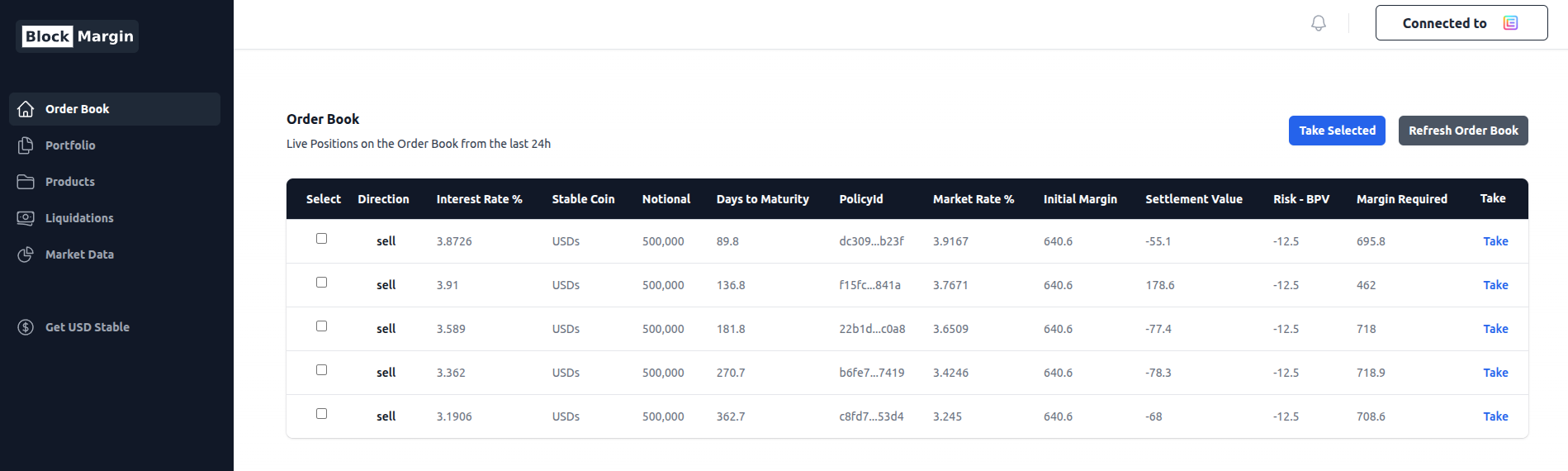
A simple order book is already running on the testnet, printscreen below
Describe realistic measures of success, ideally with on-chain metrics.
The MarginDEX app that we will launch on the testnet will be the result of R&D on how best to implement an AMM for Interest Rate Derivatives. A model of how this word currently does not exist for these types of instruments and we will need to use a novel approach
A successful outcome would be:
- A user is able to create a Forward Rate Agreement (FRA) against a predefined maturity point
- This automatically matches the user with a counterparty that takes the other side of the trade (DEX functionality)
- The managing of Margin is managed through BlockMargin
- We include Margin DEX in our discussions with Financial Institutions to showcase Cardano's proposition
- Plan for integration on Midnight for use cases where privacy is critical to Financial Institutions
[Your Project and Solution] Solution
Please describe your proposed solution and how it addresses the problem
Interest rate derivatives differ from single-asset derivatives like those based on stocks, bonds and crypto assets because their value depends on an entire interest rate curve - a set of rates across different maturities - rather than a single market price. This means its pricing and risk management involve shifts in the whole curve, not just movements in one asset’s value.
Most AMMs today are designed for single-price assets, using formulas like constant product or stableswap curves. These models assume one price point for liquidity provision and trading, which doesn’t translate well to interest rate derivatives. Here, liquidity needs to account for the curve’s shape, multiple maturities, and how trades affect different points along it.
As a result, an AMM for interest rate derivatives must be built with models that capture curve dynamics, allow pricing along multiple tenors, and handle the more complex payoff structures—something that requires a fundamentally different approach from existing single-asset AMMs.
1 - Cluster of AMMs
One way to adapt AMMs for curve-based pricing in interest rate derivatives is to use a cluster of AMMs, where each pool is dedicated to a specific maturity (e.g., 1M, 3M, 6M, 1Y). This approach breaks the interest rate curve into discrete points, allowing each AMM to price and provide liquidity for its own tenor. Together, the cluster replicates the full curve while keeping pricing and risk local to each maturity, making the system simpler to model and more capital efficient than a single complex curve-wide AMM.
2 - Curve wide AMM
A curve-wide AMM that provides liquidity for interest rate risk rather than for specific maturities. In this model, trades are expressed in standardized “risk units” (e.g., DV01), which represent the sensitivity of a position to movements along the interest rate curve. Each transaction is converted into these units, which are then drawn from a shared liquidity pool. This allows a single pool to support the entire curve, letting liquidity providers back all maturities at once while the AMM dynamically prices and manages how each trade impacts the curve’s shape.
Both of these methods are innovations on top of a classic AMM and as a result we will need to go through some degree of trial and error to identify which works better
Integration with BlockMargin
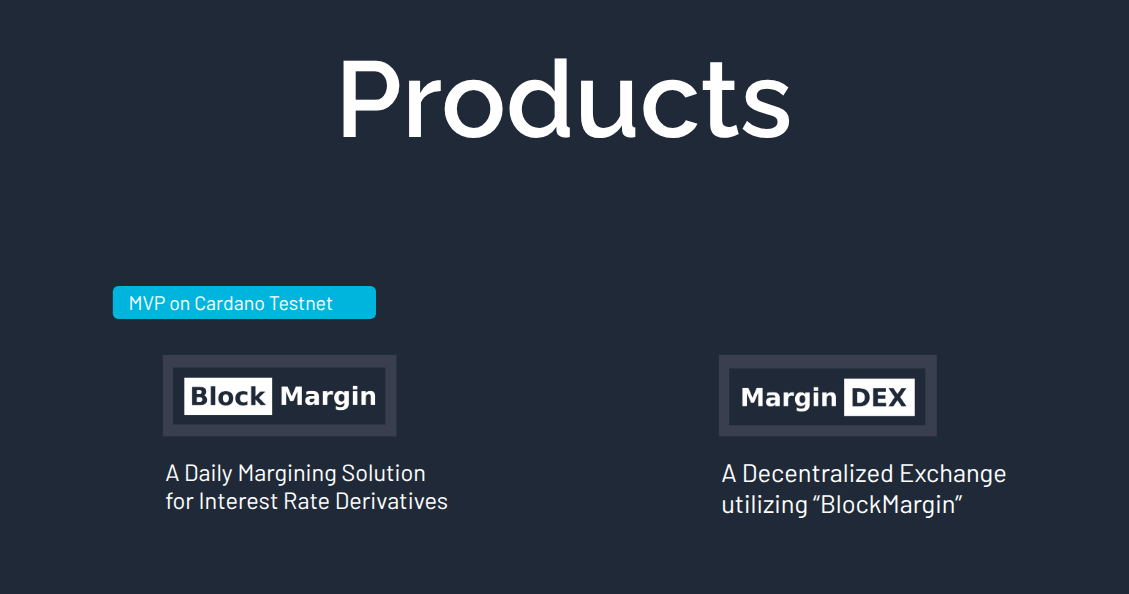
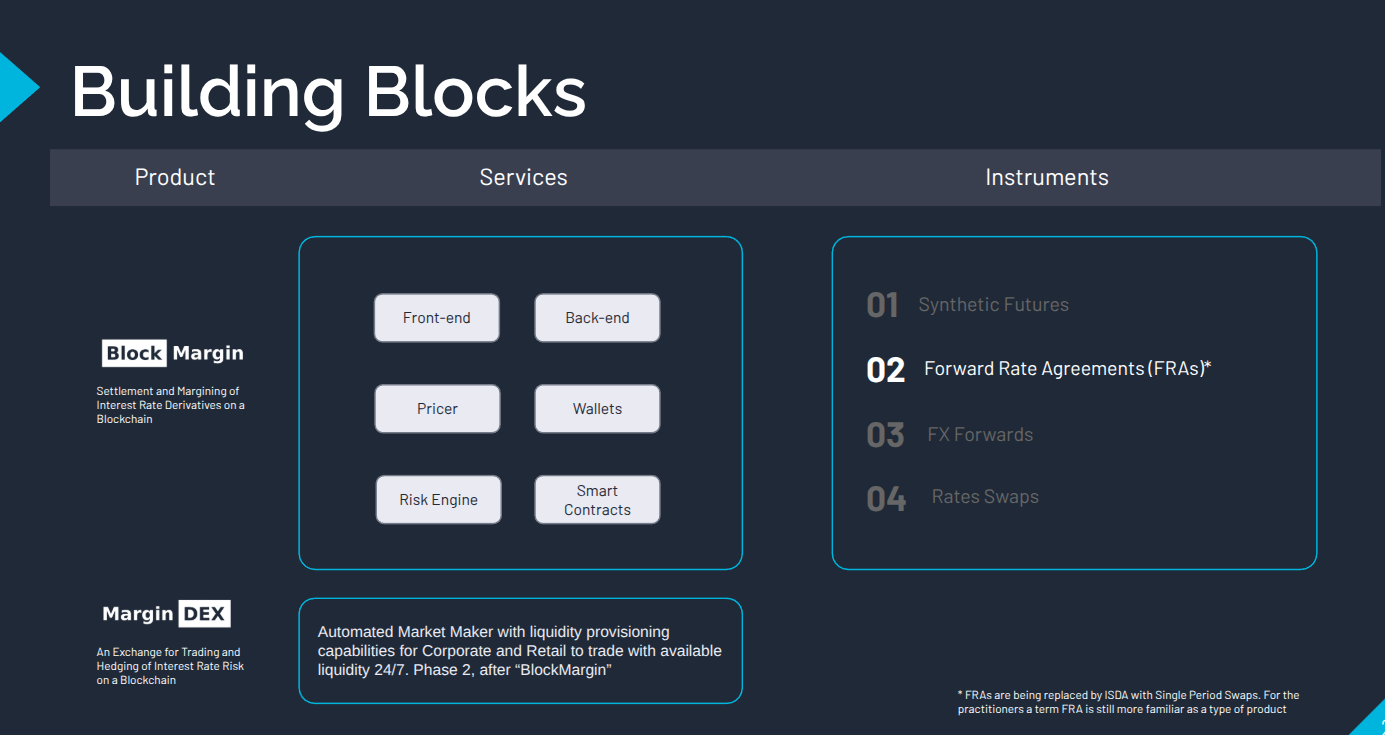
Over the last year we have been working on a platform called BlockMargin to manage the settlement process for interest rate derivatives. It has not been released on the Cardano Testnet and we are actively including in our dicussions with Financial Institutions. MarginDEX is the next evolution of this platform to build a DEX on top of BlockMargin.
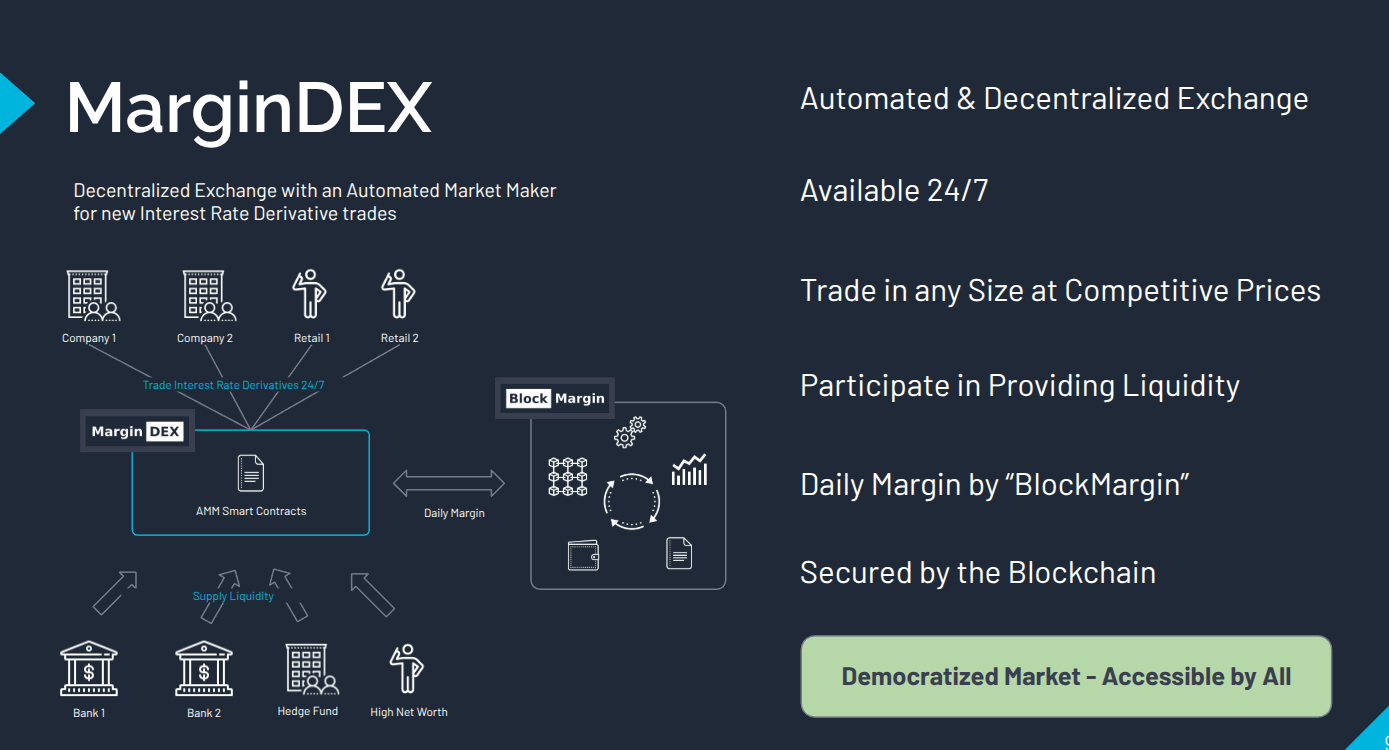
MarginDEX is the marketplace and BlockMargin as the delivery mechanism. MargiDEX is where trades are initiated, buyers and sellers are matched and then BlockMargin is the delivery vehicle that ensures the correct management of Margin throughout the life of the contract.
Significance of Margin Posting:
Understanding why margin matters is important to appreciating the BlockMargin solution. Interest rate derivatives involve dynamic contract values that can turn positive or negative at any point. Margin posting becomes essential to prevent defaults and provide compensation if one party decides to exit the contract prematurely. Additionally, margin posting aids in avoiding litigation, as both parties can walk away, leaving margin with the counterparty to cover any adverse market moves.
[Your Project and Solution] Impact
Please define the positive impact your project will have on the wider Cardano community
MarginDEX is a first-of-its-kind platform - both on Cardano and across other blockchains. It builds on the innovation of Automated Market Makers (AMMs) and applies it to traditional financial instruments widely used in traditional finance (TradFi).
A successful launch will not only showcase Cardano’s capabilities but also attract significant attention from the TradFi sector.
Historically, AMMs have been designed for account-based blockchains like Ethereum, and required adaptation to work on UTXO-based blockchains such as Cardano. Through the BlockMargin project, we’ve successfully leveraged the UTXO model to manage margin for existing interest rate derivative trades. With MarginDEX, we’re taking the next step - designing an evolved AMM model specifically for trading interest rate derivatives within a UTXO framework.
The proposal will further validate the possibility of trading interest rate derivatives on Cardano (a completely new product on Cardano and other blockchains) and can potentially bring the financial services industry onto Cardano.
This proposal targets the traditional finance sector and aims to bring some of their operations onto the blockchain and create a Decentralized Finance alternative (DeFi)
It will increase the Total Value locked, total number and active daily users. And it will bring the largest market in the world onto a blockchain.
The Interest Rate Derivative market is the largest market in the world by a big margin, with $250+ Billion daily volume between Small Corporates, Retail and Financial institutions. The overall market that includes large corporations is even bigger at over $5 trillion of volume per day.
Bringing the market making, trading and settlement of these derivatives onto a blockchain has the potential to open up adoption of the large financial sector on a blockchain and, over time, drive a tide of adoption to that blockchain.
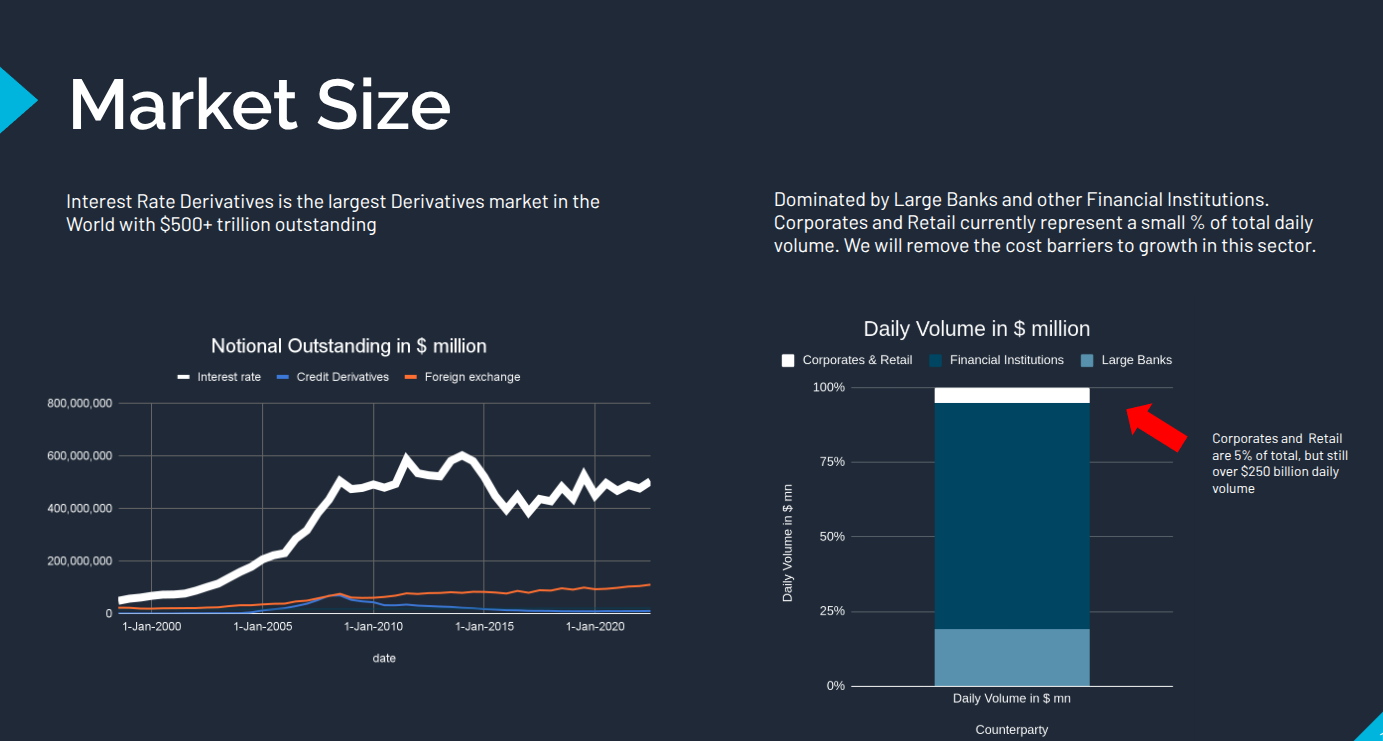
Settling these trades on the blockchain, drastically reduces operational cost, making it possible for financial institutions to offer these products to smaller clients they overlooked in the past. This can lead to market growth as new participants enter the market.
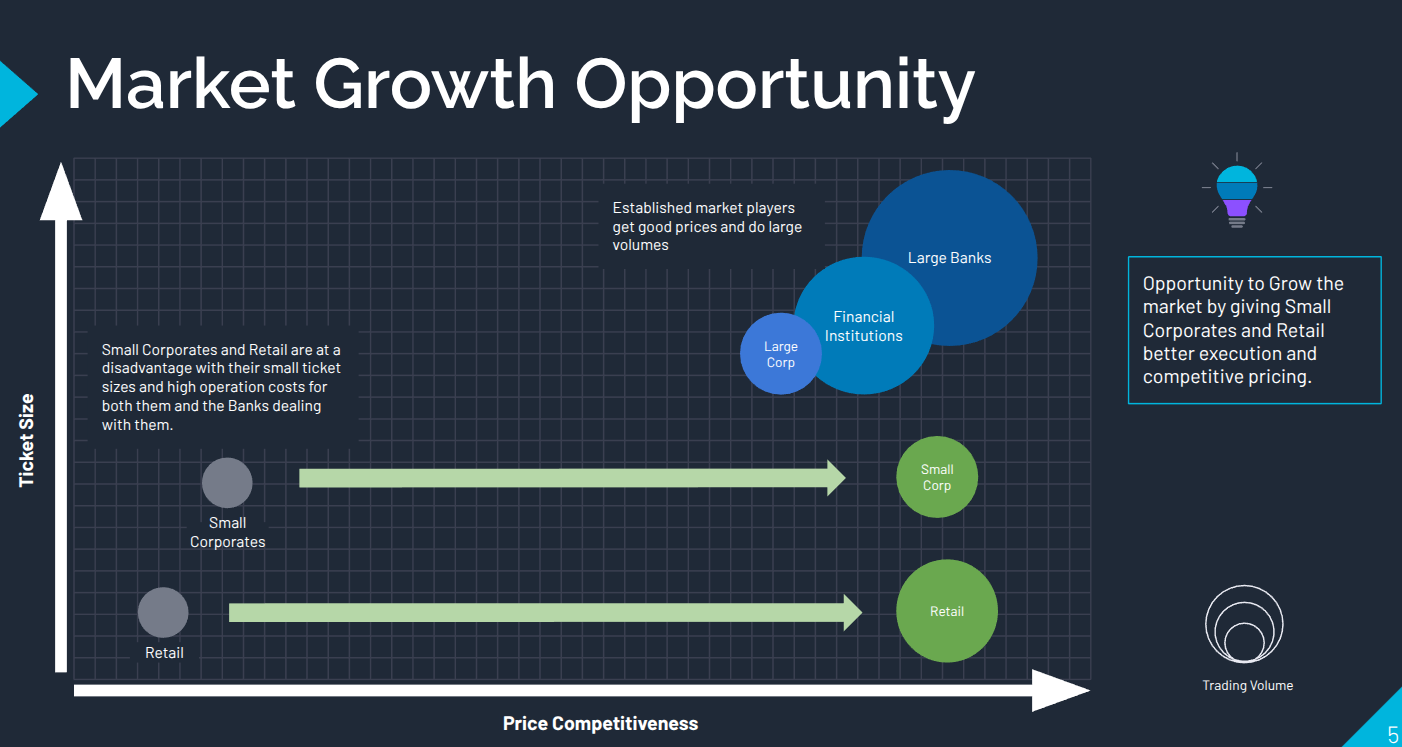
The chart shows that there are significant growth opportunities for the mid-tier and corporates and retail customers who are currently priced out of this market that is dominated by large financial institutions.
Challenges Faced by Mid-tier Entities and Retail
Interest Rate Derivatives serve as crucial risk management tools for corporations and asset managers, enabling them to hedge interest rate risks associated with loans, bond issuance, and other liabilities. However, small corporates and private individuals often find themselves excluded from this market due to the intricate back-office processes involved, particularly the daily margining requirements. Without the resources to handle daily margining, these entities face inflated fees imposed by financial institutions, leading to elevated credit and operational risks.
[Your Project and Solution] Capabilities & Feasibility
What is your capability to deliver your project with high levels of trust and accountability? How do you intend to validate if your approach is feasible?
We have recently finished the build of BlockMargin on the testnet https://blockmargin.app , you can go and use it to do test trades and manage the margin on those trades. This proposal is to continue its development and use BlockMargin in this proposals Margin DEX
The key team members, Dmitry and Sergio, have decades of experience with trading and settling these types of Interest Rate derivative contracts and have worked together at a large financial institution in the Netherlands
Dmitry spent over a decade in Risk Management and Trading, managing multi-million dollar positions for the bank and the bank’s clients. Sergio is a banking professional with hands-on expertise in Regulation and bank-to-corporate interactions. They both have deep connections in the industry necessary to convince large financial institutions to do a pilot.
Automated Market Making (AMM) DEXs
The team has extensive knowledge of the operational intricacies of AMM DEX and their risks. We are providers of liquidity on existing Cardano and on other chain AMM DEXs
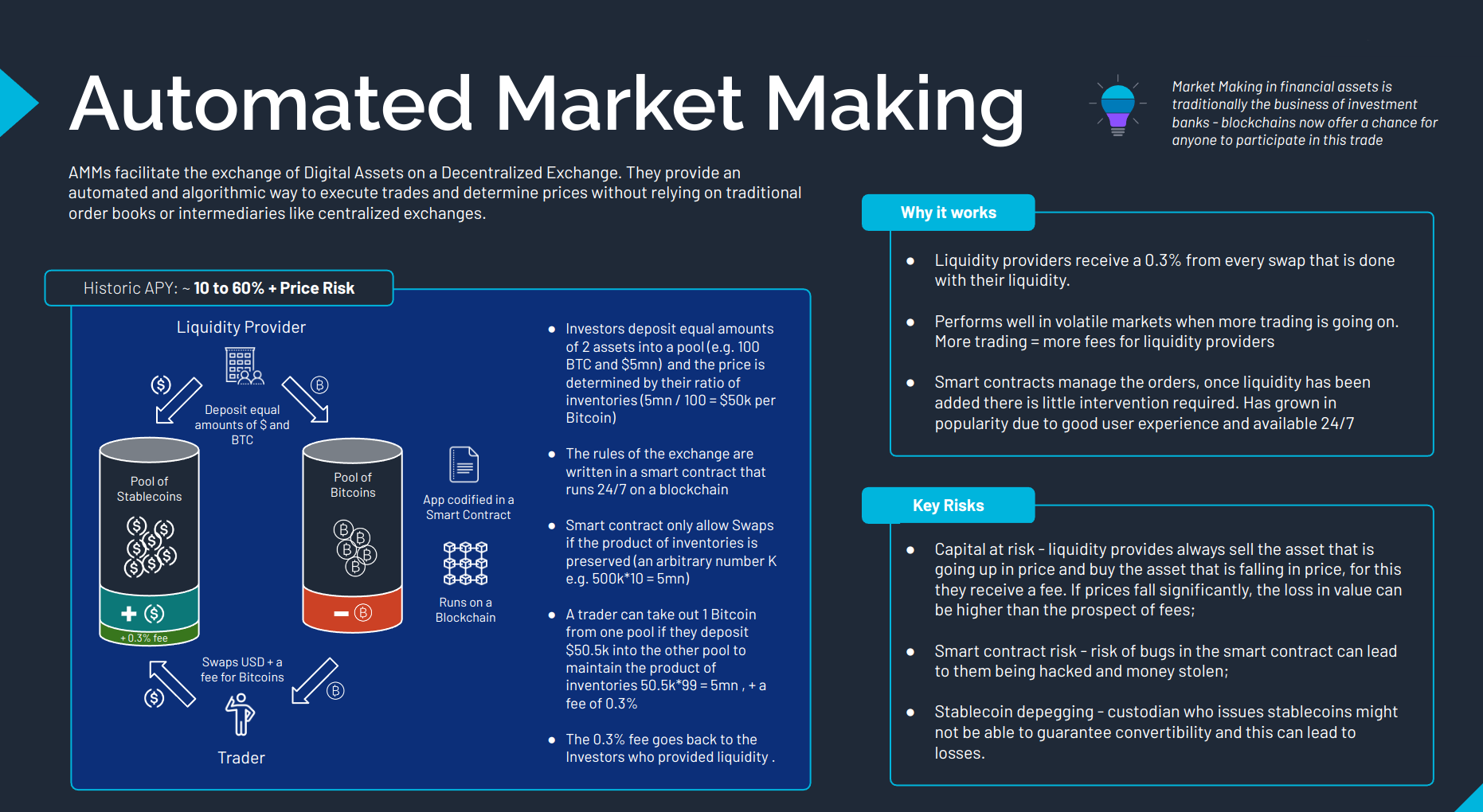
Dmitry has written extensively and taught classes at Universities on AMM DEXs. A diagram below for university students with an example of an AMM for BTCUSDC
Public articles written
https://dynamicstrategies.io/docs/automated-market-makers/
University lecture:
https://www.linkedin.com/feed/update/urn:li:activity:7360747744832950272/
[Milestones] Project Milestones
Milestone Title
Design Automated Market Making (AMM) models for Interest Rate Derivatives
Milestone Outputs
Perform R&D on how to operationalize the Cluster AMMs and Curve-wide AMM in the UTXO model. We know that classic AMMs require a “batcher” to operate, so we will need to study if the same batcher is still required for our AMMs and how it would work for both types of approached
Layout in a diagram of how the following elements should interact between each other for each AMM model
- Liquidity provider’s wallet
- Newly minted “receipt” tokens during liquidity provision
- Buy vs Sell side
- Automatic rate adjustment (the rate needs to adjust if there is too much demand in one direction)
Address the following questions:
- Managing margin post execution
- How to deal with trades that require liquidity from more than one liquidity provider
- How to deal with concurrent trades against the same liquidity in the UTXO model
Acceptance Criteria
A diagram of how different elements described in the Output above interact between each other in a diagram, “pseudo” script of how a transaction should be built to provide liquidity and of a transaction that consumes liquidity
Evidence of Completion
A diagram and a description of how both types of AMMs should work (the Cluster of AMMs and Curve-wide AMM). A video walkthrough the diagram and discussion of the pros and cons of each approach.
Delivery Month
3
Cost
48000
Progress
20 %
Milestone Title
Implement Cluster of AMMs model
Milestone Outputs
First we will implement an AMM for 1 maturity point, e.g. the 1 year maturity point on an interest rate curve.
Then we will expand the same method to other maturity points, we will do up to 5 maturity point to evidence that the implementation is working
The user will be able to connect with their Cardano web-wallet (e.g. Eternl) running on testnet and initiate a buy or sell FRA trade for any of the 5 maturity points. The liquidity provider will automatically take the other side of the trade.
If we identify that a batcher is required for this set-up then we will build a batcher that will aggregate transactions and execute a UTXO where liquidity is provided.
Acceptance Criteria
A web dashboard with the functionality to add liquidity to each of the pre-defined 5 tenor points of the curve. The liquidity provider should be able to add and remove liquidity
In a separate section of the dashboard a trader should be able to initiate a FRA trade against any of the 5 maturity points and be automatically matched on the other side with the liquidity provider. Example: if a trader is initiating a buy FRA, then the sell FRA should be automatically confirmed by the liquidity provider(s)
Evidence of Completion
A video walkthrough of a dashboard on a Cardano testnet and a successful execution of:
- Adding liquidity
- Withdrawing liquidity
- Performing a trade against available liquidity
Delivery Month
5
Cost
36000
Progress
40 %
Milestone Title
Implement Curve-wide AMM model
Milestone Outputs
The Curve-wide AMM is a more advanced version of the AMM as it needs to take into account the difference in risk across the different maturity points on the curve when providing liquidity.
For liquidity providers, we will implement the ability to add liquidity to the whole curve, irrespective of maturity
A trader should then be able to trade against any maturity on the curve, and liquidity will be consumed based on the risk amount, rather than the notional amount
Acceptance Criteria
A web dashboard with the functionality to add liquidity to the whole curve. The liquidity provider should be able to add and remove liquidity
In a separate section of the dashboard a trader should be able to initiate a FRA trade against any maturity and be automatically matched on the other side with the liquidity provider. Example: if a trader is initiating a buy FRA, then the sell FRA should be automatically confirmed by the liquidity provider(s)
Evidence of Completion
A video walkthrough of a dashboard on a Cardano testnet and a successful execution of:
- Adding liquidity
- Withdrawing liquidity
- Performing a trade against available liquidity
Delivery Month
8
Cost
48000
Progress
60 %
Milestone Title
Integration with BlockMargin
Milestone Outputs
An assessment of which AMM model works better (the Cluster of AMMs, or the Curve-wide AMM)
The AMM will then be connected to BlockMargin on the Cardano testnet to manage the margin posting and withdrawals throughout the life of the contract. In this set-up, MarginDEX will initiate the trades by matching traders with liquidity providers and then once the trade is initiated the rest of the settlement process will be managed by BlockMargin
Acceptance Criteria
A web dashboard where a buy and a sell can be initiated by a trader and be automatically matched against the liquidity in the AMM
The trade is then passed onto the BlockMargin interface to manage the settlement of the trade until maturity.
The test will be in a local development environment, connected to a Cardano testne
Evidence of Completion
Liquidity provided by 5 different wallets on the testnet
Successfully executed a batch of 10 trades which are then passed onto BlockMargin
A video walkthrough of the evidence
Delivery Month
10
Cost
14400
Progress
80 %
Milestone Title
App Launch
Milestone Outputs
A new domain will be registered for MarginDEX and the front end will be deployed. The backend will also be deployed on the same server. We will aim to use a Web2 framework such as NextJs, with which we have experience, for this. We will make a decision if it is worth bringing over the BlockMargin app into the same domain as these apps become very closely integrated.
The MarginDEX app is launched on the Cardano Testnet and open for the community to run test trades.
The smart contracts of the AMM will open sourced on our public github repo.
Acceptance Criteria
A web dashboard where the buyers and sellers of FRAs are matched in a dynamically updating order book resembling an AMM. A user is able to add liquidity to the AMM and the traders are able to execute new trades using that liquidity. The price of the product is adjusted with the supply and demand of this liquidity in the AMM (e.g. more buy orders for FRA will drive up the price of the FRAs).
Evidence of Completion
A video walkthrough of the evidence of trades done on an app running on a public website, users can connect to the app with the web wallets (e.g. Eterl, Vespr, Lace) and execute trades (buys or sells) in FRAs against provided liquidity on a Cardano testnet.
Delivery Month
12
Cost
18450
Progress
100 %
[Final Pitch] Budget & Costs
Please provide a cost breakdown of the proposed work and resources
The budget is estimated based on 40 hours per week and 4 weeks per month.
Milestone 1: Design AMM models
One Senior developer 40h per week for 4 weeks @ $60/h
One Senior derivatives expert 40h per week for 4 weeks @ $60/h
Total 19,200 USD
Milestone 2: Implement Cluster of AMMs model
One Senior developer 40h per week for 4 weeks @ $60/h
One Senior derivatives expert 40h per week for 2 weeks @ $60/h
Total 14,400 USD
Milestone 3: Implement Curve-wide AMM model
One Senior developer 40h per week for 6 weeks @ $60/h
One Senior derivatives expert 40h per week for 2 weeks @ $60/h
Total 19,200 USD
Milestone 4: Integration with BlockMargin
One Senior developer 40h per week for 4 weeks @ $60/h
One Junior developer 40h per week for 4 weeks @ $30/h
Total 14,400 USD
Milestone 5: App Launch
One Senior developer 40h per week for 2 weeks @ $60/h
One Junior developer 40h per week for 2 weeks @ $30/h
Server costs at $30 per month for 6 months = $180
Total 7,380 USD
Server costs @ $30 per month for 6 months = $180
Total for project 74,580 USD
A conservative ADAUSD exchange rate of 0.4 is assumed for the budgeting. At this level we are happy to hold ADA if the price drops significantly below that
Total for project in ada 186,450
[Final Pitch] Value for Money
How does the cost of the project represent value for the Cardano ecosystem?
MarginDEX represents a high-value use of funds because it brings the world’s largest financial market - Interest Rate Derivatives - onto Cardano, creating a first-of-its-kind DeFi application. By funding this project, the Cardano ecosystem gains a transparent, permissionless, and automated trading platform for instruments historically restricted to large institutions. A Cardano-native financial infrastructure not available on any other blockchain.
This innovation demonstrates Cardano’s capability to handle complex financial products, increasing adoption by financial institutions, attracting liquidity, and expanding Total Value Locked (TVL). The project also fosters DeFi growth by enabling smaller corporates and retail participants - largely excluded from this market - to trade the products efficiently.
The proposal enables us to work on R&D and deployment of the AMM models (Cluster and Curve-wide), integration with BlockMargin, and operational testnet activity - all of which are critical for demonstrating viability and attracting future institutional adoption. Successful execution will generate network effects, showcasing Cardano as a platform for high-value, real-world financial applications.
The team has decades of combined experience in derivatives trading and blockchain development, has successfully delivered multiple prior Catalyst-funded projects, and is deeply familiar with AMM DEXs on Cardano and other Blockchains.
The prototype and MVP are already partially operational on testnet (BlockMargin and simple order book), which reduces risk and ensures that each milestone produces a demonstrable output.
[Self-Assessment] Self-Assessment Checklist
I confirm that evidence of prior research, whitepaper, design, or proof-of-concept is provided.
Yes
I confirm that the proposal includes ecosystem research and uses the findings to either (a) justify its uniqueness over existing solutions or (b) demonstrate the value of its novel approach.
Yes
I confirm that the proposal demonstrates technical capability via verifiable in-house talent or a confirmed development partner (GitHub, LinkedIn, portfolio, etc.)
Yes
I confirm that the proposer and all team members are in good standing with prior Catalyst projects.
Yes
I confirm that the proposal clearly defines the problem and the value of the on-chain utility.
Yes
I confirm that the primary goal of the proposal is a working prototype deployed on at least a Cardano testnet.
Yes
I confirm that the proposal outlines a credible and clear technical plan and architecture.
Yes
I confirm that the budget and timeline (≤ 12 months) are realistic for the proposed work.
Yes
I confirm that the proposal includes a community engagement and feedback plan to amplify prototype adoption with the Cardano ecosystem.
Yes
I confirm that the budget is for future development only; excludes retroactive funding, incentives, giveaways, re-granting, or sub-treasuries.
Yes
[Required Acknowledgements] Consent & Confirmation
I Agree
Yes
Team
Project Lead: Dmitry Shibaev
https://www.linkedin.com/in/shibaev/
Dmitry Shibaev is an experienced Project Lead and Senior Developer with a proven track record in both big tech and financial markets. His expertise spans 5 years in delivering large-scale SAP projects for energy companies in southern Europe and 15 years in financial markets, where he successfully led significant projects at a prominent investment bank across London, Singapore, and Amsterdam.
Open source contributor: https://github.com/dynamicstrategies
University Lecturer: https://www.linkedin.com/feed/update/urn:li:activity:7360747744832950272/
Recognized by the Portuguese business journal for building innovative projects on blockchains: https://www.jornaldenegocios.pt/negocios-em-rede/detalhe/queremos-atrair-fixar-e-desenvolver-talento-em-cascais
Creator of the Cardano’s Staking Reward Calculator: https://cardano.org/calculator/
Key in delivering previously funded Catalyst projects
- Cardano Beam - https://projectcatalyst.io/funds/8/dapps-and-integrations/cardano-beam-gps-based-assets
- Education Material for Workshops - https://projectcatalyst.io/funds/8/grow-africa-grow-cardano/education-material-for-workshops
- Blueprint for Investment Funds - https://projectcatalyst.io/funds/9/legal-and-financial-implementations/blueprint-for-investment-funds
- Credit Card Gateway - https://projectcatalyst.io/funds/11/cardano-open-developers/credit-card-gateway
- BlockMargin - proof of concept on the testnet - https://projectcatalyst.io/funds/11/cardano-use-cases-concept/blockmargin-interest-rate-futures-on-cardano
Full stack Web2, Web3 and Mobile developer behind:
Regulatory Expert: Sergio Rodrigues
https://www.linkedin.com/in/sergio-vieira-rodrigues-819bb8/
Sergio has 20 years of experience in systems implementation in Large International Banks. He is also a Banking Regulatory Expert with experience dealing with financial regulators across Europe
Junior Developer: Vlad Mikirtumov
https://www.linkedin.com/in/vmikirtumov/
Aerospace Engineer by education. Experience project manager and test engineer at ASML microchips and HODL funds
Data Expert: Paulo Rosario
https://www.linkedin.com/in/paulorosario/
Paulo is an experienced Economist/Data Scientist/Econometrician with a demonstrated history of working with data (from econometrics to Machine learning) to produce business insights and actionable knowledge.
He previously held senior data role at M&G and Skytra - a data company of Airbus