Last updated 10 months ago
Palestra: Minswap x Snek DeFi onboarding game
Problem
Most crypto users trade only on CEXs and never try Cardano DeFi. There is no fun, risk-free way for them to practice swaps and liquidity on familiar tokens before using real funds.
Solution
Build a web game on Cardano testnet where players “fund from CEX”, trade in Minswap/Snek pools, react to events, and learn swaps and liquidity safely with testnet tokens.
About this idea
[Proposal setup] Proposal title
Please provide your proposal title
Palestra: Minswap x Snek DeFi onboarding game
[Proposal Summary] Budget Information
Enter the amount of funding you are requesting in ADA
200000
[Proposal Summary] Time
Please specify how many months you expect your project to last
12
[Proposal Summary] Translation Information
Please indicate if your proposal has been auto-translated
No
Original Language
en
[Proposal Summary] Problem Statement
What is the problem you want to solve?
Most crypto users trade only on CEXs and never try Cardano DeFi. There is no fun, risk-free way for them to practice swaps and liquidity on familiar tokens before using real funds.
[Proposal Summary] Supporting Documentation
Supporting links
- https://docs.google.com/document/d/1tJjTqEhzqSyMoBbO5BPxq8yS2tZuSSHOzZGN1domDQI ,
- https://docs.google.com/document/d/1ctXZJqZaYacr1ixuNphjnZWmi4rqOqOlmpClLFUtYh8
[Proposal Summary] Project Dependencies
Does your project have any dependencies on other organizations, technical or otherwise?
No
Describe any dependencies or write 'No dependencies'
No dependencies
[Proposal Summary] Project Open Source
Will your project's outputs be fully open source?
Yes
Please provide details on the intellectual property (IP) status of your project outputs, including whether they will be released as open source or retained under another licence.
MIT
[Theme Selection] Theme
Please choose the most relevant theme and tag related to the outcomes of your proposal
GameFi
[Campaign Category] Category Questions
Describe what makes your idea innovative compared to what has been previously launched in the market (whether by you or others).
Prior Research & Ecosystem Scan
https://docs.google.com/document/d/1tJjTqEhzqSyMoBbO5BPxq8yS2tZuSSHOzZGN1domDQI/edit?tab=t.0
This is not another generic crypto trading game or paper-trading simulator. Most existing “practice” tools either simulate prices off-chain, mimic a CEX order book, or provide static tutorials. My approach is to build a live DeFi game directly on Cardano testnet, where every swap and liquidity action is a real on-chain transaction against actual AMM pools. Players are not just clicking through a fake UI – they are interacting with Cardano DeFi as it really works, but with testnet funds so there is no risk to their real capital.
The core innovation is the way CEX-style onboarding is combined with Cardano-native mechanics. New users start with a familiar flow – “transfer from CEX” – which in reality is a themed faucet that funds an in-game wallet with testnet ADA and tokens. From there they can trade in public testnet pools of recognisable projects like Minswap and SNEK, practice providing and removing liquidity, and watch their portfolio climb (or fall) on a leaderboard. These project names are used only as familiar reference points through their open testnet pools; there is no partnership implied.
On top of this, the game adds an event-driven layer that is uncommon even in other ecosystems: global “news” and frequent random events that actually submit transactions on testnet to move prices and liquidity. Players have to react to these events, not just abstract charts. Structured missions (first swap, first LP, seeing impermanent loss, surviving volatility) turn the game into a guided DeFi learning path rather than just a sandbox.
Cardano does not yet have a game that combines: real testnet DEX interactions, CEX-flavoured onboarding, recognisable DeFi tokens, event-driven price moves, and an educational mission/leaderboard system designed specifically to onboard CEX traders and newcomers into Cardano DeFi. That combination – a serious trading simulator that is also a Cardano-specific teaching tool, fully on-chain on testnet – is what makes this proposal novel for the ecosystem.
Describe what your prototype or MVP will demonstrate, and where it can be accessed.
The prototype will be a live web game deployed on Cardano testnet. It will connect to real testnet AMM pools (for example, public Minswap and SNEK testnet pools) and use an in-game wallet funded via a themed “transfer from CEX” faucet. Every in-game action – swaps, adding/removing liquidity, reacting to events – will submit real transactions to Cardano testnet, but only with testnet ADA and tokens, so players can experiment safely with no financial risk. Recognisable projects like Minswap and SNEK are used purely via their open testnet pools as familiar reference points; no formal partnership is implied.
The MVP will demonstrate the full core loop: creating an in-game wallet, “funding from CEX”, performing swaps, providing liquidity, reacting to global news events that move testnet prices, and tracking portfolio value on a leaderboard. It will also include a small set of guided missions (e.g. first swap, first LP, seeing impermanent loss) to prove the educational flow.
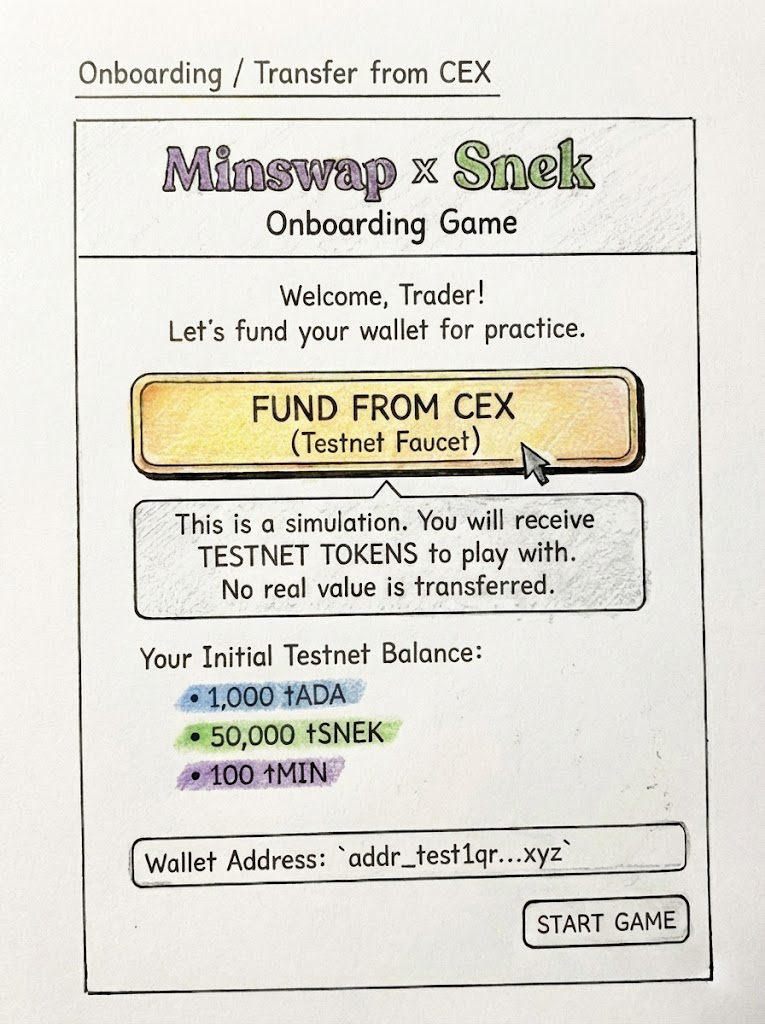
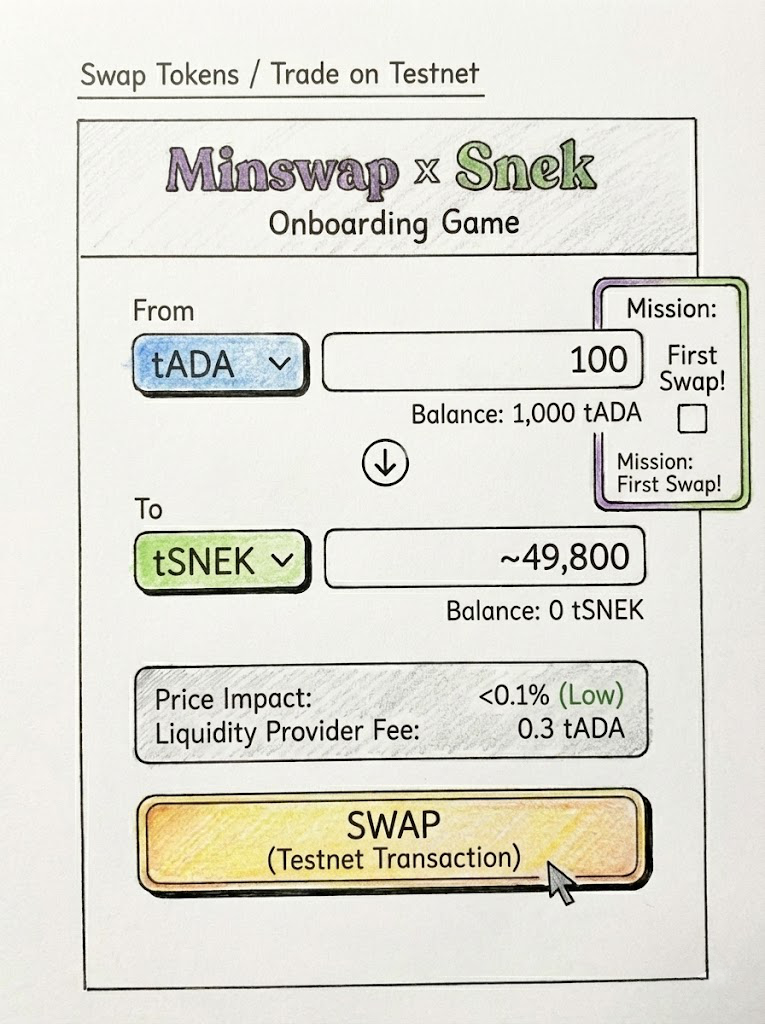
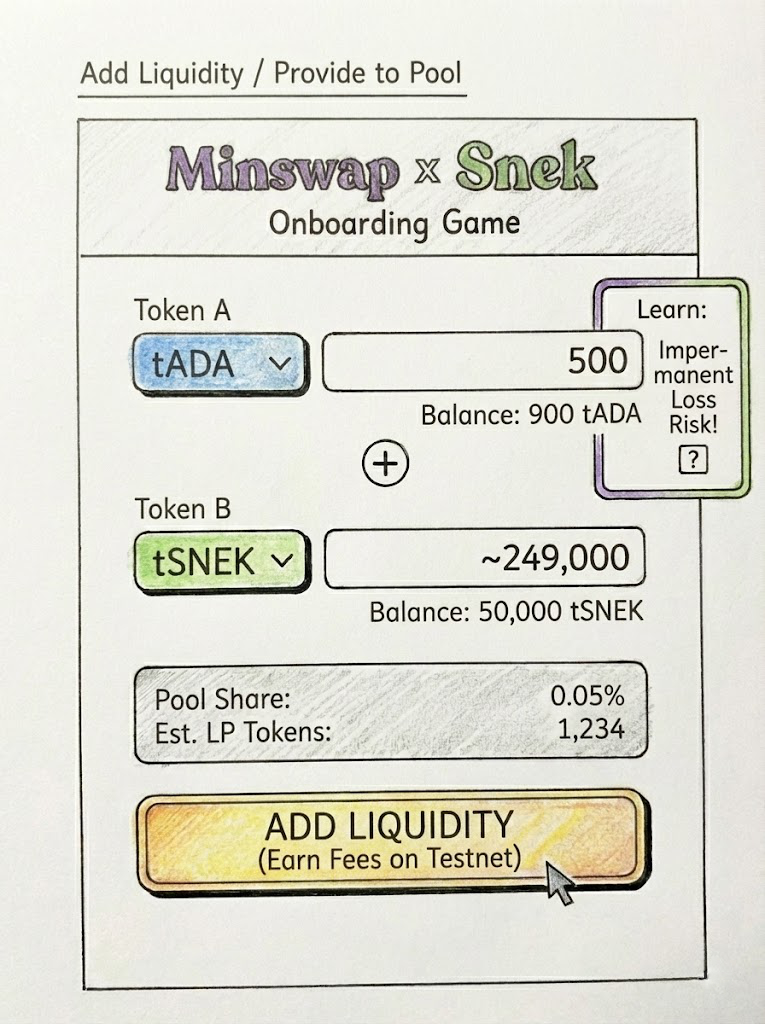
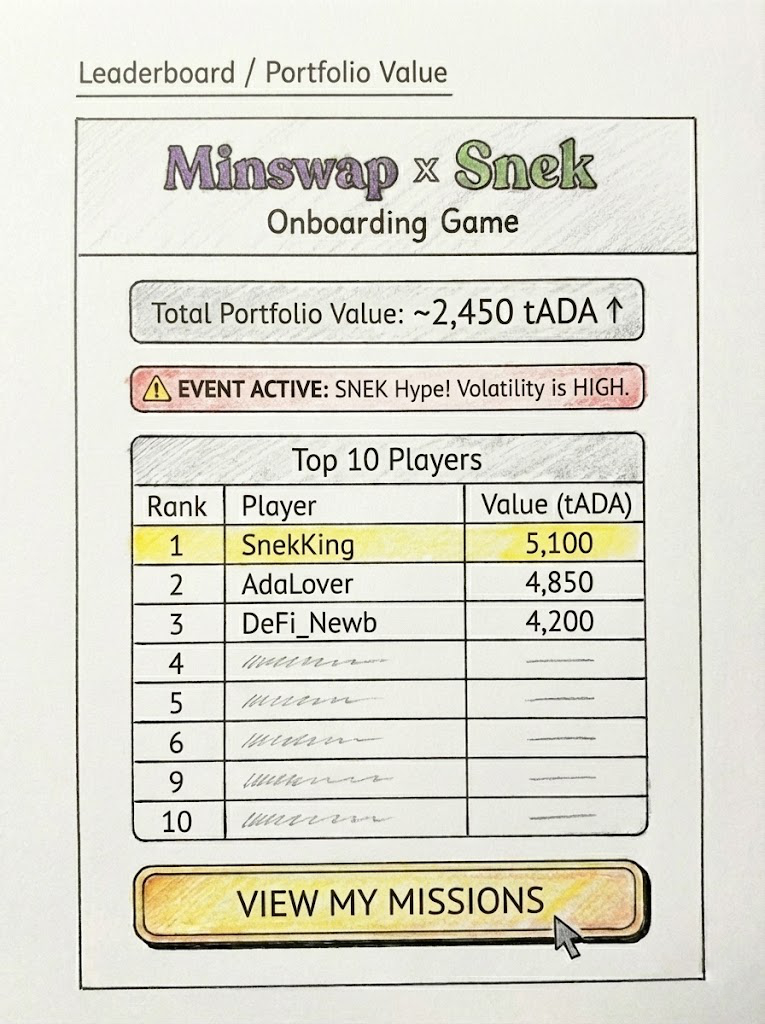
To demonstrate exactly how this flow works for a new user, we have designed the core experience to be familiar yet educational. Below is the 5-step user journey our MVP will deliver:
This project uses public Minswap and Snek testnet pools as familiar reference points. It is not affiliated with or endorsed by the Minswap or Snek teams.
- Risk-Free Onboarding The user starts by "transferring from a CEX", which is a themed faucet giving them testnet tokens to play with safely.
- The First Swap They perform their first on-chain swap using an interface identical to Minswap, guided by an in-game mission.
- Learning Liquidity & Impermanent Loss They learn to provide liquidity and are visually warned about advanced concepts like Impermanent Loss.
- Competition & Events Their progress is tracked on a leaderboard, which also alerts them to real-time, price-moving volatility events they must react to.
- The Learning Loop When the simulation ends (or if they lose virtual funds), they are encouraged to reset and try a new strategy, emphasizing that testnet mistakes are free lessons.
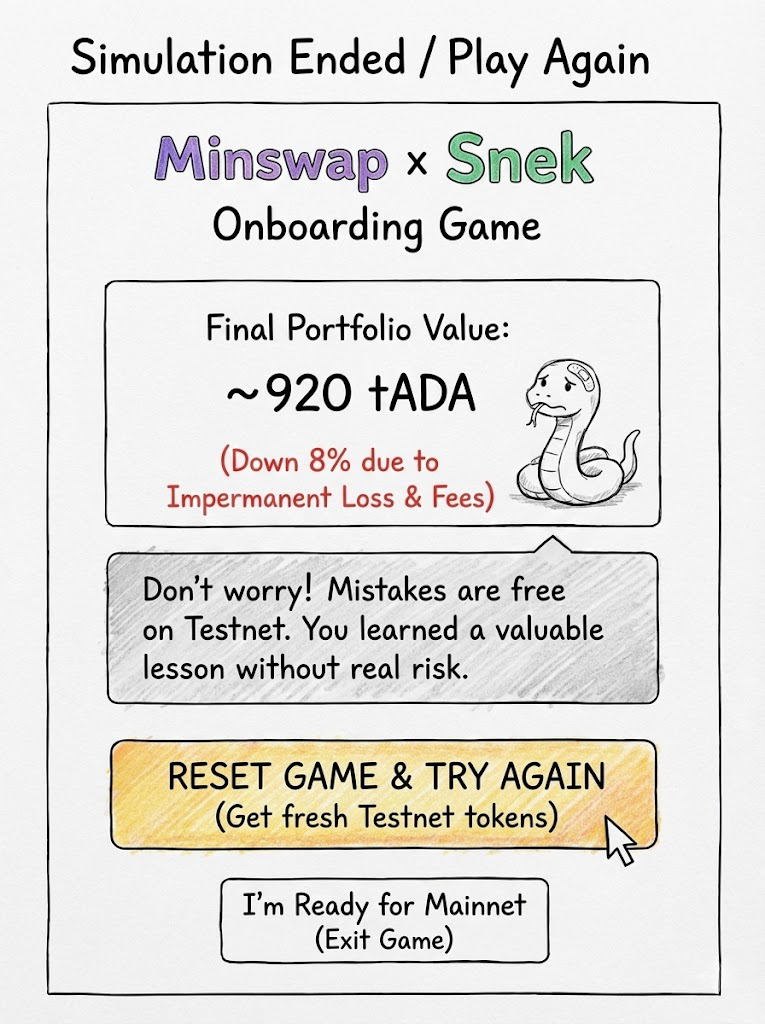
The prototype will be accessible as a public web app at a dedicated URL (testnet environment), with all game logic and contracts interacting only with Cardano testnet. The community will be able to help test it by:
- claiming testnet funds via the in-game “transfer from CEX” flow,
- playing through the missions and events,
- trying to climb the leaderboard,
- and submitting feedback via an embedded form or linked feedback channel.
Describe realistic measures of success, ideally with on-chain metrics.
Because this is a testnet-only game, success is best measured by how much real DeFi behaviour it generates on Cardano testnet, and by signals that players are more likely to try mainnet DeFi later.
I’ll focus on three compact sets of metrics:
Testnet DeFi activity
- Count how many distinct in-game wallets submit at least one swap or LP transaction on Cardano testnet, and how many total DeFi transactions the game generates (swaps, LP adds/removes, faucet “fund from CEX”). A realistic target is on the order of 150–300 unique addresses and 5,000–15,000 DeFi-related testnet transactions over 12 months, with at least half of active addresses doing both swaps and liquidity actions.
Learning & progression
- Track how many players complete core missions (first swap, first LP, an IL/volatility mission) and how many come back on multiple days. For example, success would be ~70% of players who start the tutorial completing a first swap mission, ~40–50% of those also completing a first LP mission, and at least 30% of active addresses generating transactions on three or more separate days.
Future mainnet intent (indirect impact)
- Use a short in-game survey and simple click tracking as indirect signals: what share of respondents were CEX-only before playing, and what share say they now feel confident to try mainnet DeFi; plus how often players click out to official wallet/DEX documentation links. Even a few hundred outbound clicks and 30–40% of respondents reporting increased confidence would be a strong indication that the game is nudging users toward real Cardano DeFi.
[Your Project and Solution] Solution
Please describe your proposed solution and how it addresses the problem
This project uses public Minswap and Snek testnet pools as familiar reference points. It is not affiliated with or endorsed by the Minswap or Snek teams.
AMMs and liquidity pools are central to DeFi, but for many users they remain abstract and intimidating. Most retail traders interact only with centralized exchanges, where they never see pool shares, impermanent loss, or how swaps affect on-chain liquidity. Existing Cardano DeFi apps are built for users who already understand wallets and on-chain risk, and written tutorials or videos, while useful, do not recreate the feeling of making real trades in a moving market. The gap is a safe, engaging environment where CEX traders and newcomers can learn Cardano DeFi by doing, without risking real funds.
This project addresses that gap by building a web-based trading game running entirely on Cardano testnet, using real testnet AMM pools as the backend. The core loop is simple and familiar:
- The player enters the game and an in-game wallet is created for them (no seed phrase UX).
- They “transfer from CEX” into the game – in reality, a themed faucet that sends testnet ADA and tokens from a system wallet into their in-game wallet.
- With that balance, they can perform actual on-chain testnet swaps and liquidity actions against public AMM pools, including pools for recognisable projects such as Minswap and SNEK. Those project names are used purely via their open testnet pools as familiar reference points; there is no formal partnership implied.
- As they trade and provide/remove liquidity, their portfolio value and positions are tracked, and they appear on an in-game leaderboard.
Every action that matters in the game – swaps, LP adds/removes, even price-moving events – is a real transaction on Cardano testnet, but always with testnet assets. This means players are learning how Cardano DeFi actually behaves (fees, slippage, pool price impact, position value changes) in a risk-free setting.
On top of this core loop, the game adds several layers to make it educational and engaging:
- Guided missions / tutorials: A mission system walks players through key DeFi concepts:
- “Fund from CEX” (use the faucet and see funds arrive).
- First swap (execute a testnet swap, see price impact/fees).
- First liquidity provision (add liquidity to a pool and understand pool shares).
- Impermanent loss and volatility (watch how an LP position changes as prices move).
- Completing missions rewards players with in-game progression (XP, badges, or titles), and ensures they don’t just click random buttons but actually understand the mechanics.
- Event-driven markets and news feed: The game includes a global news feed that periodically broadcasts events to all players:
- Themed events like “Token X gets hyped on social media” or “Liquidity incentives ending soon”,
- More frequent random micro-events such as sudden volatility or liquidity shifts.
- Behind the scenes, these events trigger real trades or liquidity actions on testnet (executed by the game’s backend) so that prices and pool states actually change. Players must react to these events, just like in real markets, by rebalancing, swapping, or adjusting liquidity.
- Portfolio & LP views: The interface provides clear portfolio breakdowns (by token, % allocation) and simple charts showing how the player’s total value changes over time. For LP positions, the UI highlights:
- initial deposit vs current value,
- how much value has come from fees vs price movement. This makes otherwise opaque concepts like impermanent loss more intuitive.
- Leaderboards and repeated play: A leaderboard ranks players by portfolio performance and/or other metrics (e.g. number of successful missions completed, or performance around news events). This adds a light competitive layer that encourages repeated play and exploration of more advanced strategies.
The project primarily engages three groups:
- CEX-only traders who know how to buy/sell tokens but have never touched Cardano DeFi.
- Newcomers to crypto who prefer interactive learning over reading technical docs.
- Existing Cardano community members who want a safe sandbox to experiment with swaps, LP and event-driven markets without risking mainnet funds.
Impact will be demonstrated through a combination of on-chain testnet data and in-game analytics: the number of unique in-game wallets that perform swaps and LP actions, total DeFi-related transactions generated on testnet, how many players complete core learning missions, how many return on multiple days, and simple surveys asking whether players feel more confident using DeFi on mainnet after playing. Together, these show whether the game is successfully converting curiosity and CEX-only habits into practical Cardano DeFi experience.
What is unique about this solution is the way it combines real Cardano testnet DEX interactions, a CEX-flavoured onboarding flow, recognisable DeFi tokens, and an event-driven, mission-based learning design. It is not a trading bot, not a mainnet protocol, and not an off-chain price simulator; it is a Cardano-specific onboarding game where users can make real on-chain decisions with fake money, see the consequences, and build confidence. If successful, it can increase the pool of users ready to use Cardano DeFi on mainnet, improve general understanding of AMMs and liquidity, and provide a reusable framework for future educational or gamified DeFi experiences in the ecosystem.
High-Level Architecture Overview
Architecture in more detail can be viewed here:
https://docs.google.com/document/d/1ctXZJqZaYacr1ixuNphjnZWmi4rqOqOlmpClLFUtYh8
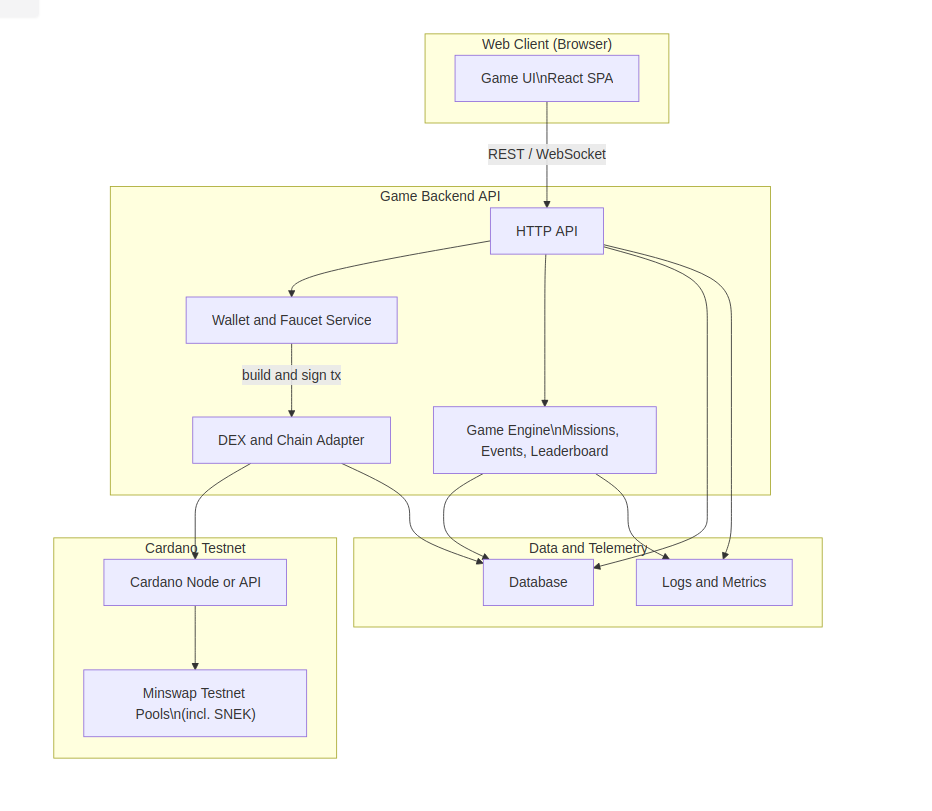
The game is a web application that runs entirely against Cardano testnet, using real Minswap testnet AMM pools as its backend. All meaningful player actions (funding, swaps, liquidity adds/removes, event-driven moves) are real testnet transactions, but only with test assets, so users never risk mainnet funds.
At a high level, the system has three layers:
- Frontend web app (game UI and logic in the browser)
- Game backend & API (ingestion, orchestration, telemetry)
- Cardano testnet + Minswap testnet pools (on-chain execution and state)
Core Components
Frontend (Game Client)
The browser-based UI handles onboarding, “fund from CEX” flow, pool browsing, swaps, LP actions, missions, events, portfolio and leaderboard. It talks only to the backend API, never directly to a node. The client renders:
- A simplified DEX-style interface (pool list, pool detail, swap form, LP form).
- A game layer (missions, global news/events feed, portfolio timeline, leaderboard).
In-Game Wallet Layer
Each player is mapped to a dedicated testnet address managed by the backend. From the user’s perspective it behaves like a simple in-game wallet: they see balances, positions and history, but never handle seed phrases. Server-side key management and signing are kept minimal and scoped to testnet only. The wallet layer:
- Tracks per-player UTxOs and token balances.
- Signs and submits transactions for faucet funding, swaps and liquidity interactions.
Backend & API
The backend is a stateless-ish web service plus a database. It connects to Cardano testnet infrastructure (node or indexer) and to Minswap testnet contracts. It is responsible for:
- DEX integration & data ingestion: continuously reading Minswap testnet pool state (reserves, fees), swaps and LP events, and storing them in a normalized schema.
- Game API: exposing endpoints for pool lists/details, historical series, player portfolios, missions, events and leaderboard data.
- Tx orchestration: building, signing and submitting testnet transactions for swaps, LP actions, faucet transfers and price-moving “event” actions.
- Telemetry: recording high-level metrics (addresses, actions per day, mission completion, etc.) for evaluation and reporting.
Cardano Testnet & Minswap Pools
Execution and state live on Cardano testnet:
- Pool state, swaps and LP positions are maintained by real Minswap testnet pools.
- Faucet transfers, swaps and LP actions are all normal Cardano testnet transactions.
- Event-driven market moves are implemented as backend-initiated swaps or liquidity changes on selected pools.
Data & Transaction Flow (Simplified)
- Onboarding & funding
- The user starts the game, the backend creates or retrieves their testnet address, and the “fund from CEX” action triggers a faucet transaction from a system wallet to that address. The frontend updates balances once the backend confirms the transaction.
- Exploring pools & making trades
- The frontend queries pool and price data from the backend. When a user submits a swap or LP action, the backend builds and signs a testnet transaction against the relevant Minswap pool and submits it. Once confirmed, the backend updates local state and the UI shows the new balances, positions and history.
- Missions, events & leaderboard
- The mission system and leaderboard logic run in the backend, driven by on-chain data. Missions are marked complete based on observed on-chain actions (e.g. first swap, first LP, surviving a volatility event). Global events are scheduled in the backend and executed as real swaps/LP changes, which in turn move pool state and affect player portfolios. Leaderboard rankings are calculated from current on-chain balances and stored snapshots.
Extensibility
The architecture is deliberately modular:
- Additional testnet pools or tokens can be added by extending the DEX adapter and configuration.
- New mission types or event rules can be added without changing the core ingestion layer.
- Other Cardano projects can reuse the backend/API and in-game wallet patterns to build their own onboarding games or tutorials, or fork the UI to target different tokens and pools.
[Your Project and Solution] Impact
Please define the positive impact your project will have on the wider Cardano community
AMMs and LPs are core to Cardano DeFi, but most potential users never touch them because the first step feels too risky and too technical. This project turns that first step into a safe, playful, but fully on-chain experience. The positive impact comes from converting “I only trade on CEX” users into people who’ve actually used Cardano DeFi mechanics – even if only on testnet – and from leaving behind reusable code and patterns for future onboarding tools.
How this brings value to the Cardano community
- More DeFi-ready users:
- CEX-only traders and newcomers will learn how to:
- fund a wallet (via the “transfer from CEX” faucet),
- swap tokens in AMM pools,
- provide and remove liquidity,
- react to market events.
- By the time they consider mainnet, they’ve already made real on-chain decisions in a low-risk environment, which reduces friction and fear when approaching Cardano DeFi “for real”.
- Better understanding of AMMs & LP risk:
- The game’s missions and UI make impermanent loss, fees, and pool price impact more tangible. That leads to better-informed mainnet users, which is good for protocol health, user retention and fewer “I lost everything, DeFi is a scam” stories.
- Reusable onboarding framework:
- The codebase (in-game wallet abstraction, faucet logic, testnet DEX integration, mission system) can be reused or adapted by other Cardano projects that want to do interactive tutorials or themed onboarding. Even if adoption is modest, the technical patterns are valuable.
- Testbed for DeFi education & UX:
- Educators, content creators and DeFi projects can point users to a live playground instead of only static docs. Over time, this can become a standard “go here first if you’re new to Cardano DeFi” recommendation.
How impact will be measured
- On-chain testnet DeFi activity generated by the game
- Number of unique in-game wallets / addresses that perform at least one swap or LP action on Cardano testnet.
- Total DeFi-related testnet transactions initiated via the game (swaps, LP add/remove, faucet “fund from CEX”).
- Share of active addresses that have done both swaps and LP actions (showing players aren’t just doing a single click).
- Learning & engagement
- How many players complete key missions:
- “fund from CEX”,
- first swap,
- first LP,
- at least one “volatility/IL” mission.
- How many addresses generate transactions on 3+ separate days, indicating repeated practice rather than a one-off test.
- How many players complete key missions:
- Future mainnet intent
- Short in-game survey asking:
- whether players had used Cardano DeFi before,
- whether they now feel confident enough to try mainnet DeFi in the future.
- Optional tracking of click-throughs from in-game “learn more” links to official wallet and DEX documentation (clearly marked as external resources; recognisable projects like Minswap and SNEK referenced only via their public materials and testnet pools, with no partnership implied).
- Short in-game survey asking:
Together, these metrics show:
- how much real DeFi behaviour the game has created on testnet, and
- whether it is shifting users’ confidence and intent toward using Cardano DeFi on mainnet.
How outputs will be shared
- The web game itself will be publicly accessible on Cardano testnet at a dedicated URL, with no barriers besides a simple login/start flow.
- The codebase (minus any secrets/ops details) will be open-sourced under a permissive license so other Cardano teams can reuse the integration patterns, mission system, or UX ideas.
- A short documentation set (README, “how it works”, and a guide for educators / community managers on how to use the game in workshops or content) will be published alongside the repo.
- Periodic progress and results posts (for example on the Catalyst forum and relevant Cardano DeFi / developer channels) will share:
- updates on testnet activity and mission completion stats,
- lessons learned about what confuses new users,
- suggestions for how other projects can plug into or build on the game.
All of this will also be summarised in the final Catalyst close-out report and video, with links to the live game, code, and any aggregated statistics, so the wider Cardano community can see exactly what was delivered and decide how to make use of it.
[Your Project and Solution] Capabilities & Feasibility
What is your capability to deliver your project with high levels of trust and accountability? How do you intend to validate if your approach is feasible?
I’m proposing Palestra as a one-person project, scoped to match my existing experience. Over the last few years I’ve worked full-time as a Cardano DeFi / DEX engineer: integrating with AMM DEXes, building trading frontends (swaps, LP, portfolio), writing off-chain indexers for pool state and trades, and even running an arbitrage bot across multiple Cardano DEXes. Before that, I spent more than a decade as a full-stack and backend engineer at Microsoft Development Center Serbia, shipping and operating web services for Azure / Microsoft 365 used by millions of users. That combination – Cardano DeFi internals plus long production web experience – maps directly to what Palestra needs: a reliable on-chain backend, a clear browser UI, and a stable testnet deployment.
Feasibility is de-risked by how the project is structured. The milestones follow a thin-slice, incremental approach: first a backend that ingests Minswap testnet pools and interactions and stores history; then a basic web UI and in-game wallet + faucet that submit real testnet swaps; then the game layer (missions, events, leaderboard) on top of infrastructure that already works. At each step, correctness is validated against public testnet explorers (pool reserves, swap results, wallet balances), and the game logic only ever touches testnet assets, so there is no financial risk to players.
Trust and accountability come from keeping the work open and verifiable. The codebase (backend, game logic, UI) will be public under a permissive license; each milestone has clear evidence (repo links, screenshots, testnet transaction hashes, metrics snapshots); and the final month is reserved for documentation, a walkthrough video and the Catalyst close-out report. The budget is essentially one year of full-time engineering plus modest infra (testnet node/indexer access, hosting, domain, monitoring) — no incentives, or re-granting. This makes it straightforward for the community to see where funds went and to independently verify that Palestra was delivered as proposed.
[Milestones] Project Milestones
Milestone Title
Backend: DEX Integration & Data Layer
Milestone Outputs
Backend service that connects to Cardano testnet via the chosen infrastructure and ingests Minswap testnet pool definitions, pool state (reserves, fees) and swap/liquidity interactions.
Database schema and implementation for storing pools, tokens and pool interactions, including historical series per pool and per trading pair.
Backend API endpoints to query pools and tokens, recent interactions for a pool, and historical series for a pool or pair over a given time range.
Acceptance Criteria
The service continuously ingests interactions from Minswap testnet and maintains an up-to-date history of pool states over time.
For a sample of Minswap testnet pools and transactions, stored data (reserves, fees, swaps) matches what is visible on a public
Cardano testnet explorer at given block heights.
API endpoints return correct data for pool lists, recent interactions and historical series for at least five Minswap testnet pools and five trading pairs.
Evidence of Completion
Repository link with backend code and schema definition.
Logs or screenshots showing ingestion of Minswap testnet data and populated tables for pools and interactions.
Sample JSON/CSV exports from the API for a few pools/pairs, with a short note matching them to public Cardano testnet explorer data.
Delivery Month
3
Cost
60000
Progress
30 %
Milestone Title
Wallet, Initial UI & Backend Integration
Milestone Outputs
Minimal web UI providing a pool list and detail view, a swap form, and a portfolio page showing balances and recent actions.
In-game wallet abstraction for each player that assigns a testnet address, can hold testnet ADA and tokens, and can sign and send transactions via the backend.
Themed “transfer from CEX” faucet flow that funds the in-game wallet from a system faucet wallet on testnet under defined limits.
Frontend integration with backend APIs to display current Minswap testnet pool state and basic historical charts, and to submit swaps from the UI and show them in local history once on-chain.
Acceptance Criteria
New test users can receive an in-game wallet, use the faucet once, see updated balances and perform at least one swap from the UI.
Swap transactions appear on a Cardano testnet explorer with the expected token amounts and Minswap pools, matching what the UI shows.
Pool pages read data from the backend and show correct reserves and prices for at least five Minswap testnet pools.
Evidence of Completion
Screenshots or screencast of a new user going through faucet → swap → portfolio update.
Example transaction hashes from faucet and swap actions, visible on a Cardano testnet explorer.
Screenshots of pool detail and history views showing data returned from the backend.
Delivery Month
6
Cost
60000
Progress
60 %
Milestone Title
Game Design & Core Game Systems
Milestone Outputs
Game design and architecture document for the game layer covering the core loop, mission types and progression, event rules, and leaderboard metrics and update logic.
Mission system with at least four missions: fund from CEX, first swap, first LP add, and a volatility/impermanent-loss mission.
Global events and news feed that presents periodic events to all players and links them to on-chain Minswap testnet actions (swaps/liquidity changes) that move prices or liquidity in selected pools.
Leaderboard that ranks players by portfolio value (and optionally basic stats) and updates based on on-chain balances.
Acceptance Criteria
The game design and architecture document is available and reflects the implemented missions, events and leaderboard behaviour.
All four missions can be completed by a test player and are automatically marked complete based on on-chain actions rather than manual toggles.
The event feed shows multiple events over a test period, each with at least one associated Minswap testnet transaction hash and an observable effect on a pool.
The leaderboard lists at least twenty test players and updates on a documented schedule using on-chain balances.
Evidence of Completion
Link to the game design and architecture document.
Screenshots of the missions UI and a sample player’s mission progress.
Screenshots or logs of the event feed with example transaction hashes and a brief before/after snapshot for at least one Minswap testnet pool.
Screenshot of the leaderboard with a small comparison table to on-chain balances for a few players.
Delivery Month
8
Cost
30000
Progress
70 %
Milestone Title
Public Testnet Deployment, Telemetry & Feedback
Milestone Outputs
Public Cardano testnet deployment at a stable URL providing the full loop: onboarding, faucet, swaps, liquidity, missions, events and leaderboard.
Telemetry and logging for in-game wallets, swaps, liquidity actions, mission completions and returning players.
In-game feedback form and a short survey about prior DeFi experience and confidence to try mainnet.
Initial usage snapshot (beta report) after several weeks of public use.
Acceptance Criteria
A fresh user can visit the URL, receive an in-game wallet, fund from CEX, perform a swap and a liquidity action, and appear on the leaderboard.
Metrics export or dashboard shows counts of wallets, swaps, liquidity actions and mission completions.
At least twenty players have submitted survey or feedback responses.
A short beta summary document exists with headline usage numbers and a summary of survey answers.
Evidence of Completion
Public URL and a short screencast of a new user going through the main loop.
Screenshot or export of telemetry data with the required counters.
Link or anonymised export of survey/feedback responses.
Link to the beta usage summary document.
Delivery Month
10
Cost
20000
Progress
80 %
Milestone Title
Documentation, Open Assets & Close-Out
Milestone Outputs
Two–three page project summary detailing goals, metrics achieved, system overview, limitations and suggested next steps.
Updated public documentation in the repository, including README, how-it-works description, deployment notes and guidance for educators or community managers.
Public walkthrough video showing the end-to-end experience.
Final Catalyst close-out report with all relevant links.
Acceptance Criteria
The summary document lists key targets from the proposal, marks them as achieved, partially achieved or not achieved, and briefly explains any gaps.
Repository documentation is sufficient for a technical user to deploy the game on Cardano testnet and understand the main components.
The walkthrough video clearly shows onboarding, faucet, swap, liquidity action, at least one event and the leaderboard, and is publicly accessible.
The close-out submission via the Milestone Module includes links to the app (if still hosted), repository, documentation and video.
Evidence of Completion
Public link to the summary document.
Public repository link with final documentation in place.
Public link to the walkthrough video.
Screenshot or confirmation of the final Catalyst close-out submission.
Delivery Month
12
Cost
30000
Progress
100 %
[Final Pitch] Budget & Costs
Please provide a cost breakdown of the proposed work and resources
Core engineering & game logic (~70%)
- Backend:
- Minswap testnet integration, pool/interaction ingestion, historical storage.
- API endpoints for pools, interactions and history.
- Frontend:
- Web interface for pools, swaps, portfolio.
- Game layer: missions, events, leaderboard.
- On-chain integration:
- In-game wallet abstraction, faucet, swap and liquidity transactions.
- Infrastructure & deployment:
- Testnet deployment of backend + frontend, monitoring, telemetry.
Design, documentation & project management (~20%)
- Game design and architecture documents.
- UX flows and lightweight UI design.
- Technical documentation (README, how-it-works, deployment notes).
- Milestone statements, Proof-of-Achievement submissions.
- Final summary, close-out report and walkthrough video script.
Community, outreach & misc (~10%)
- Setting up and maintaining the public testnet deployment and basic status page.
- Preparing and publishing beta announcement posts in relevant Cardano channels.
- Managing the in-game survey/feedback form and summarising responses.
- Minor admin tasks: domain registration, basic bookkeeping for the project.
Third-party products and services
The project uses a small set of external services, all covered within the 200k ADA budget:
- Cardano infra / indexer access: a hosted Cardano testnet API or indexer to fetch chain data for Minswap pools and interactions and to submit transactions from the backend.
- Hosting & storage: cloud hosting for the backend/API service, database and web frontend, plus storage for logs, telemetry and static assets.
- Domain & basic tooling: a domain name for the public testnet deployment and, if needed, lightweight tools for monitoring and simple surveys/feedback.
[Final Pitch] Value for Money
How does the cost of the project represent value for the Cardano ecosystem?
The requested 200,000 ADA funds a 12-month, full-time effort by a single engineer covering every aspect of the project: backend integration with Minswap testnet, game logic, frontend, wallet/faucet plumbing, deployment, telemetry, documentation and Catalyst reporting. There is no extra management, marketing, or agency overhead hidden in the budget — it’s essentially one full-stack/blockchain engineer for a year plus modest infrastructure costs.
Spread over ~2,000 working hours, this equates to a modest hourly rate for a specialised role that combines Cardano integration, game design, and web development. Comparable freelance or agency rates for similar work are often significantly higher, especially once project management and profit margins are added. Here, those functions are absorbed into the same person and into the same budget.
From the ecosystem’s perspective, the project delivers durable assets rather than a one-off campaign:
- A reusable backend that ingests and stores Minswap testnet pool states and interactions, with an API that other teams could adapt for their own educational or simulation tools.
- A web game that turns “DeFi on Cardano” into an interactive experience using real testnet transactions (wallet, swaps, liquidity, events, missions, leaderboard) without exposing new users to financial loss.
- An open codebase and documentation that can be forked and re-themed by other projects (for different tokens, pools, or educational pathways), giving Cardano a flexible “playground” for CEX-only users who might consider trying DeFi.
The cost structure is also lean in terms of external spend: low cloud hosting, testnet infra/indexer access, a domain and basic monitoring/feedback tools. There is no budget for token incentives, airdrops, giveaways, re-granting or speculative treasury activity; all funds go into building and operating the prototype, plus the required reporting and close-out.
Taken together — one reasonably priced full-time builder, a clear milestone plan tied to concrete deliverables, and an output that can be reused as an on-chain DeFi onboarding and education tool — the proposal represents good value for money as a focused experiment in growing Cardano’s future mainnet user base via testnet gameplay.
[Self-Assessment] Self-Assessment Checklist
I confirm that evidence of prior research, whitepaper, design, or proof-of-concept is provided.
Yes
I confirm that the proposal includes ecosystem research and uses the findings to either (a) justify its uniqueness over existing solutions or (b) demonstrate the value of its novel approach.
Yes
I confirm that the proposal demonstrates technical capability via verifiable in-house talent or a confirmed development partner (GitHub, LinkedIn, portfolio, etc.)
Yes
I confirm that the proposer and all team members are in good standing with prior Catalyst projects.
Yes
I confirm that the proposal clearly defines the problem and the value of the on-chain utility.
Yes
I confirm that the primary goal of the proposal is a working prototype deployed on at least a Cardano testnet.
Yes
I confirm that the proposal outlines a credible and clear technical plan and architecture.
Yes
I confirm that the budget and timeline (≤ 12 months) are realistic for the proposed work.
Yes
I confirm that the proposal includes a community engagement and feedback plan to amplify prototype adoption with the Cardano ecosystem.
Yes
I confirm that the budget is for future development only; excludes retroactive funding, incentives, giveaways, re-granting, or sub-treasuries.
Yes
[Required Acknowledgements] Consent & Confirmation
I Agree
Yes
Team
Full stack Engineer Nenad Mihajlovic