Last updated 6 months ago
ROSCA-Prototype Reverse Auction Smart Contract Saving System
Problem
Cardano’s DeFi is still early stage with TVL under $300M (<1% of Ethereum’s). It lags behind Ethereum and Solana, needing growth as ADA treasury funds shrink and fees alone can’t sustain it.
Solution
Building the ROSCA prototype on Cardano—a DeFi platform for savings and capital raising, offering interest-based returns that are flexible, scalable, and globally accessible for all users.
About this idea
[Proposal setup] Proposal title
Please provide your proposal title
ROSCA-Prototype Reverse Auction Smart Contract Saving System
[Proposal Summary] Budget Information
Enter the amount of funding you are requesting in ADA
98000
[Proposal Summary] Time
Please specify how many months you expect your project to last
6
[Proposal Summary] Translation Information
Please indicate if your proposal has been auto-translated
No
Original Language
en
[Proposal Summary] Problem Statement
What is the problem you want to solve?
Cardano’s DeFi is still early stage with TVL under $300M (<1% of Ethereum’s). It lags behind Ethereum and Solana, needing growth as ADA treasury funds shrink and fees alone can’t sustain it.
[Proposal Summary] Supporting Documentation
Supporting links
- https://github.com/DUALCORE-VuNam/Cardano-Decentralized-ROSCA-contract ,
- https://dualcore-vunam.gitbook.io/rosca-sc-dualcore-team/summary/quickstart ,
- https://dualcore-vunam.gitbook.io/rosca-sc-dualcore-team/summary/rosca-whitepaper-1.0 ,
- https://dualcore-vunam.gitbook.io/rosca-sc-dualcore-team/summary/resources ,
- https://dualcore-vunam.gitbook.io/rosca-sc-dualcore-team/summary/budget
[Proposal Summary] Project Dependencies
Does your project have any dependencies on other organizations, technical or otherwise?
No
Describe any dependencies or write 'No dependencies'
No dependencies
[Proposal Summary] Project Open Source
Will your project's outputs be fully open source?
Yes
Please provide details on the intellectual property (IP) status of your project outputs, including whether they will be released as open source or retained under another licence.
Yes, the entire project will be released under the MIT License. The source code and datasets will be made public on GitHub from the first stages of the project.
[Theme Selection] Theme
Please choose the most relevant theme and tag related to the outcomes of your proposal
DeFi
[Campaign Category] Category Questions
Describe what makes your idea innovative compared to what has been previously launched in the market (whether by you or others).
Our ROSCA (Rotating Savings and Credit Association) model introduces innovation by combining the traditional community-based savings mechanism with blockchain-native features tailored to Cardano. While previous funded projects in Catalyst have focused on decentralized lending, staking pools, or microfinance solutions, none have explored a non-liquidation, collateralized ROSCA contract where participants secure their commitments with ADA or stablecoin in a risk-free structure.
Describe what your prototype or MVP will demonstrate, and where it can be accessed.
Our MVP is a ROSCA dApp on Cardano that enables users to form savings groups with trustless, collateralized commitments via smart contracts. Users contribute in cycles, receive payouts in turns, and provide ADA/stablecoin collateral. The MVP will run on Cardano testnet with open-source code and a demo UI accessible via GitHub and web app.
Describe realistic measures of success, ideally with on-chain metrics.
Success will be measured by the number of active users, completed ROSCA cycles, smart contract interactions, total ADA/stablecoin collateral committed, and group formations—all observable on-chain. We will also track payout history, and user retention via testnet explorer and analytics dashboards. Community feedback during MVP testing will provide additional qualitative metrics to assess usability and trustless functionality.
[Your Project and Solution] Solution
Please describe your proposed solution and how it addresses the problem
*General status of the Cardano ecosystem:
Currently, the dApp community on the Cardano ecosystem is showing specific data on users participating in dApp protocols as well as DeFi on the Cardano ecosystem in general is not yet vibrant, shown through specific TVL data compared to other blockchain platforms such as Ethereum, Solona, .... or some other blockchain platforms, the number of assets being locked and circulating on dApp protocols is still quite poor compared to previous generation and peer-to-peer ecosystems.
*Analysis of specific data on Cardano's TVL compared to other prominent blockchains: https://drive.google.com/file/d/1GfixVmOhXQWw4jj8_3vNMKp5B_GxCMyM/view?usp=sharing
*The reality of traditional financial models in real life:
Traditional rotating savings models (hui/ho/phường) and informal credit systems are popular for their simplicity and community trust, but they reveal major risks when scaled: lack of cash-flow transparency, dependence on fund holders, potential fund-run fraud, absence of automatic penalties, unresolved disputes, and no measurable reputation system. The ROSCA documentation highlights these real risk scenarios and even requires a formal “risk & dispute handling chart,” showing that the traditional model has multiple structural weaknesses that must be standardized and solved through technology.
Actual figures:
- Solution:
We will develop a proof of concept and a minimal smart contract prototype for ROSCA 1.0 — a DeFi platform that enables savings and credit pools to earn net interest and scale globally. Built on Cardano smart contracts, the platform provides a decentralized system where users can flexibly accumulate and mobilize capital according to their personal financial needs within the Cardano ecosystem.
*Proof of concept - Explanation of the ROSCA model and logic process:
ROSCA is a revolving savings and credit model that allows members to both accumulate medium- to long-term assets and proactively mobilize capital. It operates through an auction-based mechanism where participants who need capital accept predefined interest rates, while others benefit from stable asset accumulation similar to interest-bearing savings. The ROSCA contract emphasizes decentralization, providing a safe, flexible, and transparent financial system that supports diverse personal financial needs.
***The contract logic is implemented: **
Each member must deposit a required amount of capital as defined by the smart contract. In each cycle, a reverse auction is conducted: the interest rate (price) gradually decreases until a member accepts it to obtain the capital for that round.
The member who accepts the rate receives the pooled funds contributed by all participants and must continue contributing in every subsequent cycle until the contract ends. Once a member has received capital, they cannot participate in future auctions. The reverse auction process repeats each cycle until all rounds are completed. The final remaining member — the only one who has not taken capital — receives the fixed pooled amount from all previous contributors.
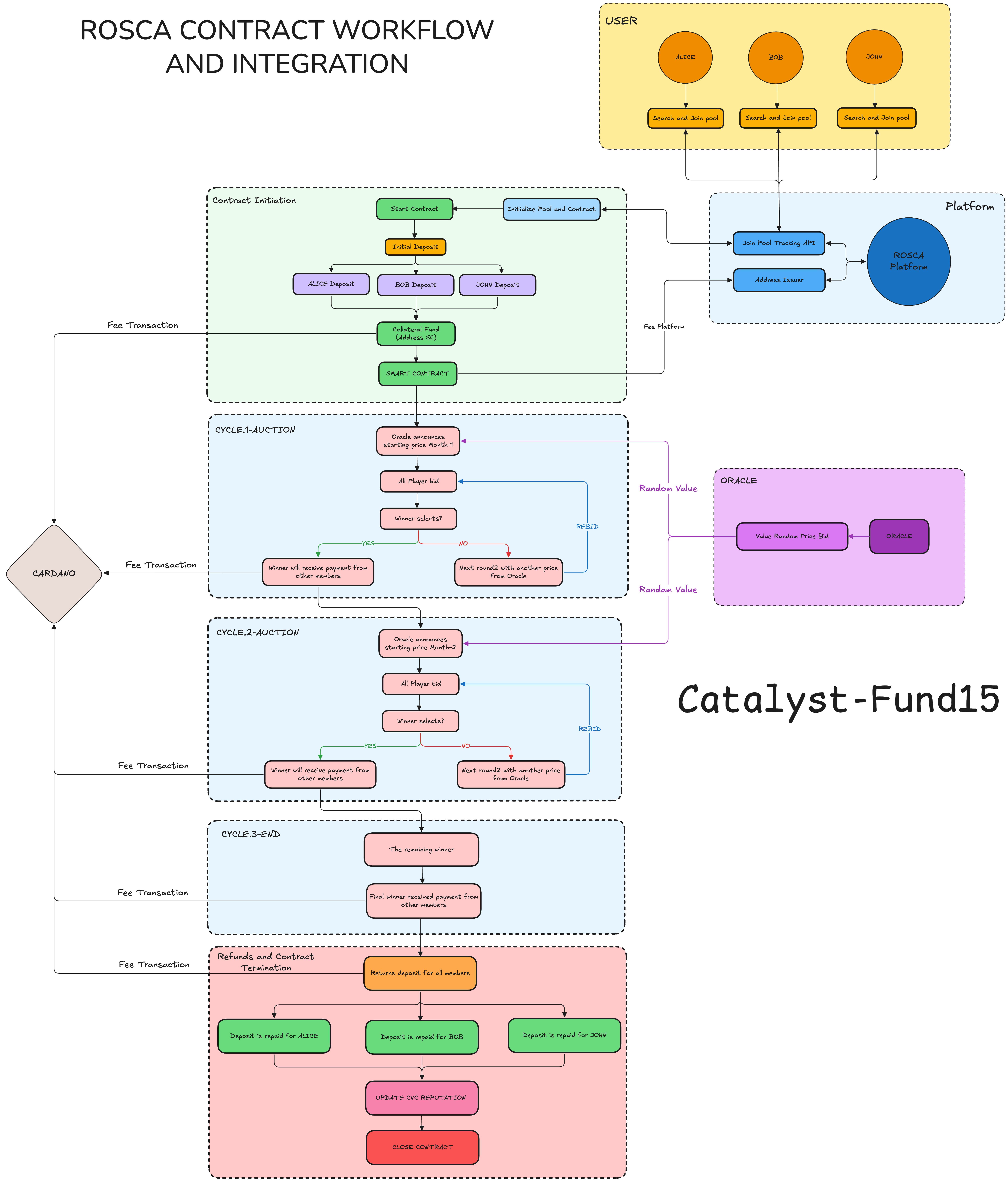
*Rotating Savings & Credit Protocol dApp operation process:
1.Register-Verify membership & Check Rosca Reputation Score (Register-Check and Join):
-Users join the group by connecting Cardano wallet and signing to accept the terms.
-The system checks RRS and selects a compatible pool.
2.Initiation:
-Host creates a new ROSCA pool: Fixed capital contribution level, Number of members, Cycle time, type of asset used (ADA/Stablecoin: Djed, USDM, USDA,..).
-Users choose the appropriate pool and perform the initial deposit to ensure responsibility.
3.Reverse Auction Cycle:
-Oracle provides random discount value, ensuring fairness and transparency.
-Members who need to raise capital early can bid by accepting a higher interest rate.
4.Distribution & Settlement:
-Other members continue to contribute capital minus the auction price in each cycle to the smart contract.
-Smart contract automatically records the transaction and distributes the capital.
-Winners receive the capital raised from the smart contract.
-Data is stored on-chain for transparent cash flow tracking.
5.Dispute & Enforcement:
-If a member fails to fulfill their obligations:
-The contract automatically deducts the security deposit.
-That amount is used to compensate the group.
-The offending member is blocked from participating in the next auction and his reputation score is reduced.
6.Completion:
-The last member receives the fixed capital.
-All deposits are refunded.
-The contract is automatically closed and the final result is recorded.
7.Rosca Reputation Score Update:
-The system updates the ROSCA Reputation Score (RRS) for each member.
-People with a history of timely and transparent contributions will be given priority when joining a new ROSCA group along with incentives for platform users.
8.Reporting & Analytics:
-All data is synchronized to the ROSCA Analytics Dashboard.
-Group performance.
-Average profitability.
-Cash flow structure & reputation score.
*Background and operational data of the entire ROSCA model logic process:
●Members: 3 participants (Alice, Bob, John).
●Term: 3-month cycle.
●Currency: ADA/Stablecoin(Djed, USDM, USDA,..).
●Monthly contribution: Amount varies based on the auction system.
●Distribution method: Monthly auction, the highest bidder will receive the common money.
●Standard contribution: 10,000 ADA/Djed, USDM, USDA,.. per member per month (basic).
●Recorded auction data: January(John): 3000, February(Bob): 2500, March(Alice): 0.
●Auction system: Members bid higher to receive money sooner.
**Based on the details of a small-scale simulated ROSCA group, the detailed calculation formula for members receiving funds in month t is as follows:

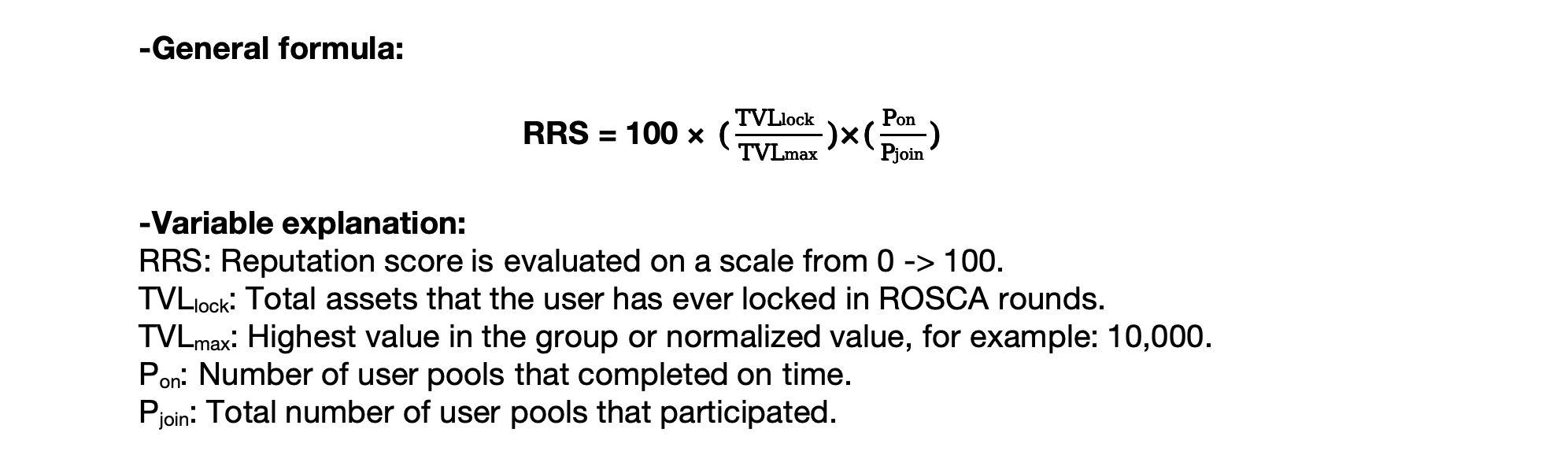
Variable explanation:
•Rt: “Amount Received (ADA/Stablecoin)” in month t.
•n: number of members in ROSCA (here n=3).
•S: standard contribution level of each member after receiving the fund (i.e. monthly repayment obligation is 1,000 ADA).
•st: “base” contribution level of each member who has not received the fund in month t (sequence is 7000, 7500, 0 respectively) - The capital that needs to be contributed to the contract to distribute to the winner after deducting the auction price.
•t-1: number of members who have received the fund before month t → each person pays S in month t.
•n-t: number of members who have not received the fund after month t (excluding the winner of month t) → each person pays st in month t.
Interpretation: The total amount of money that the winner receives in month t is equal to the total contribution of all members except the winner of that month: there are t-1 people who have won before (closed S) and n-t people who have not won yet (closed st).
Actual problem data:
•Month 1: R1 = (0) . 10000 + (2) . 7000 = 14000 ADA.
•Month 2: R2 = (1) . 10000 + (1) . 7500 = 17500 ADA.
•Month 3: R3 = (2) . 10000 + (0) . s3 = 20000 ADA.
*Please refer to the extended spreadsheet of the ROSCA model. This is a spreadsheet showing detailed data of the entire ROSCA model simulating a larger scale real-world problem: https://drive.google.com/file/d/1DAkp0UZGCXImuq0SD-a8iUpruzUaIZnS/view?usp=sharing
*ROSCA Immutable Reputation Score: ROSCA REPUTATION SCORE (RRS).
-RRS is the core financial and behavioral reputation score for users on the ROSCA platform, built using Atala PRISM decentralized identifiers (DID).
-General formula:
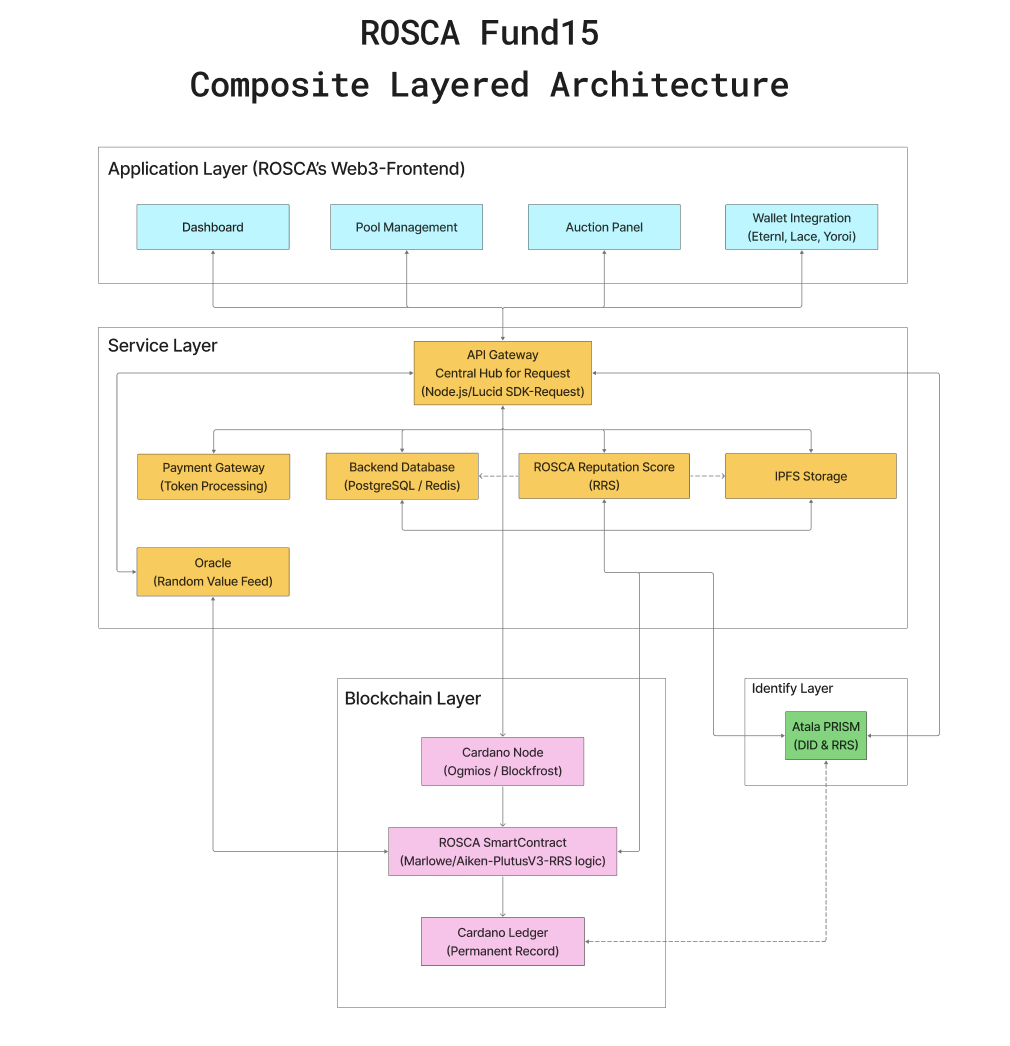
*ROSCA System Layer Architecture:
Application Layer:
-ROSCA Web3 dApp (Dashboard, Pool Management, Reverse Auction Panel, Wallet Integration – Eternl, Lace, Nami).
-Build on React/Next.js/Tailwind CSS+Lucid SDK for wallet connection and transaction signing.
Service Layer:
-Payment Gateway and API Gateway (Node.js+Lucid SDK).
-Oracle (Random Value Feed).
-Backend Database (PostgreSQL/Redis).
-ROSCA Reputation Score (RRS), IPFS Storage (Audit & Metadata).
-Off-chain logic processing, data synchronization and indexing.
Blockchain Layer:
-Cardano Node (Ogmios / Blockfrost).
-ROSCA Smart Contract (Marlowe/Aiken-Plutus V3 – Auction Logic).
-Cardano Ledger (Permanent Record).
Smart Contracts and Cardano Technology
-Language: Marlowe/Aiken-Plutus V3.
-Fee Optimization: Reference Scripts (CIP-33), Inline Datums (CIP-32).
-Testing & Security: Property-based testing, Formal Verification, Internal Audit.
-Oracle Security: Data is signed and verified directly on-chain.
Identity Layer
-Technology: Atala PRISM (DID-RRS).
-Functionality: Decentralized identity, linking to RRS with DID.
***Whitepaper ROSCA-Fund15:
https://dualcore-vunam.gitbook.io/rosca-sc-dualcore-team/summary/rosca-whitepaper-1.0
[Your Project and Solution] Impact
Please define the positive impact your project will have on the wider Cardano community
*Impact:
The implementation of the ROSCA model on the Cardano blockchain platform not only brings value to individual users, but also creates a far-reaching positive consequence for the entire ecosystem:
1-ROSCA is a decentralized finance (DeFi) application that is close to real life. Instead of approaching users with complex DeFi tools such as lending protocols or yield farming, ROSCA helps people who have never used blockchain to easily participate in a transparent savings and borrowing system, thereby expanding adoption for Cardano at the community, household, cooperative or small group level in developing countries.
2-Programming ROSCA in the smart contract language on Cardano demonstrates the practical applicability of Cardano's financial infrastructure, while also motivating developers to explore Cardano's financial tools in the direction of "community finance", helping to diversify the dApps ecosystem which is currently inclined towards high-tech products.
3-ROSCA can become a template model for human-centered DeFi applications, helping Cardano affirm its mission of "blockchain for social good" in the era of sustainable finance.
4-Increase transaction volume and total value locked in (TVL). The ROSCA model creates a regular and cyclical flow of transactions in the network, from periodic contributions from members to reverse auctions that distribute capital, contributing to increasing transaction volume and total value locked in (TVL) on the Cardano blockchain. This increase not only boosts liquidity and ecosystem vitality, but also increases transaction fees collected for the network, creating a sustainable source of revenue that improves long-term financials, supporting operating costs and developing Cardano infrastructure.
Uniqueness of the proposal:
1- Combination of traditional model and modern technology: ROSCA is a rotating savings and borrowing model that has existed for hundreds of years in many cultures. However, because there are still many risk factors of this model in real life such as: the intermediary position of the treasurer will be the role of the person controlling the cash flow of the model and taking on the role of revenue and expenditure for each cycle stage of the model, this shows dependence on a third party intermediary, and this is a very risky factor for participating members, potentially causing many factors that can cause damage to the assets of all members and destroy the general structure of the model, the implementation of the model on the blockchain through Smart Contract - Cardano is a breakthrough, helping this model to operate for the first time in a decentralized, transparent and trustless manner among members.
2- Smart integrated reverse auction mechanism: Different from traditional ROSCA models that divide shares in order or draw lots, this system integrates an automatic reverse auction mechanism (The discount value of each round will be provided by a random value provided by the Oracle), allowing those who need to raise capital to accept a higher interest rate, thereby increasing the return for the remaining members. This mechanism increases the efficiency of capital use and optimizes the benefits in the group.
3- Financial discipline guaranteed by smart contracts: Participation and maintenance of contribution obligations are no longer dependent on honor commitments, but are bound by self-executing contracts, eliminating the risk of the group's common treasurer breaking, leaving the group or cheating.
4- Scalability and community financialization: With the coded logic, this model can be deployed to any community: from groups of friends (3-5-7-9-12 members per fund group and the time per cycle can be flexible), non-profit organizations, to self-operating DAOs. Users do not need in-depth financial knowledge, just need a Cardano wallet to participate and accumulate capital safely.
-Distinctive advantages of ROSCA in Cardano DeFi ecosystem:
-The ROSCA (Rotating Savings and Credit Association) model acts as a new breakthrough in Cardano's DeFi ecosystem by introducing a flexible, user-friendly approach and limiting the risks commonly found in traditional decentralized lending platforms.
-High availability and easy access.
ROSCA facilitates users to accumulate assets and raise capital based on community trust and transparent rotation, without the need to deeply understand the complex technicalities of DeFi. This helps expand the audience to newcomers and financially underserved communities.
-No sudden liquidation of assets due to specific market price fluctuations.
The deposit in SmartContract is the initial liability capital to ensure the required behavior of each member in each cycle of the ROSCA fund and will be fully refunded after the contract ends. And an unavoidable factor from the participating member (losing connection with the member for some reason in real life), this will be the capital to compensate the remaining members in the next cycles, to ensure the general structure of the model, avoiding risks like the model in real life. Unlike the usual mortgage lending protocols in DeFi, ROSCA does not activate the mechanism to liquidate the collateral due to fluctuations in market prices, thereby eliminating the risk of sudden loss of assets due to market fluctuations. The mortgage mechanism in ROSCA only plays the role of ensuring responsibility and does not affect the general structure of the nature of the contract, does not cause losses when the market price changes.
-Use pairs of the same type of value - Limit fluctuations.
Transactions and loans in ROSCA are made between value pairs of the same type such as ADA–ADA or stablecoin–stablecoin (USDM, USDA, Djed, etc.), which helps avoid the risk of exchange rate differences, thereby ensuring stability and ease of calculation for both the capital mobilization and accumulation roles.
-Medium and long-term accumulation model.
ROSCA encourages patience and commitment through the rotating cycle model. Members can not only mobilize capital when needed, but also accumulate a significant amount of savings over time – in line with the medium and long-term financial strategy of individuals or groups.
-Contribute to diversifying the Cardano DeFi ecosystem.
While most current DeFi projects on Cardano focus on AMM, lending/liquidation or yield farming, ROSCA offers a completely new direction: an environment that enables investors to have a long-term view and build a personal financial picture in the direction of accumulation and reinvestment, community finance, based on social structure and risk sharing mechanism - in line with the spirit of financial inclusion that Cardano aims for.
-ROSCA is not just a simple financial application
As a completely new piece in Cardano's DeFi architecture. With high availability, eliminating the risk of asset liquidation, and encouraging medium-to-long-term accumulation, raising capital when needed and returning it in installments, ROSCA opens up a comprehensive financial approach, full of humanity and in line with the vision of "banking the unbanked" that Cardano pursues.
[Your Project and Solution] Capabilities & Feasibility
What is your capability to deliver your project with high levels of trust and accountability? How do you intend to validate if your approach is feasible?
-Our team consists of young, dynamic, eager to learn developers with extensive experience in the fields of financial modeling as well as focusing on researching real-life models to apply to Cardano in particular as well as blockchain technology and Smart Contract applications in general. With the experience of operating real-life financial models, we have had objective views as well as general assessments through the process of operating these models. From there, we can exploit all the advantages and disadvantages of the difficulties, challenges and barriers. With a practical approach, our team has built and designed the idea for this proposed model to optimally exploit the advantages of real-life models as well as handle as thoroughly as possible the risk factors in financial models with the technological solutions that Cardano brings.
-Our development team consists of developers with a solid grasp of basic and advanced knowledge of blockchain technology, programming, AI data analysis, and a special focus on the Cardano ecosystem. With practical experience through the positions of vCR, Moderator and many contributions to many funds from Catalyst before and now, we have a deep insight into the Cardano ecosystem as well as the blockchain generations that exist and develop in the market, from which we can build highly effective proposals for the community as well as bring real values to the Cardano ecosystem.
-With extensive skills and experience in operating business and financial models, combined with the ability to analyze, program, apply technology through practical experiences and in-depth assessments from experts who accompany us, this will be the basis for us to be able to commit to the capacity to implement this project.
-Along with that, to enhance the feasibility of the project and trust from the community, we will combine with strict plans and solutions throughout the project implementation process.
*Risk Mitigation Plan:
1. Technical & Development Risks.
- Risk: Structural errors in smart contract logic and incorrect allocation navigation.
- Solution: Contracts will be subject to automated testing (property-based testing), internal peer-review and third-party security audits before mainnet deployment. Testing will begin on testnet thoroughly from the project team and testing community to thoroughly detect and handle in the strictest way.
2. Oracle & Data Integrity Risks.
- Risk: Erroneous or manipulated oracle data can distort auction results.
- Solution: Use reputable oracle sources (Charli3, Oraichain), with multi-source authentication. Add a fallback mechanism: if the oracle does not respond, the auction round will be paused and strictly follow the system error reporting solution.
3. Legal & Regulatory Risks.
- Risk: ROSCA may be misunderstood as a custodial service or a form of lending that is not licensed in the country, which poses legal risks.
- Solution: The project is completely non-custodial — users always control their wallets, the contract only temporarily locks the deposit and will be refunded when the user performs the responsible behavior under the contract. The project team never holds funds on behalf of users, and will consult local legal advice before the mainnet pilot phase.
4. Adoption & Usability Risks
- Risk: New users may have difficulty working with blockchain wallets and on-chain contracts.
- Solution: Provide step-by-step instructions, testing mode using ADA testnet, and detailed documentation to the community. Collect user feedback to improve the user experience.
5. Delivery & Milestone Risks
- Risk: Development delays or external audits can delay delivery milestones.
- Solution: Milestones are clearly defined, with internal deadlines, and each milestone has independently verifiable deliverables (repo, tx-hash, report). Budget disbursement will follow Catalyst's milestone approval mechanism.
* Project Budget Management Solutions:
- Budget Planning: We will develop a detailed budget plan, outlining the allocation of funds for each project milestone and activity. This plan will be shared with stakeholders for review and approval.
- Milestone Validation: Monthly milestone validation by the milestone assessor will ensure that funds are disbursed based on the achievement of pre-determined milestones and outcomes. The use of funds will be broken down into specific phases, ensuring that cash flow is controlled effectively and flexibly.
- Transparent Reporting: Regular financial reports will be prepared and shared with stakeholders, providing clear information on the financial status of the project. These reports will include details of expenses, income and any deviations from the budget. The project team commits to not spending on items not included in the approved plan, will not include any additional costs.
- Legal and compliance: We will comply with all legal requirements and regulations related to financial management, ensuring proper governance and compliance throughout the project.
- Risk calculation: The total project funding includes the calculation for the conversion value in the worst case of strong market fluctuations while still ensuring the completion of the proposal. As the price of ADA can fluctuate during the project implementation period, if the price decreases, we will have a backup plan to cover the core costs to ensure the project implementation is completed. If we have a spare budget due to the increase in ADA price, we will commit to adding some functions for the next phase as in case of additional budget, the team commits to coordinate with technical experts in the Cardano community and dev Catalyst to externally audit the entire ROSCA model and develop more features for ROSCA such as: test external code audit, Analytics Dashboard (Comprehensive spreadsheet for in-depth platform), Localization (Multi-language support for ROSCA), Multi-Group Management (Support users to participate in multiple pools).
*Conclusion: Through a strict governance model, transparent real-time reporting, and milestone disbursements. We are committed to not only technical innovation, but also to upholding the standards of financial transparency and community responsibility.
[Milestones] Project Milestones
Milestone Title
System Architecture & Smart Contract Foundation
Milestone Outputs
- Development of a Comprehensive End-to-End System Architecture for the ROSCA 1.0 Platform
- Design, Specification, and Simulation of Smart Contract Logic for the Reverse Auction and Escrow Mechanisms
- Creation of a Full Figma-Based User Interface Prototype Accompanied by Detailed User Flow Documentation
Acceptance Criteria
- Completion of the Full-System Architecture Along With Comprehensive Demonstration of All Operational Flows Across the Entire ROSCA Model
- Publication of the Complete User Interface Prototype Through a Publicly Accessible Figma Link
- Deployment and Release of the Entire Codebase via a Public GitHub Repository for Transparency and Open Development
Evidence of Completion
- Link to Diagram: ROSCA System Architecture (backend, frontend, SC layers).
- Link to Diagram: Smart Contract Specification (loop logic, penalty, payout).
- Link to Figma UI prototype (dashboard, auction screen, wallet connect).
- Link to GitHub Repo (Folder structure, README, MIT License).
Delivery Month
1
Cost
17000
Progress
20 %
Milestone Title
User Behavior Study & Deploy Smartcontact and Simulation ROSCA Group Prototype
Milestone Outputs
Survey real user behavior and needs (≥50 people).
Complete the model and functions of the smart contract (Aiken/Marlowe).
Build a ROSCA group model on testnet (small: 3–5 members).
Design risk scenarios and penalty mechanisms when members violate.
Acceptance Criteria
Survey dataset (50 people): behavior, profit expectations, acceptable margin level.
100% Smart Contract + preliminary test case (Aiken/Marlowe).
Test basic logic with 5 simulated test cases (auction, payout, default).
Flowchart for risk handling: no contribution, late payment.
ROSCA group simulation report (3 members - 3 complete rounds).
Smart Contract prototype running on testnet.
Evidence of Completion
Link to detailed survey file and analysis report on collected survey data (anonymized).
Link to ROSCA's Smartcontract open source on public Github repo.
Link to 5 test case video (120s demo video).
Link to flowchart of risk handling.
Link to internal Dashboard document showing 3 successful auction rounds.
Link to Testnet contract file running with ≥10 transactions (tx-hash).
Delivery Month
2
Cost
31000
Progress
50 %
Milestone Title
Security Audit & Security Policy & Scalability
Milestone Outputs
Complete security, internal code audit via Lucid/Aiken/Marlowe test suite.
Conduct internal testing & external code audit to identify and resolve any bugs or issues.
Standardized Security & Privacy Policy document.
Scalability and performance document.
Acceptance Criteria
Minimum 10 test cases pass (property-based test).
Testnet stable operation ≥ 50 tx hash.
Attached code audit report Achieved ≥ 90% coverage, no critical bugs affecting data or transactions.
Attached scalability and performance document report.
Evidence of Completion
Link to internal/external code audit test suite report
Link to list of successful Tx hashes of user actions recorded onchain.
Link to Security & Privacy Policy documentation publicly available on GitHub.
Link to Scalability and Performance documentation.
Delivery Month
2
Cost
23500
Progress
80 %
Milestone Title
Bug reporting & Feedback surveys - Final Reporting
Milestone Outputs
Develop a testing plan and strategy, publish to the community.
Collect feedback from participants to refine and improve the system.
Deploy testing with communities in 2 regions (VietNam + Africa).
Summary report “ROSCA Impact Report F15” with adoption KPI.
Acceptance Criteria
Detailed plan for promoting the “User Testing & Feedback Rewards” test.
Collect at least 80% positive feedback (through surveys, interviews, feedback forms).
ROSCA operates stably with 10 pools with KPIs reaching ≥80% of the target (adoption metrics).
Full and detailed report content of the entire project implementation process and information related to ROSCA's Impact index.
Evidence of Completion
Link to a user analytics report detailing engagement, retention, and feedback.
Link to on-chain transaction data from ROSCA displayed on Cardano (Cexplorer: total Tx-hash list file).
Link to a community pilot video or community media content article (Catalyst, Cardano Forum, X, Telegram...) showcasing the ROSCA test results.
Link to a summary Impact Report PDF.
Delivery Month
1
Cost
23500
Progress
100 %
[Final Pitch] Budget & Costs
Please provide a cost breakdown of the proposed work and resources
ROSCA Fund 15 – Milestone Budget Allocation (98,000 ADA).
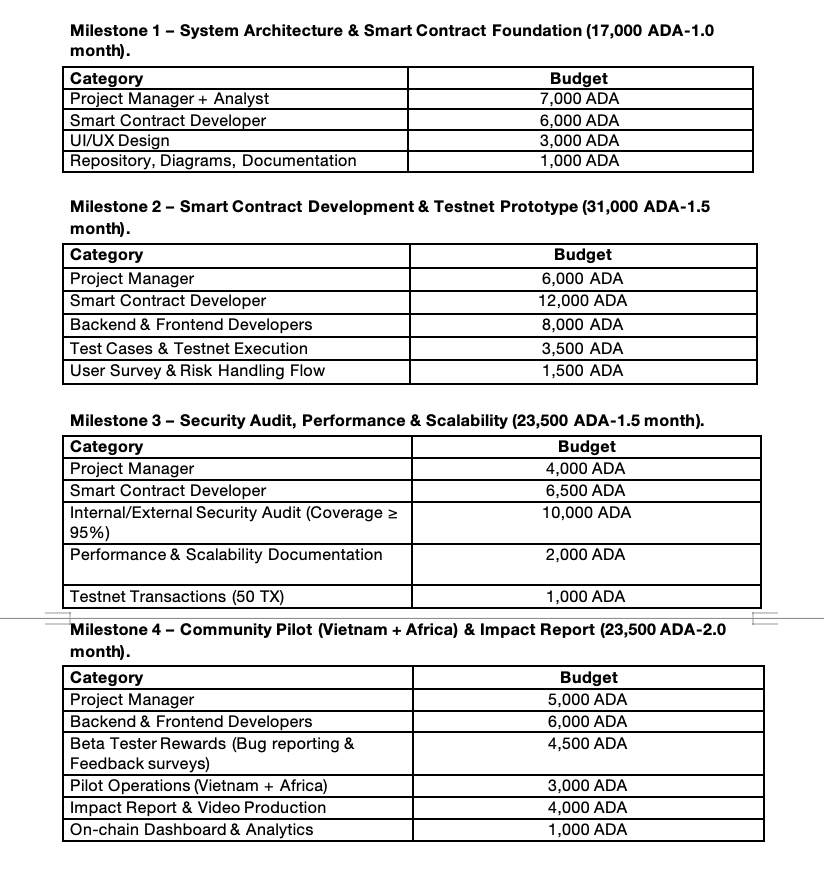
***Summary Budget Table – Full Budget Document
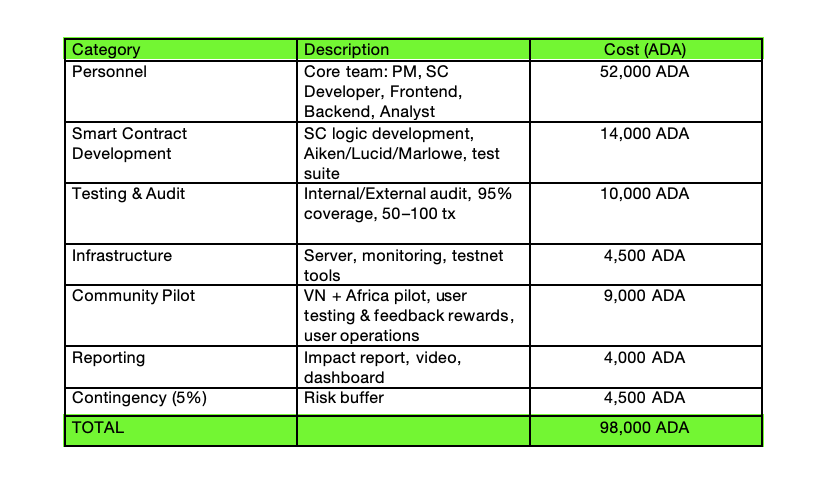
-LINK BUDGET: https://dualcore-vunam.gitbook.io/rosca-sc-dualcore-team/summary/budget
[Final Pitch] Value for Money
How does the cost of the project represent value for the Cardano ecosystem?
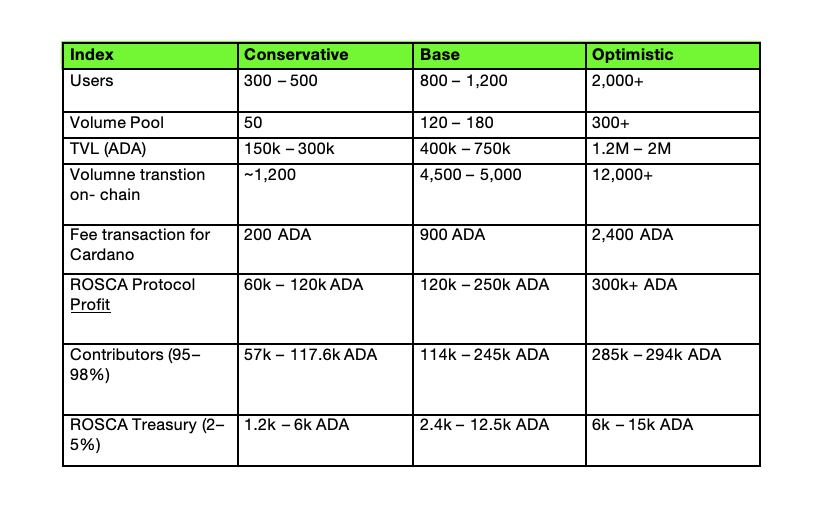
Project Value Plan & KPI 6 Months After Mainnet – ROSCA
1.KPI Table First 6 Months After Mainnet – ROSCA
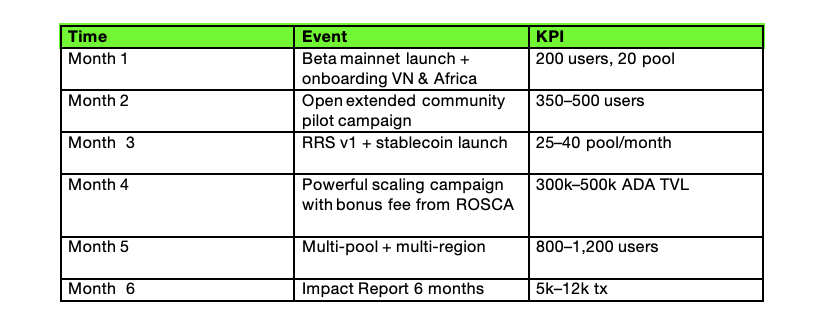
2.Timeline 6 Months Post Mainnet
3.Value proposition – ROSCA Mainnet (first 6 months)
In the first 6 months of mainnet operation, ROSCA expects to create a real and measurable impact on the Cardano ecosystem:
• 300 – 2,000 real active users
• 50 – 300 active pools, spread across regional communities
• 150k – 2M ADA TVL stable, incentive-free
• 1,200 – 12,000 on-chain transactions, generating regular monthly network activity
• 200 – 2,400 ADA network fees deposited directly into Cardano
• 60k – 300k ADA total ROSCA Protocol Profit generated from the auction mechanism
In which Profit is distributed according to the ratio:
• 95–98% for Contributors → increasing natural returns for depositors
• 2–5% for ROSCA Treasury → for operations, maintenance, oracle & infrastructure
-The human resource costs for this project are calculated based on the average salary in Vietnam and have been reviewed and approved by experts to ensure suitability for the project. Information about the average salary of Vietnamese programmers will fluctuate between $2000-$3000, the salary payment for programmers in this project is considered a reasonable and highly competitive cost, promoting the spirit of construction and responsibility in using Catalyst's capital.
-The budget includes funds allocated for personnel, platform development and hiring experienced experts to deliver high-quality results.
-The project's monetary value is demonstrated through the following contents: building a healthy foundation for Cardano's Defi application store, demonstrating the depth of real-life financial models when applying blockchain technology, smart contracts, thereby breaking down the barriers of real-life financial models as well as contributing to Cardano's practical application cases in life. From here, it is possible to contribute to the Cardano ecosystem a more flexible, safe, and transparent model in addition to current models such as borrowing and lending. Thereby creating a more vibrant ecosystem for the group of users with DeFi needs in particular as well as the large Cardano community in general (in terms of practical indicators such as: transaction volume, user, TVL, fee, .. ---> Cardano's target source of life).
-This project not only benefits Cardano but also has the potential to attract hundreds of millions of users with Defi needs on the Cardano ecosystem. This could increase the demand for ADA, adding value and stability to the coin.
-Because the price of ADA can fluctuate during the project, if the price drops, we will have a backup capital plan supported by other organizations to ensure safety during project implementation. And in the opposite case, if the value of ADA exceeds the initial estimate, we will consider this as a source of reinvestment capital for the project to be able to set up and add some features to the project in the next phase such as: test external code audit, Analytics Dashboard, Localization, Mutil-Group Management.
[Self-Assessment] Self-Assessment Checklist
I confirm that evidence of prior research, whitepaper, design, or proof-of-concept is provided.
Yes
I confirm that the proposal includes ecosystem research and uses the findings to either (a) justify its uniqueness over existing solutions or (b) demonstrate the value of its novel approach.
Yes
I confirm that the proposal demonstrates technical capability via verifiable in-house talent or a confirmed development partner (GitHub, LinkedIn, portfolio, etc.)
Yes
I confirm that the proposer and all team members are in good standing with prior Catalyst projects.
Yes
I confirm that the proposal clearly defines the problem and the value of the on-chain utility.
Yes
I confirm that the primary goal of the proposal is a working prototype deployed on at least a Cardano testnet.
Yes
I confirm that the proposal outlines a credible and clear technical plan and architecture.
Yes
I confirm that the budget and timeline (≤ 12 months) are realistic for the proposed work.
Yes
I confirm that the proposal includes a community engagement and feedback plan to amplify prototype adoption with the Cardano ecosystem.
Yes
I confirm that the budget is for future development only; excludes retroactive funding, incentives, giveaways, re-granting, or sub-treasuries.
Yes
[Required Acknowledgements] Consent & Confirmation
I Agree
Yes
Team
*MR.Vu Van Nam - Project Manager:
Bachelor of Industrial Management at HCMC University of Technology and Education.
5 years working at MEX-DN Commodity Trading Company Limited.
4 years of experience in business.
3 years of experience in blockchain.
Complete course credits:2 course of Marlowe ,Lucid, Aiken, Cardano-CLI, CBCA.
Blockchain Fundamentals
Credential ID:
62aabf58-6f41-4d14-8e29-dca4c236e9fc
Cardano Blockchain Certified Associate (CBCA)
Credential ID:
96b3a3c6-3ec2-42f3-91de-5988cd3608ab
Policy NFT Certificate : 51964ec5764252718ddfe92a9145bf0d085b3a9d61c01fe9b0808635
Fingerprint: asset1u4dfl4psa6xnvtlr6lat6e3qvvssqza54hw9wn
Completed Course of Project Management: https://www.coursera.org/account/accomplishments/specialization/certificate/AOXJVU4J1OB4
Active contributor to Catalyst since F9, holding the positions of vCR and Moderator.
Github: https://github.com/DUALCORE-VuNam
Linkedin: https://www.linkedin.com/in/vu-nam-5922682a7/
Telegram: https://t.me/namcoitiensinh
*Roles:
Project Manager.
Human Resources Direction.
Build project framework and roadmap.
Responsible for project monitoring and promotion.
In-depth research on real-life models applying smart contracts.
Model analysis, prototype contract building, debugging when applied to smart contracts.
*MR.Nguyen Van Tai - Product Analyst:
Bachelor of Information Technology at BRVT University.
Leader of Prudential Finance.
8 years freelance experience in financial modeling.
6 years of experience in blockchain and AI.
Proficient in using AI tools: n8n, Genspark, claude, gemini,....
Complete course credits: Marlowe Mastery, Lucid, Aiken, Cardano-CLI, CBCA.
Blockchain Fundamentals
Credential ID:
d5ceac97-d9ab-46f7-9167-b35a07d5c89c
Cardano Blockchain Certified Associate (CBCA)
Credential ID:
37bea67c-48b6-4d92-b918-e554be7d4430
Policy NFT Certificate : 51964ec5764252718ddfe92a9145bf0d085b3a9d61c01fe9b0808635
Fingerprint: asset1h7fczhjcyndg6lwevh8xmphprr053xhf038znn
Completed Course of Generative AI.
Completed Course of Product Innovation.
Active contributor to Catalyst since F11, holding the positions of vCR and Moderator.
Github: https://github.com/taiwoan5
Linkedin: https://www.linkedin.com/in/tai-nguyen-287513336/
Telegram: https://t.me/taiwoan
*Roles:
Product Data Analysis.
AI Data Analysis.
Detailed Model Research.
Develop Project Scalability and Performance.
UX/UI Design and Build.