Last updated 6 months ago
ZapCoin x CalOne — Cardano-Powered Student Engagement Token
Problem
Attendance and event momentum are down; incentives are hard to track and easy to game. Students need a digital-native reward inside a tool they already use—CalOne.
Solution
ZapCoin rewards verified student attendance with a Cardano-native token, redeemable for campus discounts and perks, while providing organizers real-time engagement metrics and ROI insights.
About this idea
[Proposal setup] Proposal title
Please provide your proposal title
ZapCoin x CalOne — Cardano-Powered Student Engagement Token
[Proposal Summary] Budget Information
Enter the amount of funding you are requesting in ADA
75000
[Proposal Summary] Time
Please specify how many months you expect your project to last
7
[Proposal Summary] Translation Information
Please indicate if your proposal has been auto-translated
No
Original Language
en
[Proposal Summary] Problem Statement
What is the problem you want to solve?
Attendance and event momentum are down; incentives are hard to track and easy to game. Students need a digital-native reward inside a tool they already use—CalOne.
[Proposal Summary] Supporting Documentation
Supporting links
[Proposal Summary] Project Dependencies
Does your project have any dependencies on other organizations, technical or otherwise?
No
Describe any dependencies or write 'No dependencies'
No dependencies
[Proposal Summary] Project Open Source
Will your project's outputs be fully open source?
No
Please provide details on the intellectual property (IP) status of your project outputs, including whether they will be released as open source or retained under another licence.
Core ZapCoin and CalOne code will remain proprietary (backend, apps, and infrastructure are not open-sourced). We do not plan to file patents. We will publicly share tokenomics, minting policy, QR and Partner API specifications, and key learnings; small generic tools may be released under a permissive OSS license.
[Theme Selection] Theme
Please choose the most relevant theme and tag related to the outcomes of your proposal
Tokenization
[Campaign Category] Category Questions
Describe what makes your idea innovative compared to what has been previously launched in the market (whether by you or others).
ZapCoin is innovative because it connects real-world student attendance directly to on-chain rewards inside CalOne, a tool students already use daily. Instead of generic points or punch cards, each verified check-in mints a Cardano-native token under a capped policy, with geofenced, time-boxed QR codes reducing fraud and “passive” attendance. A Partner API lets venues and organizers both earn and accept ZapCoin, turning a campus calendar into a living, measurable token economy where incentives, behavior, and value flow can be transparently tracked.
Describe what your prototype or MVP will demonstrate, and where it can be accessed.
The ZapCoin MVP will demonstrate the full end-to-end flow of a Cardano-native student reward system. Students will be able to check in at events using time-boxed, geofenced QR codes inside CalOne, automatically earn capped amounts of ZapCoin on Cardano, see their balance in an in-app wallet, and redeem tokens for concrete campus perks (e.g., discounts or free items at partner venues). Organizers and partner venues will use a simple dashboard and Partner API to configure events and rewards, and to track real-time metrics such as unique attendees, repeat attendance/retention, redemption utilization, and cost per engaged participant.
The prototype will first run in a staged environment (Cardano testnet + CalOne staging) for internal pilots, and then be made available to students and partners through the production CalOne app and event portal. It can be accessed via the CalOne web platform and mobile experience at CalOne.com and Events.CalOne.com, where eligible users will see ZapCoin-enabled events, check-in flows, wallets, and dashboards once the MVP is live.
Describe realistic measures of success, ideally with on-chain metrics.
Successfully launch ZapCoin as a Cardano-native token with an in-app ZapCoin wallet module in CalOne, enabling students to earn and redeem it through campus activities, while partner venues and organizers also earn ZapCoin for hosting and rewarding engagement. The token demonstrates real-world utility, circulates within a campus economy, and supports optional swaps to ADA—balancing on-chain value with the preservation of campus perks. This creates a transparent, measurable, and replicable model for student and partner incentive programs on Cardano.
[Your Project and Solution] Solution
Please describe your proposed solution and how it addresses the problem
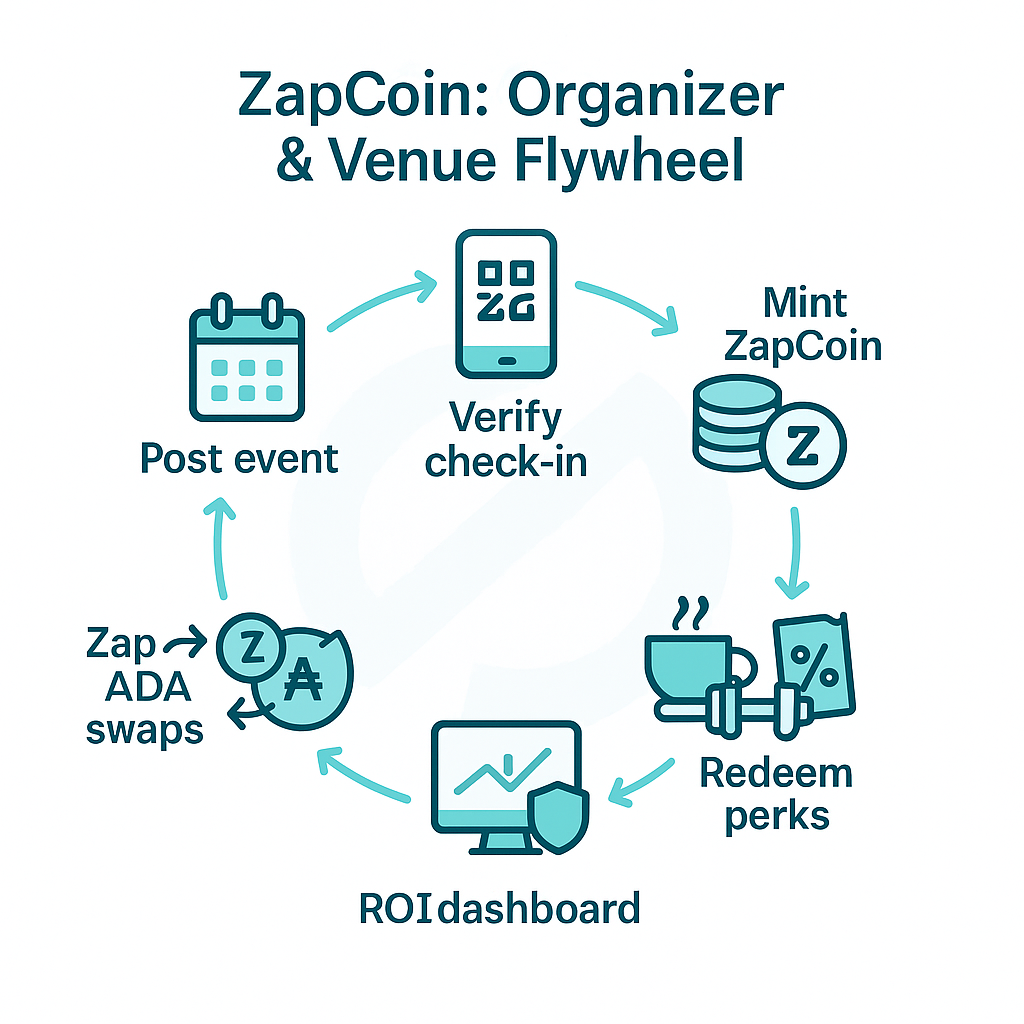 ZapCoin is a Cardano-native token that rewards verified participation at campus events. Students earn tokens via time-boxed, geofenced QR check-ins that help prevent fraud and verify attendance. Tokens are redeemable for campus perks, creating immediate, tangible value and encouraging repeat engagement. Partner venues and organizers—student clubs and event hosts—also earn ZapCoin when they run events or provide perks, forming a circular campus economy where token flow mirrors real-world activity.
Core components
• QR check-ins: Time-boxed and geofenced to help prevent abuse and verify legitimate attendance
• Capped minting with multisig: Per-event and per-user caps (optional total cap) under multi-signature policy control to keep rewards predictable and sustainable
• Redemption UI: Spend ZapCoin on campus perks; real-time tracking for students and participating partners
• Partner API: Let organizers/venues accept ZapCoin, earn tokens for participation, and access engagement metrics
• Optional Zap→ADA swap (capped, gated): Prepared but feature-flagged OFF on mainnet until adoption gates are met; when enabled, it launches with an allowlisted pilot, per-user and global caps, a small fee to a community pot, and a circuit breaker. Swapping trades off future campus perks for immediate ADA
Implementation strategy
• Participation first: Delay the swap so users focus on attending multiple events and redeeming perks, boosting early adoption
• Build the campus economy: Circulate tokens among students, organizers, and partners to prove real utility before enabling cash-like features
• Control inflation risk: Caps and a delayed swap help keep incentives balanced and sustainable
• Stabilize the system: Validate QR, capped minting, the Partner API, and dashboards early—without financial pressure—to ensure a smooth rollout
Impact and measurable outcomes
• Dashboards for organizers/partners: Track unique attendees, retention, incremental attendance, and cost per engaged participant; use simple behavior rules (e.g., on-time arrival, full-session stay) to reward meaningful participation
• On-chain activity: Native-asset mints and transfers tied to verified events; optional capped swaps only after adoption gates are met (e.g., partner coverage, redemption utilization, active wallets)
• Value to the ecosystem: Demonstrates a practical native-asset use case that links real-world engagement to measurable on-chain outcomes for students, organizers, partner venues, and the broader Cardano community
In short
ZapCoin combines on-chain rewards, partner incentives, staged tokenomics, and data-driven dashboards to deliver a sustainable, measurable response to declining campus participation—while keeping the swap optional and responsibly gated until the model is clearly working.
[Your Project and Solution] Impact
Please define the positive impact your project will have on the wider Cardano community
ZapCoin drives concrete, measurable usage of the Cardano blockchain by tying everyday campus behavior to native-asset activity. Students earn ZapCoin in their in-app wallet when they attend events; organizers and partner venues earn and spend it as they host activities and provide perks. This generates recurring mints and transfers between real users, plus smart-contract interactions once programmatic rules are introduced.
The optional, capped Zap→ADA swap is designed as a late-stage feature rather than the core utility: it is feature-flagged, adoption-gated, and rate-limited to protect campus incentives and avoid early inflation. The main value comes first from circulation within the campus economy—earn at events, redeem at partners, see the effect in dashboards—not from quick exits to ADA.
Impact will be tracked using both on-chain and program metrics: active wallets, native-asset mints and transfers between students/organizers/venues, and (if enabled) capped ADA swaps, combined with attendance lift, repeat participation, redemption utilization, and partner coverage. These data will be summarized for the Catalyst community as anonymized dashboards, snapshots, and short playbooks so that other teams can replicate successful patterns and avoid pitfalls.
By showing how a campus calendar can double as a Cardano-native incentive layer, ZapCoin offers a reusable blueprint for other universities and community hubs that want to connect real-world engagement with transparent, accountable on-chain outcomes.
[Your Project and Solution] Capabilities & Feasibility
What is your capability to deliver your project with high levels of trust and accountability? How do you intend to validate if your approach is feasible?
The ZapCoin team combines blockchain-aware product development, operations, and campus engagement, giving us the capacity and accountability to deliver this project.
- Lars Føleide (Applicant / Product Lead): Co-creator of CalOne and NTNU ecosystem lead, responsible for product strategy, campus integration, stakeholder coordination, and overseeing the Cardano-native token implementation in collaboration with external experts where needed.
- Lukas Krondorf (COO): Co-creator of CalOne and operations lead, managing partner onboarding, pilot execution, QA, SLAs, and budget tracking.
- Svein Jøran Johnsen (Marketing & Outreach): Co-creator of CalOne, running go-to-market campaigns, student union and club engagement, and on-campus activations.
Feasibility & validation
- Pilot programs: Early events test QR check-ins, token minting, redemptions, and Partner API workflows.
- Staged tokenomics: Capped minting and a feature-flagged swap allow us to monitor adoption and circulation before enabling cash-like features.
- Dashboards & metrics: Real-time attendance, token distribution, and partner engagement metrics validate performance and guide iteration.
- Risk mitigation: Geofencing, time-boxed check-ins, device checks, per-user caps, and circuit breakers reduce fraud and abuse.
Trust & accountability
We use milestone-based fund allocation, internal controls, and clear evidence (mint logs, dashboard screenshots, partner activity, and impact reports) so Catalyst voters can verify progress and value for money.
[Milestones] Project Milestones
Milestone Title
M1 — Foundation & Testnet Alpha (Months 1–2)
Milestone Outputs
• QR check-in built into CalOne (time-limited and location-locked)
• Testnet token minting with per-event and per-user limits (policy ID in place)
• Basic organizer dashboard with unique attendees and check-in metrics (using test data)
• Pilot playbook covering setup, operations, and troubleshooting for easy repeat rollouts
Acceptance Criteria
• ≥95% successful check-ins across pilot events and <1% duplicate scans
• Testnet policy ID established and verified; caps demonstrably enforced
• Functional basic dashboard live with accurate metrics for organizers
Evidence of Completion
• Published testnet policy ID
• Screenshots (or short screencast) of the dashboard with sample pilot data
• Pilot playbook detailing setup, execution, and lessons learned
Delivery Month
2
Cost
18750
Progress
20 %
Milestone Title
M2 — Mainnet MVP & Swap Path (Months 3–4)
Milestone Outputs
Finalized mainnet minting policy with per-event and per-user caps enforced
Capped Zap→ADA swap dApp (prepared, gated): deployed to pre-production with fee routing to a community pot; mainnet build deployed but disabled via a feature flag
Security reviews: internal security audit completed; independent review summary (threat model, key management, custody) delivered
Privacy compliance finalized: Data Protection Impact Assessment (DPIA), data-minimization map, and retention policy
Acceptance Criteria
• Successful mints on mainnet under the new policy with caps demonstrably enforced
• Swap executes successfully on pre-production; on mainnet the swap endpoint is deployed but disabled (feature flag = off), with circuit breaker and rate-limits configured
• DPIA signed off; privacy/security checklist passed
• Documented go-live gates for enabling mainnet swap after adoption targets (e.g., ≥8 partners live, redemption utilization baseline, wallet/activity thresholds) are met in M3
Evidence of Completion
• Mainnet policy ID published, plus example transactions showing caps are enforced
• Pre-production swap link and transaction IDs; mainnet settings showing the swap feature flag/allowlist is OFF
• Security review package (internal + independent) with all fixes completed
• Data Protection Impact Assessment (DPIA) and other compliance documents, signed and approved
• Operations playbook for key management and deployments
Delivery Month
4
Cost
26250
Progress
60 %
Milestone Title
M3 — Partner Rollout & Analytics (Months 5–6)
Milestone Outputs
• Partner API (production-ready): stable endpoints, API keys and role permissions, webhook callbacks, and sandbox credentials
• Onboarding kit: step-by-step playbook, configuration templates, testing checklist, and defined support service levels and response times
• Partner activation: at least eight partner venues/organizers live (events and redemptions) with configuration records
• Analytics v1 dashboards: unique attendees, repeat rate (retention), share of first-time attendees, redemption utilization, and cost per engaged participant
• Organizer controls: event boosts, capped engagement budgets, and engagement rules — e.g., reward only if attendee checks in within the first 15 minutes (on-time arrival) or stays until the end of the session (full-session stay)
• Service operations: lightweight baseline on reliability (expected uptime targets and support response times), a simple playbook for handling incidents, and a template for periodic partner updates
• Adoption gates for the optional Zap→ADA swap: go/no-go criteria defined; swap remains disabled unless targets are met
Acceptance Criteria
• At least eight partner venues/organizers onboarded and active, with a minimum of 40 rewarded events completed during the milestone period
• Analytics v1 live with real partner data, allowing organizers to track unique attendees, retention, and cost per engaged participant
• Organizer controls (event boosts and engagement budgets) available in production, with their effects clearly visible in dashboards
• Organizer satisfaction score averages at least 4.0 out of 5 during the milestone period, based on a minimum of 10 responses
• Baseline reliability and support expectations (uptime and response times) defined and shared with partners
• Adoption gate reviewed and documented; the Zap→ADA swap remains disabled unless engagement, redemption, and partner coverage targets are met
Evidence of Completion
• Signed partner agreements and setup records, with API keys issued and access logs available
• Partner API documentation and onboarding playbook published
• Live analytics dashboards demonstrated with screenshots and sample exports of event and redemption data
• Organizer satisfaction survey results compiled, including average score (1–5), response count, and summarized feedback
• Baseline reliability notes and simple incident response playbook documented, plus a template for regular partner updates
• Adoption gate decision memo prepared for the optional Zap→ADA swap
Delivery Month
6
Cost
22500
Progress
90 %
Milestone Title
M4 — Impact Report & Phase-2 Scale Plan (Month 7)
Milestone Outputs
• Campus-wide impact snapshot covering attendance, engagement, redemption utilization, token distribution, and partner coverage
• Audit of Key Performance Indicators (KPIs): targets, methods, and results mapped to Month-7 goals
• Lessons-learned report (technical, operational, adoption, and anti-fraud outcomes)
• Phase-2 scale plan: requirements, staffing, budget, timeline, and risk/dependency register for expansion to additional campuses/partners
• Adoption gate review for the optional Zap→ADA swap with a documented decision (enabled only if gates are met)
Acceptance Criteria
• Publish a public impact report with anonymized datasets, charts, dashboard screenshots, and a clear methodology explaining what was measured, how it was measured, and known limitations
• Complete a Phase-2 scale plan covering targets, staffing, budget, timeline, and risks
• Complete the adoption-gate review and record the decision; keep the Zap→ADA swap disabled unless the predefined go/no-go targets are met
• Deliver an anti-fraud evaluation (duplicate scans, geofence accuracy, device checks)
• Confirm that privacy and data-retention practices align with the completed Data Protection Impact Assessment (DPIA)
Evidence of Completion
• Completed KPI audit; final impact report; downloadable anonymized datasets; dashboard screenshots
• Adoption gate memo (criteria, evidence, and the decision on the optional swap)
• Anti-fraud evaluation notes and planned mitigations; privacy/retention summary
Delivery Month
7
Cost
7500
Progress
100 %
[Final Pitch] Budget & Costs
Please provide a cost breakdown of the proposed work and resources
- Total Budget Requested: ₳75,000
- Milestone-Based Allocation:
- M1 — Foundation & Testnet Alpha (₳18,750)
- Core backend & QR SDK: Event check-ins and capped, time-boxed, geofenced minting
- Testnet minting & dashboard: Validate mint engine, basic organizer dashboard
- Resources: Developer time, pre-production hosting, testing tools
- Purpose: Prove reliable token creation and check-ins before mainnet
- M2 — Mainnet MVP & Swap Path (₳26,250)
- Mainnet policy & token launch: Cardano-native asset with per-event and per-user caps
- Capped ADA swap dApp (prepared, gated): Pre-production live with fee to community pot; mainnet build shipped but disabled via feature flag/allowlist until adoption targets are met
- Independent review & privacy compliance: Internal security audit, independent review summary, Data Protection Impact Assessment (DPIA)
- Resources: Blockchain developer hours, security review, privacy/compliance services
- Purpose: Secure mainnet minting and swap readiness while preventing early inflation
- M3 — Partner API & Engagement Rollout (₳22,500)
- Partner onboarding & integrations: Production-ready Partner API for organizers and venues
- Analytics v1 & dashboard enhancements: Track unique attendees, retention, redemption utilization, token flow, cost per engaged participant
- Marketing & outreach: Go-to-market, organizer engagement, campaigns, on-campus activations
- Resources: Developer time, hosting, marketing materials, event logistics, API docs
- Purpose: Drive adoption and demonstrate real-world token utility with measurable data
- M4 — Impact Reporting & Phase-2 Scale Plan (₳7,500)
- Impact reporting & data publishing: Token circulation, adoption, engagement, anti-fraud results
- Phase-2 scale plan: Targets, staffing, budget, timeline, risks; document adoption-gate decision for the optional Zap→ADA swap
- Resources: Analyst hours and report production
- Purpose: Provide transparency, share insights, and prepare practical scaling
- M1 — Foundation & Testnet Alpha (₳18,750)
- Third-Party Products/Services
- Professional services: DPIA review, code audit/security review, independent compliance validation
- Software & hosting: Hosting for dashboards/API, development tools/licenses
- Marketing & community engagement: Promotional materials, campaigns, event logistics
- Funding Shortfall Contingency
- Core scope covered within ₳75,000; any shortfall covered by partner venue support or CalOne in-kind contributions
- Management & Accountability
- Milestone-based fund allocation tied to specific deliverables
- Transparent reporting & evidence (mint logs, partner activity, dashboard analytics)
- Regular review checkpoints for course correction and objective tracking
[Final Pitch] Value for Money
How does the cost of the project represent value for the Cardano ecosystem?
The ₳75,000 budget represents strong value for the Cardano ecosystem by directly enabling measurable on-chain activity and real-world token utility. Each allocation is tied to milestones delivering verifiable outputs: QR check-ins, capped token minting, partner API integration, real-time dashboards, and the optional Zap→ADA swap. Milestone-based funding ensures that each tranche produces concrete results, reducing financial risk while maximizing ecosystem impact.
Developer, marketing, and professional service costs reflect competitive rates in Norway for software development, audits, compliance, and outreach, ensuring efficient use of funds. Organizers benefit from measurable, capped-cost engagement, calculated as incremental attendance × margin minus redemptions, giving them clear insight into ROI and behavior-shaping effects.
Meanwhile, students, partner venues, and organizers generate repeated on-chain transactions and interactions, introducing real users to Cardano-native tokens in a controlled, measurable environment. The optional swap connects campus activity to the broader Cardano ecosystem, demonstrating practical use cases for native assets.
Overall, ZapCoin turns a modest investment into repeated engagement, transparent metrics, and a replicable model for other campuses, delivering high value for both participants and the Cardano network.
[Self-Assessment] Self-Assessment Checklist
I confirm that evidence of prior research, whitepaper, design, or proof-of-concept is provided.
Yes
I confirm that the proposal includes ecosystem research and uses the findings to either (a) justify its uniqueness over existing solutions or (b) demonstrate the value of its novel approach.
Yes
I confirm that the proposal demonstrates technical capability via verifiable in-house talent or a confirmed development partner (GitHub, LinkedIn, portfolio, etc.)
Yes
I confirm that the proposer and all team members are in good standing with prior Catalyst projects.
Yes
I confirm that the proposal clearly defines the problem and the value of the on-chain utility.
Yes
I confirm that the primary goal of the proposal is a working prototype deployed on at least a Cardano testnet.
Yes
I confirm that the proposal outlines a credible and clear technical plan and architecture.
Yes
I confirm that the budget and timeline (≤ 12 months) are realistic for the proposed work.
Yes
I confirm that the proposal includes a community engagement and feedback plan to amplify prototype adoption with the Cardano ecosystem.
Yes
I confirm that the budget is for future development only; excludes retroactive funding, incentives, giveaways, re-granting, or sub-treasuries.
Yes
[Required Acknowledgements] Consent & Confirmation
I Agree
Yes
Team
- Lars Føleide (Applicant / Product Lead): Co-creator of CalOne and NTNU ecosystem lead; responsible for product strategy, campus system integration, and coordinating student and partner adoption, including the Cardano integration work.
- Lukas Krondorf (COO): Co-creator of CalOne; operations lead managing partner onboarding, pilot programs, QA, SLAs, and budget tracking to ensure smooth execution.
- Svein Jøran Johnsen (Marketing & Outreach): Co-creator of CalOne; leads go-to-market strategy, student union and club engagement, campaigns, and on-campus activations to drive adoption.